



Global Internet of Robotic Things (IoRT) Market, By Types (Sensors, Actuators, Power Source, Control Systems, Others), Software type (Real Time Streaming Analytics, Security Solution, Data Management, Remote Monitoring System, Network Bandwidth Management), Platform (Introduction, Device Management Platform, Application Management Platform, Network Management Platform), Component (Software, Services), Service (Professional Services, Managed Services), Application (Collaborative Industrial Robots, Service Sector), End User (Aerospace and Defense, Automotive and Manufacturing, Healthcare, Food and Beverages, Logistics, Media and Entertainment, Others) – Industry Trends and Forecast to 2030.
Internet of Robotic Things (IoRT) Market Analysis and Size
Robots can be included as objects in the Internet of Things (IoT) infrastructure, allowing for connections between various objects using a range of communication protocols. Robots that are "connected as a thing" and connect to other things via the Internet are referred to as the Internet of Robotic Things (IoRT) in IoT technology. They are intelligent devices that gather sensor data from various sources to decide on a course of action, helping to monitor events and control objects in the physical world. The use of the Internet of robotic things is being boosted by the expanding e-commerce sector and expanding application areas as a result of the integration of robots with different technologies.
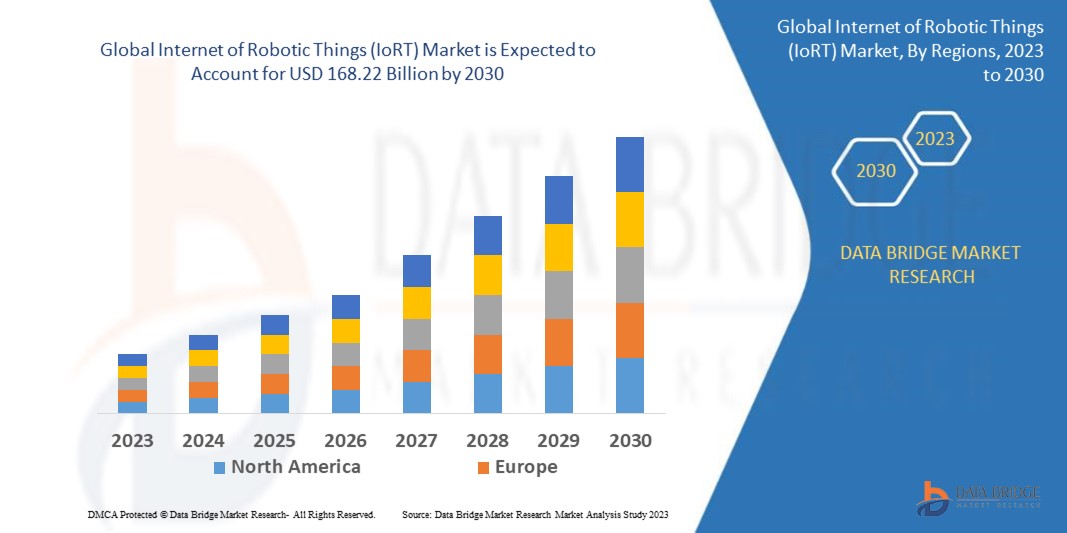
Data Bridge Market Research analyses that the internet of robotic things (IoRT) market, valued at USD 24.97 billion in 2022, will reach USD 168.22 billion by 2030, growing at a CAGR of 26.93% during the forecast period of 2023 to 2030. In addition to the market insights such as market value, growth rate, market segments, geographical coverage, market players, and market scenario, the market report curated by the Data Bridge Market Research team includes in-depth expert analysis, import/export analysis, pricing analysis, production consumption analysis, and pestle analysis.
Internet of Robotic Things (IoRT) Market Scope and Segmentation
|
Report Metric |
Details |
|
Forecast Period |
2023 to 2030 |
|
Base Year |
2022 |
|
Historic Years |
2021 (Customizable to 2015 - 2020) |
|
Quantitative Units |
Revenue in USD Billion, Volumes in Units, Pricing in USD |
|
Segments Covered |
Types (Sensors, Actuators, Power Source, Control Systems, Others), Software type (Real Time Streaming Analytics, Security Solution, Data Management, Remote Monitoring System, Network Bandwidth Management), Platform (Introduction, Device Management Platform, Application Management Platform, Network Management Platform), Component (Software, Services), Service (Professional Services, Managed Services), Application (Collaborative Industrial Robots, Service Sector), End User (Aerospace and Defense, Automotive and Manufacturing, Healthcare, Food and Beverages, Logistics, Media and Entertainment, Others) |
|
Countries Covered |
U.S., Canada and Mexico in North America, Germany, France, U.K., Netherlands, Switzerland, Belgium, Russia, Italy, Spain, Turkey, Rest of Europe in Europe, China, Japan, India, South Korea, Singapore, Malaysia, Australia, Thailand, Indonesia, Philippines, Rest of Asia-Pacific (APAC) in the Asia-Pacific (APAC), Saudi Arabia, U.A.E, South Africa, Egypt, Israel, Rest of Middle East and Africa (MEA) as a part of Middle East and Africa (MEA), Brazil, Argentina and Rest of South America as part of South America. |
|
Market Players Covered |
Cisco Systems, Inc. (U.S.), Microsoft (U.S.), Apple Inc. (U.S.), SAP SE (Germany), Oracle (U.S.), Intel Corporation (U.S.), Siemens (Germany), ABB (Switzerland), Huawei Technologies Co., Ltd (China), Hitachi Vantara LLC (U.S.), Qualcomm Technologies, Inc. (U.S.), Google (U.S.), KUKA AG (Germany), FANUC CORPORATION (Japan), YASKAWA ELECTRIC CORPORATION. (Japan), Northrop Grumman. (U.S.), Omron Corporation (Japan), Robert Bosch GmbH (Germany), SAMSUNG (South Korea) |
|
Market Opportunities |
|
Market Definition
The "Internet of Robotic Things" is a concept that refers to a network of intelligent devices that can observe events, combine sensor data from various sources, use intelligence to determine the best course of action, and manipulate real-world objects. Internet of robotic things are robots that are "connected as a thing" in IoT technology, which connects with other things over the Internet. Intelligent.
Internet of Robotic Things (IoRT) Market Dynamics
Drivers
- Increasing use in the e-commerce sector
The market's quick return on investment and payback times, the adoption of IoRT by the e-commerce industry, and the expansion of robots' potential application areas as a result of technology integration. The development of IoRT-powered robots that are capable of automatically identifying and resolving systemic issues goes beyond minimizing human interference in supply chains. Furthermore, it is predicted that in the future, lower and middle-level staff at various e-commerce facilities will either be completely absent or grossly understaffed. Intelligent IoRT systems will eventually be able to completely satisfy all user needs as a result of the growing automation of the manufacturing and shipping industries.
- Market expansion is facilitated by high-speed connectivity
High-speed data connectivity and seamless web connectivity are the main market drivers for internet of robotic things. Furthermore, high-speed data connectivity especially in developing economies will further create the growth of the market. High speed allows the reduced time required for a healthy return on investment and growing demand for robotics by the education industry, thus it is bolstering the growth of the market.
Opportunities
- Increasing use of modern technologies combined with robotics for industry 4.0 creates lucrative opportunities to grow
IoRT-integrated new technologies are increasingly being used in communications, services, and production. With the aid of improved automation systems, repetitive tasks are now completed quickly and precisely. Additionally, robotics is steadily making it possible to produce high-quality goods while maintaining the value of the existing worker. The main outcome of Industry 4.0 is the creation of intelligent factories that are very strong, safe, and economical to enhance robotics, massive data, cloud computing, strong safety, intelligent sensors, the Internet of Robotic Things, and other cutting-edge technological developments. As a result, businesses are utilizing IoRT widely to increase production.
- Rising adoption creates lucrative opportunities to grow
Growing demand for various types of access and control over robotics technology devices across industry verticals and the growing adoption of industrial robots by small and medium-sized businesses are also anticipated to present opportunities for vendors operating in the internet robotic things market. A robot is an entity that is integrated into the internet of things (IOT) infrastructure, enabling connections between various entities that use different communication protocols. They are intelligent machines that gather sensor data from various sources and make decisions to monitor activities and manage physical objects. . The integration of robots with various technologies is boosting the use of the internet of robotic things.
Restraints/Challenges
- Lack of skilled professionals can impede the market
Lack of technological knowledge and a skilled labor force in developing and underdeveloped economies will limit market expansion. Consumers' ignorance of Internet of Robotics technology and the challenges involved in creating new products. It is anticipated that the lack of technological knowledge in developing and underdeveloped economies will limit the market's ability to expand. Additionally, problems with data security, interoperability, and high deployment are anticipated. The market's rate of growth is also expected to be slowed by lengthy product development cycles.
- High cost of IoRT can impede the market growth
Robotic automation can be challenging, especially for companies with no prior experience. Replacing human workers may not always decrease the operational costs for an organization. A single collaborative robot system can cost anywhere from USD 3,000 to USD 100,000. The price of a robotic system ranges from USD 15,000 to USD 150,000. The cost of industrial robots, coupled with integration costs and the cost of peripherals, such as end effectors and vision systems, makes automation a costly investment for SMEs, especially when they are engaged in low-volume production. The price issue is more severe for companies involved in seasonal or inconstant production schedules, which can impede market growth.
This internet of robotic things (IoRT) market report provides details of new recent developments, trade regulations, import-export analysis, production analysis, value chain optimization, market share, impact of domestic and localized market players, analyses opportunities in terms of emerging revenue pockets, changes in market regulations, strategic market growth analysis, market size, category market growths, application niches and dominance, product approvals, product launches, geographic expansions, technological innovations in the market. To gain more info on the internet of robotic things (IoRT) market contact Data Bridge Market Research for an Analyst Brief, our team will help you take an informed market decision to achieve market growth.
Recent Developments
- In 2022, Sparrow, a cutting-edge intelligent robot that handles millions of different products before they are packaged, was unveiled by Amazon.
- In 2022, The "Smart Power portfolio" of ABB India, one of the pioneers in India to make the switch to Industry 5.0, increased its capacity with cobots. The company reported a 40% increase in productivity, a 15% increase in energy productivity, and a 50% increase in test automation ratio.
- In 2022, ABB created the high-speed, 4-axis, small IRB 460 robot with artificial intelligence for commercial use. It has intelligent wireless sensors and is designed specifically for palletizing, depalletizing, and material handling applications.
- In 2019, A robotic delivery system that can assist retailers in distributing same-day orders to their customers was announced by FedEx. Additionally, it is outfitted with pedestrian-safe technology that scans its surroundings using LIDAR and numerous cameras.
Global Internet of Robotic Things (IoRT) Market Scope
The internet of robotic things (IoRT) market is segmented on the basis of type, software type, platform, component, service, application and end user. The growth amongst these segments will help you analyze meagre growth segments in the industries and provide the users with a valuable market overview and market insights to help them make strategic decisions for identifying core market applications.
Types
- Sensors
- Actuators
- Power Source
- Control Systems
- Others
- Electrical
- Electronic
- Mechanical
Software type
- Real Time Streaming Analytics
- Security Solution
- Data Management
- Remote Monitoring System
- Network Bandwidth Management
Platform
- Introduction
- Device Management Platform
- Application Management Platform
- Network Management Platform
Component
- Software
- Services
Service
- Professional Services
- Deployment and Integration
- Support and Maintenance
- Consulting Services
- Managed Services
Application
- Collaborative Industrial Robots
- Automotive
- Electronics
- Food and Beverages
- Others
- Service Sector
- Professional Services
- Defense and Security
- Demining
- Fire
- Bomb Fighting
- Field
- Agriculture and Forestry
- Milking Robots
- Medical
- Rehabilitation System
- Others
- Assistive Robots
- Underwater
- Logistics
- Factory Logistics
- Service Logistics
- Telepresence
- Business
- Healthcare
- Personal
- Inspection and Maintenance
- Factory Facilities
- Tank
- Tubes
- Pipes and Sewers
- Ships and Turbines
- Others
- Infrastructure and Construction
- Others
- Personal services
- Domestic
- Entertainment
- Smart Toys
- Robotic Pets
- Others
End User
- Aerospace and Defense
- Automotive and Manufacturing
- Healthcare
- Food and Beverages
- Logistics
- Media and Entertainment
- Others
Internet of Robotic Things (IoRT) Market Regional Analysis/Insights
The internet of robotic things (IoRT) market is analysed and market size insights and trends are provided by type, software type, platform, component, service, application and end user as referenced above.
The countries covered in the internet of robotic things (IoRT) market report are U.S., Canada and Mexico in North America, Germany, France, U.K., Netherlands, Switzerland, Belgium, Russia, Italy, Spain, Turkey, Rest of Europe in Europe, China, Japan, India, South Korea, Singapore, Malaysia, Australia, Thailand, Indonesia, Philippines, Rest of Asia-Pacific (APAC) in the Asia-Pacific (APAC), Saudi Arabia, U.A.E, South Africa, Egypt, Israel, Rest of Middle East and Africa (MEA) as a part of Middle East and Africa (MEA), Brazil, Argentina and Rest of South America as part of South America.
North America dominates the market and will continue to flourish its trend of dominance during the forecast period. The major factors attributable to the region’s dominance are owing to the abundance of vendors in this area and the growing use of smart robotics for a variety of applications.
Asia-Pacific will undergo the highest growth rate during the forecast period owing to the rising adoption of connected devices and growth in the expenditure to strengthen the education industry. Additionally, the aging population has resulted in a labor shortage in recent years, which has driven up wages. In view of this, businesses are adopting automation and industrial robots to cut costs.
The country section of the report also provides individual market impacting factors and changes in regulation in the market domestically that impacts the current and future trends of the market. Data points such as down-stream and upstream value chain analysis, technical trends and porter's five forces analysis, case studies are some of the pointers used to forecast the market scenario for individual countries. Also, the presence and availability of global brands and their challenges faced due to large or scarce competition from local and domestic brands, impact of domestic tariffs and trade routes are considered while providing forecast analysis of the country data.
Competitive Landscape and Internet of Robotic Things (IoRT) Market Share Analysis
The internet of robotic things (IoRT) market competitive landscape provides details by competitor. Details included are company overview, company financials, revenue generated, market potential, investment in research and development, new market initiatives, global presence, production sites and facilities, production capacities, company strengths and weaknesses, product launch, product width and breadth, application dominance. The above data points provided are only related to the companies' focus related to internet of robotic things (IoRT) market.
Some of the major players operating in the internet of robotic things (IoRT) market are:
- Cisco Systems, Inc. (U.S.)
- Microsoft (U.S.)
- Apple Inc. (U.S.)
- SAP SE (Germany)
- Oracle (U.S.)
- Intel Corporation (U.S.)
- Siemens (Germany)
- ABB (Switzerland)
- Huawei Technologies Co., Ltd (China)
- Hitachi Vantara LLC (U.S.)
- Qualcomm Technologies, Inc. (U.S.)
- Google (U.S.)
- KUKA AG (Germany)
- FANUC CORPORATION (Japan)
- YASKAWA ELECTRIC CORPORATION. (Japan)
- Northrop Grumman. (U.S.)
- Omron Corporation (Japan)
- Robert Bosch GmbH (Germany)
- SAMSUNG (South Korea)
SKU-
Obtenha acesso online ao relatório sobre a primeira nuvem de inteligência de mercado do mundo

- Painel interativo de análise de dados
- Painel de análise da empresa para oportunidades de elevado potencial de crescimento
- Acesso de analista de pesquisa para personalização e customização. consultas
- Análise da concorrência com painel interativo
- Últimas notícias, atualizações e atualizações Análise de tendências
- Aproveite o poder da análise de benchmark para um rastreio abrangente da concorrência
Metodologia de Investigação
A recolha de dados e a análise do ano base são feitas através de módulos de recolha de dados com amostras grandes. A etapa inclui a obtenção de informações de mercado ou dados relacionados através de diversas fontes e estratégias. Inclui examinar e planear antecipadamente todos os dados adquiridos no passado. Da mesma forma, envolve o exame de inconsistências de informação observadas em diferentes fontes de informação. Os dados de mercado são analisados e estimados utilizando modelos estatísticos e coerentes de mercado. Além disso, a análise da quota de mercado e a análise das principais tendências são os principais fatores de sucesso no relatório de mercado. Para saber mais, solicite uma chamada de analista ou abra a sua consulta.
A principal metodologia de investigação utilizada pela equipa de investigação do DBMR é a triangulação de dados que envolve a mineração de dados, a análise do impacto das variáveis de dados no mercado e a validação primária (especialista do setor). Os modelos de dados incluem grelha de posicionamento de fornecedores, análise da linha de tempo do mercado, visão geral e guia de mercado, grelha de posicionamento da empresa, análise de patentes, análise de preços, análise da quota de mercado da empresa, normas de medição, análise global versus regional e de participação dos fornecedores. Para saber mais sobre a metodologia de investigação, faça uma consulta para falar com os nossos especialistas do setor.
Personalização disponível
A Data Bridge Market Research é líder em investigação formativa avançada. Orgulhamo-nos de servir os nossos clientes novos e existentes com dados e análises que correspondem e atendem aos seus objetivos. O relatório pode ser personalizado para incluir análise de tendências de preços de marcas-alvo, compreensão do mercado para países adicionais (solicite a lista de países), dados de resultados de ensaios clínicos, revisão de literatura, mercado remodelado e análise de base de produtos . A análise de mercado dos concorrentes-alvo pode ser analisada desde análises baseadas em tecnologia até estratégias de carteira de mercado. Podemos adicionar quantos concorrentes necessitar de dados no formato e estilo de dados que procura. A nossa equipa de analistas também pode fornecer dados em tabelas dinâmicas de ficheiros Excel em bruto (livro de factos) ou pode ajudá-lo a criar apresentações a partir dos conjuntos de dados disponíveis no relatório.











