


Global Lighting Control System Market, By Installation Type (New Installations, Retrofit Installations), Offering (Hardware, Dimmers, Relay Units, Gateways, Software, Services), Communication Protocol (Wired, Wireless), End- Use Applications (Indoor, Outdoor)- Industry Trends and Forecast to 2032
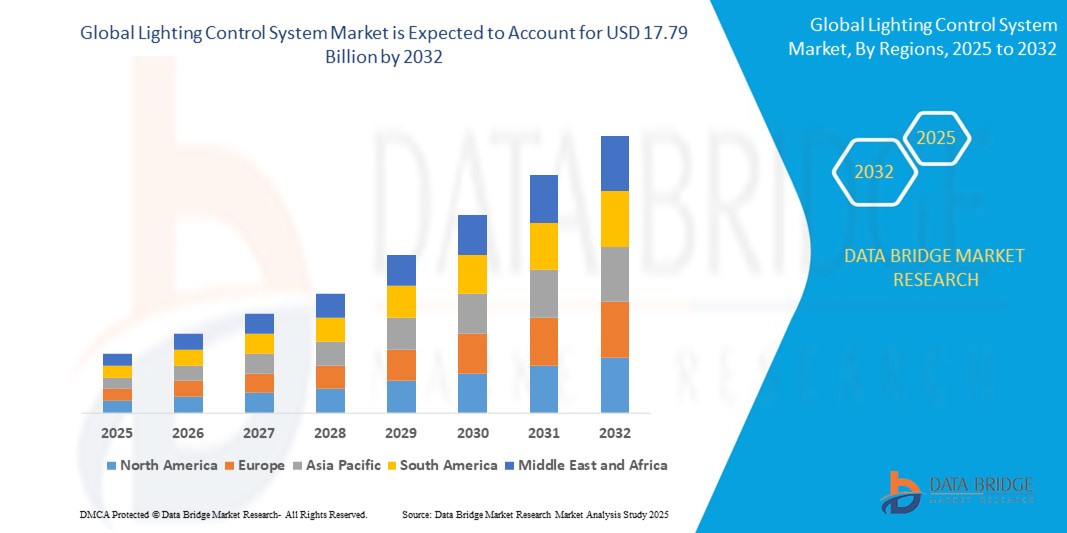
Lighting Control System Market Size
- The global Lighting Control System market size was valued atUSD 12.21 billion in 2024and is expected to reachUSD 17.79 billion by 2032, at aCAGR of 18.47%during the forecast period
- This growth is driven by factors such as increasing demand for energy-efficient lighting solutions, rising adoption of smart building technologies, supportive government regulations promoting sustainability, and advancements in wireless communication and IoT integration within lighting systems.
Lighting Control System Market Analysis
- The lighting control system refers to the technology that comprises of multiple lighting fixtures connected in a network to control lighting. These systems enhance performance, efficiency and customer value. These systems have various across diverse verticals, including automobiles, home appliances, aircrafts and many other systems.
- The increase in awareness of energy management across the globe acts as one of the major factors driving the growth of lighting control system market. The rise in the use of led lights and luminaries in outdoor lighting applications, and growing acceptance of standard protocols for lighting control systems are accelerate the market growth.
- North America is expected to dominate the lighting control system market due to the growing adoption and penetration of lighting control systems across the region for reducing energy consumption within the region
- Asia-Pacific is expected to be the fastest growing region in the lighting control system market during the forecast period because of the rapid infrastructure building activities in the region
- Hardware segment is expected to dominate the market with a market share of 56.22% due to the essential role of physical components such as sensors, dimmers, switches, and control modules in both new and retrofit lighting systems, alongside rising adoption of automated lighting in commercial and residential spaces
Report Scope and Lighting Control System Market Segmentation
|
Attributes |
Lighting Control System Key Market Insights |
|
Segments Covered |
|
|
Countries Covered |
North America
Europe
Asia-Pacific
Middle East and Africa
South America
|
|
Key Market Players |
|
|
Market Opportunities |
|
|
Value Added Data Infosets |
In addition to the insights on market scenarios such as market value, growth rate, segmentation, geographical coverage, and major players, the market reports curated by the Data Bridge Market Research also include import export analysis, production capacity overview, production consumption analysis, price trend analysis, climate change scenario, supply chain analysis, value chain analysis, raw material/consumables overview, vendor selection criteria, PESTLE Analysis, Porter Analysis, and regulatory framework. |
Lighting Control System Market Trends
“Advancements in Smart Lighting & IoT Integration”
- A key trend is the integration of AI, wireless protocols (Zigbee, Bluetooth Mesh), and cloud-based lighting management systems, enabling real-time adaptive control.
- These innovations enhance energy efficiency (up to 80% savings) and user customization through automated scheduling, occupancy sensing, and daylight harvesting.
- For instance, On March 12, 2021, Henry Wong of the Bluetooth SIG highlighted barriers in the commercial connected lighting sector, including the need for customer education, proper staff training, and achieving open interoperability. While the technology promises advanced control, energy efficiency, and data-driven insights, challenges such as proprietary systems and high deployment costs are restraining mass adoption and hindering full market potential
- Such advancements are transforming smart homes, offices, and cities, driving demand for next-gen lighting control systems with predictive analytics and voice control (Alexa/Google Assistant).
Lighting Control System Market Dynamics
Driver
“Growing Demand for Energy-Efficient Lighting Solutions”
- The growing demand for energy-efficient lighting solutions is driven by stricter government regulations, rising energy costs, and sustainability goals. Smart lighting controls like occupancy sensors and automated dimming reduce electricity consumption by up to 80%, offering significant cost savings.
- Governments worldwide are enforcing strict energy-efficiency regulations (e.g., EU’s Ecodesign Directive, U.S. ENERGY STAR) to reduce carbon footprints. These policies mandate the use of smart lighting controls (e.g., occupancy sensors, dimmers) in commercial and residential buildings, compelling businesses to adopt compliant systems or face penalties
- Businesses and homeowners increasingly adopt these systems to comply with green building standards (e.g., LEED) and lower operational expenses.
For instance,
- On April 22, 2024, energy-efficient lighting was highlighted as a key strategy for building sustainable workplaces. These solutions lower energy bills, reduce environmental impact by cutting emissions, and enhance employee comfort and productivity. As sustainability becomes central to modern business, efficient lighting plays a vital role in promoting cost savings and creating healthier, more eco-friendly work environments.
- As a result advancements in wireless and AI-powered controls further accelerate adoption, making energy-efficient lighting a key growth driver in the market.
Opportunity
“AI-Powered Predictive Lighting & Li-Fi Technology”
- AI-Powered Predictive Lighting & Li-Fi Technology" presents a transformative opportunity for the Lighting Control System Market. AI-driven predictive lighting uses machine learning to analyze usage patterns and automatically adjust illumination, optimizing energy efficiency by up to 60%.
- Li-Fi (Light Fidelity) enables ultra-fast, secure data transmission through LED lights, revolutionizing IoT connectivity in smart buildings. Together, these technologies enhance automation, reduce costs, and enable innovative applications like real-time indoor navigation and bandwidth-heavy data transfer.
- With smart cities and Industry 4.0 driving demand, early adopters can gain a competitive edge by integrating these solutions, positioning themselves at the forefront of next-generation lighting innovation.
For instance,
- On April 10, 2025, Li-Fi—Light Fidelity—gained attention as a revolutionary alternative to Wi-Fi, using light signals to transmit data at speeds up to 100 times faster. Pioneered by Harald Haas and advanced by Oledcomm, Li-Fi is now being tested in space via Europe’s Ariane 6 mission, offering exciting potential despite current limitations in everyday broadband use.
- The convergence of AI-powered predictive lighting and Li-Fi technology is poised to redefine the lighting control industry, offering unprecedented energy savings, enhanced connectivity, and smarter automation.
Restraint/Challenge
“High Upfront Costs & Interoperability Issues”
- The Lighting Control System Market faces significant growth barriers due to high initial investment requirements and compatibility challenges.
- Advanced smart lighting systems, including IoT-enabled controls and AI-driven solutions, often involve substantial upfront costs for hardware, software, and installation—making them prohibitive for small businesses and budget-conscious consumers.
- Additionally, the lack of universal communication protocols creates interoperability issues, as lighting components from different manufacturers may not seamlessly integrate. For instance, Zigbee, Z-Wave, and proprietary systems often operate in silos, forcing users into single-vendor ecosystems or costly workarounds.
For instance,
- In November 2024, according to an article published by the Ningbo Haishu HONYU Opto-Electro Co., Ltd, one of the main concerns surrounding the high cost of ophthalmic surgical microscopes is its potential impact on healthcare affordability and accessibility. The high cost of ophthalmic surgical microscopes adds to this burden, as it limits the ability of healthcare facilities to invest in the latest technology and equipment, thereby affecting the quality of care provided to patients
Lighting Control System Market Scope
The market is segmented on the basis application, product type, technology, magnification type, end user, and distribution channel.
|
Segmentation |
Sub-Segmentation |
|
By Installation Type |
|
|
By Offering |
|
|
By Communication Protocol |
|
|
By End- Use Applications |
|
|
By Distribution Channel
|
|
|
|
|
In 2025, the retrofit installations is projected to dominate the market with a largest share in installation type segment
In 2025, the retrofit installations segment is expected to dominate the Lighting Control System market due to the increasing demand for energy-efficient upgrades in existing buildings. With growing awareness of sustainability and cost-saving measures, commercial and residential spaces are increasingly adopting smart lighting retrofits without major infrastructure changes.
Thehardwaremicroscopes is expected to account for the largest share during the forecast period in technology market
In 2025, The hardware segment is projected to lead the market with the largest share of 56.22%. This dominance is attributed to the essential role of physical components like sensors, dimmers, switches, and relay units, which form the backbone of lighting control systems. Rising adoption in both new constructions and retrofits supports its continued growth.
Lighting Control System Market Regional Analysis
“North America Holds the Largest Share in the Lighting Control System Market”
- North America dominates the Lighting Control System market, driven by widespread adoption of smart building technologies, strong presence of leading lighting control system providers, and robust demand for energy-efficient solutions across commercial, industrial, and residential sectors.
- The U.S. holds a significant share due to rapid implementation of IoT-enabled lighting systems, supportive government initiatives promoting energy conservation, and the growing popularity of home automation and smart lighting solutions.
- The presence of well-established infrastructure, along with favorable regulatory frameworks and growing investments in smart city projects, further strengthens the regional market.
- Additionally, the increasing number of commercial buildings and renovation activities, coupled with the rising adoption of wireless and cloud-based lighting control technologies, continues to drive market expansion across North America
“Asia-Pacific is Projected to Register the Highest CAGR in the Lighting Control System Market”
- The Asia-Pacific region is expected to witness the highest growth rate in the Lighting Control System market, driven by rapid urbanization, growing construction activities, and rising demand for energy-efficient and automated lighting solutions.
- Countries such as China, India, and Japan are emerging as key markets due to increasing smart city initiatives, expansion of commercial infrastructure, and growing government focus on sustainable energy management.
- Japan, known for its advanced technological landscape, continues to lead in the adoption of intelligent lighting systems, particularly in commercial buildings and public infrastructure projects, enhancing energy efficiency and operational control.
- China and India, with their large-scale residential and commercial developments, are witnessing substantial government and private sector investments in smart infrastructure and lighting automation. The growing presence of global lighting control system manufacturers and improving digital infrastructure further contribute to the region’s strong market growth.
Lighting Control System Market Share
The market competitive landscape provides details by competitor. Details included are company overview, company financials, revenue generated, market potential, investment in research and development, new market initiatives, global presence, production sites and facilities, production capacities, company strengths and weaknesses, product launch, product width and breadth, application dominance. The above data points provided are only related to the companies' focus related to market.
The Major Market Leaders Operating in the Market Are:
- Signify Holding (Netherlands)
- Legrand North America, LLC (U.S.)
- Eaton (U.S.)
- GE Current (U.S.)
- OSRAM GmbH (Germany)
- ACUITY BRANDS LIGHTING, INC. (U.S.)
- Lutron Electronics Co., Inc. (U.S.)
- Schneider Electric (France)
- Honeywell International Inc. (U.S.)
- IDEAL INDUSTRIES, INC. (U.S.)
- Hubbell (U.S.)
- Leviton Manufacturing Co., Inc. (U.S.)
- Helvar (Finland)
- Zumtobel Group AG (Austria)
- RAB Lighting Inc. (U.S.)
- Synapse Wireless (U.S.)
- Panasonic Corporation (Japan)
Latest Developments in Global Lighting Control System Market
- On April 15, 2025, Enlighted, a Siemens-owned smart building tech firm, announced it is winding down its core lighting business due to unprofitable growth despite major investments. The company has stopped taking new orders for lighting-related hardware, software, and services, informing partners and agents of the decision via a memo issued last week.
- On March 12, 2025, Enlighted launched Enlighted Eazy, a smart lighting control solution tailored for SMBs. It features laser-based commissioning for 30% faster setup, intuitive app-based management, and wireless installation. Designed to deliver high performance at an affordable price, Enlighted Eazy brings the company’s advanced lighting technology to smaller businesses for the first time.
- On July 2, 2024, lighting control systems emerged as a key trend in corporate and large-scale buildings, driven by energy savings, enhanced employee well-being, and simplified management. With features like occupancy sensors and centralized controls, these systems reduce costs, support sustainability, and improve productivity—making them essential for modern, efficient workplace environments.
- On June 16, 2023, facility managers increasingly embraced advanced lighting controls to manage lighting and HVAC systems centrally. Leveraging IoT, LLLC, and emerging AI technologies, these systems enhance energy efficiency, reduce utility costs, and optimize comfort. Sensors like dimming and occupancy detection also improve building aesthetics and employee well-being, making smart lighting a key tool for modern facility management.
SKU-
Obtenha acesso online ao relatório sobre a primeira nuvem de inteligência de mercado do mundo

- Painel interativo de análise de dados
- Painel de análise da empresa para oportunidades de elevado potencial de crescimento
- Acesso de analista de pesquisa para personalização e customização. consultas
- Análise da concorrência com painel interativo
- Últimas notícias, atualizações e atualizações Análise de tendências
- Aproveite o poder da análise de benchmark para um rastreio abrangente da concorrência
Metodologia de Investigação
A recolha de dados e a análise do ano base são feitas através de módulos de recolha de dados com amostras grandes. A etapa inclui a obtenção de informações de mercado ou dados relacionados através de diversas fontes e estratégias. Inclui examinar e planear antecipadamente todos os dados adquiridos no passado. Da mesma forma, envolve o exame de inconsistências de informação observadas em diferentes fontes de informação. Os dados de mercado são analisados e estimados utilizando modelos estatísticos e coerentes de mercado. Além disso, a análise da quota de mercado e a análise das principais tendências são os principais fatores de sucesso no relatório de mercado. Para saber mais, solicite uma chamada de analista ou abra a sua consulta.
A principal metodologia de investigação utilizada pela equipa de investigação do DBMR é a triangulação de dados que envolve a mineração de dados, a análise do impacto das variáveis de dados no mercado e a validação primária (especialista do setor). Os modelos de dados incluem grelha de posicionamento de fornecedores, análise da linha de tempo do mercado, visão geral e guia de mercado, grelha de posicionamento da empresa, análise de patentes, análise de preços, análise da quota de mercado da empresa, normas de medição, análise global versus regional e de participação dos fornecedores. Para saber mais sobre a metodologia de investigação, faça uma consulta para falar com os nossos especialistas do setor.
Personalização disponível
A Data Bridge Market Research é líder em investigação formativa avançada. Orgulhamo-nos de servir os nossos clientes novos e existentes com dados e análises que correspondem e atendem aos seus objetivos. O relatório pode ser personalizado para incluir análise de tendências de preços de marcas-alvo, compreensão do mercado para países adicionais (solicite a lista de países), dados de resultados de ensaios clínicos, revisão de literatura, mercado remodelado e análise de base de produtos . A análise de mercado dos concorrentes-alvo pode ser analisada desde análises baseadas em tecnologia até estratégias de carteira de mercado. Podemos adicionar quantos concorrentes necessitar de dados no formato e estilo de dados que procura. A nossa equipa de analistas também pode fornecer dados em tabelas dinâmicas de ficheiros Excel em bruto (livro de factos) ou pode ajudá-lo a criar apresentações a partir dos conjuntos de dados disponíveis no relatório.











