Segmentação do mercado global de gliomas de baixo grau, por tipo (baixo grau I e baixo grau II), classe de medicamento (trametinibe, dabrafenibe, ivosidenibe e mirdametinibe), via de administração (tópica e oral), canal de distribuição (farmácias online, farmácias hospitalares e farmácias de varejo) – Tendências e previsões do setor até 2032.
Análise de mercado de gliomas de baixo grau
O mercado de gliomas de baixo grau tem apresentado um crescimento significativo, impulsionado por avanços em diagnósticos e tratamentos. Com uma ênfase crescente na detecção precoce e em terapias personalizadas, há uma demanda cada vez maior por opções de tratamento eficazes, incluindo cirurgia, radioterapia e quimioterapia. Inovações em terapias direcionadas e imunoterapias têm impulsionado ainda mais a expansão do mercado, oferecendo modalidades de tratamento mais precisas e com menos efeitos colaterais em comparação aos métodos tradicionais.
O mercado também é influenciado pela crescente prevalência de gliomas de baixo grau e pela maior conscientização entre profissionais de saúde e pacientes sobre as opções de tratamento disponíveis. O aumento dos investimentos em pesquisa e desenvolvimento, juntamente com as colaborações entre empresas farmacêuticas, empresas de biotecnologia e instituições acadêmicas, aceleraram a introdução de novas terapias no mercado. Além disso, espera-se que os ensaios clínicos que exploram novos candidatos a medicamentos e combinações de tratamentos moldem ainda mais a dinâmica do mercado.
O desenvolvimento contínuo de melhores ferramentas de diagnóstico, como técnicas avançadas de imagem, está aprimorando a precisão dos diagnósticos de gliomas de baixo grau, facilitando intervenções mais precoces e melhores resultados para os pacientes. No entanto, desafios como os altos custos do tratamento, a complexidade dos regimes terapêuticos e a disponibilidade limitada de infraestrutura de saúde especializada em certas regiões podem, em certa medida, dificultar o crescimento do mercado. Apesar desses desafios, a perspectiva geral para o mercado de gliomas de baixo grau permanece positiva, com a expectativa de que os avanços contínuos melhorem o atendimento ao paciente e a eficácia do tratamento.
Tamanho do mercado de gliomas de baixo grau
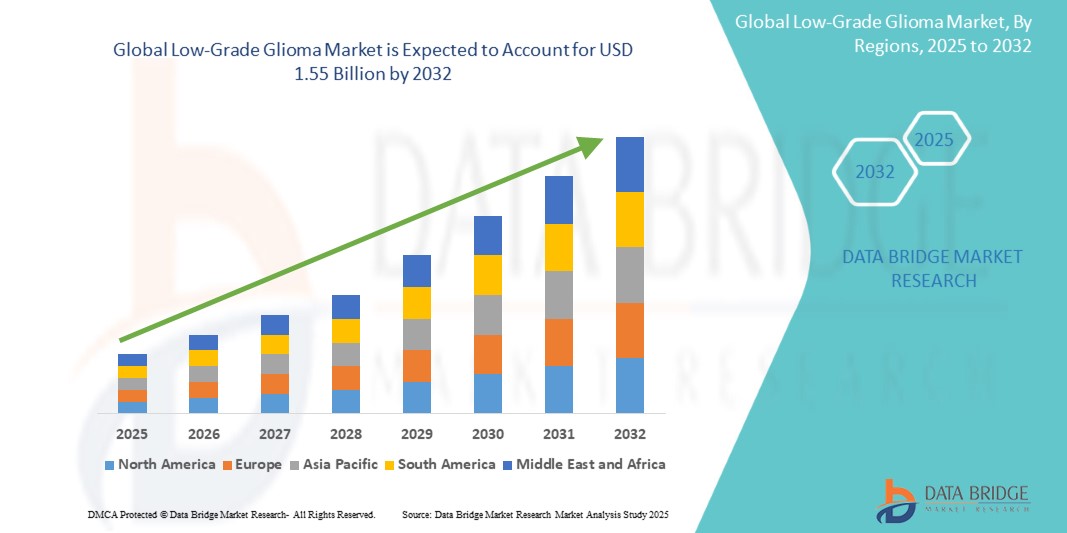
O mercado global de gliomas de baixo grau foi avaliado em US$ 1,11 bilhão em 2024 e projeta-se que alcance US$ 1,55 bilhão até 2032, com uma taxa de crescimento anual composta (CAGR) de 4,28% durante o período de previsão de 2025 a 2032. Além das informações sobre cenários de mercado, como valor de mercado, taxa de crescimento, segmentação, cobertura geográfica e principais participantes, os relatórios de mercado elaborados pela Data Bridge Market Research também incluem análises aprofundadas de especialistas, epidemiologia de pacientes, análise de projetos em desenvolvimento, análise de preços e estrutura regulatória.
Tendências do mercado de gliomas de baixo grau
“Aumento da adoção de terapias direcionadas e imunoterapias”
Uma das principais tendências no mercado de gliomas de baixo grau é a crescente adoção de terapias-alvo e imunoterapias. Esses tratamentos estão ganhando espaço por oferecerem opções mais precisas e eficazes em comparação com as terapias tradicionais, como quimioterapia e radioterapia. As terapias-alvo atuam focando em mutações genéticas específicas ou alvos moleculares presentes nas células do glioma, minimizando os danos ao tecido saudável circundante. As imunoterapias, como os inibidores de checkpoint e os tratamentos baseados em vacinas, visam fortalecer o sistema imunológico do corpo para que ele reconheça e destrua as células cancerígenas.
A crescente compreensão dos mecanismos genéticos e moleculares dos gliomas de baixo grau acelerou o desenvolvimento dessas terapias avançadas, oferecendo o potencial para melhores resultados para os pacientes e redução dos efeitos colaterais. Espera-se que os ensaios clínicos e as pesquisas em andamento sobre esses tratamentos inovadores moldem ainda mais o mercado, tornando essa tendência um fator-chave no futuro do cuidado e das estratégias de tratamento de gliomas de baixo grau.
Escopo do relatório e segmentação do mercado de gliomas de baixo grau
|
Atributos |
Principais informações de mercado sobre glioma de baixo grau |
|
Segmentos abrangidos |
|
|
Países abrangidos |
Estados Unidos, Canadá e México, Alemanha, França, Reino Unido, Itália, Rússia, Espanha, Dinamarca, Suécia, Noruega, Resto da Europa, China, Japão, Índia, Coreia do Sul, Austrália, Tailândia, Resto da Ásia-Pacífico (APAC), Arábia Saudita, Emirados Árabes Unidos, África do Sul, Nigéria, Egito, Kuwait, Resto do Oriente Médio e África, Brasil, Argentina e Resto da América do Sul |
|
Principais participantes do mercado |
AstraZeneca (Reino Unido), AbbVie Inc. (EUA), Amgen Inc. (EUA), Bristol-Myers Squibb Company (EUA), DAIICHI SANKYO COMPANY, LIMITED (Japão), Day One Biopharmaceuticals, Inc. (EUA), F. Hoffmann-La Roche Ltd (Suíça), Genentech, Inc. (EUA), Helsinn Healthcare SA (Suíça), Lilly (EUA), LES LABORATOIRES SERVIER (França), Merck & Co., Inc. (EUA), Merck KGaA (Alemanha), Novo Nordisk A/S (Dinamarca), Novartis AG (Suíça), Pfizer Inc. (EUA), Rigel Pharmaceuticals, Inc. (EUA), SpringWorks Therapeutics, Inc. (EUA), Sun Pharmaceutical Industries Ltd. (Índia) e Teva Pharmaceutical Industries Ltd. (Israel) |
|
Oportunidades de mercado |
|
|
Conjuntos de informações de dados de valor agregado |
Além das informações sobre cenários de mercado, como valor de mercado, taxa de crescimento, segmentação, cobertura geográfica e principais participantes, os relatórios de mercado elaborados pela Data Bridge Market Research também incluem análises aprofundadas de especialistas, epidemiologia de pacientes, análise de projetos em desenvolvimento, análise de preços e estrutura regulatória. |
Definição de mercado de glioma de baixo grau
Glioma de baixo grau refere-se a um tipo de tumor cerebral que se origina nas células da glia, responsáveis pela sustentação e proteção dos neurônios no cérebro. Esses tumores são geralmente classificados como grau 1 ou grau 2, com base em seu crescimento relativamente lento e menor malignidade em comparação com gliomas de alto grau. Gliomas de baixo grau são mais comuns em pacientes jovens e podem ocorrer em diversas partes do cérebro. Embora sejam menos agressivos que gliomas de alto grau, ainda podem causar sintomas neurológicos significativos e requerem tratamento como cirurgia, radioterapia e, às vezes, quimioterapia. Devido ao seu crescimento lento, os gliomas de baixo grau podem ser difíceis de detectar precocemente, mas podem evoluir para formas mais agressivas com o tempo.
Dinâmica do mercado de gliomas de baixo grau
Motoristas
- Avanços em terapias direcionadas e imunoterapias
O crescente desenvolvimento e adoção de terapias direcionadas e imunoterapias são importantes impulsionadores do mercado de gliomas de baixo grau. As terapias direcionadas concentram-se em mutações genéticas ou proteínas específicas envolvidas no crescimento tumoral, oferecendo tratamentos mais precisos e com menos efeitos colaterais em comparação a métodos tradicionais, como quimioterapia e radioterapia. As imunoterapias, como os inibidores de checkpoint, atuam estimulando o sistema imunológico do corpo para melhor atacar as células cancerígenas. Um excelente exemplo é o desenvolvimento de medicamentos como o mirdametinibe, um inibidor de MEK em fase de investigação, que está sendo avaliado para gliomas de baixo grau em ensaios clínicos. Esses tratamentos avançados têm o potencial de melhorar significativamente os resultados para os pacientes, oferecendo opções mais personalizadas e eficazes. À medida que essas terapias se tornam mais amplamente disponíveis, espera-se que revolucionem o cenário do tratamento de gliomas de baixo grau, impulsionando o crescimento do mercado ao melhorar as taxas de sobrevida e reduzir os efeitos colaterais relacionados ao tratamento. O crescente interesse e investimento nessas terapias devem aumentar o tamanho do mercado, conforme a demanda por tratamentos direcionados aumenta, contribuindo para a mudança geral em direção a regimes de tratamento mais especializados e eficazes.
- Aumento do diagnóstico precoce e aprimoramento das tecnologias de imagem
O aumento no diagnóstico precoce devido aos avanços nas tecnologias de imagem é outro fator crítico que impulsiona o mercado de gliomas de baixo grau. Ferramentas de diagnóstico mais precisas, como ressonância magnética avançada, tomografia por emissão de pósitrons (PET) e técnicas de imagem funcional, permitem a detecção precoce de gliomas, o que pode levar a intervenções mais oportunas. A capacidade de detectar gliomas de baixo grau em estágios iniciais permite melhores resultados de tratamento, reduzindo a progressão do tumor e melhorando a qualidade de vida dos pacientes. Por exemplo, técnicas de imagem sofisticadas ajudam a diferenciar os tipos de tumor, facilitando o planejamento preciso do tratamento. Além disso, o diagnóstico precoce pode ajudar a identificar os pacientes com maior probabilidade de se beneficiarem de terapias emergentes, como tratamentos direcionados ou imunoterapia. À medida que as ferramentas de diagnóstico melhoram, o mercado de tratamentos para gliomas de baixo grau se expande, com a intervenção precoce levando a uma maior demanda por terapias, particularmente aquelas voltadas para o gerenciamento e monitoramento da doença a longo prazo. Isso contribui para o crescimento do mercado, promovendo uma mudança para estratégias de cuidado proativas.
Oportunidades
- Crescimento nas opções de tratamento pediátrico e para adolescentes
Uma oportunidade significativa no mercado de gliomas de baixo grau reside na expansão das opções de tratamento para pacientes pediátricos e adolescentes. Os gliomas de baixo grau são um dos tumores cerebrais mais comuns em crianças e jovens adultos, e existe uma lacuna considerável nas opções de tratamento personalizadas para essa faixa etária. Em resposta, as empresas farmacêuticas estão cada vez mais focadas no desenvolvimento de terapias especificamente adaptadas a pacientes mais jovens, que frequentemente requerem regimes de dosagem diferentes e apresentam efeitos colaterais distintos em comparação aos adultos. Por exemplo, a SpringWorks Therapeutics iniciou um estudo de Fase 1/2 em 2021 para avaliar o mirdametinibe, um inibidor de MEK em investigação, em crianças e jovens adultos com glioma de baixo grau. Esse foco no atendimento pediátrico e adolescente oferece uma oportunidade de mercado significativa, à medida que a demanda por terapias adequadas à idade cresce. Conforme esses tratamentos especializados forem aprovados, provavelmente aumentarão a penetração no mercado e atrairão novos investimentos no cenário do tratamento de gliomas de baixo grau.
- Expansão dos ensaios clínicos para novas modalidades de tratamento
O crescente número de ensaios clínicos que avaliam terapias inovadoras para gliomas de baixo grau representa uma oportunidade fundamental para o mercado. Com o aumento das pesquisas sobre novas modalidades de tratamento, como terapias gênicas, vírus oncolíticos e terapias combinadas, os ensaios clínicos estão impulsionando o desenvolvimento de estratégias de tratamento mais eficazes e personalizadas. Por exemplo, a designação de medicamento órfão concedida à Mustang Bio para o MB-108, um vírus oncolítico HSV-1 para glioma maligno, reflete o crescente interesse em terapias alternativas para gliomas. A expansão dos ensaios clínicos provavelmente levará à introdução de tratamentos inovadores, ampliando a gama de terapias disponíveis para pacientes com glioma de baixo grau. Esse crescimento nas opções de tratamento pode atrair investimentos e demanda, impulsionando a expansão geral do mercado à medida que novas terapias são aprovadas e integradas às práticas de tratamento padrão.
Restrições/Desafios
- Altos custos de tratamento
Uma das principais restrições no mercado de gliomas de baixo grau é o alto custo do tratamento, particularmente para terapias avançadas como terapias-alvo e imunoterapias. Essas terapias, embora mais eficazes, podem ser significativamente mais caras em comparação com métodos tradicionais como cirurgia e quimioterapia. Por exemplo, o uso de mirdametinibe, um novo inibidor de MEK, pode ter um preço mais elevado devido ao seu status de pesquisa e natureza especializada. O alto custo do tratamento pode limitar o acesso dos pacientes, principalmente em regiões com infraestrutura de saúde precária ou para aqueles sem cobertura de seguro saúde suficiente. O ônus financeiro associado a esses tratamentos pode dificultar a expansão do mercado, já que nem todos os pacientes terão condições de arcar com terapias de ponta. Empresas farmacêuticas e sistemas de saúde podem sofrer pressão para encontrar maneiras de reduzir custos ou oferecer programas de assistência financeira para garantir maior acessibilidade, influenciando, assim, o potencial de crescimento do mercado.
- Resistência tumoral e progressão da doença
Um desafio significativo no tratamento de gliomas de baixo grau é o potencial de resistência tumoral e progressão ao longo do tempo. Embora os gliomas de baixo grau inicialmente apresentem crescimento lento, eles podem evoluir para gliomas de alto grau, mais agressivos e de tratamento mais complexo. Essa progressão pode limitar a eficácia dos tratamentos a longo prazo e dificultar o controle da doença. Por exemplo, apesar dos resultados promissores de terapias direcionadas, como o mirdametinibe, pode ocorrer o desenvolvimento de resistência a esses tratamentos, tornando-os menos eficazes. O desafio da resistência tumoral e da progressão pode limitar a eficácia sustentada dos tratamentos disponíveis, potencialmente retardando a adoção de novas terapias.
Este relatório de mercado fornece detalhes sobre os desenvolvimentos recentes, regulamentações comerciais, análise de importação e exportação, análise de produção, otimização da cadeia de valor, participação de mercado, impacto de players de mercado nacionais e locais, análise de oportunidades em termos de novos nichos de receita, mudanças nas regulamentações de mercado, análise estratégica de crescimento de mercado, tamanho do mercado, crescimento de mercado por categoria, nichos de aplicação e dominância, aprovações de produtos, lançamentos de produtos, expansões geográficas e inovações tecnológicas no mercado. Para obter mais informações sobre o mercado, entre em contato com a Data Bridge Market Research para uma análise detalhada. Nossa equipe ajudará você a tomar decisões de mercado informadas para alcançar o crescimento desejado.
Escopo do mercado de gliomas de baixo grau
O mercado é segmentado com base no tipo, classe de medicamento, via de administração e canal de distribuição. O crescimento entre esses segmentos ajudará você a analisar os segmentos de crescimento mais lento nos setores e fornecerá aos usuários uma visão geral valiosa do mercado e informações relevantes para ajudá-los a tomar decisões estratégicas na identificação das principais aplicações de mercado.
Tipo
- Grau baixo I
- Grau baixo II
Classe de medicamento
- Trametinib
- Dabrafenibe
- Ivosidenib
- Mirdametinib
Via de Administração
- Tópico
- Oral
Canal de Distribuição
- Farmácias online
- Farmácias hospitalares
- Farmácias de varejo
Análise Regional do Mercado de Gliomas de Baixo Grau
O mercado é analisado e são fornecidas informações sobre o tamanho e as tendências do mercado por país, tipo, classe de medicamento, via de administração e canal de distribuição, conforme mencionado acima.
Os países abrangidos no relatório de mercado são: Estados Unidos, Canadá e México, Alemanha, França, Reino Unido, Itália, Rússia, Espanha, Dinamarca, Suécia, Noruega, Resto da Europa, China, Japão, Índia, Coreia do Sul, Austrália, Tailândia, Resto da Ásia-Pacífico (APAC), Arábia Saudita, Emirados Árabes Unidos, África do Sul, Nigéria, Egito, Kuwait, Resto do Oriente Médio e África, Brasil, Argentina e Resto da América do Sul.
A América do Norte deverá dominar o mercado de gliomas de baixo grau devido à sua infraestrutura de saúde avançada, alta prevalência de câncer cerebral e fortes investimentos em pesquisa e desenvolvimento. A região se beneficia de tecnologias de diagnóstico de ponta e novas opções de tratamento, incluindo terapias direcionadas e imunoterapias. Além disso, um alto nível de conscientização, diagnóstico precoce e a presença de grandes empresas farmacêuticas e de biotecnologia conduzindo ensaios clínicos contribuem ainda mais para a liderança da América do Norte no mercado.
A região Ásia-Pacífico deverá apresentar a maior taxa de crescimento no mercado de gliomas de baixo grau. Esse crescimento é impulsionado pela melhoria da infraestrutura de saúde, pelo aumento da conscientização sobre o câncer e pela expansão do acesso a tratamentos avançados em países como China e Índia. Além disso, o aumento dos investimentos em pesquisa e desenvolvimento, juntamente com o crescimento dos gastos com saúde, contribuem para a expansão do mercado. À medida que o diagnóstico precoce e as opções de tratamento se tornam mais acessíveis, espera-se que a demanda por terapias para gliomas de baixo grau aumente consideravelmente nessa região.
A seção do relatório dedicada a cada país também fornece informações sobre os fatores que impactam o mercado local e as mudanças na regulamentação que afetam as tendências atuais e futuras do mercado. Dados como análises da cadeia de valor a montante e a jusante, tendências tecnológicas, análise das cinco forças de Porter e estudos de caso são alguns dos indicadores utilizados para prever o cenário de mercado em cada país. Além disso, a presença e a disponibilidade de marcas globais e os desafios que enfrentam devido à concorrência, seja ela intensa ou escassa, de marcas locais e nacionais, bem como o impacto das tarifas e rotas comerciais internas, são considerados na análise das previsões para cada país.
Participação de mercado de gliomas de baixo grau
O panorama competitivo do mercado fornece detalhes por concorrente. Os detalhes incluem visão geral da empresa, dados financeiros, receita gerada, potencial de mercado, investimento em pesquisa e desenvolvimento, iniciativas em novos mercados, presença global, locais e instalações de produção, capacidades de produção, pontos fortes e fracos da empresa, lançamento de produtos, amplitude e profundidade do portfólio de produtos e domínio de aplicações. Os dados acima referem-se apenas ao foco das empresas no mercado.
Os principais fabricantes que atuam no mercado de gliomas de baixo grau são:
- AstraZeneca (Reino Unido)
- AbbVie Inc. (EUA)
- Amgen Inc. (EUA)
- Empresa Bristol-Myers Squibb (EUA)
- DAIICHI SANKYO COMPANY, LIMITADA (Japão)
- Day One Biopharmaceuticals, Inc. (EUA)
- F. Hoffmann-La Roche Ltda. (Suíça)
- Genentech, Inc. (EUA)
- Helsinn Healthcare SA (Suíça)
- Lírio (EUA)
- LES LABORATOIRES SERVIER (França)
- Merck & Co., Inc. (EUA)
- Merck KGaA (Alemanha)
- Novo Nordisk A/S (Dinamarca)
- Novartis AG (Suíça)
- Pfizer Inc. (EUA)
- Rigel Pharmaceuticals, Inc. (EUA)
- SpringWorks Therapeutics, Inc. (EUA)
- Sun Pharmaceutical Industries Ltd. (Índia)
- Teva Pharmaceutical Industries Ltd. (Israel)
Novidades no mercado de gliomas de baixo grau
- Em novembro de 2024, a Mustang Bio, Inc. anunciou que a Food and Drug Administration (FDA) dos EUA concedeu a designação de medicamento órfão ao MB-108, um vírus oncolítico do vírus herpes simplex tipo 1 (HSV-1), para o tratamento de glioma maligno.
- Em setembro de 2024, a Adaptin Bio anunciou que a FDA havia aprovado o pedido de Novo Medicamento Investigacional (IND) para seu programa APTN-101 no tratamento do glioblastoma (GBM), o tumor cerebral primário mais prevalente e agressivo. Essa aprovação permite que a empresa inicie um ensaio clínico de Fase 1, o primeiro em humanos, para avaliar o potencial do medicamento investigacional no tratamento do GBM.
- Em agosto de 2024, a Servier anunciou que a Food and Drug Administration (FDA) dos EUA aprovou o VORANIGO, um inibidor que tem como alvo a isocitrato desidrogenase-1 (IDH1) e a isocitrato desidrogenase-2 (IDH2). Este tratamento agora está aprovado para pacientes adultos e pediátricos com 12 anos ou mais com astrocitoma ou oligodendroglioma de grau 2 que apresentem uma mutação suscetível em IDH1 ou IDH2, após cirurgia como biópsia, ressecção subtotal ou ressecção total macroscópica. O VORANIGO já está disponível, oferecendo aos pacientes com glioma um comprimido de administração única diária para o controle ativo da doença.
- Em setembro de 2023, a AnHeart Therapeutics anunciou que o primeiro paciente recebeu a dose no ensaio clínico de Fase 2, G203, que avalia a eficácia do safusidenib em pacientes com glioma recorrente ou progressivo de grau 2 ou 3 com mutação no gene da isocitrato desidrogenase 1 (mIDH1), uma forma prevalente de câncer cerebral primário em adultos.
- Em junho de 2021, a SpringWorks Therapeutics, Inc. anunciou o lançamento de um ensaio clínico de Fase 1/2 para avaliar a eficácia do mirdametinibe, um inibidor experimental de MEK, no tratamento de crianças, adolescentes e adultos jovens com glioma de baixo grau (GBG).
SKU-
Obtenha acesso online ao relatório sobre a primeira nuvem de inteligência de mercado do mundo
- Painel interativo de análise de dados
- Painel de análise da empresa para oportunidades de elevado potencial de crescimento
- Acesso de analista de pesquisa para personalização e customização. consultas
- Análise da concorrência com painel interativo
- Últimas notícias, atualizações e atualizações Análise de tendências
- Aproveite o poder da análise de benchmark para um rastreio abrangente da concorrência
Metodologia de Investigação
A recolha de dados e a análise do ano base são feitas através de módulos de recolha de dados com amostras grandes. A etapa inclui a obtenção de informações de mercado ou dados relacionados através de diversas fontes e estratégias. Inclui examinar e planear antecipadamente todos os dados adquiridos no passado. Da mesma forma, envolve o exame de inconsistências de informação observadas em diferentes fontes de informação. Os dados de mercado são analisados e estimados utilizando modelos estatísticos e coerentes de mercado. Além disso, a análise da quota de mercado e a análise das principais tendências são os principais fatores de sucesso no relatório de mercado. Para saber mais, solicite uma chamada de analista ou abra a sua consulta.
A principal metodologia de investigação utilizada pela equipa de investigação do DBMR é a triangulação de dados que envolve a mineração de dados, a análise do impacto das variáveis de dados no mercado e a validação primária (especialista do setor). Os modelos de dados incluem grelha de posicionamento de fornecedores, análise da linha de tempo do mercado, visão geral e guia de mercado, grelha de posicionamento da empresa, análise de patentes, análise de preços, análise da quota de mercado da empresa, normas de medição, análise global versus regional e de participação dos fornecedores. Para saber mais sobre a metodologia de investigação, faça uma consulta para falar com os nossos especialistas do setor.
Personalização disponível
A Data Bridge Market Research é líder em investigação formativa avançada. Orgulhamo-nos de servir os nossos clientes novos e existentes com dados e análises que correspondem e atendem aos seus objetivos. O relatório pode ser personalizado para incluir análise de tendências de preços de marcas-alvo, compreensão do mercado para países adicionais (solicite a lista de países), dados de resultados de ensaios clínicos, revisão de literatura, mercado remodelado e análise de base de produtos . A análise de mercado dos concorrentes-alvo pode ser analisada desde análises baseadas em tecnologia até estratégias de carteira de mercado. Podemos adicionar quantos concorrentes necessitar de dados no formato e estilo de dados que procura. A nossa equipa de analistas também pode fornecer dados em tabelas dinâmicas de ficheiros Excel em bruto (livro de factos) ou pode ajudá-lo a criar apresentações a partir dos conjuntos de dados disponíveis no relatório.