


Global Low-Light Imaging Market, By Technology (Complementary Metal-Oxide Semiconductor (CMOS) and Charge-Coupled Device (CCD)), Application (Photography, Monitoring, Inspection and Detection and Security and Surveillance), Vertical (Consumer Electronics, Automotive, Medical and Life Sciences, Military and Defence and Industrial, Commercial and Residential Infrastructure) – Industry Trends and Forecast to 2030.
Low-Light Imaging Market Analysis and Size
Images captured in outdoor scenes can be highly degraded owing to poor lighting conditions. These images can have high noise levels with low dynamic ranges that affect the overall presentation of computer vision algorithms. To make the computer vision algorithms robust in low-light conditions, use low-light imaging to improve the visibility of an image. The low-lighting imaging market is developing at a remarkable pace to serve better applications in cinematography, photography, security, and medical and life sciences research. Numerous breakthrough innovations in this area have led to the evolution of low-light imaging for better applications.
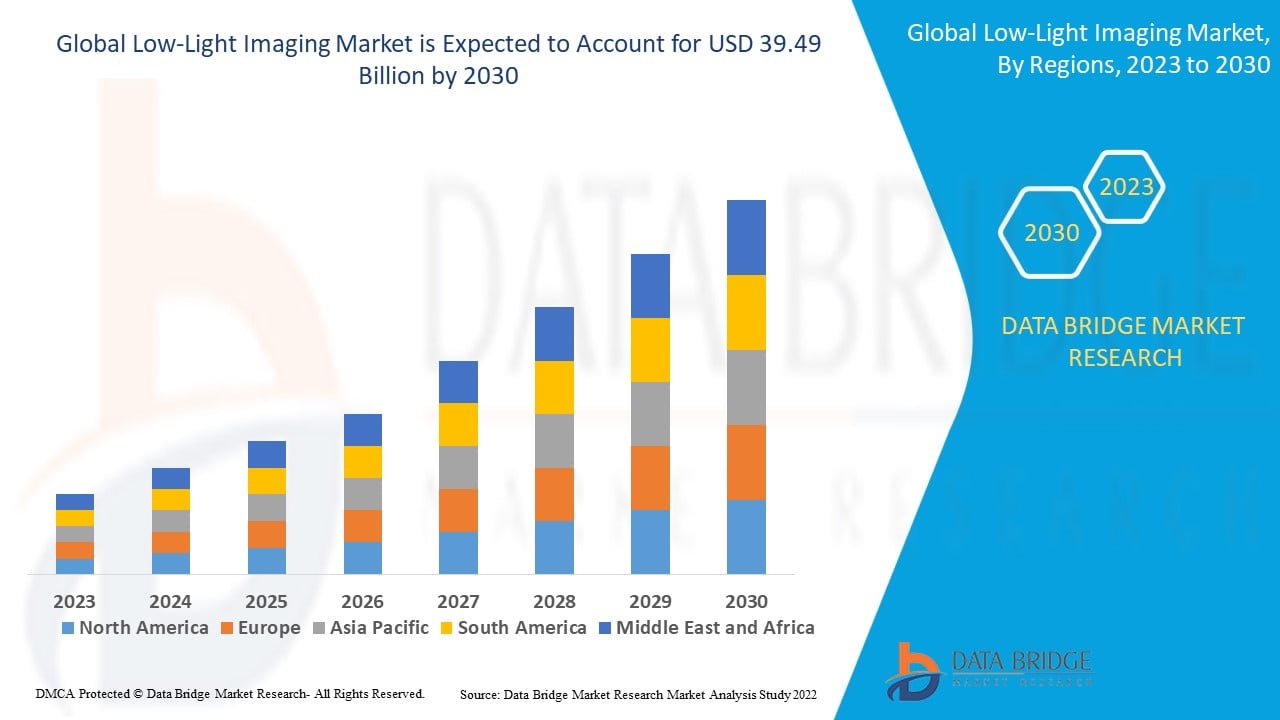
Data Bridge Market Research analyses that the low-light imaging market was valued at USD 14.54 billion in 2022 and is expected to reach the value of USD 39.49 billion by 2030, at a CAGR of 13.30% during the forecast period. In addition to the insights on market scenarios such as market value, growth rate, segmentation, geographical coverage, and major players, the market reports curated by the Data Bridge Market Research also include in-depth expert analysis, geographically represented company-wise production and capacity, network layouts of distributors and partners, detailed and updated price trend analysis and deficit analysis of supply chain and demand.
Low-Light Imaging Market Scope and Segmentation
|
Report Metric |
Details |
|
Forecast Period |
2023 to 2030 |
|
Base Year |
2022 |
|
Historic Years |
2021 (Customizable to 2015 - 2020) |
|
Quantitative Units |
Revenue in USD Billion, Volumes in Units, Pricing in USD |
|
Segments Covered |
Technology (Complementary Metal-Oxide Semiconductor (CMOS) and Charge-Coupled Device (CCD)), Application (Photography, Monitoring, Inspection and Detection and Security and Surveillance), Vertical (Consumer Electronics, Automotive, Medical and Life Sciences, Military and Defence and Industrial, Commercial and Residential Infrastructure) |
|
Countries Covered |
U.S., Canada and Mexico in North America, Germany, France, U.K., Netherlands, Switzerland, Belgium, Russia, Italy, Spain, Turkey, Rest of Europe in Europe, China, Japan, India, South Korea, Singapore, Malaysia, Australia, Thailand, Indonesia, Philippines, Rest of Asia-Pacific (APAC) in the Asia-Pacific (APAC), Saudi Arabia, U.A.E, South Africa, Egypt, Israel, Rest of Middle East and Africa (M.E.A.) as a part of Middle East and Africa (M.E.A.), Brazil, Argentina and Rest of South America as part of South America |
|
Market Players Covered |
Panasonic Corporation Co, Ltd (Japan), Samsung (South Korea), BAE Systems (U.K.), Andanta GmbH (Germany), ams-OSRAM AG (Austria), STMicroelectronics (Switzerland), Sharp Corporation (Japan), Teledyne FLIR LLC (U.S.), Hamamatsu Photonics K.K. (Japan), Semiconductor Components Industries, LLC (U.S.), PIXELPLUS (U.A.E), OmniVision (U.S., Sony Semiconductor Solutions Corporation (Japan), ROHM CO., LTD. (Japan), TE Connectivity. (Switzerland), Ushio America, Inc. (Japan), Würth Elektronik GmbH & Co. KG (Germany) |
|
Market Opportunities |
|
Market Definition
Low light imaging is also referred as night vision camera or night vision imaging since primary application of this practice was the improvement in the capability of human night vision. Low-light imaging is used to improve the visibility of the image in dimly lit environments. The developments in low-light technology have considerably improved sensitivity in IP cameras and allow capabilities to capture colour images in as little as 0.1 lux illuminance.
Global Low-Light Imaging Market Dynamics
Drivers
- Rising demand of low-light imaging in automotive sector
The automotive sector is projected to contribute favorable revenue to the low-light imaging market in the upcoming future. Rapid adoption of advanced driver assistance systems (ADAS) for vehicles is indirectly paving mode for the demand of low-light imaging. Low-light image sensors are used in advanced driver assistance systems (ADAS) components for forward-collision warning, lane-keep assistance and blind spot monitoring. Besides this, 360-degree surround-view cameras front-view machine vision cameras, camera monitor systems and dash cameras, rear-view cameras are some areas in automobiles where low-light image sensors are used. The rising demand of low-light imaging in the automotive sector is expected to drive the market growth.
- High usage of low-light imaging in smartphones
The market is growing owing to smartphone image sensors' increasing usage. The low-light imaging market is being driven by a rise in the usage of low-light imaging goods owing to the increasing adoption of low-light image sensor technology in smartphones. The cameras used in the smartphones requires higher resolution, higher frame rates and more extended range even in low-lit conditions. This creates high demand for low light imaging solutions, driving the market growth rate.
Opportunities
- Surging product launches
The surging product launches and other innovations by major market players further offer many growth opportunities within the market. For instance, In January 2019, OmniVision Technologies has announced the release of OVO2K image sensor with new configuration. This 2.9 micron 1080p image sensor is intended for smartphones with featuring video-centricity. In this technology, the image sensor enables secondary camera in multi-configurations smartphones to capture high-quality videos, even when ambient light is very low.
- Innovations in medical devices
Innovations in medical devices for complex processes is another major factor which will generate ample opportunities for the market. Low-light imaging allowed endoscopic devices for both surgical and diagnostic procedures. For instance, OmniVision’s launch - a new PureCel-S stacked-die sensor named OV2741 for addition to its offerings of medical image sensors. This compact chip-scale sensor offers high image quality and 1080p full HD resolution for lucid internal viewing of organs.
Restraints
- High cost and lack of standard testing practices
High cost required for initial set up of cameras and high costs associated with high resolution low light security camera are some of the major restraining factor that could obstruct the growth of the market.
This low-light imaging market report provides details of new recent developments, trade regulations, import-export analysis, production analysis, value chain optimization, market share, impact of domestic and localized market players, analyses opportunities in terms of emerging revenue pockets, changes in market regulations, strategic market growth analysis, market size, category market growths, application niches and dominance, product approvals, product launches, geographic expansions, technological innovations in the market. To gain more info on the low-light imaging market contact Data Bridge Market Research for an Analyst Brief, our team will help you take an informed market decision to achieve market growth.
Impact and Current Market Scenario of Raw Material Shortage and Shipping Delays
Data Bridge Market Research offers a high-level analysis of the market and delivers information by keeping in account the impact and current market environment of raw material shortage and shipping delays. This translates into assessing strategic possibilities, creating effective action plans, and assisting businesses in making important decisions.
Apart from the standard report, we also offer in-depth analysis of the procurement level from forecasted shipping delays, distributor mapping by region, commodity analysis, production analysis, price mapping trends, sourcing, category performance analysis, supply chain risk management solutions, advanced benchmarking, and other services for procurement and strategic support.
Covid-19 Impact on Low-Light Imaging Market
The outbreak of COVID-19 has affected almost every industry, and the long-term effects do this pandemic is projected to impact the industry growth during the forecast period. With the outbreak of COVID-19, drones are becoming more important tools in the fight against pandemic across states. The law enforcement agencies using them to ensuring social distancing, monitor public gatherings, spraying disinfectants over locations, among others. Many drones are designed with larger CMOS image sensors that makes it easier to capture high-quality images in low light.
Expected Impact of Economic Slowdown on the Pricing and Availability of Products
When economic activity slows, industries begin to suffer. The forecasted effects of the economic downturn on the pricing and accessibility of the products are taken into account in the market insight reports and intelligence services provided by DBMR. With this, our clients can typically keep one step ahead of their competitors, project their sales and revenue, and estimate their profit and loss expenditures.
Recent Development
- In April 2020, Panasonic has declared the launch of latest I-Pro Extreme U-Series of network security cameras. These cameras are manufactured to work in both night-time and day with IR-LED. These cameras have low level lighting capabilities to guarantee clear colour images and quality security.
Global Low-Light Imaging Market Scope
The low-light imaging market is segmented based on the technology, application and vertical. The growth amongst these segments will help you analyse meagre growth segments in the industries and provide the users with a valuable market overview and market insights to help them make strategic decisions for identifying core market applications.
Technology
- Complementary Metal-Oxide Semiconductor (CMOS)
- Charge-Coupled Device (CCD)
Application
- Photography
- Monitoring
- Inspection and Detection
- Security and Surveillance
Vertical
- Consumer Electronics
- Automotive
- Medical and Life Sciences
- Military and Defence and Industrial
- Commercial and Residential Infrastructure
Low-Light Imaging Market Regional Analysis/Insights
The low-light imaging market is analysed and market size insights and trends are provided by country, technology, application and vertical as referenced above.
The countries covered in the low-light imaging market report are report U.S., Canada and Mexico in North America, Germany, France, U.K., Netherlands, Switzerland, Belgium, Russia, Italy, Spain, Turkey, Rest of Europe in Europe, China, Japan, India, South Korea, Singapore, Malaysia, Australia, Thailand, Indonesia, Philippines, Rest of Asia-Pacific (APAC) in the Asia-Pacific (APAC), Saudi Arabia, U.A.E, South Africa, Egypt, Israel, Rest of Middle East and Africa (M.E.A.) as a part of Middle East and Africa (M.E.A.), Brazil, Argentina and Rest of South America as part of South America.
Asia-pacific dominates the low-light imaging market in terms of revenue growth because in Japan, the major players such Samsung, as Sony Semiconductor Solutions Corporation are manufacturing more number of image sensors for their products. Japan is leading the growth of the Asia-Pacific market due increasing awareness among the customers and growing business expansion.
North America is projected to be the fastest developing region during the forecast period of 2023-2030. This is mainly due to technology advancement in image sensors. Germany is dominating the European market owing to the growing usage of advanced driver safety systems in the North America region.
The country section of the report also provides individual market impacting factors and changes in market regulation that impact the current and future trends of the market. Data points like down-stream and upstream value chain analysis, technical trends and porter's five forces analysis, case studies are some of the pointers used to forecast the market scenario for individual countries. Also, the presence and availability of Global brands and their challenges faced due to large or scarce competition from local and domestic brands, impact of domestic tariffs and trade routes are considered while providing forecast analysis of the country data.
Competitive Landscape and Low-Light Imaging Market Share Analysis
The low-light imaging market competitive landscape provides details by competitor. Details included are company overview, company financials, revenue generated, market potential, investment in research and development, new market initiatives, Global presence, production sites and facilities, production capacities, company strengths and weaknesses, product launch, product width and breadth, application dominance. The above data points provided are only related to the companies' focus related to low-light imaging market.
Some of the major players operating in the low-light imaging market are:
- Panasonic Corporation Co, Ltd (Japan)
- Samsung (South Korea)
- BAE Systems (U.K.)
- Andanta GmbH (Germany)
- ams-OSRAM AG (Austria)
- STMicroelectronics (Switzerland)
- Sharp Corporation (Japan)
- Teledyne FLIR LLC (U.S.)
- Hamamatsu Photonics K.K. (Japan)
- Semiconductor Components Industries, LLC (U.S.)
- PIXELPLUS (U.A.E)
- OmniVision (U.S.)
- Sony Semiconductor Solutions Corporation (Japan)
- ROHM CO., LTD. (Japan)
- TE Connectivity. (Switzerland)
- Ushio America, Inc. (Japan)
- Würth Elektronik GmbH & Co. KG (Germany)
Research Methodology: Global Low-Light Imaging Market
Data collection and base year analysis is done using data collection modules with large sample sizes. The stage includes the obtainment of market information or related data through various sources and strategies. It includes examining and planning all the data acquired from the past advance. It likewise envelops the examination of information inconsistencies seen across different information sources. The market data is analyzed and estimated using market statistical and coherent models. Also market share analysis and key trend analysis are the major success factors in the market report. To know more, please request an analyst call or drop down your inquiry.
The key research methodology used by DBMR research team is data triangulation which involves data mining, analysis of the impact of data variables on the market, and primary (industry expert) validation. Apart from this, data models include Vendor Positioning Grid, Market Time Line Analysis, Market Overview and Guide, Company Positioning Grid, Patent Analysis, Pricing Analysis, Company Market Share Analysis, Standards of Measurement, Global versus Regional and Vendor Share Analysis. To know more about the research methodology, drop in an inquiry to speak to our industry experts.
Customization Available
Data Bridge Market Research is a leader in advanced formative research. We take pride in servicing our existing and new customers with data and analysis that match and suits their goal. The report can be customized to include price trend analysis of target brands understanding the market for additional countries (ask for the list of countries), clinical trial results data, literature review, refurbished market and product base analysis. Market analysis of target competitors can be analyzed from technology-based analysis to market portfolio strategies. We can add as many competitors that you require data about in the format and data style you are looking for. Our team of analysts can also provide you data in crude raw excel files pivot tables (Factbook) or can assist you in creating presentations from the data sets available in the report.
SKU-
Obtenha acesso online ao relatório sobre a primeira nuvem de inteligência de mercado do mundo

- Painel interativo de análise de dados
- Painel de análise da empresa para oportunidades de elevado potencial de crescimento
- Acesso de analista de pesquisa para personalização e customização. consultas
- Análise da concorrência com painel interativo
- Últimas notícias, atualizações e atualizações Análise de tendências
- Aproveite o poder da análise de benchmark para um rastreio abrangente da concorrência
Metodologia de Investigação
A recolha de dados e a análise do ano base são feitas através de módulos de recolha de dados com amostras grandes. A etapa inclui a obtenção de informações de mercado ou dados relacionados através de diversas fontes e estratégias. Inclui examinar e planear antecipadamente todos os dados adquiridos no passado. Da mesma forma, envolve o exame de inconsistências de informação observadas em diferentes fontes de informação. Os dados de mercado são analisados e estimados utilizando modelos estatísticos e coerentes de mercado. Além disso, a análise da quota de mercado e a análise das principais tendências são os principais fatores de sucesso no relatório de mercado. Para saber mais, solicite uma chamada de analista ou abra a sua consulta.
A principal metodologia de investigação utilizada pela equipa de investigação do DBMR é a triangulação de dados que envolve a mineração de dados, a análise do impacto das variáveis de dados no mercado e a validação primária (especialista do setor). Os modelos de dados incluem grelha de posicionamento de fornecedores, análise da linha de tempo do mercado, visão geral e guia de mercado, grelha de posicionamento da empresa, análise de patentes, análise de preços, análise da quota de mercado da empresa, normas de medição, análise global versus regional e de participação dos fornecedores. Para saber mais sobre a metodologia de investigação, faça uma consulta para falar com os nossos especialistas do setor.
Personalização disponível
A Data Bridge Market Research é líder em investigação formativa avançada. Orgulhamo-nos de servir os nossos clientes novos e existentes com dados e análises que correspondem e atendem aos seus objetivos. O relatório pode ser personalizado para incluir análise de tendências de preços de marcas-alvo, compreensão do mercado para países adicionais (solicite a lista de países), dados de resultados de ensaios clínicos, revisão de literatura, mercado remodelado e análise de base de produtos . A análise de mercado dos concorrentes-alvo pode ser analisada desde análises baseadas em tecnologia até estratégias de carteira de mercado. Podemos adicionar quantos concorrentes necessitar de dados no formato e estilo de dados que procura. A nossa equipa de analistas também pode fornecer dados em tabelas dinâmicas de ficheiros Excel em bruto (livro de factos) ou pode ajudá-lo a criar apresentações a partir dos conjuntos de dados disponíveis no relatório.











