



Global Magnetic Resonance Imaging (MRI) systems market Segmentation, By Application (Neurology, Cardiology, Breast Imaging, Vascular Imaging, Extremity Imaging, Pediatric Imaging, and Others), Field Strength (Very-high—field, High-field, and Low-to-mid-field), Architecture (Closed MRI systems, Standard bore MRI, Wide bore MRI, and Open MRI systems) - Industry Trends and Forecast to 2032
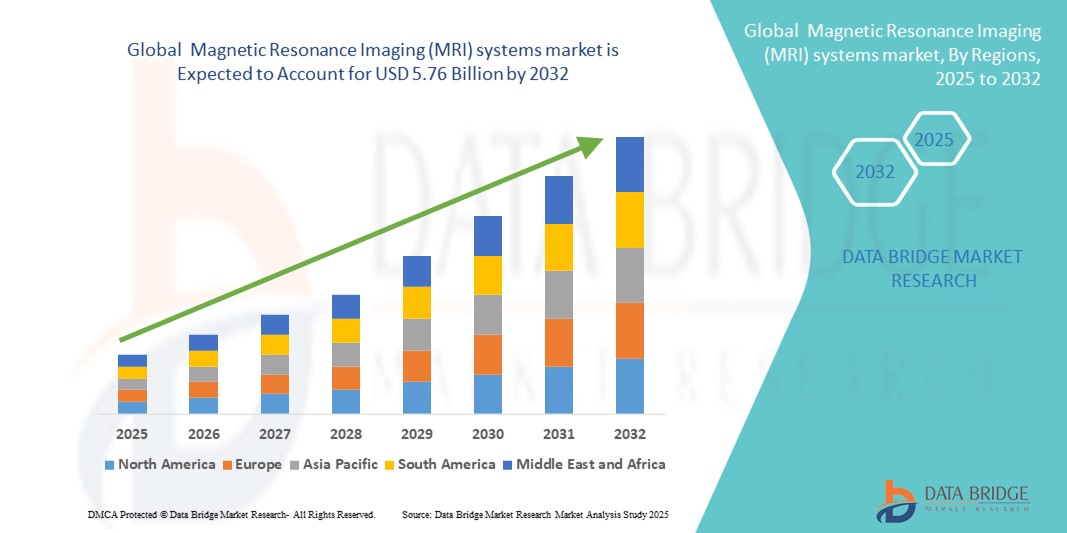
Magnetic Resonance Imaging (MRI) systems market Size
- The global Magnetic Resonance Imaging (MRI) systems market size was valued at USD 4.13 billion in 2024 and is expected to reach USD 5.76 billion by 2032, at a CAGR of 4.25% during the forecast period
- This growth is driven by factors such as the increasing prevalence of chronic diseases, advancements in MRI technology, rising demand for early diagnosis, and expanding healthcare infrastructure worldwide
Magnetic Resonance Imaging (MRI) systems market Analysis
- Magnetic resonance imaging (MRI) is an imaging technology which is used to diagnose the diseases or health concerns in the body
- Magnetic resonance imaging scanners uses electromagnetic radiation to develop images of the body. Its applications are widespread in terms of diagnosis, aftermath of diseases, identification of phase of disease
- North America is expected to dominate the Global Magnetic Resonance Imaging (MRI)s market due to advanced healthcare infrastructure and with a high number of MRI systems per capita
- Asia-Pacific is expected to be the fastest growing region in the magnetic resonance imaging (MRI) systems market during the forecast period due to Increasing geriatric population leading to higher demand for diagnostic imaging
- Closed MRI systems segment is expected to dominate the market with a market share of 76.10% due to its high prevalence and demand for precision. As the leading procedure for vision restoration, advancements in surgical techniques and microscope technologies enhance outcomes
Report Scope and Magnetic Resonance Imaging (MRI) systems market Segmentation
|
Attributes |
Magnetic Resonance Imaging (MRI) systems Key Market Insights |
|
Segments Covered |
|
|
Countries Covered |
North America
Europe
Asia-Pacific
Middle East and Africa
South America
|
|
Key Market Players |
|
|
Market Opportunities |
|
|
Value Added Data Infosets |
In addition to the insights on market scenarios such as market value, growth rate, segmentation, geographical coverage, and major players, the market reports curated by the Data Bridge Market Research also include in-depth expert analysis, patient epidemiology, pipeline analysis, pricing analysis, and regulatory framework. |
Magnetic Resonance Imaging (MRI) systems market Trends
“Integration of Artificial Intelligence (AI) in MRI Systems”
- AI algorithms assist in analyzing complex MRI images, leading to more accurate and timely diagnoses
- For instance, AI-driven tools can detect subtle abnormalities that may be overlooked by human radiologists
- AI integration streamlines the image acquisition and interpretation processes, reducing scan times and increasing throughput in clinical settings
- By analyzing vast datasets, AI can help in tailoring individualized treatment strategies based on MRI findings
- AI models can predict disease progression by analyzing changes in MRI scans over time, aiding in proactive patient management
- The incorporation of AI is expected to drive the MRI systems market, with projections indicating significant growth in the coming years
Magnetic Resonance Imaging (MRI) systems market Dynamics
Driver
“Increasing Prevalence of Chronic Diseases”
- Chronic conditions such as cancer, cardiovascular diseases, and neurological disorders are becoming more prevalent globally, increasing the demand for diagnostic imaging
- The global aging demographic contributes to a higher incidence of age-related chronic diseases, further driving the need for MRI diagnostics
- The growing number of patients with chronic diseases places additional pressure on healthcare systems, highlighting the necessity for advanced diagnostic tools such as MRI.
- Early diagnosis through MRI can lead to better treatment outcomes and reduced healthcare costs in the long term
- The increasing burden of chronic diseases is a significant factor propelling the growth of the MRI systems market
Opportunity
“Expansion in Emerging Markets”
- Emerging economies are investing in healthcare infrastructure, creating opportunities for MRI system adoption
- For Instance, increased spending on healthcare in developing countries facilitates the procurement of advanced diagnostic equipment such as MRI systems
- Improved awareness and accessibility to healthcare services in emerging markets drive the demand for diagnostic imaging
- Supportive government policies and initiatives aimed at enhancing healthcare services contribute to the growth of the MRI market in these regions
- The expansion of healthcare services in emerging markets presents significant growth opportunities for the MRI systems market
Restraint/Challenge
“High Cost and Limited Accessibility”
- The high cost of MRI systems makes them unaffordable for many healthcare facilities, particularly in low-resource settings
- Maintenance, operational expenses, and the need for specialized personnel add to the overall cost of MRI services
- For Instance, in many regions, especially rural and underserved areas, access to MRI facilities is limited, affecting timely diagnosis and treatment
- Inadequate insurance coverage and reimbursement policies can deter healthcare providers from investing in MRI technology
- These challenges hinder the widespread adoption of MRI systems, particularly in developing countries, affecting market growth
Magnetic Resonance Imaging (MRI) systems market Scope
The market is segmented on the basis of application, field strength, and architecture.
|
Segmentation |
Sub-Segmentation |
|
By Application |
|
|
By Field Strength |
|
|
By Architecture |
|
In 2025, the cataract surgery is projected to dominate the market with a largest share in architecture segment
The closed MRI system segment is expected to dominate the magnetic resonance imaging (MRI) systems market with the largest share of 76.10% in 2025 due to its high prevalence and demand for precision. As the leading procedure for vision restoration, advancements in surgical techniques and microscope technologies enhance outcomes.
The neurology is expected to account for the largest share during the forecast period in application market
In 2025, the neurology segment is expected to dominate the market with the largest market share due to its rising prevalence of neurological disorders such as Alzheimer's, Parkinson's, and multiple sclerosis. The ability of MRI to provide detailed, non-invasive imaging of the brain and spinal cord makes it an essential tool for diagnosing and monitoring these conditions.
Magnetic Resonance Imaging (MRI) systems market Regional Analysis
“North America Holds the Largest Share in the Magnetic Resonance Imaging (MRI) systems market”
- North America magnetic resonance imaging market dominated the market with the largest revenue share of 37.1%
- U.S. Is expected to dominate the global magnetic resonance imaging (MRI) systems market, particularly in the North America region. This dominance is attributed to its presence of leading MRI system manufacturers and research institutions
- High prevalence of chronic diseases such as breast cancer, cardiovascular disorders, and neurological conditions. Advanced healthcare infrastructure with a high number of MRI systems per capita.
- Significant healthcare expenditure and favorable reimbursement policies. Presence of leading MRI system manufacturers and research institutions.
- Integration of artificial intelligence (AI) and big data analytics in MRI systems.
- Development of high-field MRI systems offering superior image quality. Introduction of portable and open MRI systems catering to diverse patient needs.
- Continued dominance expected due to ongoing investments in healthcare infrastructure and technological innovations.
“Asia-Pacific is Projected to Register the Highest CAGR in the Magnetic Resonance Imaging (MRI) systems market”
- Increasing geriatric population leading to higher demand for diagnostic imaging. Rising prevalence of chronic diseases such as cancer and cardiovascular disorders.
- Government initiatives to enhance healthcare infrastructure and accessibility. Expansion of medical tourism, particularly in countries such as India and Thailand.
- Adoption of advanced MRI technologies, including high-field and open MRI systems. Implementation of AI-driven diagnostic tools to improve imaging accuracy.
- Growth in private healthcare facilities equipped with state-of-the-art MRI systems Rapid expansion anticipated due to favorable demographic trends and increasing healthcare investments.
Magnetic Resonance Imaging (MRI) systems market Share
The market competitive landscape provides details by competitor. Details included are company overview, company financials, revenue generated, market potential, investment in research and development, new market initiatives, global presence, production sites and facilities, production capacities, company strengths and weaknesses, product launch, product width and breadth, application dominance. The above data points provided are only related to the companies' focus related to market.
The Major Market Leaders Operating in the Market Are:
- Siemens Healthcare Private Limited(Germany)
- GENERAL ELECTRIC(U.S.)
- Koninklijke Philips N.V.(Netherlands)
- Hitachi Ltd. (Japan)
- CANON MEDICAL SYSTEMS CORPORATION(Japan)
- Aspect Imaging (U.S.)
- Bruker (U.S.)
- Aurora Health Care (U.S.)
- Esaote SpA (Italy)
- FONAR (U.S.)
- Neusoft Corporation (China)
- Shenzhen Mindray Bio-Medical Electronics Co. Ltd. (China)
- Shimadzu Corporation (Japan)
- Carestream Health (U.S.)
- Hologic Inc. (U.S.)
- Barco (Belgium)
- Nordion Inc (Canada)
Latest Developments in Global Magnetic Resonance Imaging (MRI) systems Market
- In March 2025, Polarean Imaging plc expanded its Xenon MRI imaging platform to support pharma-sponsored research. This expansion, in partnership with VIDA Diagnostics, included the introduction of a new service model to enable the use of the device in enhanced research applications
- In November 2023, GE Healthcare collaborated with The University of Wisconsin School of Medicine and Public Health at UW–Madison to expand the existing scope beyond medical imaging to the introduction of new digital technologies and disease-focused solutions
- In October 2023, Siemens Healthineers and Cardiff University formed a strategic partnership to advance medical technologies, building on their decade-long collaboration in diagnostics. The partnership focuses on imaging research and precision diagnostics, with Cardiff’s Brain Research Imaging Centre (CUBRIC) driving innovation in MR technology and brain mapping
- In June 2023, Imagion Biosystems Limited expanded its collaboration with Siemens Healthineers, extending its existing agreement with Siemens Healthcare Pty Ltd in Australia for 2 more years. The partnership now includes collaboration in the U.S. through Siemens Medical Solutions USA
- In April 2023, Siemens Healthineers expanded its manufacturing presence in India by launching an MRI facility in Bengaluru, supported by the Government of India’s PLI scheme. The company has also introduced a new production line at the Bengaluru facility for manufacturing MRI machines
- In November 2022, Siemens Healthineers (Germany) launched a new MRI system for mobile use. The Magnetom Viato.Mobile system is equipped with latest advancements and can be used anywhere.
SKU-
Obtenha acesso online ao relatório sobre a primeira nuvem de inteligência de mercado do mundo

- Painel interativo de análise de dados
- Painel de análise da empresa para oportunidades de elevado potencial de crescimento
- Acesso de analista de pesquisa para personalização e customização. consultas
- Análise da concorrência com painel interativo
- Últimas notícias, atualizações e atualizações Análise de tendências
- Aproveite o poder da análise de benchmark para um rastreio abrangente da concorrência
Metodologia de Investigação
A recolha de dados e a análise do ano base são feitas através de módulos de recolha de dados com amostras grandes. A etapa inclui a obtenção de informações de mercado ou dados relacionados através de diversas fontes e estratégias. Inclui examinar e planear antecipadamente todos os dados adquiridos no passado. Da mesma forma, envolve o exame de inconsistências de informação observadas em diferentes fontes de informação. Os dados de mercado são analisados e estimados utilizando modelos estatísticos e coerentes de mercado. Além disso, a análise da quota de mercado e a análise das principais tendências são os principais fatores de sucesso no relatório de mercado. Para saber mais, solicite uma chamada de analista ou abra a sua consulta.
A principal metodologia de investigação utilizada pela equipa de investigação do DBMR é a triangulação de dados que envolve a mineração de dados, a análise do impacto das variáveis de dados no mercado e a validação primária (especialista do setor). Os modelos de dados incluem grelha de posicionamento de fornecedores, análise da linha de tempo do mercado, visão geral e guia de mercado, grelha de posicionamento da empresa, análise de patentes, análise de preços, análise da quota de mercado da empresa, normas de medição, análise global versus regional e de participação dos fornecedores. Para saber mais sobre a metodologia de investigação, faça uma consulta para falar com os nossos especialistas do setor.
Personalização disponível
A Data Bridge Market Research é líder em investigação formativa avançada. Orgulhamo-nos de servir os nossos clientes novos e existentes com dados e análises que correspondem e atendem aos seus objetivos. O relatório pode ser personalizado para incluir análise de tendências de preços de marcas-alvo, compreensão do mercado para países adicionais (solicite a lista de países), dados de resultados de ensaios clínicos, revisão de literatura, mercado remodelado e análise de base de produtos . A análise de mercado dos concorrentes-alvo pode ser analisada desde análises baseadas em tecnologia até estratégias de carteira de mercado. Podemos adicionar quantos concorrentes necessitar de dados no formato e estilo de dados que procura. A nossa equipa de analistas também pode fornecer dados em tabelas dinâmicas de ficheiros Excel em bruto (livro de factos) ou pode ajudá-lo a criar apresentações a partir dos conjuntos de dados disponíveis no relatório.











