



Global Nanobots Market, By Type (Microbivore Nanorobots, Respirocyte Nanorobots, Clottocyte Nanorobots, Cellular Repair Nanorobots), Application (Nano Medicine, Biomedical, Mechanical, Others) – Industry Trends and Forecast to 2029
Market Analysis and Size
In order to diagnose or treat a patient on a cellular level, nanobots are injected into the patient. The diagnosis or treatment takes place at the nanoscale, molecular, or atomic level. Modifications to the structure and content at the molecular or submolecular level may be part of treatments using nanorobots. Nanorobots' many uses take advantage of the special characteristics of materials and equipment with nanoscale dimensions. For instance, scores of firms tried to break into this brand-new industry in 2019.
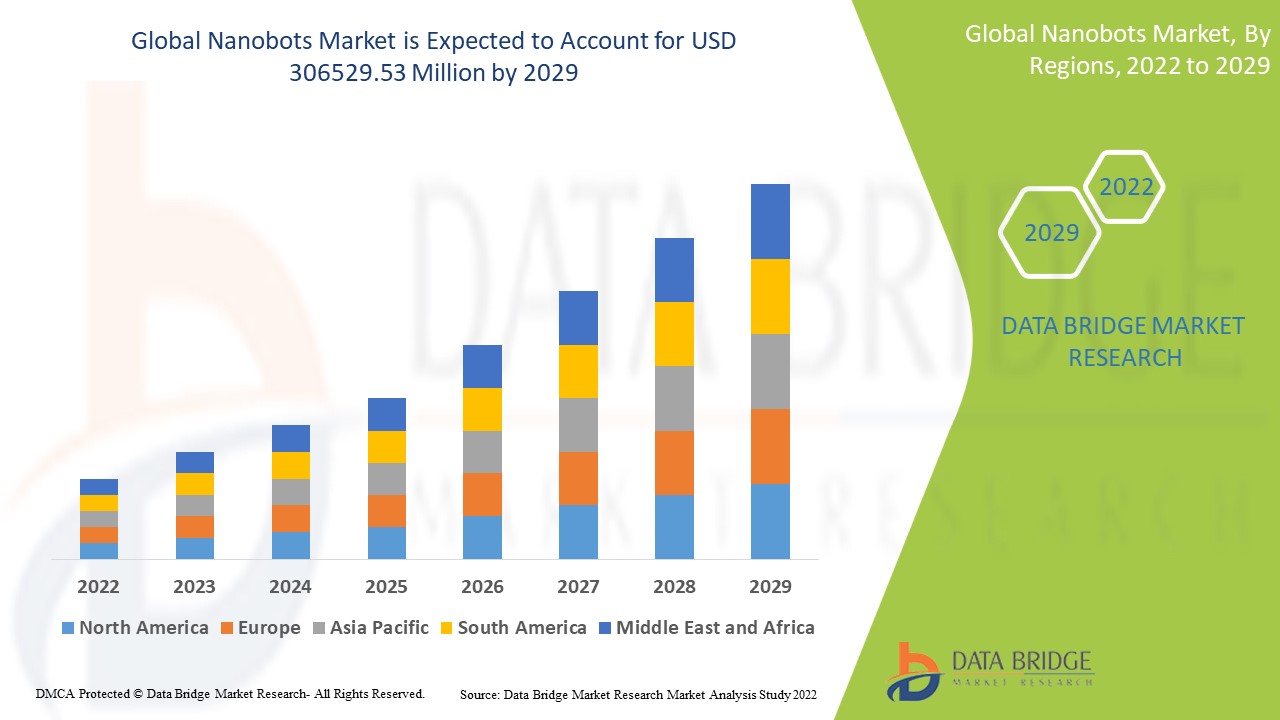
Data Bridge Market Research analyses that the nanobots market which was USD 124690 billion in 2021, would rocket up to USD 306529.53 million by 2029, and is expected to undergo a CAGR of 11.90% during the forecast period 2022 to 2029. In addition to the market insights such as market value, growth rate, market segments, geographical coverage, market players, and market scenario, the market report curated by the Data Bridge Market Research team also includes in-depth expert analysis, patient epidemiology, pipeline analysis, pricing analysis, and regulatory framework.
Report Scope and Market Segmentation
|
Report Metric |
Details |
|
Forecast Period |
2022 to 2029 |
|
Base Year |
2021 |
|
Historic Years |
2020 (Customizable to 2014 - 2019) |
|
Quantitative Units |
Revenue in USD Million, Volumes in Units, Pricing in USD |
|
Segments Covered |
Type (Microbivore Nanorobots, Respirocyte Nanorobots, Clottocyte Nanorobots, Cellular Repair Nanorobots), By Application (Nano Medicine, Biomedical, Mechanical, Others) |
|
Countries Covered |
U.S., Canada and Mexico in North America, Germany, France, U.K., Netherlands, Switzerland, Belgium, Russia, Italy, Spain, Turkey, Rest of Europe in Europe, China, Japan, India, South Korea, Singapore, Malaysia, Australia, Thailand, Indonesia, Philippines, Rest of Asia-Pacific (APAC) in the Asia-Pacific (APAC), Saudi Arabia, U.A.E, South Africa, Egypt, Israel, Rest of Middle East and Africa (MEA) as a part of Middle East and Africa (MEA), Brazil, Argentina and Rest of South America as part of South America. |
|
Market Players Covered |
Bruker (U.S.), JEOL Ltd. (Japan), Thermo Fisher Scientific Inc. (U.S.), Ginkgo Bioworks (U.S.), Oxford Instruments (U.K.), EV Group (Austria), Imina Technologies SA (Switzerland), Toronto Nano Instrumentation Inc. (Canada), Klocke Nanotechnik (Germany), Xidex (U.S.), Synthace (U.K.), Park Systems (South Korea), SmarAct GmbH (Germany), Nanonics Imaging (Israel), Novascan Technologies Inc. (U.S.), Angstrom Advanced Inc. (U.S.) |
|
Market Opportunities |
|
Market Definition
Nanobots could prove useful in the field of defence as well. Nano-scale legged robots were the subject of a project financed by the US Army Research Office and Air Force Office of Scientific Research. These tiny machines have the ability to move when powered by lasers, which is useful in combat. The necessity to update technologies used for national security has arisen as a result of the rise in militant activity. Governments are known to support and promote the development of nanotechnology all around the world.
Nanobots Market Dynamics
Drivers
- Technological developments
Nanobots are beginning to accomplish minute tasks, such as positioning tiny electrical components and delivering medications to cancer cells on a targeted basis. These developments are seen to be supporting the popularity of nanobots According to the MRFR analysis, these factors are the reason for nanobots market growth.
- Increase in research and development activities
The market may profit from advancements in technology, the healthcare sector, and the market's enormous development potential. An increase in the market may also result from the establishment of several small and medium-sized businesses with private and public grants for research activities. The market expansion may also be aided by the rising output of industrial robotics, the increased acceptance of automation systems, and the accessibility of considerable resources.
- Increased in government investments
The government's increased investment in and support of nanorobotics, the development of molecular robots, the expanding emphasis on regenerative medicine and nanotechnology, and the expansion of cancer research are all factors driving the growth of the nanobots market. Growth is anticipated to be driven by technological developments and expanding research into cancer treatments throughout the forecast period.
Opportunities
Innovations in the field of genome mining brought forth by in-depth study by select businesses may support market expansion. In the coming years, the market may profit from acquisitions, the creation of platforms for the study of next-generation antibiotics, and expanding knowledge of the advantages of technologies like sequencing, synthetic biology, bioinformatics, and others. Additionally, the market expansion in the near future may be supported by players' increasing attention to natural product diversification and discovery for production purposes.
Restraints/Challenges
- High costs
High development costs, rigorous regulations governing the creation and usage of nanobots, and limitations on the integration of nanobots with medical equipment are some factors that are predicted to restrain the growth of this market.
This nanobots market report provides details of new recent developments, trade regulations, import-export analysis, production analysis, value chain optimization, market share, impact of domestic and localized market players, analyses opportunities in terms of emerging revenue pockets, changes in market regulations, strategic market growth analysis, market size, category market growths, application niches and dominance, product approvals, product launches, geographic expansions, technological innovations in the market. To gain more info on the nanobots market contact Data Bridge Market Research for an Analyst Brief, our team will help you take an informed market decision to achieve market growth.
COVID-19 Impact on Nanobots Market
Since the coronavirus outbreak started in late 2019, scientists have been scrambling to learn more about SARS-CoV-2, a strain from the coronavirus family named for their crown-like structure. The idea of using nanoparticles similar to the virus that causes COVID-19 which could attach to SARS-CoV-2 viruses and disrupt their structure with a combination of infrared light treatment is being put forth by a number of researchers. If the practise is successful, the market is anticipated to increase.
Recent Development
- In June 2019, EV Group introduced a fully integrated track system for wafers up to 300 millimetres in diameter that combines cleaning, resist coating, and baking pre-processing stages with the company's exclusive SmartNIL wafer-level nanoimprint lithography process on a single platform.
Global Nanobots Market Scope
The nanobots market is segmented on the basis of product type, application. The growth amongst these segments will help you analyze meagre growth segments in the industries and provide the users with a valuable market overview and market insights to help them make strategic decisions for identifying core market applications.
Type
- Microbivore Nanorobots
- Respirocyte Nanorobots
- Clottocyte Nanorobots
- Cellular Repair Nanorobots
Application
- Nano Medicine
- Biomedical
- Mechanical
- Others
Nanobots Market Regional Analysis/Insights
The nanobots market is analysed and market size insights and trends are provided by country, product type, application as referenced above.
The countries covered in the nanobots market report are U.S., Canada and Mexico in North America, Germany, France, U.K., Netherlands, Switzerland, Belgium, Russia, Italy, Spain, Turkey, Rest of Europe in Europe, China, Japan, India, South Korea, Singapore, Malaysia, Australia, Thailand, Indonesia, Philippines, Rest of Asia-Pacific (APAC) in the Asia-Pacific (APAC), Saudi Arabia, U.A.E, South Africa, Egypt, Israel, Rest of Middle East and Africa (MEA) as a part of Middle East and Africa (MEA), Brazil, Argentina and Rest of South America as part of South America.
North America dominates the nanobots market due to the high expenditure on healthcare, is expected to impact the market in the region positively.
Asia-Pacific is expected to grow during forecast period of 2022 to 2029 due to increasing investments in R&D by the major players, healthcare infrastructure improvement and patient base.
The country section of the report also provides individual market impacting factors and changes in regulation in the market domestically that impacts the current and future trends of the market. Data points like down-stream and upstream value chain analysis, technical trends and porter's five forces analysis, case studies are some of the pointers used to forecast the market scenario for individual countries. Also, the presence and availability of global brands and their challenges faced due to large or scarce competition from local and domestic brands, impact of domestic tariffs and trade routes are considered while providing forecast analysis of the country data.
Competitive Landscape and Nanobots Market Share Analysis
The nanobots market competitive landscape provides details by competitor. Details included are company overview, company financials, revenue generated, market potential, investment in research and development, new market initiatives, global presence, production sites and facilities, production capacities, company strengths and weaknesses, product launch, product width and breadth, application dominance. The above data points provided are only related to the companies' focus related to nanobots market.
Some of the major players operating in the nanobots market are:
- Bruker (U.S.)
- JEOL Ltd. (Japan)
- Thermo Fisher Scientific Inc. (U.S.)
- Ginkgo Bioworks (U.S.)
- Oxford Instruments (U.K.)
- EV Group (Austria)
- Imina Technologies SA (Switzerland)
- Toronto Nano Instrumentation Inc. (Canada)
- Klocke Nanotechnik (Germany)
- Xidex (U.S.)
- Synthace (U.K.)
- Park Systems (South Korea)
- SmarAct GmbH (Germany)
- Nanonics Imaging (Israel)
- Novascan Technologies Inc. (U.S.)
- Angstrom Advanced Inc.(U.S.)
SKU-
Obtenha acesso online ao relatório sobre a primeira nuvem de inteligência de mercado do mundo

- Painel interativo de análise de dados
- Painel de análise da empresa para oportunidades de elevado potencial de crescimento
- Acesso de analista de pesquisa para personalização e customização. consultas
- Análise da concorrência com painel interativo
- Últimas notícias, atualizações e atualizações Análise de tendências
- Aproveite o poder da análise de benchmark para um rastreio abrangente da concorrência
Metodologia de Investigação
A recolha de dados e a análise do ano base são feitas através de módulos de recolha de dados com amostras grandes. A etapa inclui a obtenção de informações de mercado ou dados relacionados através de diversas fontes e estratégias. Inclui examinar e planear antecipadamente todos os dados adquiridos no passado. Da mesma forma, envolve o exame de inconsistências de informação observadas em diferentes fontes de informação. Os dados de mercado são analisados e estimados utilizando modelos estatísticos e coerentes de mercado. Além disso, a análise da quota de mercado e a análise das principais tendências são os principais fatores de sucesso no relatório de mercado. Para saber mais, solicite uma chamada de analista ou abra a sua consulta.
A principal metodologia de investigação utilizada pela equipa de investigação do DBMR é a triangulação de dados que envolve a mineração de dados, a análise do impacto das variáveis de dados no mercado e a validação primária (especialista do setor). Os modelos de dados incluem grelha de posicionamento de fornecedores, análise da linha de tempo do mercado, visão geral e guia de mercado, grelha de posicionamento da empresa, análise de patentes, análise de preços, análise da quota de mercado da empresa, normas de medição, análise global versus regional e de participação dos fornecedores. Para saber mais sobre a metodologia de investigação, faça uma consulta para falar com os nossos especialistas do setor.
Personalização disponível
A Data Bridge Market Research é líder em investigação formativa avançada. Orgulhamo-nos de servir os nossos clientes novos e existentes com dados e análises que correspondem e atendem aos seus objetivos. O relatório pode ser personalizado para incluir análise de tendências de preços de marcas-alvo, compreensão do mercado para países adicionais (solicite a lista de países), dados de resultados de ensaios clínicos, revisão de literatura, mercado remodelado e análise de base de produtos . A análise de mercado dos concorrentes-alvo pode ser analisada desde análises baseadas em tecnologia até estratégias de carteira de mercado. Podemos adicionar quantos concorrentes necessitar de dados no formato e estilo de dados que procura. A nossa equipa de analistas também pode fornecer dados em tabelas dinâmicas de ficheiros Excel em bruto (livro de factos) ou pode ajudá-lo a criar apresentações a partir dos conjuntos de dados disponíveis no relatório.











