


Global Organic Electronics Market Segmentation, By Material (Semiconductor Materials, Conductive Materials, Dielectric Materials, and Substrate Materials), Component Type (Active and Passive Components), Application (Display Application, OLED Lighting Application, Organic Photovoltaic Application, System Components Application, and Other Organic Electronics Applications)-Industry Trends and Forecast to 2032
Organic Electronics Market Analysis
The organic electronics market's entire value chain is tightly related to the traditional silicon electronics value chain, and it has been rapidly expanding and forming into a robust, well-connected chain over the last few years. Because of the application potential of organic electronics in numerous applications, several new product developments and models have emerged.
Organic Electronics Market Size
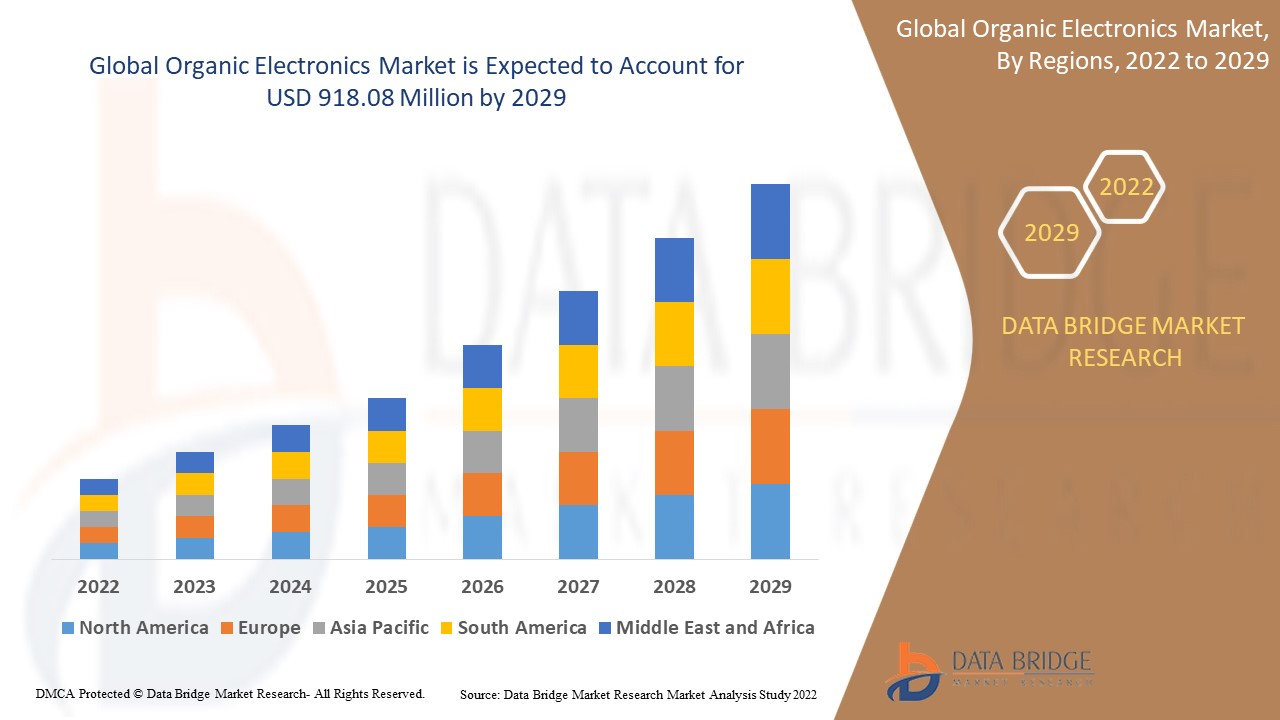
Global organic electronics market size was valued at USD 346.80 million in 2024 and is projected to reach USD 1646.96 million by 2032, with a CAGR of 21.5% during the forecast period of 2025 to 2032.
Report Scope and Market Segmentation
|
Attributes |
Organic Electronics Key Market Insights |
|
Segmentation |
|
|
Countries Covered |
U.S., Canada and Mexico in North America, Germany, France, U.K., Netherlands, Switzerland, Belgium, Russia, Italy, Spain, Turkey, Rest of Europe in Europe, China, Japan, India, South Korea, Singapore, Malaysia, Australia, Thailand, Indonesia, Philippines, Rest of Asia-Pacific (APAC) in the Asia-Pacific (APAC), Saudi Arabia, U.A.E, South Africa, Egypt, Israel, Rest of Middle East and Africa (MEA) as a part of Middle East and Africa (MEA), Brazil, Argentina and Rest of South America as part of South America |
|
Key Market Players |
FUJIFILM Holdings Corporation (Japan), Bayer AG (Germany), H.C. Starck GmbH (Germany), AGC SEIMI CHEMICAL CO., LTD. (Japan), BASF SE (Germany), DuPont (US), Merck & Co., Inc. (US), Evonik Industries AG (Germany), Sumitomo Chemical Co., Ltd. (Japan), Heliatek GmbH (Germany), Novaled GmbH. (Germany), AU Optronics Corp., (Taiwan), Graphic Packaging International, LLC (US), WestRock Company. (US), Smurfit Kappa (Irenland) and Krones AG (Germany), Amcor plc (Switzerland), Graham Packaging Company. (US), Sonoco Products Company (US), Parker Hannifin Corp. (US) and Berry Global Inc. (US) |
Organic Electronics Market Definition
Organic electronics differ from inorganic semiconductors in several ways. Organic electronic materials are created using artificial technologies developed in the field of organic and polymer chemistry and organic (carbon-based) polymers or molecules. For construction, organic electronics use a variety of materials such as semiconductors, conductive materials, dielectrics, and substrates. These are also employed in a variety of applications such as displays, lights, batteries, conductive ink, and so on.
Organic Electronics Market Dynamics
Drivers:
- Rapidly increasing consumer electronics industry transforms.
Due to low resource use and simple manufacturing processes, organic electronic devices have the potential to become a low-cost alternative to typical inorganic electronic applications.
- Enhanced performance and sustainable technology.
Rise in the scientific and technological revolution and growing adoption of technologies supporting sustainable development is one of the contributing factors.
- Advancing functionalities and applications.
The demand for organic films in display panels is increasing due to their improved performance in terms of colour, brightness, contrast, and refresh rates. Organic electronics are widely used in modern lighting and display technologies.
Opportunities
In addition, the increase in the research and development activities for several applications will further provide potential opportunities for the growth of the organic electronics market in the coming years.
Restrains/Challenges
On the other hand, the decrease in the efficiency of organic electronics after a period of time is further projected to impede the growth of the organic electronics market in the coming years. However, the technical in-compatibility might further challenge the growth of the organic electronics market in the near future.
This organic electronics market report provides details of new recent developments, trade regulations, import-export analysis, production analysis, value chain optimization, market share, impact of domestic and localized market players, analyses opportunities in terms of emerging revenue pockets, changes in market regulations, strategic market growth analysis, market size, category market growths, application niches and dominance, product approvals, product launches, geographic expansions, technological innovations in the market. To gain more info on the organic electronics market contact Data Bridge Market Research for an Analyst Brief, our team will help you take an informed market decision to achieve market growth.
Organic Electronics Market Scope
The organic electronics market is segmented on the basis of material, component type and application. The growth amongst these segments will help you analyze meagre growth segments in the industries and provide the users with a valuable market overview and market insights to help them make strategic decisions for identifying core market applications.
Material
- Semiconductor Materials
- Conductive Materials
- Dielectric Materials
- Substrate Materials
Component Type
- Active Components
- Passive Components
Application
- Display Application
- OLED Lighting Application
- Organic Photovoltaic Application
- System Components Application
- Other Organic Electronics Applications
Organic Electronics Market Regional Analysis
The organic electronics market is analysed and market size insights and trends are provided by country, material, component type and application as referenced above.
The countries covered in the organic electronics market report are U.S., Canada and Mexico in North America, Germany, France, U.K., Netherlands, Switzerland, Belgium, Russia, Italy, Spain, Turkey, Rest of Europe in Europe, China, Japan, India, South Korea, Singapore, Malaysia, Australia, Thailand, Indonesia, Philippines, Rest of Asia-Pacific (APAC) in the Asia-Pacific (APAC), Saudi Arabia, U.A.E, South Africa, Egypt, Israel, Rest of Middle East and Africa (MEA) as a part of Middle East and Africa (MEA), Brazil, Argentina and Rest of South America as part of South America.
North America dominates the organic electronics market due to the rise in the purchasing power. Furthermore, the growing technological development will further boost the growth of the organic electronics market in the region during the forecast period. Asia-Pacific is projected to observe significant amount of growth in the organic electronics market due to the rise in the disposable income among individuals. Moreover, the increasing demand for premium electronic devices and occurrence of major semiconductor and organic electronic manufacturers is further anticipated to propel the growth of the organic electronics market in the region in the coming years.
The country section of the report also provides individual market impacting factors and changes in market regulation that impact the current and future trends of the market. Data points like down-stream and upstream value chain analysis, technical trends and porter's five forces analysis, case studies are some of the pointers used to forecast the market scenario for individual countries. Also, the presence and availability of global brands and their challenges faced due to large or scarce competition from local and domestic brands, impact of domestic tariffs and trade routes are considered while providing forecast analysis of the country data.
Organic Electronics Market Share
The organic electronics market competitive landscape provides details by competitor. Details included are company overview, company financials, revenue generated, market potential, investment in research and development, new market initiatives, global presence, production sites and facilities, production capacities, company strengths and weaknesses, product launch, product width and breadth, application dominance. The above data points provided are only related to the companies' focus related to organic electronics market.
Organic Electronics Market Leaders Operating in the Market Are:
- FUJIFILM Holdings Corporation (Japan)
- Bayer AG (Germany)
- H.C. Starck GmbH (Germany)
- AGC SEIMI CHEMICAL CO., LTD. (Japan)
- BASF SE (Germany)
- DuPont (US)
- Merck & Co., Inc. (US)
- Evonik Industries AG (Germany)
- Sumitomo Chemical Co., Ltd. (Japan)
- Heliatek GmbH (Germany)
- Novaled GmbH. (Germany)
- AU Optronics Corp., (Taiwan)
- Graphic Packaging International, LLC (US)
- WestRock Company. (US)
- Smurfit Kappa (Irenland)
- Krones AG (Germany)
- Amcor plc (Switzerland)
- Graham Packaging Company. (US)
- Sonoco Products Company (US)
- Parker Hannifin Corp. (US)
- Berry Global Inc. (US)
Latest Developments in Organic Electronics Market
- Bayer completed the purchase of Monsanto India in June, 2018. The $63 billion acquisition was a mega-deal that resulted in the creation of the world's largest chemical and seed firm.
SKU-
Obtenha acesso online ao relatório sobre a primeira nuvem de inteligência de mercado do mundo

- Painel interativo de análise de dados
- Painel de análise da empresa para oportunidades de elevado potencial de crescimento
- Acesso de analista de pesquisa para personalização e customização. consultas
- Análise da concorrência com painel interativo
- Últimas notícias, atualizações e atualizações Análise de tendências
- Aproveite o poder da análise de benchmark para um rastreio abrangente da concorrência
Metodologia de Investigação
A recolha de dados e a análise do ano base são feitas através de módulos de recolha de dados com amostras grandes. A etapa inclui a obtenção de informações de mercado ou dados relacionados através de diversas fontes e estratégias. Inclui examinar e planear antecipadamente todos os dados adquiridos no passado. Da mesma forma, envolve o exame de inconsistências de informação observadas em diferentes fontes de informação. Os dados de mercado são analisados e estimados utilizando modelos estatísticos e coerentes de mercado. Além disso, a análise da quota de mercado e a análise das principais tendências são os principais fatores de sucesso no relatório de mercado. Para saber mais, solicite uma chamada de analista ou abra a sua consulta.
A principal metodologia de investigação utilizada pela equipa de investigação do DBMR é a triangulação de dados que envolve a mineração de dados, a análise do impacto das variáveis de dados no mercado e a validação primária (especialista do setor). Os modelos de dados incluem grelha de posicionamento de fornecedores, análise da linha de tempo do mercado, visão geral e guia de mercado, grelha de posicionamento da empresa, análise de patentes, análise de preços, análise da quota de mercado da empresa, normas de medição, análise global versus regional e de participação dos fornecedores. Para saber mais sobre a metodologia de investigação, faça uma consulta para falar com os nossos especialistas do setor.
Personalização disponível
A Data Bridge Market Research é líder em investigação formativa avançada. Orgulhamo-nos de servir os nossos clientes novos e existentes com dados e análises que correspondem e atendem aos seus objetivos. O relatório pode ser personalizado para incluir análise de tendências de preços de marcas-alvo, compreensão do mercado para países adicionais (solicite a lista de países), dados de resultados de ensaios clínicos, revisão de literatura, mercado remodelado e análise de base de produtos . A análise de mercado dos concorrentes-alvo pode ser analisada desde análises baseadas em tecnologia até estratégias de carteira de mercado. Podemos adicionar quantos concorrentes necessitar de dados no formato e estilo de dados que procura. A nossa equipa de analistas também pode fornecer dados em tabelas dinâmicas de ficheiros Excel em bruto (livro de factos) ou pode ajudá-lo a criar apresentações a partir dos conjuntos de dados disponíveis no relatório.











