Global Repetitive Strain Injury (RSI) Market, By Type (Carpal Tunnel Syndrome, Bursitis, Tennis Elbow, Others), Treatment (Medication, Physiotherapy, Steroid Injections, Surgery, Others), End-Users (Hospitals, Specialty Clinics, Homecare, Others), Distribution Channel (Hospital Pharmacy, Retail Pharmacy, Online Pharmacy, Others) – Industry Trends and Forecast to 2030.
Análise e tamanho do mercado de tratamento de Lesão por Estresse Repetitiva (RSI)
A procura crescente de tratamento de lesões por esforço repetitivo (IRS) tem crescido em grande medida devido à incidência crescente de lesões por esforço repetitivo (IRS), o que irá impulsionar o crescimento do mercado. Além disso, a crescente sensibilização e o aumento da I&D criarão novas oportunidades no mercado. No entanto, o aumento do custo das cirurgias impedirá o crescimento do mercado.
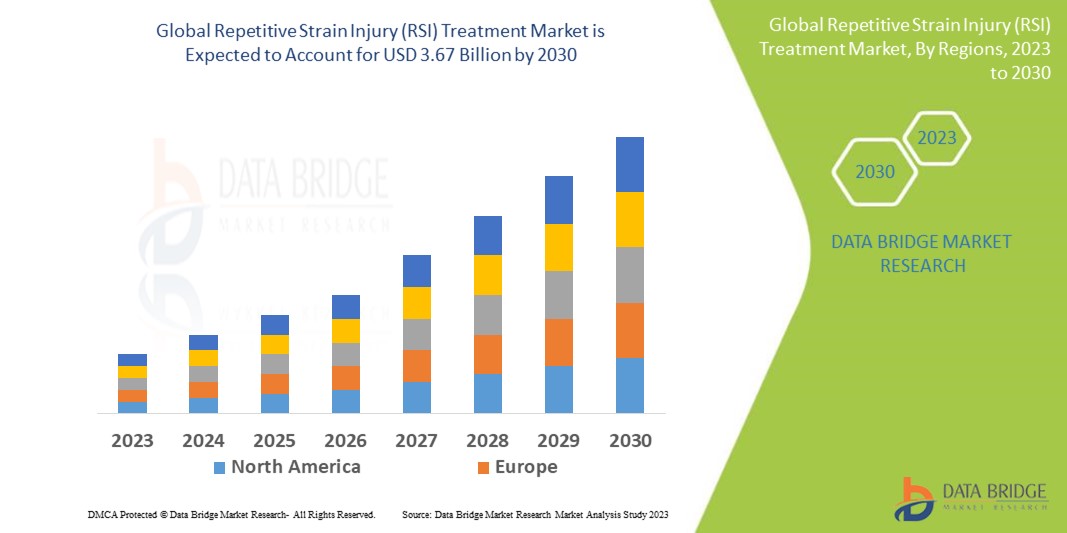
Data Bridge Market Research analisa uma taxa de crescimento no mercado de lesões por esforço repetitivo (IRS) no período de previsão 2023-2030. O CAGR esperado de lesão por esforço repetitivo (RSI) é tendencialmente cerca de 7,90% no período de previsão mencionado. O mercado foi avaliado em USD 2 bilhões em 2022, e cresceria até USD 3,67 bilhões em 2030. Além dos insights de mercado, como valor de mercado, taxa de crescimento, segmentos de mercado, cobertura geográfica, atores de mercado e cenário de mercado, o relatório de mercado curado pela equipe de Pesquisa do Mercado Data Bridge também inclui análise de especialistas em profundidade, epidemiologia do paciente, análise de pipeline, análise de preços e marco regulatório.
Âmbito do mercado de tratamento e segmentação
|
Metric de Relatório |
Detalhes |
|
Período de previsão |
2023 a 2030 |
|
Ano de base |
2022 |
|
Anos Históricos |
2021 (Personalizável até 2015 - 2020) |
|
Unidades quantitativas |
Receitas em USD Billion, Volumes em Unidades, Preços em USD |
|
Segmentos Cobertos |
Tipo (Síndrome do Túnel Carpal, Bursite, Cotovelo de Tênis, Outros), Tratamento (Medicação, Fisioterapia, Injeções Esteroides, Cirurgia, Outros), Usuários finais (Hospitais, Clínicas Especiais, Homecare, Outros), Canal de Distribuição ( Farmácia Hospitalar, Farmácia Varejista, Farmácia Online, Outros) |
|
Países abrangidos |
EUA, Canadá e México na América do Norte, Alemanha, França, Reino Unido, Holanda, Suíça, Bélgica, Rússia, Itália, Espanha, Turquia, Resto da Europa na Europa, China, Japão, Índia, Coreia do Sul, Singapura, Malásia, Austrália, Tailândia, Indonésia, Filipinas, Resto da Ásia-Pacífico (APAC) na Ásia-Pacífico (APAC), Arábia Saudita, EUA, África do Sul, Egito, Israel, Resto do Oriente Médio e África (MEA) como parte do Oriente Médio e África (MEA), Brasil, Argentina e Resto da América do Sul como parte da América do Sul |
|
Jogadores de mercado cobertos |
Zimmer Biomet (EUA), Neuren Pharmaceuticals (Austrália), Teva Pharmaceutical Industries Ltd (Irlanda), Stemedica Cell Technologies, Inc. (EUA), bioMérieux Inc (EUA), QuesGen Systems, Inc (EUA), Oculogica (EUA), VASOFARM (Alemanha) |
|
Oportunidades de Mercado |
|
Definição do mercado
A lesão por strain repetitive (RSI) ocorre devido ao movimento excessivo, postura pobre e uso excessivo de fibras musculares. Esta condição afeta principalmente a parte superior do corpo, tais como ombros, costas, antebraços, pescoço, outros. Os possíveis sintomas incluem formigueiro, fraqueza, dormência e outros. A maioria das pessoas com lesão por esforço repetitivo (RSI) pode gerenciar seus sintomas e melhorar sem tratamento adicional.
Dinâmica de Tratamento de Lesões por Estresse Repetitiva (RSI)
Controladores
- Disponibilidade de diferentes métodos de tratamento
A ampla disponibilidade de vários métodos de tratamento está a impulsionar o crescimento do mercado. Métodos de tratamento tais como analgésicos anti-inflamatórios, tais como aspirina ou ibuprofeno, relaxantes musculares, eantidepressivos, talas, terapia térmica, fisioterapia, tais como exercícios, terapia manual, braçadeira ou splinting, injeção de esteróides e cirurgia ajudar no tratamento mais rápido dos pacientes.
Oportunidades
- Incidência crescente de bursite
Todos os anos, pelo menos 1 em cada 10.000 pessoas sofre de bursite nos joelhos ou cotovelos sozinho. Um terço destas inflamações são causadas devido a qualquer infecção bacteriana. Homens de meia-idade são mais afetados. A prevalência de bursite é maior nos atletas, atingindo níveis até 10% nos corredores. Além disso, ocorre frequentemente bursite pré-atelar, com pelo menos uma incidência anual de 10/100 000. Assim, isso impulsiona o crescimento do mercado.
Restrições/Desafios
- Procedimentos de tratamento de alto custo
O aumento do custo dos processos de tratamento, como cirurgia, diferentes tipos de terapia, aconselhamento genético, injeções de esteróides e muito mais, dificulta o crescimento do mercado.
- Falta de profissionais qualificados
Existem vários profissionais que não conseguem lidar com os pacientes que sofrem de LER, pois é difícil diferenciar e não tão comum. Assim, leva tempo para lidar com esse tipo de paciente. Assim, isso dificulta o crescimento do mercado.
Este relatório de mercado de lesão por esforço repetitivo (RSI) fornece detalhes de novos desenvolvimentos recentes, regulamentos comerciais, análise importação-exportação, análise de produção, otimização da cadeia de valor, market share, impacto de atores do mercado nacional e localizado, analisa oportunidades em termos de bolsas de receita emergentes, mudanças na regulamentação do mercado, análise estratégica do crescimento do mercado, tamanho do mercado, crescimentos de mercado categoria, nichos de aplicação e dominância, aprovações de produtos, lançamentos de produtos, expansões geográficas, inovações tecnológicas no mercado. Para obter mais informações sobre a lesão de esforço repetitivo (RSI) contato de mercado Data Bridge Market Research for an Analyst Brief, nossa equipe irá ajudá-lo a tomar uma decisão de mercado informada para alcançar o crescimento do mercado.
Âmbito global do mercado de tratamento de lesões por esforço repetitivo (IRS)
O mercado da lesão por esforço repetitivo (IRS) é segmentado com base no tipo, tratamento, utilizador final e canal de distribuição. O crescimento entre esses segmentos irá ajudá-lo a analisar segmentos de crescimento escassos nas indústrias e fornecer aos usuários uma visão geral de mercado valiosa e insights de mercado para ajudá-los a tomar decisões estratégicas para identificar aplicações de mercado principais.
Tipo
- Síndrome do Túnel Carpal
- Bursite
- Cotovelo de Tênis
- Outros
- Tratamento Medicamentos
- Fisioterapia
- Injeções Esteróides
- Cirurgia
- Outros
Usuários finais
- Serviços hospitalares
- Clínicas especiais
- Homecare
- Outros
Canal de Distribuição
- Farmácia Hospitalar
- Farmácia de retalho
- Farmácia Online
- Outros
Análises/Insights Regionais de Tratamento de Lesões Repetitivas (RSI)
O mercado de lesão por esforço repetitivo (IRS) é analisado e as insights e tendências do tamanho do mercado são fornecidas pelo tipo, tratamento, usuário final e canal de distribuição como referenciado acima.
Os principais países abrangidos pelo relatório de mercado relativo ao prejuízo por esforço repetitivo (IRS) são os Estados Unidos, Canadá e México na América do Norte, Alemanha, França, Reino Unido, Holanda, Suíça, Bélgica, Rússia, Itália, Espanha, Turquia, Resto da Europa na Europa, China, Japão, Índia, Coreia do Sul, Singapura, Malásia, Austrália, Tailândia, Indonésia, Filipinas, Resto da Ásia-Pacífico (APAC) na Ásia-Pacífico (APAC), Arábia Saudita, EUA, África do Sul, Egito, Israel, Resto do Oriente Médio e África (MEA) como parte do Oriente Médio e África (MEA), Brasil, Argentina e Resto da América do Sul como parte da América do Sul.
A América do Norte domina o mercado no período de previsão devido ao excelente gasto em saúde. Além disso, a Europa é a segunda maior parte de mercado devido às grandes despesas de cuidados de saúde e às crescentes doenças genéticas.
Asia-Pacific é considerado crescer ao longo dos próximos anos devido aos casos crescentes de lesões por esforço repetitivo.
A secção «país» do relatório também fornece factores de impacto individuais no mercado e alterações na regulamentação no mercado nacional que afectam as tendências actuais e futuras do mercado. Além disso, a presença e disponibilidade de marcas globais e seus desafios enfrentados devido à grande ou escassa concorrência de marcas locais e nacionais, o impacto das tarifas nacionais e rotas comerciais são considerados ao fornecer análise de previsão dos dados do país.
Análise competitiva do mercado de ações de tratamento da paisagem e da lesão de Strain Repetitive Global (RSI)
O cenário concorrencial do mercado do prejuízo por esforço repetitivo (RSI) fornece pormenores por parte do concorrente. Detalhes incluídos são visão geral da empresa, finanças da empresa, receita gerada, potencial de mercado, investimento em pesquisa e desenvolvimento, novas iniciativas de mercado, presença global, locais de produção e instalações, capacidades de produção, pontos fortes e fracos da empresa, lançamento do produto, largura e amplitude do produto, dominância da aplicação. Os pontos de dados acima apresentados estão apenas relacionados com o foco das empresas relacionado com o mercado do prejuízo por esforço repetitivo (IRS).
Os principais intervenientes no mercado da lesão por esforço repetitivo (IRS) incluem:
- Zimmer Biomet (EUA)
- Neuren Pharmaceuticals (Austrália)
- Teva Pharmaceutical Industries Ltd (Israel)
- Stemedica Cell Technologies, Inc. (EUA)
- BioMérieux Inc (EUA)
- QuesGen Systems, Inc (EUA)
- Oculogica (EUA)
- VASOPHARM (Alemanha)
SKU-
Obtenha acesso online ao relatório sobre a primeira nuvem de inteligência de mercado do mundo
- Painel interativo de análise de dados
- Painel de análise da empresa para oportunidades de elevado potencial de crescimento
- Acesso de analista de pesquisa para personalização e customização. consultas
- Análise da concorrência com painel interativo
- Últimas notícias, atualizações e atualizações Análise de tendências
- Aproveite o poder da análise de benchmark para um rastreio abrangente da concorrência
Metodologia de Investigação
A recolha de dados e a análise do ano base são feitas através de módulos de recolha de dados com amostras grandes. A etapa inclui a obtenção de informações de mercado ou dados relacionados através de diversas fontes e estratégias. Inclui examinar e planear antecipadamente todos os dados adquiridos no passado. Da mesma forma, envolve o exame de inconsistências de informação observadas em diferentes fontes de informação. Os dados de mercado são analisados e estimados utilizando modelos estatísticos e coerentes de mercado. Além disso, a análise da quota de mercado e a análise das principais tendências são os principais fatores de sucesso no relatório de mercado. Para saber mais, solicite uma chamada de analista ou abra a sua consulta.
A principal metodologia de investigação utilizada pela equipa de investigação do DBMR é a triangulação de dados que envolve a mineração de dados, a análise do impacto das variáveis de dados no mercado e a validação primária (especialista do setor). Os modelos de dados incluem grelha de posicionamento de fornecedores, análise da linha de tempo do mercado, visão geral e guia de mercado, grelha de posicionamento da empresa, análise de patentes, análise de preços, análise da quota de mercado da empresa, normas de medição, análise global versus regional e de participação dos fornecedores. Para saber mais sobre a metodologia de investigação, faça uma consulta para falar com os nossos especialistas do setor.
Personalização disponível
A Data Bridge Market Research é líder em investigação formativa avançada. Orgulhamo-nos de servir os nossos clientes novos e existentes com dados e análises que correspondem e atendem aos seus objetivos. O relatório pode ser personalizado para incluir análise de tendências de preços de marcas-alvo, compreensão do mercado para países adicionais (solicite a lista de países), dados de resultados de ensaios clínicos, revisão de literatura, mercado remodelado e análise de base de produtos . A análise de mercado dos concorrentes-alvo pode ser analisada desde análises baseadas em tecnologia até estratégias de carteira de mercado. Podemos adicionar quantos concorrentes necessitar de dados no formato e estilo de dados que procura. A nossa equipa de analistas também pode fornecer dados em tabelas dinâmicas de ficheiros Excel em bruto (livro de factos) ou pode ajudá-lo a criar apresentações a partir dos conjuntos de dados disponíveis no relatório.