



Mercado de Implantes Retinais Globais, Por Tipo de Produto (Retina Implante Alpha AMS, Telescópio de Miniatura Implante, Argus II e Outros), Tipo de Implante (Implantes Epiretinais, Implantes Subrretinais, Implantes Suprachoroidais e Implantes Nervosos Ópticos), Indicação (Retinite Pigmentosa, Degeneração Macular Relacionada à Idade, Retinopatia Diabética, Cegueira e Outros Transtornos Degenerativos Retinais), Usuário Final (Centros de Cuidados Oculares e Hospitais)- Tendências e Previsão da Indústria para 2033
Mercado de Implantes de RetinaVisão geral
O Mercado de Implantes de Retina foi avaliado em47,40 mil milhões de dólares em 2025e é projetado para alcançar110,81 mil milhões de USD até 2033, crescendo emCAGR de 11,20% de 2026 a 2033O mercado está a assistir a um crescimento constante, impulsionado pelo aumento da prevalência de doenças degenerativas da retina, pelo aumento da população geriátrica e por rápidos avanços nas tecnologias de restauração da visão neuroprotética e bioeletrônica.
A crescente incidência de condições como retinite pigmentosa e degeneração macular relacionada à idade, combinada com necessidades clínicas não atendidas em casos graves de perda de visão, é encorajadora a adoção de dispositivos protéticos retinianos e sistemas de restauração visual implantáveis. Melhorias contínuas na microeletrônica, materiais biocompatíveis e tecnologias de estimulação da retina sem fio estão melhorando o desempenho do dispositivo e os resultados do paciente. Além disso, crescentes investimentos em pesquisa oftálmica e suporte regulatório para dispositivos médicos inovadores estão acelerando ensaios clínicos e comercialização de implantes de retina de próxima geração.
Principais tendências do mercado e perspectivas
- A América do Norte dominou o Mercado de Implantes Retinais com a maior parcela de receita de 38,6% em 2025, apoiada por infraestrutura de saúde oftálmica avançada, fortes quadros de reembolso e adoção precoce de tecnologias de restauração de visão neuroprotética.
- O segmento Argus II liderou o mercado com uma participação de 42,6% em 2025, impulsionado pelo seu status como um dos primeiros sistemas de próteses de retina aprovados comercialmente para tratamento de perda de visão grave.
- Espera-se que a Ásia-Pacífico seja a região de crescimento mais rápido em um CAGR de 9,1% de 2026 a 2033, alimentado pelo aumento da prevalência de distúrbios da retina, expansão da população geriátrica, melhoria da infraestrutura de saúde e aumento do acesso a tratamentos oftálmicos avançados em países como China, Índia, Japão e Coreia do Sul.
- Retina Implant Alpha AMS é o tipo de produto de crescimento mais rápido, projetado para registrar um CAGR de 10,8%, refletindo o aumento de avanços na tecnologia de estimulação subrretinal e melhores resultados de resolução visual.
- O segmento de implantes epirretinianos dominou a categoria tipo implante com uma participação de 46,3% em 2025, liderada pela comercialização precoce e uso clínico generalizado de dispositivos como Argus II.
- A retinite pigmentosa representou 51,7% do mercado, preferencialmente pela indicação primária aprovada para a maioria dos sistemas de próteses retinianas.
- O segmento de degeneração macular relacionada à idade (DMA) é a categoria de indicação de maior crescimento, com um CAGR de 9,6%, impulsionado pela população idosa em rápido aumento no mundo.
Tamanho e previsão do mercado
- Valor de Mercado Global (2025): USD 47,40 Bilhões
- Valor de mercado esperado (2033): USD 110.81 Bilhões
- Previsões CAGR (2026-2033): 11,20%
- Região líder em 2025: América do Norte
- Região de crescimento mais rápido: Ásia Pacífico
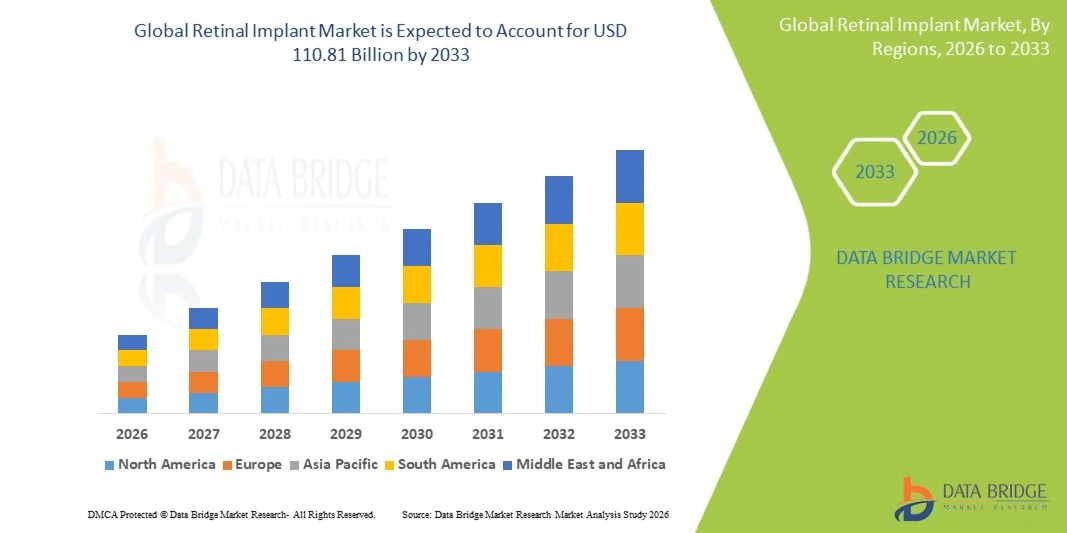
Âmbito de aplicação do relatório e mercado de implantes de retinaSegmentação
|
Atributos |
Chave de Implante de RetinaPerspectivas de mercado |
|
Segmentos Cobertos |
|
|
Países abrangidos |
América do Norte · U.S. · Canadá · México Europa · Alemanha · França · U.K. · Países Baixos · Suíça · Bélgica · Rússia · Itália · Espanha · Turquia · Resto da Europa Ásia- Pacífico · China · Japão · Índia · Coreia do Sul · Singapura · Malásia · Austrália · Tailândia · Indonésia · Filipinas · Resto da Ásia-Pacífico Médio Oriente e África · Arábia Saudita · U.A.E. · África do Sul · Egito · Israel · Resto do Oriente Médio e África América do Sul · Brasil · Argentina · Resto da América do Sul |
|
Jogadores do mercado chave |
·Cortigente(EUA) ·Corporação Científica(EUA) ·Visão de Pixium(França) ·Tecnologias Oftalmológicas VisionCare(EUA) ·Nano Retina(Israel) · Retina Implant AG (Alemanha) · Bionic Vision Technologies (Austrália) · Monash Vision Group (Austrália) · iBionics Inc. (Canadá) · Segunda Visão de Produtos Médicos (EUA) · Shanghai Artificial Vision Technology Co., Ltd. (China) · Shenzhen SiBion Technology Co., Ltd. (China) · Universidade de Kyoto (Japão) · Universidade de Osaka (Japão) · Universidade de Stanford (EUA) · Harvard Medical School (EUA) · University College London (U.K.) · Universidade de Oxford (U.K.) · EPFL – Instituto Federal Suíço de Tecnologia (Suíça) · Hospital Universitário Nacional de Seul (Coreia do Sul) |
|
Oportunidades de Mercado |
· Desenvolvimento de implantes de retina sem fio de alta resolução de próxima geração · Expansão de aplicações clínicas além da retinite pigmentosa em degeneração macular relacionada à idade · Integração crescente de técnicas cirúrgicas minimamente invasivas e materiais microeletrodos biocompatíveis |
|
Informações sobre o Valor Adicionado |
Além dos insights sobre cenários de mercado, como valor de mercado, taxa de crescimento, segmentação, cobertura geográfica e grandes atores, os relatórios de mercado curados pela Data Bridge Market Research também incluem análise de especialistas em profundidade, epidemiologia de pacientes, análise de pipelines, análise de preços e marco regulatório. |
Tendências do mercado de implantes de retina
Tendência: Avanço nas tecnologias de restauração da visão bioeletrônica
Os sistemas de implantes retinais estão cada vez mais incorporando matrizes de microeletrodos de alta densidade, transmissão de energia sem fio e tecnologias de estimulação fotovoltaica para melhorar a resolução visual e a estabilidade do implante a longo prazo. O progresso contínuo na engenharia de interface neural está possibilitando estimulação mais precisa das células ganglionares da retina, melhorando a qualidade da percepção da imagem em pacientes com perda de visão grave. Instituições de pesquisa e empresas de dispositivos médicos também estão focando em sistemas miniaturizados e totalmente implantáveis que reduzem a complexidade cirúrgica e aumentam o conforto do paciente, enquanto o pré-processamento de imagem assistida por IA está melhorando a interpretação de sinal visual em tempo real em dispositivos de próxima geração. Por exemplo, sistemas de implante fotovoltaico de retina PRIMA e plataformas de microchip subrretinais avançadas estão sendo desenvolvidos para melhorar as capacidades de restauração de visão sem fio.
Dinâmica do Mercado de Implantes de Retina
Motorista do Mercado-Chave: Prevalência crescente de Doenças de Retina Degenerativas e População Envelhecida
A crescente incidência global de degeneração macular relacionada à idade, retinite pigmentosa e retinopatia diabética está impulsionando significativamente a demanda por soluções de implante retiniano, pois tratamentos convencionais oferecem eficácia limitada na perda de visão em estágio avançado. A crescente população geriátrica em todo o mundo está acelerando ainda mais o pool de pacientes exigindo tecnologias de restauração de visão, particularmente em mercados de saúde desenvolvidos e emergentes. Sistemas de saúde e centros de oftalmologia estão cada vez mais adotando próteses retinianas como opção de tratamento de última linha para restaurar a função visual parcial e melhorar a qualidade de vida do paciente. Por exemplo, os sistemas de implante de Argus II e Alpha AMS têm sido utilizados clinicamente em pacientes com retinite grave pigmentosa para restaurar a percepção visual básica.
Restrição/Desafio-chave: alto custo, complexidade cirúrgica e acessibilidade limitada
Uma das principais restrições no mercado de implantes retinianos é o custo extremamente elevado de dispositivos e procedimentos cirúrgicos combinados com a complexidade da implantação e das necessidades de reabilitação pós-operatória. Esses sistemas requerem expertise cirúrgica altamente especializada, infraestrutura hospitalar avançada e treinamento de pacientes em longo prazo, o que limita a adoção de centros de saúde avançados. Além disso, a cobertura de reembolso limitada em vários países e a natureza experimental de muitos dispositivos restringem a comercialização em larga escala e a acessibilidade para pacientes em regiões de baixa e média renda. Por exemplo, procedimentos de implantação de dispositivos como Argus II requerem cirurgia em múltiplos estágios e reabilitação intensiva, tornando a adoção ampla desafiadora fora dos centros oftálmicos especializados.
Oportunidade chave do mercado: expansão dos sistemas de restauração de visão assistida por IA e sem fio
A integração de tecnologias de estimulação da retina sem fio, o processamento de imagens baseadas em inteligência artificial e plataformas neuroprotéticas conectadas à nuvem apresentam uma grande oportunidade de crescimento para o mercado de implantes da retina. Esses avanços são esperados para melhorar a clareza visual, permitir a modulação do sinal adaptativo em tempo real e reduzir a dependência de hardware externo volumosa, aumentando assim o conforto e a usabilidade do paciente. A crescente colaboração entre empresas de biotecnologia, desenvolvedores de IA e fabricantes de dispositivos oftálmicos está acelerando a inovação em próteses de retina totalmente implantáveis e minimamente invasivas. Por exemplo, sistemas emergentes de implantes fotovoltaicos e plataformas de decodificação retiniana aprimoradas por IA estão sendo desenvolvidos para permitir resultados de restauração de visão mais naturais e adaptativos.
Âmbito do mercado de implantação de retina
O mercado de implantes da retina é segmentado com base no tipo de produto, tipo de implante, indicação e usuário final.
- Por tipo de produto
Com base no tipo de produto, o Mercado de Implantes Retina é segmentado em Retina Implant Alpha AMS, Implantable Miniature Telescope (IMT), Argus II e Outros. O segmento Argus II dominou o mercado com a maior parcela de 42,6% em 2025, devido ao seu status como um dos primeiros sistemas de próteses de retina aprovados comercialmente para tratamento de perda de visão grave. Tem sido amplamente adotado em pesquisas clínicas e centros oftálmicos especializados para pacientes com retinite pigmentosa avançada. A forte validação clínica e os dados de evolução dos pacientes em longo prazo reforçaram sua dominância. Os protocolos cirúrgicos estabelecidos pelo sistema e a consciência global entre os oftalmologistas também contribuem para o uso sustentado. No entanto, sua disponibilidade é limitada devido à interrupção e substituição por tecnologias de próxima geração. Apesar disso, sua base de adoção do legado continua mantendo a liderança de mercado em sistemas instalados.
Espera-se que o segmento Retina Implant Alpha AMS testemunhe o crescimento mais rápido em um CAGR de 10,8% de 2026 a 2033, impulsionado por avanços na tecnologia de estimulação subrretinal e melhoria dos resultados de resolução visual. Oferece melhor biocompatibilidade e processamento de sinal mais natural em comparação com dispositivos anteriores. O aumento dos ensaios clínicos na Europa e o alargamento das aprovações regulamentares apoiam a adopção. A capacidade do sistema de restaurar a visão funcional parcial em condições de baixa luminosidade está aumentando ainda mais a demanda. O aumento do investimento na investigação neuroprotética de próxima geração está a acelerar o desenvolvimento dos produtos. O crescente foco nas técnicas de implantação sem fio e minimamente invasiva também está fortalecendo sua trajetória de crescimento.
- Por Tipo de Implante
Com base no tipo de implante, o Mercado de Implantes Retinais é segmentado em implantes epirretinais, subrretinais, supracoroidais e nervo óptico. O segmento de implantes epirretinais dominou o mercado com uma participação de 46,3% em 2025, principalmente devido à comercialização precoce e uso clínico generalizado de dispositivos como Argus II. Esses implantes são posicionados na superfície interna da retina, permitindo estimulação direta das células ganglionares da retina para percepção visual básica. Seus procedimentos cirúrgicos estabelecidos e familiaridade clínica entre cirurgiões oftálmicos têm apoiado a adoção generalizada. Forte uso histórico em pacientes com retinite pigmentosa tem reforçado a dominância. No entanto, limitações na resolução de imagens e dependência de hardware externo restringem o desempenho avançado. Apesar da evolução tecnológica, os implantes epirretinianos continuam sendo a categoria mais implantada clinicamente globalmente.
Espera-se que o segmento de implantes subrretinais seja o que mais cresce em um CAGR de 11,2% de 2026 a 2033, impulsionado pelo alinhamento anatômico superior com camadas fotorreceptoras e melhora da fidelidade visual. Estes implantes imitam o processamento natural da retina mais de perto, levando à percepção melhorada da imagem. Avanços na tecnologia fotovoltaica de microchip estão permitindo operação totalmente sem fio. O aumento dos ensaios clínicos e as aprovações regulatórias na Europa e na Ásia-Pacífico estão acelerando a adoção. A crescente procura de sistemas de restauração de visão de próxima geração está a aumentar ainda mais o financiamento da investigação. O segmento também está se beneficiando de inovações em projetos de implantes ultra-miniaturizados e materiais biocompatíveis.
- Por Indicação
Com base na indicação, o Mercado de Implantes Retinais é segmentado em retinite pigmentosa, degeneração macular relacionada com a idade, retinopatia diabética, cegueira e outras doenças degenerativas da retina. O segmento de retinite pigmentosa dominou o mercado com participação de 51,7% em 2025, pois representa a principal indicação aprovada para a maioria dos sistemas de próteses retinianas. Pacientes com RP avançada apresentam degeneração fotorreceptora grave, tornando-os candidatos ideais para restauração da visão eletrônica. O histórico de ensaios clínicos estabelecidos e as aprovações regulatórias para dispositivos específicos para RP têm reforçado sua dominância. Necessidade médica elevada não satisfeita na doença tardia suporta ainda mais a demanda. A pesquisa contínua em terapias genéticas combinadas com implantes está expandindo as vias de tratamento. No entanto, a população de pacientes limitada comparada à DMA restringe a expansão de volume em longo prazo.
Espera-se que o segmento de degeneração macular relacionada à idade (DMA) seja o crescimento mais rápido em um CAGR de 9,6% de 2026 a 2033, impulsionado pelo rápido aumento da população idosa em todo o mundo. AMD leva à perda de visão central, criando forte demanda por tecnologias de restauração visual assistiva. Avanços em sistemas de implante de alta resolução estão melhorando a adequação para pacientes com DMA. A ampliação da pesquisa clínica em sistemas híbridos de implante-fotovoltaico está apoiando a adoção. Aumentar as despesas de saúde e melhorar as taxas de diagnóstico estão a acelerar ainda mais a procura. O foco crescente na restauração da visão funcional em populações de envelhecimento está posicionando a AMD como uma indicação chave de crescimento futuro.
- Por Usuário Final
Com base no usuário final, o Mercado de Implantes de Retina é segmentado em hospitais e centros de cuidados oculares. O segmento hospitalar dominou o mercado com 63,9% de participação em 2025, devido à necessidade de procedimentos de implantação cirúrgica altamente complexos e cuidados pós-operatórios multidisciplinares. Os hospitais estão equipados com infraestrutura cirúrgica oftálmica avançada e especialistas em retina treinados, tornando-os os centros primários para procedimentos de implantação. A disponibilidade de serviços de reabilitação e a monitorização a longo prazo dos doentes reforça ainda mais a sua dominância. Redes de referência fortes para casos graves de perda de visão também contribuem para maior entrada do paciente. No entanto, altos custos de tratamento e acessibilidade limitada restringem a adoção generalizada fora de centros especializados. Apesar disso, os hospitais continuam sendo o centro central para procedimentos de implante retiniano em todo o mundo.
Espera-se que o segmento de centros de atenção ocular seja o que mais cresce em um CAGR de 10,1% de 2026 a 2033, impulsionado pelo aumento da descentralização do cuidado oftálmico e expansão de clínicas especializadas de restauração de visão. Esses centros estão se tornando mais capazes de lidar com cuidados avançados de diagnóstico e acompanhamento para pacientes com implante. Os investimentos crescentes em infra-estruturas oftalmológicas ambulatoriais estão a apoiar o crescimento. Aumentar a conscientização das tecnologias de restauração de visão está levando as visitas de pacientes a clínicas especializadas. As parcerias entre fabricantes de dispositivos e as redes de cuidados oculares estão a melhorar a acessibilidade. O crescente foco em procedimentos minimamente invasivos e modelos de atenção ambulatorial está acelerando ainda mais a adoção.
Análise Regional do Mercado de Implantes de Retina
A América do Norte dominou o Mercado de Implantes Retinais com a maior parcela de receita de 38,6% em 2025, apoiada por infraestrutura de saúde oftálmica avançada, fortes quadros de reembolso e adoção precoce de tecnologias de restauração de visão neuroprotética. A região beneficia-se do alto gasto em saúde, forte presença de empresas líderes de dispositivos médicos e quadros de reembolso favoráveis para procedimentos cirúrgicos avançados. O aumento da prevalência de doenças degenerativas da retina e o aumento da população geriátrica estão impulsionando a demanda por sistemas de implante da retina. A presença de centros de oftalmologia bem estabelecidos e instalações de reabilitação de visão especializada continua a fortalecer a liderança do mercado. O investimento contínuo em dispositivos de restauração de visão integrados com IA e em ensaios clínicos em curso suporta ainda mais o domínio regional. A adoção crescente de tecnologias sub-retinais de próxima geração e de implantes fotovoltaicos também está acelerando a expansão do mercado na região.
U.S. Retina Implant Market Insight
O mercado de implantes da retina dos EUA está testemunhando crescimento constante devido a fortes investimentos em pesquisas oftalmológicas avançadas, aumento da prevalência de doenças degenerativas da retina e adoção precoce de tecnologias de restauração da visão neuroprotética. A infraestrutura de saúde bem estabelecida do país, juntamente com a presença de empresas de dispositivos médicos líderes e instituições de pesquisa, está impulsionando a demanda por sistemas de implante de retina. A concentração crescente nos ensaios clínicos para implantes sub-retinais e fotovoltaicos de próxima geração está a acelerar ainda mais a inovação. Além disso, quadros de reembolso favoráveis e crescente conscientização sobre soluções de restauração de visão estão apoiando o acesso e adoção do paciente. O aumento da colaboração entre empresas de biotecnologia e centros acadêmicos continua a fortalecer o desenvolvimento do mercado nos EUA.
Inspeção do mercado da retina europeia
O mercado europeu de implantes de retina continua a ser um importante contributo para as receitas globais, impulsionado por uma forte actividade de investigação clínica, por vias regulamentares de apoio e por elevados investimentos em tecnologias de neuroengenharia. A região beneficia de redes de oftalmologia bem estabelecidas e participação ativa em programas de inovação de dispositivos médicos. O aumento do uso de próteses retinianas em ensaios clínicos para retinite pigmentosa e degeneração macular relacionada à idade está apoiando a expansão do mercado. Além disso, o forte financiamento do governo para a medicina bioeletrônica e a pesquisa de restauração de visão está acelerando o avanço tecnológico. A presença de institutos de investigação académicos e de empresas de medicina continua a reforçar a posição da Europa no mercado global.
U.K. Retina Implant Market Insight
O mercado de implantes de retina do Reino Unido está experimentando crescimento gradual, apoiado pelo aumento da adoção de tecnologias oftálmicas avançadas e forte foco na pesquisa clínica na restauração da visão. Os crescentes investimentos em serviços de oftalmologia apoiados pela NHS e em programas de pesquisa acadêmica estão contribuindo para o desenvolvimento do mercado. A ênfase do país no diagnóstico precoce e tratamento de doenças da retina está impulsionando a demanda por soluções implantáveis inovadoras. Além disso, a colaboração entre universidades, empresas de biotecnologia e prestadores de cuidados de saúde está aumentando a atividade de ensaios clínicos. A sensibilização crescente para a restauração da visão neuroprotética está a posicionar o Reino Unido como um importante contributo para o crescimento do mercado europeu.
Alemanha Retina Implant Market Insight
O mercado de implantes de retina da Alemanha está se expandindo constantemente devido a fortes capacidades de fabricação de dispositivos médicos, infraestrutura avançada de pesquisa e crescente foco na inovação neuroprotética. O país está ativamente envolvido no desenvolvimento e teste clínico das tecnologias de implante subrretinal. Forte colaboração entre institutos de engenharia e centros de pesquisa oftálmica está apoiando avanços tecnológicos. O aumento da prevalência de doenças oculares relacionadas com a idade está a impulsionar ainda mais a procura de soluções de restauração da visão. Além disso, o apoio governamental à inovação em medicina e aos serviços de saúde de alta qualidade está a reforçar o papel da Alemanha na paisagem europeia dos implantes de retina.
Insight de Mercado de Retina Ásia-Pacífico
Espera-se que o mercado de implante de retina Ásia-Pacífico testemunhe rápido crescimento, impulsionado pelo aumento da prevalência de distúrbios retinianos, expansão da população geriátrica e melhoria do acesso a cuidados oftálmicos avançados. O aumento dos investimentos em infraestrutura de saúde e a adoção crescente de tecnologias médicas de ponta estão apoiando a expansão regional. Países como China, Japão e Índia estão cada vez mais focados em pesquisas clínicas e programas de conscientização para o tratamento de deficiência visual. Além disso, a crescente colaboração com empresas globais de tecnologia médica está acelerando a transferência e adoção de tecnologia. O crescente pool de pacientes da região e a melhoria dos sistemas de reembolso estão posicionando a Ásia-Pacífico como um mercado de alto crescimento mundial.
Japão Retina Implant Market Insight
O mercado japonês de implantes de retina está testemunhando um crescimento consistente devido à forte ênfase na inovação em saúde avançada, envelhecimento da população e aumento de casos de degeneração macular relacionada à idade. O ecossistema de tecnologia médica altamente desenvolvido do país está apoiando pesquisas em sistemas de restauração de visão neuroprotética. Universidades e institutos de pesquisa japoneses estão ativamente envolvidos no desenvolvimento de implantes da retina e ensaios clínicos. Além disso, a integração da robótica, IA e medicina de precisão na oftalmologia está melhorando os resultados do tratamento. O apoio governamental à medicina regenerativa e às tecnologias de visão assistiva continua a fortalecer o crescimento do mercado no Japão.
China Retina Implant Market Insight
O mercado de implantes de retina da China está crescendo rapidamente, impulsionado pelo aumento da prevalência de doenças da retina, expansão da população idosa e crescente investimento em tecnologias avançadas de saúde. As iniciativas governamentais para melhorar a infraestrutura de cuidados oftálmicos e promover a inovação médica estão apoiando significativamente a expansão do mercado. A crescente participação em pesquisas clínicas e colaborações com empresas globais de medtech estão acelerando a adoção de tecnologias de implante de retina. Além disso, a crescente conscientização das soluções de restauração de visão entre os pacientes está aumentando a demanda. Avanços rápidos em biotecnologia e dispositivos médicos habilitados para IA estão posicionando a China como um dos mercados de crescimento mais rápido globalmente.
Retina Implant Market Share
A indústria de implantes de retina é liderada principalmente por empresas bem estabelecidas, incluindo:
- Cortigente (EUA)
- Corporação Científica (EUA)
- Visão de Pixium (França)
- VisionCare Oftalmic Technologies (EUA)
- Nano Retina (Israel)
- Retina Implant AG (Alemanha)
- Tecnologias de visão biônica (Austrália)
- Monash Vision Group (Austrália)
- iBionics Inc. (Canadá)
- Segunda Visão de Produtos Médicos (EUA)
- Shanghai Artificial Vision Technology Co., Ltd. (China)
- Shenzhen SiBion Technology Co., Ltd. (China)
- Universidade de Kyoto (Japão)
- Universidade de Osaka (Japão)
- Universidade de Stanford (EUA)
- Escola de Medicina de Harvard (EUA)
- Universidade de Londres (U.K.)
- Universidade de Oxford (UK)
- EPFL – Instituto Federal Suíço de Tecnologia (Suíça)
- Hospital Universitário Nacional de Seul (Coreia do Sul)
Mais recentes desenvolvimentos no mercado de implantes de retina
- Em junho de 2024, a Science Corporation e parceiros acadêmicos continuaram avançando o desenvolvimento clínico de sistemas de implante de retina baseados em PRIMA de próxima geração, com foco em melhorar a resolução visual e expandir a elegibilidade dos pacientes. Estudos em andamento demonstraram maior capacidade de processamento de imagens através de algoritmos de estimulação melhorados e hardware de implante atualizado. O desenvolvimento reflete a mudança para implantes de retina fotovoltaicos de alta densidade assistidos por IA para restauração da visão natural. Também destaca a crescente integração da decodificação da visão computacional em dispositivos oftálmicos implantáveis
- Em maio de 2023, Pixium Vision, um desenvolvedor-chave de tecnologias de implante subrretinal, incluindo sistemas baseados em PRIMA, entrou em processo de insolvência devido a restrições financeiras e prazos de comercialização atrasados. Apesar do forte progresso clínico no desenvolvimento de próteses retinianas, a empresa lutou com desafios de financiamento e longas vias regulatórias. Esse desenvolvimento refletiu a natureza de alto custo e longa gestação da comercialização do implante retiniano. Também levou ao aumento do interesse de aquisição em suas tecnologias de visão neuroprotética por outros jogadores de medicina
- Em fevereiro de 2022, a Second Sight Medical Products, desenvolvedora do sistema de próteses de retina Argus II, anunciou processos de falência e reestruturação, marcando uma grande transição na indústria de implantes de retina. Mais tarde, a empresa transferiu seus ativos para Cortigent enquanto continuava o desenvolvimento em tecnologias de próteses visuais corticais. Esse evento destacou os desafios de comercialização, custos elevados e adoção limitada de implantes de retina de primeira geração, apesar do sucesso clínico mais precoce. Também marcou uma mudança estratégica dos implantes da retina para sistemas de restauração de visão baseados no cérebro
- Em abril de 2021, pesquisadores da Universidade de Stanford e colaboradores publicaram resultados clínicos do implante de retina sub-retinal fotovoltaica sem fio PRIMA, demonstrando restauração parcial da visão em pacientes com degeneração macular atrófica. O estudo confirmou que a estimulação baseada em microchip sem fio pode restaurar a forma da visão sem sistemas de energia com fio externo, marcando um grande avanço na tecnologia de próteses de retina de próxima geração. Este desenvolvimento avançou significativamente a mudança para sistemas de restauração de visão totalmente implantáveis de alta resolução e reforçou a confiança na escalabilidade fotovoltaica do implante de retina
- Em março de 2021, UCLA e colaboradores clínicos relataram avanço no sistema de próteses visuais corticais de Orion, alcançando o primeiro implante em humanos que possibilitou a percepção básica da luz em pacientes cegos. O dispositivo contorna as estruturas retinianas danificadas e estimula diretamente o córtex visual, expandindo o ecossistema de restauração da visão além dos implantes retinianos. Esse desenvolvimento demonstrou viabilidade para visão protética em nível cortical nos casos em que o implante retiniano não é viável. Ela representou um avanço significativo na pesquisa da visão neuroprotética e abriu novas vias para tratar a cegueira total
SKU-
Obtenha acesso online ao relatório sobre a primeira nuvem de inteligência de mercado do mundo

- Painel interativo de análise de dados
- Painel de análise da empresa para oportunidades de elevado potencial de crescimento
- Acesso de analista de pesquisa para personalização e customização. consultas
- Análise da concorrência com painel interativo
- Últimas notícias, atualizações e atualizações Análise de tendências
- Aproveite o poder da análise de benchmark para um rastreio abrangente da concorrência
Metodologia de Investigação
A recolha de dados e a análise do ano base são feitas através de módulos de recolha de dados com amostras grandes. A etapa inclui a obtenção de informações de mercado ou dados relacionados através de diversas fontes e estratégias. Inclui examinar e planear antecipadamente todos os dados adquiridos no passado. Da mesma forma, envolve o exame de inconsistências de informação observadas em diferentes fontes de informação. Os dados de mercado são analisados e estimados utilizando modelos estatísticos e coerentes de mercado. Além disso, a análise da quota de mercado e a análise das principais tendências são os principais fatores de sucesso no relatório de mercado. Para saber mais, solicite uma chamada de analista ou abra a sua consulta.
A principal metodologia de investigação utilizada pela equipa de investigação do DBMR é a triangulação de dados que envolve a mineração de dados, a análise do impacto das variáveis de dados no mercado e a validação primária (especialista do setor). Os modelos de dados incluem grelha de posicionamento de fornecedores, análise da linha de tempo do mercado, visão geral e guia de mercado, grelha de posicionamento da empresa, análise de patentes, análise de preços, análise da quota de mercado da empresa, normas de medição, análise global versus regional e de participação dos fornecedores. Para saber mais sobre a metodologia de investigação, faça uma consulta para falar com os nossos especialistas do setor.
Personalização disponível
A Data Bridge Market Research é líder em investigação formativa avançada. Orgulhamo-nos de servir os nossos clientes novos e existentes com dados e análises que correspondem e atendem aos seus objetivos. O relatório pode ser personalizado para incluir análise de tendências de preços de marcas-alvo, compreensão do mercado para países adicionais (solicite a lista de países), dados de resultados de ensaios clínicos, revisão de literatura, mercado remodelado e análise de base de produtos . A análise de mercado dos concorrentes-alvo pode ser analisada desde análises baseadas em tecnologia até estratégias de carteira de mercado. Podemos adicionar quantos concorrentes necessitar de dados no formato e estilo de dados que procura. A nossa equipa de analistas também pode fornecer dados em tabelas dinâmicas de ficheiros Excel em bruto (livro de factos) ou pode ajudá-lo a criar apresentações a partir dos conjuntos de dados disponíveis no relatório.











