


Segmentação do mercado de fertilizantes de liberação lenta global, por tipo de produto (Urea revestida com polimero, Urea revestida com resina, Urea revestida com enxofre, Urea revestida com polímero de enxofre e outros fertilizantes de liberação lenta), tipo (Urea Formaldeído, Urea Isobutiraldeído, Urea Acetaldeído e outros), modo de aplicação (Fertigação, Foliar, Solo e outros modos de aplicação), uso final (Setor agrícola, Produtores Comerciais, Usuários Residenciais, Gestão Turf & Paisagem e Produtores de Horticultura)- Tendências e Previsão da Indústria para 2033
O que é a taxa de crescimento e tamanho do mercado de fertilizantes de liberação lenta
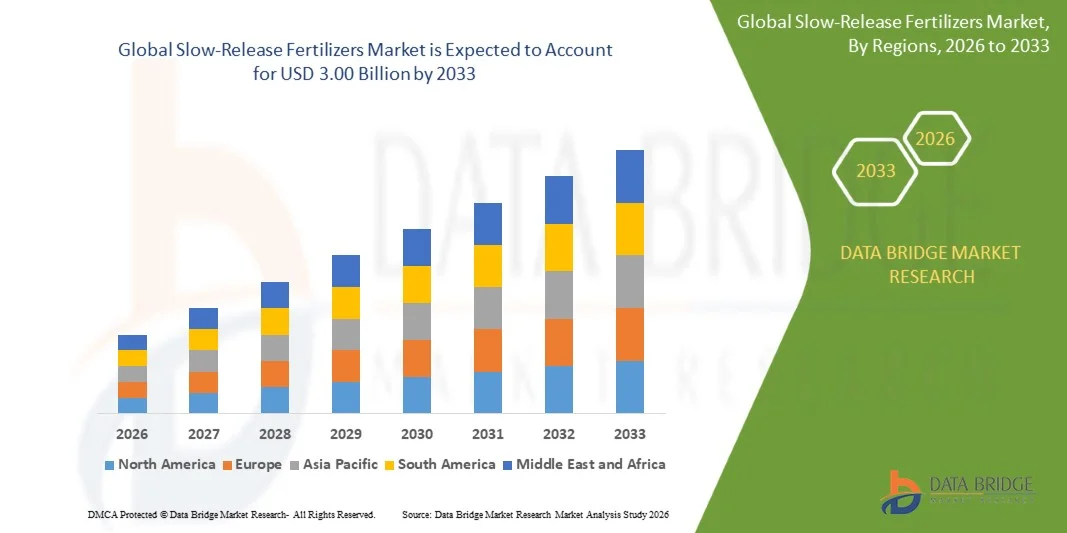
- De acordo com a análise Data Bridge Market Research, o mercado de fertilizantes de liberação lenta foi avaliado em1,80 mil milhões de dólares em 2025e é projetado para alcançarUSD 3,00 mil milhões até 2033, crescendo emCAGR de 6,60% de 2026 a 2033.
- O mercado está experimentando crescimento consistente impulsionado pela crescente demanda por soluções eficientes de gerenciamento de nutrientes, crescente adoção de agricultura de precisão, avanços nas tecnologias de revestimento de polímeros e enxofre e expansão de aplicações em cereais e grãos, frutas e vegetais, oleaginosas e pulsos, e relva e ornamentais.
- A crescente necessidade de melhorar a eficiência do uso de fertilizantes, reduzir as perdas de nutrientes através da lixiviação, volatilização e escoamento, e apoiar a produção de culturas sustentáveis está forçando os agricultores e produtores agrícolas a adotarem tecnologias de fertilizantes de liberação lenta. Formulações revestidas e de liberação controlada estão sendo cada vez mais usadas para fornecer nutrientes gradualmente de acordo com as exigências da cultura, reduzir a frequência de aplicação e melhorar a utilização de nutrientes, apoiando a expansão do mercado globalmente.
Tamanho e previsão do mercado
- Valor de Mercado Global (2025): USD 1,80 Bilhões
- Valor de mercado esperado (2033): USD 3,00 bilhões
- Previsões CAGR (2026-2033): 6,60%
- Região líder em 2025: América do Norte
- Região de crescimento mais rápido: Ásia Pacífico
Quais são as principais takeaways do mercado de fertilizantes de liberação lenta
- A América do Norte dominou o mercado de fertilizantes de liberação lenta com a maior parcela de receita de 35,2% em 2025, apoiada por práticas agrícolas avançadas, alta adoção de agricultura de precisão e crescente demanda por soluções eficientes de gerenciamento de nutrientes.
- Espera-se que a Ásia-Pacífico seja a região de crescimento mais rápido em um CAGR de 7,6% de 2026 a 2033, alimentado pelo aumento das exigências de produtividade agrícola, aumento da adoção de tecnologias de fertilizantes eficientes em nutrientes e expansão do cultivo em toda a China e Índia.
- O segmento de ureia revestida de polímero liderou o mercado com uma participação de 50,2% em 2025, impulsionada pela sua capacidade de fornecer liberação de nutrientes controlada e previsível.
- A ureia revestida com enxofre de polímeros é o tipo de produto de crescimento mais rápido, projetado para registrar um CAGR de 8,2%, refletindo o aumento da demanda por fertilizantes que combinam liberação controlada de nitrogênio com nutrição de enxofre.
- O segmento de ureia formaldeído dominou a categoria tipo com uma participação de receita de 32,5% em 2025, liderada por sua posição estabelecida como fertilizante nitrogenado de liberação lenta.
- O solo representou 55% da quota de mercado em 2025, preferida pela sua ampla compatibilidade com formulações de fertilizantes de liberação lenta.
- O segmento de fertirrigação é o modo de aplicação mais rápido de crescimento, com CAGR de 7,0%, impulsionado pelo aumento da adoção de irrigação de precisão e práticas eficientes de manejo de nutrientes.
Alcance do relatório e segmentação de mercado de fertilizantes de liberação lenta
|
Atributos |
Fertilizantes de liberação lenta Principais perspectivas de mercado |
|
Segmentos Cobertos |
|
|
Países abrangidos |
América do Norte
Europa
Ásia- Pacífico
Médio Oriente e África
América do Sul
|
|
Jogadores do mercado chave |
|
|
Oportunidades de Mercado |
|
|
Informações sobre o Valor Adicionado |
Além dos insights sobre cenários de mercado, como valor de mercado, taxa de crescimento, segmentação, cobertura geográfica e principais atores, os relatórios de mercado curados pela Data Bridge Market Research também incluem análise de importação, visão geral da capacidade de produção, análise do consumo de produção, análise de tendências de preços, cenário de mudança climática, análise da cadeia de suprimentos, análise da cadeia de valor, visão geral da matéria-prima/consumíveis, critérios de seleção de fornecedores, Análise de PESTLE, Análise de Porter e quadro regulatório. |
Qual é a tendência chave no mercado de fertilizantes de liberação lenta
- Os produtores agrícolas estão cada vez mais adotando fertilizantes de liberação lenta para melhorar a eficiência de uso de nutrientes, reduzir as perdas de nutrientes e sincronizar a disponibilidade de nutrientes com a demanda de culturas, apoiando práticas agrícolas mais sustentáveis.
- Por exemplo, em janeiro de 2024, a extensão UF/IFAS da Universidade da Flórida relatou resultados positivos de uma demonstração de fertilizantes de liberação controlada na fazenda envolvendo sete fazendas de melancia do norte da Flórida. O projeto comparou fertilizantes de liberação controlada com programas convencionais de fertilizantes e constatou que os produtores participantes expressaram interesse em continuar incorporando fertilizantes de liberação controlada para melhorar a eficiência de uso de nitrogênio.
- Formulações de liberação controlada também estão sendo integradas com tecnologias de retenção de água e de gerenciamento de nutrientes de precisão para melhorar a eficiência de fertilizantes e água.
- Revestimentos bio-baseados e materiais compósitos estão ganhando atenção como alternativas ao convencionalpolímero sintéticorevestimentos, apoiando o desenvolvimento de fertilizantes de liberação lenta biodegradáveis e ambientalmente orientados.
- Tecnologias de fertilizantes de liberação lenta habilitados por nano-nano estão surgindo como uma tendência, com nanocompósitos e sistemas de nano-biochar sendo desenvolvidos para melhorar o controle de liberação de nutrientes, reduzir as perdas de nutrientes precoces e apoiar a entrega de nutrientes de precisão.
- Por exemplo, em setembro de 2024, a Fertilizer International/BC Insight destacou o papel crescente dos fertilizantes de liberação controlada na agricultura sustentável. O artigo discutiu como fertilizantes de liberação controlada podem reduzir o número de aplicações de fertilizantes e melhorar o manejo de nutrientes, apoiando sua adoção como uma tecnologia de fertilizantes mais sustentável.
- Tecnologias de revestimento inteligentes e biodegradáveis estão sendo cada vez mais exploradas para sincronizar a liberação de nutrientes com os requisitos de cultivo, reduzindo a persistência ambiental associada com revestimentos de polímero sintético convencional.
Quais são os Principais Drivers do Mercado de Fertilizantes de Lançamento lento
- As crescentes preocupações com a baixa eficiência de uso de nutrientes, perdas de fertilizantes e impactos ambientais estão aumentando significativamente a demanda por fertilizantes de liberação lenta que fornecem nutrientes gradualmente de acordo com as exigências da cultura.
- Por exemplo, em fevereiro de 2024, Field Crops Research publicou uma meta-análise global abrangendo 8.874 observações de 240 estudos, descobrindo que substituir fertilizante nitrogenado prontamente disponível por fertilizante nitrogenado de liberação controlada aumentou o rendimento da cultura em 5,1%, a captação de nitrogênio em 7,1% e as perdas de nitrogênio em 32,6%-49,1%. Esses achados demonstram a demanda por fertilizantes de liberação lenta e controlada, pois os agricultores buscam maior eficiência de uso de nutrientes, limitando as perdas de fertilizantes.
- Os produtores agrícolas também estão integrando fertilizantes de maior eficiência em práticas de agricultura inteligentes para melhorar a produtividade, reduzindo o escoamento de nutrientes, lixiviação e frequência de aplicação.
- Por exemplo, em janeiro de 2025, a revista Plants publicou pesquisas sobre fertilizante de liberação controlada em cultivo de arroz na área de irrigação do Rio Amarelo da China. O estudo constatou que a ureia de liberação controlada reduziu a lixiviação média total de nitrogênio em 31,55% em 2022 e 27,35% em 2023, enquanto aumentou o rendimento médio de paddy em aproximadamente 20% e melhorou a eficiência do uso de nitrogênio. Os resultados destacam a crescente necessidade de tecnologias de fertilizantes que sincronizem a disponibilidade de nutrientes com as necessidades de cultivo e reduzam as perdas de nutrientes.
- Com a agricultura cada vez mais focada na maximização da produtividade de nutrientes e minimização das perdas ambientais, os fertilizantes de liberação lenta continuarão a ser importantes para a produção sustentável de culturas e para o manejo eficiente de fertilizantes, apoiando o gerenciamento mais preciso de nutrientes e reduzindo as perdas de fertilizantes em diversos sistemas agrícolas.
Que fatores estão desafiando o crescimento do mercado de fertilizantes de liberação lenta
- Adubos de liberação lenta podem enfrentar maiores custos de produção porque revestimentos de polímero sintéticos, processos de fabricação especializados e tecnologias avançadas de controle de liberação aumentam as despesas de formulação em comparação com fertilizantes convencionais.
- Por exemplo, em novembro de 2024, a Industrial Crops and Products publicou um artigo destacando a natureza de custo intensivo de fertilizantes de liberação controlada. O artigo observou que o custo de produção relativamente alto de fertilizantes de liberação controlada, juntamente com o uso de revestimentos de polímero sintético derivados do petróleo, tem limitado sua adoção comercial mais ampla. Os materiais de revestimento adicionais e os requisitos de processamento podem tornar os fertilizantes de liberação lenta mais caros do que os fertilizantes convencionais.
- Esses custos mais elevados podem restringir a adoção entre agricultores sensíveis aos preços e pequenos produtores agrícolas, especialmente quando os subsídios a fertilizantes favorecem os produtos convencionais.
- O uso de revestimentos poliméricos não biodegradáveis também cria preocupações de sustentabilidade e pode aumentar a pressão para materiais alternativos, ao mesmo tempo em que a liberação consistente de nutrientes em diferentes condições de solo e clima permanece tecnicamente desafiador.
- Por exemplo, em julho de 2025, o Journal of Cleaner Production reviu a transição para fertilizantes de liberação lenta e identificou altos custos de produção e revestimentos não biodegradáveis como principais desafios. O artigo destacou especificamente os processos complexos de revestimento e maiores custos de fabricação associados a fertilizantes de liberação lenta, ao mesmo tempo em que observa preocupações com materiais de revestimento persistentes. Estes factores podem aumentar os custos iniciais e restringir a adopção, em especial quando os agricultores são altamente sensíveis aos preços.
- Essas barreiras de custo, meio ambiente e desempenho podem retardar a comercialização e a adoção mais ampla de tecnologias avançadas de fertilizantes de liberação lenta, apesar de seus benefícios de eficiência de nutrientes e escalabilidade.
Como é segmentado o mercado de fertilizantes de liberação lenta
O mercado de fertilizantes de libertação lenta é segmentado com base no tipo de produto, tipo, modo de aplicação e utilização final.
- Por tipo de produto
Com base no tipo de produto, o mercado de fertilizantes de liberação lenta é segmentado em ureia revestida com polímero, ureia revestida com resina, ureia revestida com enxofre, ureia revestida com polímero de enxofre e outros fertilizantes de liberação lenta. O segmento de ureia revestida de polímero dominou o mercado com 50,2% de participação em 2025, devido à sua capacidade de fornecer liberação de nutrientes controlada e previsível. Revestimentos de polímeros regulam o movimento de nutrientes para o solo e ajudam a sincronizar a disponibilidade de nitrogênio com as exigências da cultura. Estes produtos são cada vez mais utilizados na produção agrícola, onde a melhoria da eficiência da utilização de nutrientes é uma prioridade fundamental. A sua aplicação em culturas de campo, horticultura, relva e gestão da paisagem apoia ainda mais a sua adopção generalizada. Os avanços nas tecnologias de revestimento também estão melhorando a consistência de liberação em condições diversas de solo e clima.
O segmento de uréia revestida de enxofre é projetado para registrar o crescimento mais rápido no CAGR de 8,2% durante o período de previsão, impulsionado pelo aumento da demanda por fertilizantes que combinam liberação controlada de nitrogênio com nutrição de enxofre. A estrutura de revestimento híbrido permite que a liberação de nutrientes seja regulada durante um período prolongado. Estes fertilizantes podem ser particularmente úteis em solos onde a suplementação de enxofre é necessária ao lado do nitrogênio. Sua capacidade de melhorar a disponibilidade de nutrientes, ao mesmo tempo em que reduz potenciais perdas de nutrientes, está apoiando o interesse entre os produtores. O aumento da adoção de práticas de manejo de nutrientes de precisão está incentivando ainda mais o uso de formulações especializadas de fertilizantes. A crescente demanda por tecnologias de fertilizantes mais eficientes também está apoiando o desenvolvimento de produtos revestidos de enxofre.
- Por Tipo
Com base no tipo, o mercado de fertilizantes de libertação lenta é segmentado em ureiaformaldeído,isobutiraldeído de ureia, acetaldeído de ureia e outros. O segmento de ureia formaldeído dominou o mercado com 32,5% de participação em 2025, apoiado por sua posição estabelecida como fertilizante nitrogenado de liberação lenta. Urea formaldeído libera progressivamente nitrogênio através da decomposição química e atividade microbiana no solo. As suas características de libertação prolongada de nutrientes tornam-no adequado para aplicações que exigem disponibilidade sustentada de azoto. O produto é utilizado em toda a produção agrícola e aplicações não agrícolas onde é necessária uma entrega prolongada de nutrientes. Sua química estabelecida e familiaridade entre os fabricantes de fertilizantes e usuários apoiam a adoção continuada.
O segmento de isobutiraldeído de ureia é projetado para registrar o crescimento mais rápido em um CAGR de 7,3% durante o período de previsão, impulsionado pelo aumento da demanda por liberação previsível e estendida de nitrogênio. Urea isobutiraldeído pode fornecer características de liberação de nutrientes adequadas para a produção intensiva de culturas e programas de gestão de nutrientes de precisão. Sua capacidade de fornecer um fornecimento controlado de nitrogênio pode ajudar a reduzir o descompasso entre disponibilidade de fertilizantes e captação de culturas. O produto é cada vez mais relevante para os produtores que procuram melhorar a eficiência de uso de fertilizantes. A adoção crescente da agricultura de precisão está apoiando a demanda por formulações de fertilizantes com perfis de liberação de nutrientes mais previsíveis. A sua adequação para culturas de alto valor e sistemas de agricultura intensiva também está a reforçar o interesse do mercado.
- Por Modo de Aplicação
Com base no modo de aplicação, o mercado de fertilizantes de liberação lenta é segmentado em fertirrigação, foliar, solo e outros modos de aplicação. O segmento do solo dominou o mercado com 55% de participação em 2025, devido à sua ampla compatibilidade com formulações de fertilizantes de liberação lenta. A aplicação do solo permite que os nutrientes permaneçam disponíveis dentro da zona da raiz da cultura e soltem progressivamente de acordo com as características da formulação. É amplamente adequado para culturas de campo e produção agrícola em larga escala. O método também pode reduzir a frequência de aplicações de fertilizantes e exigências laborais associadas. O aumento da ênfase na redução das perdas de nutrientes através da lixiviação e do escoamento está ainda a apoiar o fornecimento controlado de nutrientes através da aplicação do solo.
O segmento de fertirrigação é projetado para registrar o crescimento mais rápido no CAGR de 7,0% durante o período de previsão, impulsionado pela adoção crescente de irrigação de precisão e práticas eficientes de manejo de nutrientes. A fertilização permite que os nutrientes sejam entregues diretamente através de sistemas de irrigação e mais próximos das zonas de raízes das culturas. A abordagem pode melhorar a precisão da aplicação de nutrientes e apoiar o uso mais eficiente de água e fertilizantes. Aumentar a adoção de sistemas de gotejamento e microirrigação está criando demanda adicional para produtos de fertilizantes compatíveis com fertirrigação. Formulações de liberação lenta podem complementar esses sistemas, fornecendo um suprimento de nutrientes mais controlado durante o desenvolvimento da cultura. A adoção crescente de cultivos protegidos, horticultura e culturas de alto valor também está apoiando o uso da fertirrigação.
- Por Uso Final
Com base no uso final, o mercado de fertilizantes de liberação lenta é segmentado para o setor agrícola, produtores comerciais, usuários residenciais, turf & gestão da paisagem, e produtores de horticultura. O setor agrícola dominou o mercado com 69,7% de participação em 2025, apoiado pelo uso extensivo de fertilizantes de liberação lenta em toda a produção de cultivo. Os produtores agrícolas usam esses fertilizantes para fornecer nutrientes ao longo de períodos prolongados e melhorar a eficiência de uso de nutrientes. Suas características de liberação controlada podem reduzir a frequência de aplicações de fertilizantes e ajudar a limitar as perdas de nutrientes. Os produtos são aplicáveis em cereais, grãos, oleaginosas, leguminosas, frutas e vegetais. Aumentar a pressão para melhorar a produtividade agrícola enquanto gerencia os insumos de fertilizantes está apoiando ainda mais a adoção.
O segmento de produtores comerciais é projetado para registrar o crescimento mais rápido em CAGR de 7,5% durante o período de previsão, impulsionado pelo aumento da demanda por gerenciamento eficiente e consistente de nutrientes na produção de culturas comerciais. Os produtores comerciais exigem soluções de fertilizantes que podem fornecer disponibilidade de nutrientes previsível, reduzindo os requisitos de aplicação intensivos em trabalho. Adubos de liberação lenta podem suportar nutrição uniforme e reduzir a necessidade de aplicações repetidas de fertilizantes. A sua utilização é particularmente relevante para culturas de alto valor, onde a gestão de nutrientes influencia directamente a produtividade e a qualidade. O aumento da adoção da agricultura de precisão e do cultivo protegido está apoiando ainda mais a demanda entre os produtores comerciais. A expansão da produção de estufa, berçário e culturas especializadas também está criando aplicações adicionais para tecnologias controladas de liberação de nutrientes.
Qual região detém a maior parte do mercado de fertilizantes de liberação lenta
- A América do Norte dominou o mercado de fertilizantes de liberação lenta com a maior parcela de receita de 35,2% em 2025, apoiada por práticas agrícolas avançadas, alta adoção de agricultura de precisão e crescente demanda por soluções eficientes de gerenciamento de nutrientes.
- A região também se beneficia de ampla agricultura comercial, aumentando a adoção de tecnologias de fertilizantes de liberação controlada, e crescente ênfase na redução de perdas de nutrientes e melhoria da eficiência de uso de fertilizantes. Forte demanda entre culturas de linha, horticultura e gestão de relva, combinada com redes de distribuição de fertilizantes estabelecidas, continua a fortalecer a posição de liderança da América do Norte no mercado global.
U.S. lento-lease Fertilizers Market Insight
O mercado de fertilizantes de liberação lenta dos EUA está assistindo a um forte crescimento devido à adoção crescente de agricultura de precisão, práticas sustentáveis de manejo de nutrientes e tecnologias avançadas de fertilizantes. O setor agrícola comercial de grande escala do país, juntamente com a crescente demanda por uma maior eficiência de uso de nitrogênio e perdas de nutrientes reduzidas, está impulsionando a demanda por produtos de fertilizantes de liberação lenta em aplicações agrícolas. Além disso, a crescente ênfase na produção de culturas sustentáveis e os esforços regulatórios para minimizar o escoamento de fertilizantes estão acelerando a adoção entre agricultores e produtores comerciais.
Asia-Pacific lento-lease Fertilizers Market Insight
Espera-se que o mercado de fertilizantes de liberação lenta Ásia-Pacífico testemunhe rápido crescimento, impulsionado pela expansão da produção agrícola, aumento da demanda alimentar e aumento dos investimentos em tecnologias eficientes de gestão de nutrientes em países como China, Índia e Japão. O aumento da sensibilização para a eficiência do uso de fertilizantes, o aumento da adoção de agricultura de precisão e a demanda por melhor produtividade das culturas estão apoiando a expansão regional do mercado. Além disso, o crescente uso de fertilizantes de liberação controlada em horticultura, agricultura comercial e culturas de alto valor está acelerando a adoção de mercado em toda a região.
Japão lento-lease Fertilizers Market Insight
O mercado de fertilizantes de liberação lenta do Japão está testemunhando um crescimento consistente devido ao aumento dos investimentos em tecnologias agrícolas avançadas, agricultura de precisão e práticas sustentáveis de gestão de nutrientes. Agricultores e produtores de horticultura estão cada vez mais adotando fertilizantes de liberação lenta para melhorar a disponibilidade de nutrientes, reduzir a frequência de aplicação de fertilizantes e apoiar a produção eficiente de culturas. Além disso, o aumento da integração de tecnologias agrícolas inteligentes e o foco do país na agricultura eficiente em termos de recursos contribuem ainda mais para o crescimento do mercado.
China lenta-lease Fertilizers Market Insight
O mercado de fertilizantes de liberação lenta da China está crescendo rapidamente, impulsionado pela expansão da produção agrícola, aumento da demanda por culturas alimentares e aumento do foco do governo na eficiência de uso de fertilizantes e agricultura sustentável. A adoção crescente de tecnologias de fertilizantes de liberação controlada na agricultura comercial, horticultura e produção de culturas de alto valor está aumentando significativamente a demanda do mercado. Além disso, aumentar a conscientização sobre perdas de nutrientes, saúde do solo e aplicação eficiente de fertilizantes está apoiando a transição para soluções de liberação lenta e fortalecendo a posição da China no mercado regional.
U.K. Slow-Release Fertilizers Market Insight
O mercado de fertilizantes de liberação lenta do Reino Unido está experimentando crescimento constante, apoiado pela adoção crescente de práticas agrícolas sustentáveis, gerenciamento de nutrientes de precisão e soluções de fertilizantes ambientalmente eficientes. O aumento da procura de tecnologias que melhorem a eficiência da utilização de nutrientes e reduzam as perdas de azoto está a contribuir para o crescimento do mercado em aplicações agrícolas e hortícolas. Além disso, a crescente ênfase na redução dos impactos ambientais do uso de fertilizantes e na melhoria do manejo do solo está incentivando a adoção de produtos de fertilizantes de liberação lenta no Reino Unido.
Germany Slow-Release Fertilizers Market Insight
O mercado de fertilizantes de liberação lenta da Alemanha está em constante expansão devido ao setor agrícola avançado do país, forte foco na agricultura sustentável e crescente adoção de tecnologias de gerenciamento de nutrientes de precisão. Agricultores, produtores comerciais e produtores de horticultura estão cada vez mais utilizando fertilizantes de liberação lenta para melhorar a eficiência dos nutrientes e reduzir as perdas de fertilizantes. Os avanços contínuos nas formulações de liberação controlada, juntamente com a crescente ênfase na agricultura ambientalmente responsável e na utilização eficiente dos recursos, estão impulsionando o crescimento do mercado na Alemanha.
Quais são as principais empresas no mercado de fertilizantes de liberação lenta
A indústria de fertilizantes de liberação lenta é liderada principalmente por empresas bem estabelecidas, incluindo:
- ICL(Israel)
- Yaraworld. kgm(Noruega)
- Nutrien Ltd.(Canadá)
- Koch Fertilizer, LLC(EUA)
- Tecnologias Haifa Negev LTD(Israel)
- COMPO EXPERT GmbH (Alemanha)
- Kingenta International (China)
- Coromandel International Ltd. (Índia)
- Grupo EuroChem (Suíça)
- Fertibéria (Espanha)
- The Andersons, Inc. (EUA)
- AGLUKON Spezialdünger GmbH & Co. KG (Alemanha)
- Van Iperen International B.V. (Países Baixos)
- Harrell, LLC (EUA)
- TIMAC AGRO International (França)
- Deepak Fertilisers and Petrochemicals Corporation Limited (Índia)
- Rashtriya Chemicals and Fertilizers Limited (Índia)
- National Fertilizers Limited (Índia)
- SQM S.A. (Chile)
- OCP S.A. (Marrocos)
Quais são as últimas evoluções no mercado de fertilizantes de liberação lenta
- Em abril de 2025, a Sollio Agriculture introduziu o nitrogênio de liberação controlada PurYield, um fertilizante de próxima geração desenvolvido em parceria com a Pursell. O produto é projetado para melhorar o manejo de nitrogênio para culturas como milho, cereais, canola e batatas, reduzindo as perdas de fertilizantes e o número de aplicações de campo. O lançamento destaca o desenvolvimento contínuo da indústria de soluções de nitrogênio de liberação controlada com o objetivo de melhorar a eficiência de uso de nutrientes e reduzir os impactos ambientais.
- Em novembro de 2024, o Ministério da Ciência e Tecnologia da Índia anunciou o desenvolvimento de um revestimento de nanomateriais biodegradáveis para fertilizantes de liberação lenta. O revestimento usa materiais de carboidratos reforçados com nanoclay para retardar a liberação de fertilizantes, melhorar a eficiência de uso de nutrientes e reduzir as interações com o solo e a água. O desenvolvimento também demonstrou potencial para reduzir as necessidades de fertilizantes, mantendo a produção de culturas, representando um avanço para tecnologias de fertilizantes de liberação lenta mais sustentáveis.
- Em janeiro de 2024, a Pursell Agri-Tech e a Yara International anunciaram a disponibilidade de PurMidas, um fertilizante nitrogenado homogêneo de liberação controlada projetado para aplicações de relva. O produto combina a tecnologia patenteada de revestimento da Pursell com a tecnologia de fertilizantes da Yara e fornece um perfil controlado de liberação de nutrientes. PurMidas foi desenvolvido para fornecer nutrição consistente de nitrogênio e enxofre, apoiando a eficiência de nutrientes e reduzindo potenciais perdas de nutrientes.
- Em maio de 2024, a ICL iniciou a expedição de fertilizantes de liberação controlada usando sua tecnologia de revestimento biodegradável eqo.x, seguindo a introdução anterior da tecnologia para a agricultura em campo aberto. As primeiras entregas comerciais foram efectuadas a clientes nos Países Baixos e na Suíça para a produção de batata e de cebola de semente. A ICL também planejou aumentar os volumes nos mercados da Europa Ocidental, ampliando a disponibilidade comercial de tecnologia de fertilizantes revestidos biodegradáveis.
- Em setembro de 2022, a ICL lançou a eqo.x, uma tecnologia de revestimento biodegradável para ureia de liberação controlada projetada para agricultura em campo aberto. A tecnologia foi desenvolvida para proporcionar liberação de nutrientes mais consistente, reduzindo as perdas de nutrientes e melhorando a eficiência de uso de nitrogênio. A ICL anunciou que a tecnologia seria incorporada em seus produtos de fertilizante de liberação controlada agrícola e comprometeu-se a investir em uma linha de produção dedicada na Holanda.
SKU-
Obtenha acesso online ao relatório sobre a primeira nuvem de inteligência de mercado do mundo

- Painel interativo de análise de dados
- Painel de análise da empresa para oportunidades de elevado potencial de crescimento
- Acesso de analista de pesquisa para personalização e customização. consultas
- Análise da concorrência com painel interativo
- Últimas notícias, atualizações e atualizações Análise de tendências
- Aproveite o poder da análise de benchmark para um rastreio abrangente da concorrência
Metodologia de Investigação
A recolha de dados e a análise do ano base são feitas através de módulos de recolha de dados com amostras grandes. A etapa inclui a obtenção de informações de mercado ou dados relacionados através de diversas fontes e estratégias. Inclui examinar e planear antecipadamente todos os dados adquiridos no passado. Da mesma forma, envolve o exame de inconsistências de informação observadas em diferentes fontes de informação. Os dados de mercado são analisados e estimados utilizando modelos estatísticos e coerentes de mercado. Além disso, a análise da quota de mercado e a análise das principais tendências são os principais fatores de sucesso no relatório de mercado. Para saber mais, solicite uma chamada de analista ou abra a sua consulta.
A principal metodologia de investigação utilizada pela equipa de investigação do DBMR é a triangulação de dados que envolve a mineração de dados, a análise do impacto das variáveis de dados no mercado e a validação primária (especialista do setor). Os modelos de dados incluem grelha de posicionamento de fornecedores, análise da linha de tempo do mercado, visão geral e guia de mercado, grelha de posicionamento da empresa, análise de patentes, análise de preços, análise da quota de mercado da empresa, normas de medição, análise global versus regional e de participação dos fornecedores. Para saber mais sobre a metodologia de investigação, faça uma consulta para falar com os nossos especialistas do setor.
Personalização disponível
A Data Bridge Market Research é líder em investigação formativa avançada. Orgulhamo-nos de servir os nossos clientes novos e existentes com dados e análises que correspondem e atendem aos seus objetivos. O relatório pode ser personalizado para incluir análise de tendências de preços de marcas-alvo, compreensão do mercado para países adicionais (solicite a lista de países), dados de resultados de ensaios clínicos, revisão de literatura, mercado remodelado e análise de base de produtos . A análise de mercado dos concorrentes-alvo pode ser analisada desde análises baseadas em tecnologia até estratégias de carteira de mercado. Podemos adicionar quantos concorrentes necessitar de dados no formato e estilo de dados que procura. A nossa equipa de analistas também pode fornecer dados em tabelas dinâmicas de ficheiros Excel em bruto (livro de factos) ou pode ajudá-lo a criar apresentações a partir dos conjuntos de dados disponíveis no relatório.











