



Global Video on Demand (VOD) Market, By Component (Solutions, Services), Delivery Technology (Near Video on Demand (NVOD), Subscription Video on Demand (SVOD), Transactional Video on Demand (TVOD), Others), Application (Entertainment, Education and Training, Network Video Kiosks, Online Commerce, Digital Libraries, Others), Industry Vertical (Healthcare, Manufacturing, Academia and Government, Consumer Goods and Retail, Hospitality and Tourism, Telecommunications and IT, Media and Entertainment, Transport and Logistics, Banking, Financial Services and Insurance (BFSI), Others), Device Used (Mobile, PCs, Tablets, TV) – Industry Trends and Forecast to 2029.
Análise e Tamanho do Mercado de Vídeo sobre Demanda (VOD)
As preferências de streaming do consumidor passaram por uma evolução significativa. A disponibilidade de uma variedade de opções de assinatura, qualidade de streaming melhorada e a liberdade com que os espectadores podem agendar seu tempo todos contribuem para a popularidade do conteúdo de vídeo. Para melhorar a experiência geral de visualização, eles geralmente trabalham em conjunto com outros jogadores de tecnologia. Todas essas ocorrências estão influenciando o mercado de serviços de vídeo sob demanda (VOD) em termos de suas formas globais. A rápida expansão das plataformas OTT, especialmente entre os Millenniumls e a Gen Z, apoiada por ligações à Internet fiáveis e de preços razoáveis, tem incentivado o desenvolvimento de novas fontes de receita para as empresas do sector do vídeo sobre a procura (VOD).
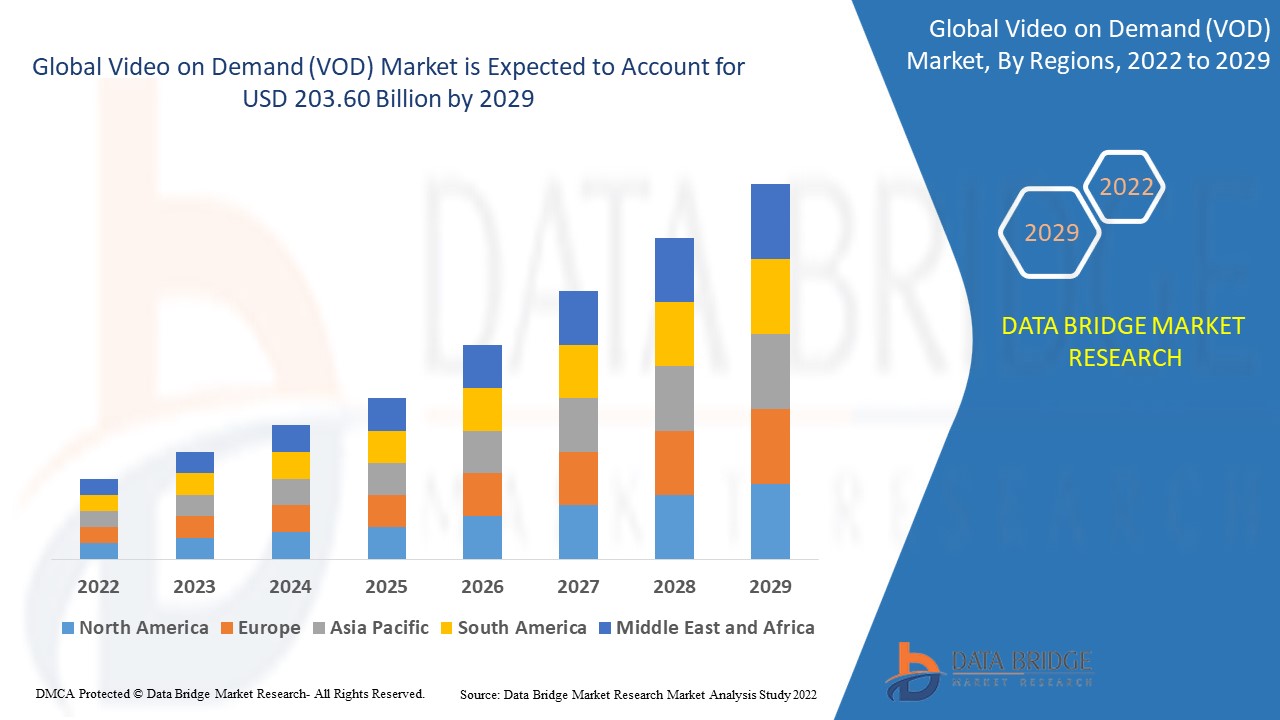
O mercado global de vídeo sobre demanda (VOD) foi avaliado em USD 54,16 bilhões em 2021 e deverá atingir USD 203,60 bilhões em 2029, registrando um CAGR de 18,00% durante o período de previsão de 2022-2029. Além dos insights de mercado, como valor de mercado, taxa de crescimento, segmentos de mercado, cobertura geográfica, atores de mercado e cenário de mercado, o relatório de mercado curado pela equipe de Pesquisa do Mercado da Ponte de Dados inclui análise de especialistas em profundidade, análise de importação/exportação, análise de preços, análise de consumo de produção e análise de pilão.
Vídeo sobre a procura (VOD) Âmbito de mercado e segmentação
|
Metric de Relatório |
Detalhes |
|
Período de previsão |
2022 a 2029 |
|
Ano de base |
2021 |
|
Anos Históricos |
2020 (Alfândega até 2014 - 2019) |
|
Unidades quantitativas |
Receitas em USD Billion, Volumes em Unidades, Preços em USD |
|
Segmentos Cobertos |
Componente (Soluções, Serviços), Tecnologia de Entrega (Video Próximo sobre Demanda (NVOD), Vídeo de Assinatura sobre Demanda (SVOD), Vídeo Transacional sobre Demanda (TVOD), Outros), Aplicação (Entertainment, Educação e Treinamento, Kiosks de Vídeo em Rede, Comércio Online, Bibliotecas Digitais, Outros), Vertical da Indústria (Healthcare, Manufacturing, Academia e Governo, Bens de Consumo e Varejo, Hospitalidade e Turismo, Telecomunicações e TI, Mídia e Entretenimento, Transporte e Logística, Bancário, Serviços Financeiros e Seguros (BFSI), Outros), Dispositivo Usado (Mobile, PCs,Comprimidos, TV) |
|
Países abrangidos |
EUA, Canadá e México na América do Norte, Alemanha, França, Reino Unido, Holanda, Suíça, Bélgica, Rússia, Itália, Espanha, Turquia, Resto da Europa na Europa, China, Japão, Índia, Coreia do Sul, Singapura, Malásia, Austrália, Tailândia, Indonésia, Filipinas, Resto da Ásia-Pacífico (APAC) na Ásia-Pacífico (APAC), Arábia Saudita, EUA, Israel, Egito, África do Sul, Resto do Oriente Médio e África (MEA) como parte do Oriente Médio e África (MEA), Brasil, Argentina e Resto da América do Sul como parte da América do Sul |
|
Jogadores de mercado cobertos |
Netflix (EUA), Amazon Inc., (EUA), Google Inc., (EUA), Akamai Technologies (EUA), YouTube (EUA), Apple Inc., (EUA), Home Box Office, Inc. (EUA), Cisco Systems, Inc. (EUA), Roku Inc., (EUA), INDIEFLIX Group Inc (EUA), Fandango (EUA), Hulu, LLC (EUA), Comcast (EUA), Huawei Technologies Co., Ltd. (China), Fujitsu (Japão), CenturyLink (EUA) Muvi LLC (EUA) e Vulbiquity, Inc. (EUA) |
|
Oportunidades de Mercado |
|
Definição do mercado
Um dispositivo de sobrecarga de choque chamado vídeo sob demanda (VOD) ou monitor de impacto detecta se um choque ou impacto aconteceu e soa um alarme. Video on demand (VOD) são usados principalmente na indústria automobilística para detectar os efeitos da entrada forçada em corpos de veículos, uma vez que eles são simples de instalar, fácil de usar, não necessitam de energia externa, e fornecer uma resposta eficaz a médio alcance para frequências mais altas. Esses sensores são utilizados em "casas inteligentes", onde um alerta é disparado por qualquer intrusão, não importa o quão pequeno, e a saída do alarme pode ser vista em um laptop ou smartphone.
Dinâmica do Mercado de Vídeo sobre Demanda (VOD)
Esta secção trata da compreensão dos condutores de mercado, vantagens, oportunidades, restrições e desafios. Tudo isto é discutido em detalhe como abaixo:
Controladores
- Burgeoning Uso de dispositivos inteligentes eSubscrições de dados móveis em ascensão
Agora é mais fácil para as pessoas assistir conteúdo de mídia porque para o aumento da popularidade de dispositivos inteligentes como tablets,smartphonese laptops, bem como a demanda do consumidor por ter acesso a uma ampla gama de alternativas de entretenimento emocionantes quando e onde quer que eles escolham. Além disso, como resultado do aumento da acessibilidade, da disponibilidade de conexões de internet de alta velocidade e do aumento da utilização dessas conexões e serviços, o mercado de vídeo sob demanda está se expandindo globalmente. Outros fatores-chave previstos para alimentar o mercado global de vídeo sobre demanda durante o período de previsão incluem o aumento das assinaturas de dados móveis, maior uso de redes de dados de alta velocidade e a introdução de capacidades de ponta em smartphones e tablets.
- Montando Popularidade de Vídeo sobre Plataformas de Demanda
Os provedores de serviços de streaming oferecem hoje vídeo sob demanda, o que permite que os clientes selecionem vídeos do catálogo e os assistam sempre que e com a frequência que preferirem. Além disso, os usuários podem se sentir livres, pois não existem tais responsabilidades contratuais com vídeo sob demanda. Além disso, os clientes que escolhem vídeo sob demanda têm acesso a uma variedade de opções de assinatura. Cada opção é ainda menos cara do que uma assinatura regular, dando-lhes mais valor para o seu dinheiro e agindo como um grande impulsionador da expansão do mercado.
Além disso, os factores como a prevalência da flexibilidade e a facilidade de utilização, que oferecem experiências contínuas aos clientes, acelerarão a expansão global do mercado durante o período previsto. Além disso, a crescente popularidade de jogadores locais e estúdios de cinema, e a alta preferência por serviços de streaming on-line sobre convencional é antecipada para impulsionar a taxa de crescimento do mercado de vídeo sob demanda (VOD). O aumento da transmissão ao vivo de vários eventos para evitar grandes multidões irá impactar ainda mais positivamente a taxa de crescimento do mercado durante o período de previsão.
Oportunidades
- Aplicação das tecnologias
Estima-se que a implementação de algoritmos de inteligência artificial (IA) e de aprendizagem de máquina gerem oportunidades lucrativas para o mercado, o que expandirá ainda mais a taxa de crescimento do mercado de serviços de vídeo sob demanda (VOD) durante o período previsto. As organizações têm se beneficiado com isso por serem capazes de identificar os interesses de seus públicos e oferecer sugestões de conteúdo personalizadas para mantê-los interessados. Como resultado, essas plataformas baseadas em IA fornecem experiências altamente personalizadas, mostrando aos usuários material que corresponde especificamente às suas preferências.
- Inovações e Desenvolvimento
Estima-se que as novas e avançadas formas de proporcionar entretenimento de alta qualidade aos espectadores de filmes e TV em plataformas de vídeo sob demanda ofereçam oportunidades de crescimento para o mercado, o que expandirá ainda mais a taxa de crescimento do mercado de vídeo sob demanda (VOD) ao longo do período de previsão. Por exemplo, um aplicativo virtual reality headset para o Oculus Go and Quest foi lançado em setembro de 2019 pelo serviço de vídeo transacional Fandango Now. Junto com mais de 90.000 novos filmes de lançamento e arquivo, ele dará aos usuários acesso a centenas de títulos 3D, bem como programação de TV no dia seguinte.
Restrições/Desafios
- Quadro Regulatório Complexo
Os longos requisitos de licenciamento e regulamentações governamentais complicadas limitarão ainda mais a expansão do setor de vídeo sob demanda (VOD). Como resultado, prevê-se que o mercado de vídeo sob demanda (VOD) enfrentaria obstáculos consideráveis durante o curso da previsão.
- Aumentar a pirataria do conteúdo
A pirataria de conteúdo continua a ser uma barreira significativa para os proprietários e emissoras de conteúdo devido à possibilidade de armazenamento digital de conteúdo de vídeo. A pirataria tem uma influência significativa na receita com o download ilegal no ambiente atual de streaming de vídeo. Por exemplo, estima-se que em 2022, o custo de transmissão de episódios e filmes de TV totalizará USD 51,6 bilhões em todo o mundo. O vídeo sobre a expansão do mercado de demanda é dificultado pelo desafio contínuo da pirataria de conteúdo nesta área.
Este relatório de mercado de vídeo sobre demanda (VOD) fornece detalhes de novos desenvolvimentos recentes, regulamentos comerciais, análise importação-exportação, análise de produção, otimização da cadeia de valor, market share, impacto de jogadores de mercado nacionais e localizados, analisa oportunidades em termos de bolsas de receita emergentes, mudanças na regulamentação de mercado, análise estratégica do crescimento do mercado, tamanho do mercado, crescimentos de mercado categoria, nichos de aplicação e dominância, aprovações de produtos, lançamentos de produtos, expansões geográficas, inovações tecnológicas no mercado. Para obter mais informações sobre o vídeo on demand (VOD) contato de mercado Data Bridge Market Research for an Analyst Brief, nossa equipe irá ajudá-lo a tomar uma decisão de mercado informada para alcançar o crescimento do mercado.
COVID-19 Impacto no mercado de vídeo sobre a procura (VOD)
A epidemia de COVID-19 afetou significativamente o setor de vídeo sob demanda (VOD), uma vez que os cinemas e outros locais de triagem foram forçados a fechar por um período prolongado. Várias nações tomaram várias medidas em todo o mundo para impedir a propagação do vírus mortal. Como resultado, houve um aumento inesperado no volume de conteúdo de entretenimento visto online durante toda a pandemia e os bloqueios que a acompanham. À medida que mais pessoas optavam por ficar em casa, as vendas de serviços de streaming sob demanda e com base em assinaturas subiram. Isso proporcionou concorrência no mercado mundial de vídeo sobre demanda com oportunidades de expansão rápida. Os benefícios e aplicações de redes avançadas, tais como educação baseada em realidade aumentada e virtual, telemedicina sofisticada e empregos remotos, têm sido mais bem compreendidos pelo público e pelo governo porque para COVID-19. Graças à tendência 5G, penetração móvel crescente e melhor conexão de banda larga de alta velocidade via acesso sem fio fixo, as pessoas agora podem desfrutar mais facilmente de entretenimento (FWA). Como resultado, estima-se que o mercado de vídeo sobre a procura (VOD) tenha um impacto positivo durante o período COVID devido ao aumento da penetração na Internet e à crescente procura de plataformas OTT.
Evolução recente
- Em junho de 2020, o negócio revelou um conceito multifacetado que permite aos clientes retornarem confiantemente aos cinemas em movimento. Com a ajuda deste novo software, Fandango é agora capaz de ativar todos os seus ativos digitais, incluindo Movieclips no YouTube e a eficácia dos seus canais de marketing. A base de fãs da Fandango crescerá como resultado desta introdução do produto, que também resultará em uma maior base de clientes para o negócio.
- Em abril de 2020, a Synamedia uniu esforços com o Google Cloud para expandir seu portfólio de rede de vídeo e oferecer uma nova solução OOT. Ao abordar as questões dos clientes sobre os serviços OTT através desta relação, a Synamedia pode maximizar o desempenho ao maximizar a escalabilidade e as despesas de corte. Um grande benefício deste relacionamento é que permite que ambas as empresas incorporem aprendizado de máquina e inteligência artificial, o que aumenta a experiência do cliente gerando conteúdo atraente para os usuários.
Vídeo global sobre a procura (VOD) Âmbito de mercado
O mercado de vídeo on demand (VOD) é segmentado com base em componentes, tecnologia de entrega, dispositivo usado, aplicação e vertical da indústria. O crescimento entre esses segmentos irá ajudá-lo a analisar segmentos de crescimento escassos nas indústrias e fornecer aos usuários uma visão geral de mercado valiosa e insights de mercado para ajudá-los a tomar decisões estratégicas para identificar aplicações de mercado principais.
Componente
- Soluções
- Serviços
Tecnologia de entrega
- Próximo vídeo sobre demanda (NVOD)
- Vídeo de assinatura sobre demanda (SVOD)
- Vídeo transacional sobre demanda (TVOD)
- Outros
Aplicação
- Entretenimento
- Educação e formação
- Kiosks de Vídeo em Rede
- Comércio Online
- Bibliotecas digitais
- Outros
Vertical da Indústria
- Cuidados de saúde
- Fabricação
- Academia e Governo
- Bens de consumo e varejo
- Hospitalidade e Turismo
- Telecomunicações e TI
- Mídia e entretenimento
- Transportes e Logística
- Bancário
- Serviços Financeiros e Seguros (BFSI)
- Outros
Dispositivo usado
- Telemóvel
- PCs
- Comprimidos
- TV
Video on Demand (VOD) Análise/Insights regionais do mercado
O mercado de vídeo on demand (VOD) é analisado e insights e tendências de tamanho do mercado são fornecidos pelo país, componente, tecnologia de entrega, dispositivo usado, aplicação e vertical da indústria como referenciado acima.
Os países abrangidos no relatório de mercado do vídeo sobre a demanda (VOD) são EUA, Canadá e México na América do Norte, Alemanha, França, Reino Unido, Holanda, Suíça, Bélgica, Rússia, Itália, Espanha, Turquia, Resto da Europa na Europa, China, Japão, Índia, Coreia do Sul, Singapura, Malásia, Austrália, Tailândia, Indonésia, Filipinas, Resto da Ásia-Pacífico (APAC) na Ásia-Pacífico (APAC), Arábia Saudita, EUA, Israel, Egito, África do Sul, Resto do Oriente Médio e África (MEA) como parte do Oriente Médio e África (MEA), Brasil, Argentina e Resto da América do Sul como parte da América do Sul.
A América do Norte domina o mercado de vídeo sob demanda (VOD) devido à crescente prevalência de prestadores de serviços na região de 2022 a 2029. Além disso, estima-se que o aumento da procura de consumo de vídeo a pedido acelere a expansão ao longo do período de previsão.
Espera-se que a Ásia-Pacífico testemunhe um crescimento significativo durante o período de previsão de 2022 a 2029, devido às crescentes preferências para os serviços de vaporização em linha na região. A crescente demanda por programas pay-per-view e filmes é um contribuinte significativo para a expansão do mercado regional.
A secção «país» do relatório também fornece factores de impacto individuais no mercado e alterações na regulamentação no mercado nacional que afectam as tendências actuais e futuras do mercado. Pontos de dados como análise de corrente descendente e a montante da cadeia de valor, tendências técnicas e análise de cinco forças de porter, estudos de caso são alguns dos indicadores usados para prever o cenário de mercado para cada país. Além disso, a presença e disponibilidade de marcas globais e seus desafios enfrentados devido à grande ou escassa concorrência de marcas locais e nacionais, o impacto das tarifas nacionais e rotas comerciais são considerados ao fornecer análise de previsão dos dados do país.
Análise competitiva da paisagem e do vídeo sobre a demanda (VOD)
O cenário competitivo do mercado de vídeo sob demanda (VOD) fornece detalhes pelo concorrente. Detalhes incluídos são visão geral da empresa, finanças da empresa, receita gerada, potencial de mercado, investimento em pesquisa e desenvolvimento, novas iniciativas de mercado, presença global, locais de produção e instalações, capacidades de produção, pontos fortes e fracos da empresa, lançamento do produto, largura e amplitude do produto, dominância da aplicação. Os pontos de dados acima fornecidos estão relacionados apenas com o foco das empresas relacionados com o mercado de vídeo sobre demanda (VOD).
Alguns dos principais jogadores que operam no mercado de vídeo sob demanda (VOD) são
- Netflix (EUA)
- Amazon Inc., (EUA)
- Google Inc., (EUA)
- Akamai Technologies (EUA)
- YouTube (EUA)
- Apple Inc., (EUA)
- Home Box Office, Inc. (EUA)
- Cisco Systems, Inc. (EUA)
- Roku Inc., (EUA)
- iNDIEFLIX Group Inc (EUA)
- Fandango (EUA)
- Hulu, LLC (EUA)
- Comcast (EUA)
- Huawei Technologies Co., Ltd. (China)
- Fujitsu (Japão)
- CenturyLink (EUA)
- Muvi LLC (EUA)
- Vubiquidade, Inc. (EUA)
SKU-
Obtenha acesso online ao relatório sobre a primeira nuvem de inteligência de mercado do mundo

- Painel interativo de análise de dados
- Painel de análise da empresa para oportunidades de elevado potencial de crescimento
- Acesso de analista de pesquisa para personalização e customização. consultas
- Análise da concorrência com painel interativo
- Últimas notícias, atualizações e atualizações Análise de tendências
- Aproveite o poder da análise de benchmark para um rastreio abrangente da concorrência
Metodologia de Investigação
A recolha de dados e a análise do ano base são feitas através de módulos de recolha de dados com amostras grandes. A etapa inclui a obtenção de informações de mercado ou dados relacionados através de diversas fontes e estratégias. Inclui examinar e planear antecipadamente todos os dados adquiridos no passado. Da mesma forma, envolve o exame de inconsistências de informação observadas em diferentes fontes de informação. Os dados de mercado são analisados e estimados utilizando modelos estatísticos e coerentes de mercado. Além disso, a análise da quota de mercado e a análise das principais tendências são os principais fatores de sucesso no relatório de mercado. Para saber mais, solicite uma chamada de analista ou abra a sua consulta.
A principal metodologia de investigação utilizada pela equipa de investigação do DBMR é a triangulação de dados que envolve a mineração de dados, a análise do impacto das variáveis de dados no mercado e a validação primária (especialista do setor). Os modelos de dados incluem grelha de posicionamento de fornecedores, análise da linha de tempo do mercado, visão geral e guia de mercado, grelha de posicionamento da empresa, análise de patentes, análise de preços, análise da quota de mercado da empresa, normas de medição, análise global versus regional e de participação dos fornecedores. Para saber mais sobre a metodologia de investigação, faça uma consulta para falar com os nossos especialistas do setor.
Personalização disponível
A Data Bridge Market Research é líder em investigação formativa avançada. Orgulhamo-nos de servir os nossos clientes novos e existentes com dados e análises que correspondem e atendem aos seus objetivos. O relatório pode ser personalizado para incluir análise de tendências de preços de marcas-alvo, compreensão do mercado para países adicionais (solicite a lista de países), dados de resultados de ensaios clínicos, revisão de literatura, mercado remodelado e análise de base de produtos . A análise de mercado dos concorrentes-alvo pode ser analisada desde análises baseadas em tecnologia até estratégias de carteira de mercado. Podemos adicionar quantos concorrentes necessitar de dados no formato e estilo de dados que procura. A nossa equipa de analistas também pode fornecer dados em tabelas dinâmicas de ficheiros Excel em bruto (livro de factos) ou pode ajudá-lo a criar apresentações a partir dos conjuntos de dados disponíveis no relatório.











