


Eletrocardiograma Global Wearable (ECG) Monitora a Segmentação do Mercado, Por Tipo (Fibrilação Atrial, Angina, Aterosclerose, Disritmia Cardíaca, Insuficiência Cardíaca Congestiva (CHF), Doença Arterial Coronariana, Ataque Cardíaco, Bradicardia e Taquicardia), Usuário Final (Hospitais, Homecare e Centro de Diagnóstico/Clínicas) - Tendências e Previsão da Indústria para 2033
O que é o eletrocardiograma de desgaste (ECG) Monitora o Tamanho e Visão Geral do Mercado
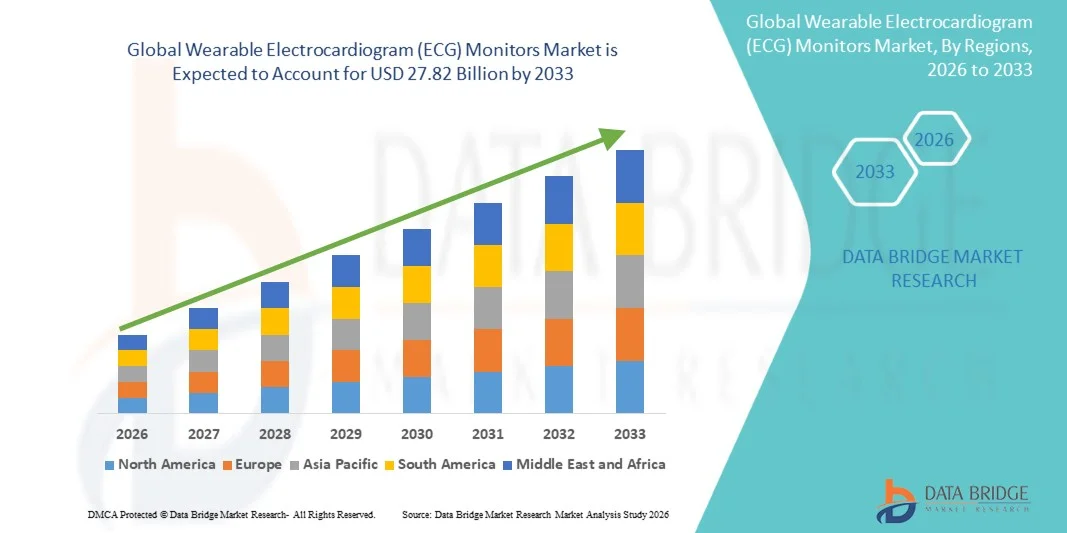
De acordo com a Data Bridge Market Research Analysis, o mercado de monitores de eletrocardiograma (ECG) foi avaliado emUSD 5,01 mil milhões em 2025e é projetado para alcançar27,82 mil milhões de USD até 2033, crescendo emCAGR de 23,90% de 2026 a 2033.O eletrocardiograma de uso (ECG) monitoriza o mercadoestá experimentando um crescimento forte e consistente impulsionado pela crescente carga global de doenças cardiovasculares, crescente demanda por monitoramento cardíaco contínuo e rápida expansão dos sistemas de saúde digital e Monitoramento Remoto de Pacientes (RPM). Prestadores de cuidados de saúde, hospitais e consumidores estão cada vez mais adotando dispositivos de ECG vestíveis, como smartwatches, patches e monitores portáteis para permitir a detecção precoce de arritmias, fibrilação atrial (AFib) e outras anormalidades cardíacas. A integração de sistemas de ECG wearable com smartphones, plataformas de nuvem e análises de IA está melhorando significativamente os diagnósticos em tempo real e os resultados de cuidados preventivos.
A crescente prevalência de distúrbios cardiovasculares, aliada à crescente conscientização sobre as iniciativas preventivas de cuidados de saúde e a crescente digitalização de cuidados de saúde, está impelindo hospitais, clínicas e usuários de cuidados domiciliares a adotar tecnologias avançadas de monitoramento de ECG wearable. Dispositivos contínuos de monitoramento do ECG estão substituindo cada vez mais os métodos tradicionais de testes episódicos, oferecendo rastreamento cardíaco de longa duração em tempo real que melhora o diagnóstico precoce e reduz eventos cardíacos de emergência. Além disso, avanços na miniaturização de sensores, algoritmos de detecção de arritmias baseados em IA e integração com plataformas de telessaúde estão acelerando ainda mais a adoção de monitores de ECG wearable em mercados de saúde desenvolvidos e emergentes.
Tamanho e previsão do mercado
- Valor de mercado global (2025):USD 5,01 Bilhões
- Valor de mercado previsto (2033):USD 27,82 Bilhões
- Previsões CAGR (2026-2033): 23.90%%
Principais tendências do mercado e perspectivas
- A América do Norte dominou o mercado de monitoramento do eletrocardiograma de desgaste (ECG) e representou uma parte significativa da receita de2% em 2025, apoiado pela adoção elevada de dispositivos de monitoramento cardíaco wearable de IA, forte penetração de programas de Monitoramento Remoto de Pacientes (RPM), infraestrutura avançada de saúde e foco crescente no diagnóstico precoce e cuidados cardíacos preventivos em hospitais e ambientes de cuidados domiciliares.
- O segmento Wireless Wearable ECG Monitors dominou o mercado com uma participação de 62,84% em 2025, devido à rápida adoção de sistemas de monitoramento remoto de pacientes e crescente demanda por rastreamento cardíaco contínuo em tempo real fora do ambiente hospitalar
- Asia-Pacific é esperado para ser a região de crescimento mais rápido em um CAGR de1% de 2026 a 2033, alimentado pelo aumento da prevalência de doenças cardiovasculares, aumento da digitalização de cuidados de saúde, expansão da adoção de telessaúde e crescente demanda por dispositivos de monitoramento de ECG wearable acessíveis em toda a China, Índia e Japão.
- Dispositivos de ECG sem fio dominaram o segmento tipo de produto com uma parte de7% em 2025, devido à crescente demanda por monitoramento cardíaco em tempo real, facilidade de uso, conectividade com smartphones e integração perfeita com plataformas de saúde digital baseadas em nuvem e aplicativos móveis.
- Segmento de aplicação de Fibrilação Atrial (AFib) liderou o mercado9% em 2025, impulsionada pelo aumento da incidência global de ritmos cardíacos irregulares, aumento do risco de acidente vascular cerebral e crescente demanda de monitoramento contínuo do ECG de longo prazo para detecção precoce e manejo de arritmias.
- Os hospitais dominaram o segmento do usuário final com uma parcela de receita de3% em 2025, devido à alta utilização de dispositivos de ECG vestíveis para monitoramento cardíaco contínuo, vigilância pós-operatória, atendimento de emergência e manejo crônico de doenças cardiovasculares.
- As configurações de cuidados domiciliares são esperadas para ser o segmento de usuário final mais rápido em um CAGR de8% entre 2026 e 2033, impulsionado pelo aumento da adoção de soluções de monitoramento remoto de pacientes, crescimento da população idosa e crescente mudança para modelos de saúde descentralizados e preventivos apoiados por tecnologias digitais de saúde wearable.
Relatório Escopo e eletrocardiograma de desgaste (ECG) Monitores Segmentação do Mercado
|
Atributos |
Eletrocardiograma Wearable (ECG) Monitores Principais Perspectivas do Mercado |
|
Segmentos Cobertos |
|
|
Países abrangidos |
América do Norte
Europa
Ásia- Pacífico
Médio Oriente e África
América do Sul
|
|
Jogadores do mercado chave |
|
|
Oportunidades de Mercado |
|
|
Informações sobre o Valor Adicionado |
Além dos insights sobre cenários de mercado, como valor de mercado, taxa de crescimento, segmentação, cobertura geográfica e principais atores, os relatórios de mercado curados pela Data Bridge Market Research também incluem análise de especialistas em profundidade, produção e capacidade em termos geográficos representadas pela empresa, layouts de redes de distribuidores e parceiros, análise detalhada e atualizada da tendência de preços e análise de déficit da cadeia de suprimentos e demanda. |
Qual é a tendência chave no eletrocardiograma de uso (ECG) Monitores Mercado
Tendência: Crescimento no monitoramento remoto do paciente e acompanhamento do desempenho esportivo
Monitores de ECG de uso estão testemunhando crescente adoção além de hospitais em ciência esportiva, atletismo profissional e programas de treinamento de resistência. Equipes esportivas de elite e academias de treinamento de maratona estão usando dispositivos de ECG wearable para monitorar continuamente a variabilidade da frequência cardíaca, detectar sinais precoces de fadiga e otimizar o desempenho do atleta durante sessões de treinamento de alta intensidade. Esses dispositivos fornecem dados de telemetria em tempo real, permitindo que treinadores e equipe médica avaliem o estresse cardiovascular e evitem eventos cardíacos súbitos durante esforços físicos extremos.
Por exemplo, em 2023-2024, vários clubes profissionais de futebol na Europa e os principais programas de esportes de resistência integraram sistemas de monitoramento cardíaco wearable para acompanhar o gerenciamento de carga e padrões de recuperação de atletas durante os campos de treinamento. Da mesma forma, remendos de ECG vestíveis e monitores torácicos são cada vez mais usados em ambientes de treinamento de ciclismo e esportes motores para analisar respostas fisiológicas em condições de corrida simuladas.
O eletrocardiograma de uso (ECG) monitora a dinâmica do mercado
Motorista do Mercado-Chave: Aumento da Carga de Doenças Cardiovasculares e Expansão de Programas de Monitoramento Remoto
A prevalência crescente de doenças cardiovasculares (DCVs) globalmente é um dos principais motores para a adoção do monitor de ECG wearable. Segundo estimativas globais de saúde, as DCV são responsáveis por quase17,9 milhões de mortes por ano, tornando o acompanhamento cardíaco contínuo uma prioridade crítica no cuidado à saúde. Isso aumentou significativamente a demanda por dispositivos de ECG wearable que permitem a detecção precoce de arritmias, fibrilação atrial e eventos isquêmicos.
Os sistemas de saúde nos EUA, Europa e Ásia-Pacífico estão cada vez mais integrando programas de monitoramento remoto de pacientes (RPM) em modelos de cuidados padrão. Dispositivos como monitores de ECG baseados em patch e sistemas Holter sem fio estão sendo implantados para pacientes cardíacos pós-alta para reduzir as taxas de readmissão hospitalar. Por exemplo, programas de monitoramento cardíaco em larga escala no sistema Medicare dos Estados Unidos têm expandido a cobertura de reembolso para dispositivos de ECG wearable, acelerando a adoção entre populações de envelhecimento e pacientes de alto risco.
Chave de retenção/desafio: Barreiras de alto custo e conformidade regulatória
Um desafio fundamental no mercado global de monitores de ECG wearable é o custo relativamente alto de dispositivos avançados e serviços de monitoramento associados. Sistemas contínuos de monitoramento de ECG muitas vezes requerem plataformas de análise baseadas em assinaturas, armazenamento em nuvem e serviços de revisão de médicos, aumentando o custo total de propriedade para provedores de saúde e pacientes.
Além disso, aprovações regulatórias rigorosas de agências como a FDA dos EUA e as autoridades europeias da CE ampliam significativamente os prazos de lançamento do produto. As empresas devem demonstrar precisão clínica a longo prazo, conformidade com a segurança de dados e interoperabilidade com sistemas hospitalares, o que aumenta os custos de desenvolvimento e atrasa a comercialização, particularmente para fabricantes de dispositivos médicos menores.
Oportunidade de Mercado-chave: Monitoramento Cardíaco Preditivo AI Possível e Ecossistemas de Saúde Digital
A integração deinteligência artificiale o aprendizado de máquina está criando oportunidades significativas no mercado de monitores de ECG wearable. Plataformas de ECG com IA podem detectar anomalias cardíacas sutis, predizer episódios de fibrilação atrial e gerar alertas precoces antes de eventos cardíacos críticos ocorrerem. Por exemplo, soluções de monitoramento cardíaco baseadas em IA demonstraram uma melhor acurácia de detecção para fibrilação atrial em comparação com a monitorização tradicional de Holter em estudos clínicos realizados entre 2022 e 2024. Empresas como a iRhythm Technologies Inc. e a AliveCor Inc. expandiram as plataformas de análise de ECG orientadas por IA integradas com painéis baseados em nuvem para médicos.
Além disso, o crescimento de ecossistemas de saúde digitais, plataformas de telemedicina e dispositivos de ECG integrados a smartphones está ampliando o acesso em mercados emergentes na Ásia-Pacífico, América Latina e Oriente Médio, onde a infraestrutura de saúde está digitalizando rapidamente.
O electrocardiograma (ECG) monitoriza o âmbito de aplicação do mercado
O mercado de Monitores de Eletrocardiograma Wearable (ECG) é segmentado com base no tipo, aplicação e usuário final.
- Por Tipo
Com base no tipo, o Mercado de Monitores de Eletrocardiograma Wearable (ECG) é segmentado em Monitores de ECG Wearable Wired e Monitores de ECG Wearable Wireless. O segmento Wireless Wearable ECG Monitors dominou o mercado com uma participação de 62,84% em 2025, devido à rápida adoção de sistemas de monitoramento remoto do paciente e crescente demanda por rastreamento cardíaco contínuo em tempo real fora do ambiente hospitalar. O segmento se beneficia da crescente integração com smartphones, plataformas de saúde baseadas em nuvem e ferramentas de diagnóstico orientadas por IA que melhoram a detecção precoce de doenças. Dispositivos sem fio como remendos ECG, alças torácicas vestíveis e sistemas de ECG baseados em smartwatch são cada vez mais preferidos devido ao seu conforto, mobilidade e facilidade de monitoramento de longo prazo. Além disso, o aumento da prevalência de doenças cardiovasculares, especialmente fibrilação atrial e arritmias, está impulsionando significativamente a adoção. O alargamento das infra-estruturas de telessaúde e o apoio ao reembolso nos mercados desenvolvidos reforçam ainda mais a penetração no mercado. Hospitais e prestadores de cuidados domiciliares estão cada vez mais mudando para sistemas sem fio para reduzir os custos de hospitalização. A sensibilização crescente para os cuidados de saúde preventivos também é encorajadora na adoção de pacientes de alto risco. Avanços tecnológicos na vida útil da bateria, precisão do sensor e conectividade sem fio estão melhorando ainda mais o desempenho do dispositivo.
Espera-se que o segmento Wireless Wearable ECG Monitors seja o segmento de crescimento mais rápido, registrando um CAGR de 8,2% de 2026 a 2033, impulsionado pela rápida expansão de programas de telemedicina e monitoramento cardíaco remoto globalmente. O aumento da adoção da saúde digital, especialmente na América do Norte, Europa e Ásia-Pacífico, está acelerando a demanda por soluções de ECG conectadas. O crescimento é ainda suportado por sistemas de interpretação de ECG habilitados para IA que fornecem alertas de risco cardíaco preditivos e análises em tempo real. O aumento da população idosa e o aumento da incidência de doenças cardiovasculares crónicas são os principais factores de crescimento. A integração com ecossistemas vestíveis, como smartwatches e rastreadores de fitness, está expandindo a adoção do consumidor. Os profissionais de saúde estão cada vez mais implementando dispositivos de ECG sem fio para monitoramento pós-alta para reduzir as taxas de readmissão. A crescente penetração de plataformas de saúde em nuvem e 5G está melhorando a eficiência da transmissão de dados. Além disso, os modelos de monitorização com base na subscrição de custos estão a aumentar a acessibilidade nas economias emergentes. A inovação contínua em sensores miniaturizados e dispositivos de ECG baseados em patch também está impulsionando a expansão do segmento.
- Por Aplicação
Com base na aplicação, o Eletrocardiograma Vestível (ECG) Monitores Market é segmentado em Fibrilação Atrial, Angina, Aterosclerose, Disritmia Cardíaca, Insuficiência Cardíaca Congestiva (CHF), Doença Arterial Coronariana, Ataque Cardíaco, Bradicardia e Taquicardia. O segmento de Fibrilação Atrial dominou o mercado com uma participação de 28,45% em 2025, principalmente devido à sua alta prevalência global e forte necessidade clínica de monitoramento contínuo do ritmo cardíaco. A fibrilação atrial é uma das arritmias cardíacas mais comuns e aumenta significativamente o risco de acidente vascular cerebral e insuficiência cardíaca, levando a demanda por soluções de detecção precoce. Monitores de ECG de uso permitem rastreamento contínuo e não invasivo do ritmo, melhorando a acurácia do diagnóstico em comparação com o Holter tradicional. O aumento da população idosa globalmente é um dos principais fatores contribuintes para o aumento da incidência de FA. Hospitais e clínicas de cardiologia estão adotando amplamente sistemas de ECG wearable para monitoramento de pacientes em longo prazo. A integração da interpretação do ECG baseado em IA melhorou ainda mais a eficiência de detecção. A conscientização crescente dos pacientes em relação aos cuidados cardíacos preventivos também está apoiando a adoção. Programas governamentais de saúde que promovem o diagnóstico precoce de doenças cardiovasculares estão acelerando o uso. A expansão dos programas de acompanhamento ambulatorial vem fortalecendo ainda mais a dominância do segmento.
Espera-se que o segmento de Fibrilação Atrial seja o segmento de crescimento mais rápido, registrando um CAGR de 8,6% de 2026 a 2033, impulsionado pelo aumento da carga cardiovascular e pela adoção crescente de ferramentas diagnósticas habilitadas para IA. O aumento da população geriátrica mundial está a aumentar significativamente as taxas de incidência de arritmias. A expansão de programas remotos de monitoramento de pacientes nos EUA e na Europa está acelerando a detecção e tratamento precoces. O aumento do uso de adesivos de ECG wearable no atendimento ambulatorial está melhorando a complacência do paciente. Os avanços tecnológicos na análise cardíaca em tempo real estão aumentando a precisão diagnóstica. A integração de dispositivos de ECG com aplicativos móveis de saúde está permitindo o engajamento contínuo do paciente. O aumento do gasto em saúde em economias emergentes está ampliando o acesso às tecnologias de monitoramento cardíaco. Colaborações farmacêuticas e médicas estão apoiando soluções de detecção de arritmias baseadas em IA. Campanhas de conscientização crescente sobre a prevenção de parada cardíaca súbita também estão contribuindo para o crescimento.
- Por Usuário Final
Com base no usuário final, o Mercado de Monitores de Eletrocardiograma (ECG) Wearable é segmentado em Hospitais, Configurações Homecare e Centros de Diagnóstico/Clínicas. O segmento dos Hospitais dominou o mercado com uma participação de 45,12% em 2025, devido ao alto fluxo de pacientes e uso extensivo de monitoramento cardíaco contínuo em situações de emergência, terapia intensiva e pós-operatório. Os hospitais dependem de dispositivos de ECG vestíveis para telemetria cardíaca em tempo real e detecção precoce de arritmias potencialmente fatais. O aumento da adoção de sistemas de monitoramento centralizados integrados aos sistemas de informação hospitalar está fortalecendo o uso. O aumento da carga de emergências cardiovasculares está aumentando a demanda no ambiente hospitalar. A disponibilidade de profissionais de saúde qualificados garante uma interpretação precisa dos dados do ECG. Os hospitais também beneficiam de quadros de reembolso avançados em regiões desenvolvidas. A integração com registros eletrônicos de saúde (REE) melhora a eficiência do gerenciamento do paciente. O aumento da implantação em UTIs cardíacas e emergências suporta a dominância do segmento. Avanços tecnológicos em sistemas de ECG vestíveis multileads estão aumentando ainda mais a adoção clínica.
Espera-se que o segmento de Homecare seja o segmento de crescimento mais rápido, registrando-se um CAGR de 9,1% de 2026 a 2033, impulsionado pelo deslocamento para o acompanhamento descentralizado e remoto dos pacientes. O aumento da população idosa e o aumento da prevalência de doenças cardíacas crônicas são fatores determinantes para o crescimento. Os pacientes estão cada vez mais preferindo soluções de monitoramento domiciliares para reduzir as visitas hospitalares. A expansão das plataformas de telessaúde está permitindo a conectividade médico-paciente em tempo real. Os serviços de ECG vestíveis baseados em assinaturas estão melhorando a acessibilidade e acessibilidade. A integração com smartphones e painéis de nuvem está aumentando a usabilidade. Os sistemas de saúde estão focados na redução das taxas de readmissão hospitalar através do monitoramento remoto. O crescimento da consciência preventiva em saúde está incentivando o diagnóstico precoce em casa. Avanços em adesivos de ECG leves e confortáveis estão melhorando a complacência do paciente. A crescente digitalização dos cuidados de saúde nos mercados emergentes está a acelerar ainda mais a adopção.
O eletrocardiograma de uso (ECG) monitora a análise regional do mercado
A América do Norte dominou o mercado de monitores de eletrocardiograma de desgaste (ECG) e representou a maior parte da receita de33,84% em 2025, apoiada pela alta adoção de dispositivos de monitoramento cardíaco wearable de IA, infraestrutura de saúde avançada, forte penetração de programas de monitoramento remoto de pacientes (RPM) e foco crescente na cardiologia preventiva. A região beneficia do uso generalizado de plataformas de saúde digitais, de fortes quadros de reembolso e da adoção precoce de dispositivos médicos conectados em hospitais e ambientes de cuidados domiciliares. O aumento da prevalência de doenças cardiovasculares e o aumento da população geriátrica estão acelerando ainda mais a demanda. A integração de dispositivos de ECG wearable com smartphones e plataformas de análise baseadas em nuvem está melhorando as capacidades de monitoramento em tempo real. Além disso, a forte presença dos principais intervenientes no mercado e a inovação contínua dos produtos está a reforçar a liderança da América do Norte no mercado global.
U.S. Wearable Eletrocardiograma (ECG) Monitores Market Insight
O mercado de Monitores de Eletrocardiograma Wearable (ECG) dos EUA está testemunhando forte crescimento devido ao aumento da prevalência de fibrilação atrial e doença arterial coronariana, aumento da digitalização de cuidados de saúde e rápida expansão de programas de monitoramento remoto de pacientes. O país possui um sistema de saúde altamente desenvolvido, apoiado em políticas avançadas de cobertura e reembolso de seguros que incentivam a adoção de dispositivos cardíacos wearable. A crescente integração das plataformas de interpretação de ECG baseadas em IA está melhorando o diagnóstico precoce e reduzindo as taxas de readmissão hospitalar. Os principais hospitais e centros de cardiologia estão cada vez mais implementando monitores de ECG baseados em patch e sem fio para rastreamento contínuo de pacientes. O aumento dos investimentos em startups digitais de saúde e plataformas de telessaúde está a apoiar ainda mais a expansão do mercado. Além disso, o aumento da conscientização dos consumidores sobre a saúde cardíaca preventiva e o monitoramento da aptidão física está impulsionando a adoção entre usuários não hospitalares. Forte apoio regulatório da FDA para dispositivos médicos wearable também está acelerando a comercialização.
Europe Wearable Eletrocardiograma (ECG) Monitora a Perspectiva do Mercado
O mercado europeu de monitorização do electrocardiograma de desgaste (ECG) continua a ser um importante contribuinte para as receitas globais, impulsionado por sistemas de saúde fortes, quadros regulamentares rigorosos e uma elevada sensibilização para a prevenção das doenças cardiovasculares. Países como Alemanha, França e Reino Unido são líderes em adotar tecnologias avançadas de monitoramento cardíaco wearable em ambientes clínicos e domiciliares. A região beneficia de iniciativas de saúde digital apoiadas pelo governo e de crescente implantação de plataformas de telemedicina. O envelhecimento da população e o aumento da incidência de distúrbios relacionados ao coração estão aumentando significativamente a demanda. Os prestadores europeus de cuidados de saúde estão a integrar cada vez mais dispositivos de ECG wearable em programas de gestão de doenças crónicas. A expansão de ferramentas de diagnóstico com IA e plataformas de monitoramento cardíaco baseadas em nuvem está melhorando ainda mais a eficiência da saúde. Além disso, fortes colaborações entre empresas de tecnologia médica e instituições de pesquisa estão impulsionando a inovação na precisão e usabilidade dos dispositivos.
O U.K. Wearable Eletrocardiograma (ECG) Monitora a Perspectiva do Mercado
O mercado de Monitores de Eletrocardiograma Wearable (ECG) do Reino Unido está experimentando crescimento constante, apoiado pelo aumento da adoção de soluções digitais de saúde e iniciativas de monitoramento remoto impulsionadas pelo NHS. O aumento da carga das doenças cardiovasculares e o enfoque governamental no diagnóstico precoce são os principais factores de crescimento. O Serviço Nacional de Saúde (NSH) está ativamente promovendo dispositivos cardíacos wearable para reduzir as internações hospitalares e melhorar os resultados dos pacientes. O uso crescente de dispositivos de ECG conectados com smartphones está permitindo maior acesso à monitorização cardíaca em ambientes de cuidado domiciliar. A integração de plataformas diagnósticas baseadas em IA está melhorando a acurácia de detecção de arritmias e fibrilação atrial. Além disso, crescentes investimentos em infraestrutura de telessaúde e programas hospitalares digitais vêm fortalecendo a adoção. A presença de empresas líderes de tecnologia médica e forte ecossistema de pesquisa clínica está apoiando ainda mais a inovação em tecnologias de ECG wearable.
Alemanha Eletrocardiograma Wearable (ECG) Monitores de mercado
O mercado de monitoramento de eletrocardiograma de desgaste da Alemanha (ECG) está se expandindo de forma constante devido à forte infraestrutura de saúde, alta adoção tecnológica e crescente carga de doenças cardiovasculares. A Alemanha tem uma indústria bem estabelecida de dispositivos médicos que suporta a rápida integração de soluções de ECG wearable em fluxos de trabalho clínicos. Hospitais e centros de diagnóstico estão adotando cada vez mais sistemas de monitoramento cardíaco contínuo para pacientes de alto risco. Um forte foco do governo na transformação digital da saúde está apoiando ainda mais o crescimento do mercado. O país também está testemunhando o uso crescente de sistemas de interpretação de ECG movidos por IA em departamentos de cardiologia. A crescente demanda por cuidados de saúde preventivos e diagnóstico precoce está impulsionando a adoção entre grupos populacionais em envelhecimento. Além disso, as colaborações entre empresas alemãs de tecnologia médica e instituições de pesquisa estão impulsionando a inovação na precisão dos sensores e design de dispositivos wearable.
Eletrocardiograma de desgaste Ásia-Pacífico (ECG) Monitora a Perspectiva do Mercado
Espera-se que o mercado de Monitores de Eletrocardiograma Wearable (ECG) Ásia-Pacífico testemunhe um rápido crescimento, impulsionado pelo aumento da prevalência de doenças cardiovasculares, pela expansão da infraestrutura de saúde e pela adoção crescente de tecnologias digitais de saúde. Países como China, Índia e Japão estão experimentando forte demanda por soluções de monitoramento cardíaco wearable acessíveis e escaláveis. Os crescentes investimentos em programas de telemedicina e monitoramento remoto de pacientes estão apoiando significativamente a expansão do mercado. O aumento da sensibilização para os cuidados de saúde preventivos e a detecção precoce de doenças está a impulsionar a adopção em regiões urbanas e semi-urbanas. A região também está testemunhando rápido crescimento na penetração de smartphones, permitindo maior uso de dispositivos de ECG conectados. As iniciativas governamentais para melhorar a acessibilidade à saúde estão acelerando ainda mais a adoção. Além disso, a expansão da fabricação local de medtech está reduzindo os custos do dispositivo e melhorando a disponibilidade.
O eletrocardiograma de uso do Japão (ECG) monitora a visão do mercado
O mercado de monitoramento de eletrocardiograma de desgaste do Japão (ECG) está testemunhando crescimento consistente devido ao seu rápido envelhecimento populacional e alta prevalência de distúrbios cardiovasculares. O Japão tem um dos sistemas de saúde mais avançados, permitindo a adoção precoce de tecnologias médicas wearable. Hospitais e clínicas estão cada vez mais integrando dispositivos de monitoramento do ECG em cuidados cardíacos de rotina e acompanhamento pós-operatório. A forte ênfase nos cuidados de saúde preventivos e no diagnóstico precoce está na procura de soluções de monitorização contínua. A integração de plataformas de saúde baseadas em IA e IoT está melhorando a análise cardíaca em tempo real. A forte indústria de eletrônicos e semicondutores do Japão também apoia a inovação em dispositivos ECG portáteis compactos e altamente precisos. Além disso, a crescente colaboração entre provedores de saúde e empresas de tecnologia está acelerando a transformação digital da saúde.
China Wearable Eletrocardiograma (ECG) Monitora a Perspectiva do Mercado
O mercado de monitoramento de eletrocardiograma (ECG) de desgaste da China está crescendo rapidamente devido ao aumento da urbanização, ao aumento da digitalização da saúde e ao forte apoio do governo para iniciativas de saúde inteligentes. A China tem uma grande população de pacientes que sofrem de doenças cardiovasculares, impulsionando significativamente a demanda por soluções contínuas de monitoramento cardíaco. A expansão das plataformas de telessaúde e dos sistemas de diagnóstico baseados em IA está acelerando a adoção de dispositivos de ECG wearable. Os fabricantes domésticos desempenham um papel fundamental na redução dos custos dos dispositivos e no aumento da acessibilidade. Os hospitais estão cada vez mais implementando sistemas de ECG sem fio para monitoramento remoto e atendimento de emergência. A crescente sensibilização da população para os cuidados de saúde preventivos está a apoiar a penetração no mercado. Além disso, iniciativas governamentais como “China saudável 2030” estão promovendo a adoção generalizada de tecnologias digitais de saúde. O país também está emergindo como um grande centro de inovação em dispositivos médicos wearable globalmente.
Eletrocardiograma Wearable (ECG) Monitores Market Share
A indústria de monitorização do eletrocardiograma de desgaste (ECG) é liderada principalmente por empresas bem estabelecidas, incluindo:
- iRhythm Technologies Inc. (EUA)
- AliveCor Inc. (EUA)
- Medtronic plc (Irlanda)
- GE HealthCare Technologies Inc. (EUA)
- Philips Healthcare (Países Baixos)
- Biosense Webster Inc. (EUA)
- Biotronik SE & Co. KG (Alemanha)
- Hillrom (Baxter) (EUA)
- OMRON Healthcare Co., Ltd. (Japão)
- Schiller AG (Suíça)
- Tecnologias médicas BPL (Índia)
- Cardiac Insight Inc. (EUA)
- Centros de Saúde do Espaço (EUA)
- Alive Technologies Pty Ltd (Austrália)
- Nihon Kohden Corporation (Japão)
- Shenzhen Mindray Bio-Medical Electronics Co., Ltd. (China)
- Samsung Medison (Coreia do Sul)
- General Electric Company (EUA)
- Boston Scientific Corporation (EUA)
- ZOLL Medical Corporation (EUA)
- Shenzhen Comen Medical Instruments Co., Ltd. (China)
- Wellysis Corp. (Coreia do Sul)
- Fukuda Denshi Co., Ltd. (Japão)
Mais recentes desenvolvimentos no eletrocardiograma de uso (ECG) Monitores Mercado
- Em fevereiro de 2021, a iRhythm Technologies, Inc. (U.S.) expandiu seu ecossistema de monitoramento cardíaco orientado por IA com a contínua escala de sua plataforma de adesivo Zio no mercado dos EUA, fortalecendo a adoção de monitoramento de longo prazo de ECG wearable para detecção de fibrilação atrial e cuidados cardíacos pós-agudos. A empresa relatou maior implantação de seu sistema de ECG baseado em retalhos em hospitais e ambientes ambulatoriais, reforçando sua liderança em monitoramento de ritmo cardíaco prolongado
- Em fevereiro de 2022, AliveCor Inc. (EUA) recebeu autorização da FDA dos EUA para seu KardiaMobile Card, um dispositivo de ECG pessoal de tamanho de cartão de crédito projetado para gravação de ritmo cardíaco em 30 segundos. O dispositivo representou um passo importante na inovação do ECG de nível de consumo, possibilitando a detecção portátil e sob demanda de arritmias, incluindo fibrilação atrial fora de ambientes clínicos.
- Em julho de 2022, a iRhythm Technologies, Inc. (EUA) recebeu autorização da FDA para o seu sistema ZEUS (Zio ECG Useization Software), desenvolvido em colaboração com Em verdade (Alphabet), integrando algoritmos baseados em IA para melhorar a detecção de fibrilação atrial e integração de fluxo de trabalho clínico com monitores de Zio ECG wearable.
- Em maio de 2023, AliveCor Inc. (U.S.) expandiu seu ecossistema KardiaMobile com adoção clínica mais ampla de seu dispositivo KardiaMobile 6L, que permite registros de ECG de seis derivações para uma melhor precisão de detecção de arritmias. A solução ganhou uso crescente em programas de monitoramento cardíaco remoto e aplicações psiquiátricas de triagem do intervalo QT em sistemas de saúde nos EUA e Reino Unido.
- Em junho de 2024, AliveCor Inc. (EUA) recebeu depuração dupla da FDA para seu Kardia 12L ECG System e tecnologia KAI 12L AI, permitindo que o primeiro dispositivo portátil de 12 derivações ECG com capacidade de IA para detectar até 35 doenças cardíacas, incluindo ataques cardíacos e arritmias. Isso marcou um avanço significativo no diagnóstico cardíaco vestível habilitado para IA
- Em outubro de 2024, a iRhythm Technologies, Inc. (EUA) recebeu autorização da FDA para modificações de projeto em seu sistema de monitoramento cardíaco wearable Zio AT, melhorando a confiabilidade do dispositivo e a qualidade dos dados para aplicações de monitoramento de ECG de longo prazo em configurações de atendimento ambulatorial e pós-hospitalar
- Em maio de 2024, WearLinq (U.S.) expandiu o acesso ao seu sistema de ECG wearable eWave liberado pela FDA através da aquisição de IAM Cardiac Monitoring, melhorando os serviços de monitoramento cardíaco ambulatorial e fortalecendo sua rede de entrega clínica para soluções de monitoramento de ECG wearable multi-leader
- Em julho de 2024, AliveCor Inc. (EUA) introduziu sua solução de IA InstantQT na Europa, ampliando as capacidades de interpretação digital do ECG para monitoramento do intervalo QT e aumentando a detecção precoce de condições de risco cardíaco através de plataformas de ECG wearable integradas com análises baseadas em nuvem
- Em outubro de 2024, iRhythm Technologies, Inc. (EUA) relatou contínuo progresso regulatório e ímpeto de comercialização para o seu sistema de ECG atualizado Zio AT patch, apoiando o melhor fluxo de trabalho de monitoramento cardíaco ambulatorial e fortalecendo a adoção em sistemas de saúde em toda a América do Norte e Europa
- Em junho de 2025, a pesquisa e desenvolvimento em sistemas de ECG wearable destacaram inovações de última geração em remendos de tórax sem fio e eletrodos baseados em tecido com o objetivo de melhorar o conforto de monitoramento de longo prazo e precisão de sinal, com ênfase em dispositivos de ECG de baixa potência habilitados para IoT para rastreamento contínuo de saúde cardíaca
SKU-
Obtenha acesso online ao relatório sobre a primeira nuvem de inteligência de mercado do mundo

- Painel interativo de análise de dados
- Painel de análise da empresa para oportunidades de elevado potencial de crescimento
- Acesso de analista de pesquisa para personalização e customização. consultas
- Análise da concorrência com painel interativo
- Últimas notícias, atualizações e atualizações Análise de tendências
- Aproveite o poder da análise de benchmark para um rastreio abrangente da concorrência
Metodologia de Investigação
A recolha de dados e a análise do ano base são feitas através de módulos de recolha de dados com amostras grandes. A etapa inclui a obtenção de informações de mercado ou dados relacionados através de diversas fontes e estratégias. Inclui examinar e planear antecipadamente todos os dados adquiridos no passado. Da mesma forma, envolve o exame de inconsistências de informação observadas em diferentes fontes de informação. Os dados de mercado são analisados e estimados utilizando modelos estatísticos e coerentes de mercado. Além disso, a análise da quota de mercado e a análise das principais tendências são os principais fatores de sucesso no relatório de mercado. Para saber mais, solicite uma chamada de analista ou abra a sua consulta.
A principal metodologia de investigação utilizada pela equipa de investigação do DBMR é a triangulação de dados que envolve a mineração de dados, a análise do impacto das variáveis de dados no mercado e a validação primária (especialista do setor). Os modelos de dados incluem grelha de posicionamento de fornecedores, análise da linha de tempo do mercado, visão geral e guia de mercado, grelha de posicionamento da empresa, análise de patentes, análise de preços, análise da quota de mercado da empresa, normas de medição, análise global versus regional e de participação dos fornecedores. Para saber mais sobre a metodologia de investigação, faça uma consulta para falar com os nossos especialistas do setor.
Personalização disponível
A Data Bridge Market Research é líder em investigação formativa avançada. Orgulhamo-nos de servir os nossos clientes novos e existentes com dados e análises que correspondem e atendem aos seus objetivos. O relatório pode ser personalizado para incluir análise de tendências de preços de marcas-alvo, compreensão do mercado para países adicionais (solicite a lista de países), dados de resultados de ensaios clínicos, revisão de literatura, mercado remodelado e análise de base de produtos . A análise de mercado dos concorrentes-alvo pode ser analisada desde análises baseadas em tecnologia até estratégias de carteira de mercado. Podemos adicionar quantos concorrentes necessitar de dados no formato e estilo de dados que procura. A nossa equipa de analistas também pode fornecer dados em tabelas dinâmicas de ficheiros Excel em bruto (livro de factos) ou pode ajudá-lo a criar apresentações a partir dos conjuntos de dados disponíveis no relatório.











