



Global Wind Turbine Nacelle Market, By Deployment (Onshore, Offshore), Turbine Capacity (Less than 1.5 MW, 1.5 to 2MW, 2 to 2.5 MW, Greater than 2.5 MW), Application (Residential, Utility, Industrial, Commercial) – Industry Trends and Forecast to 2029
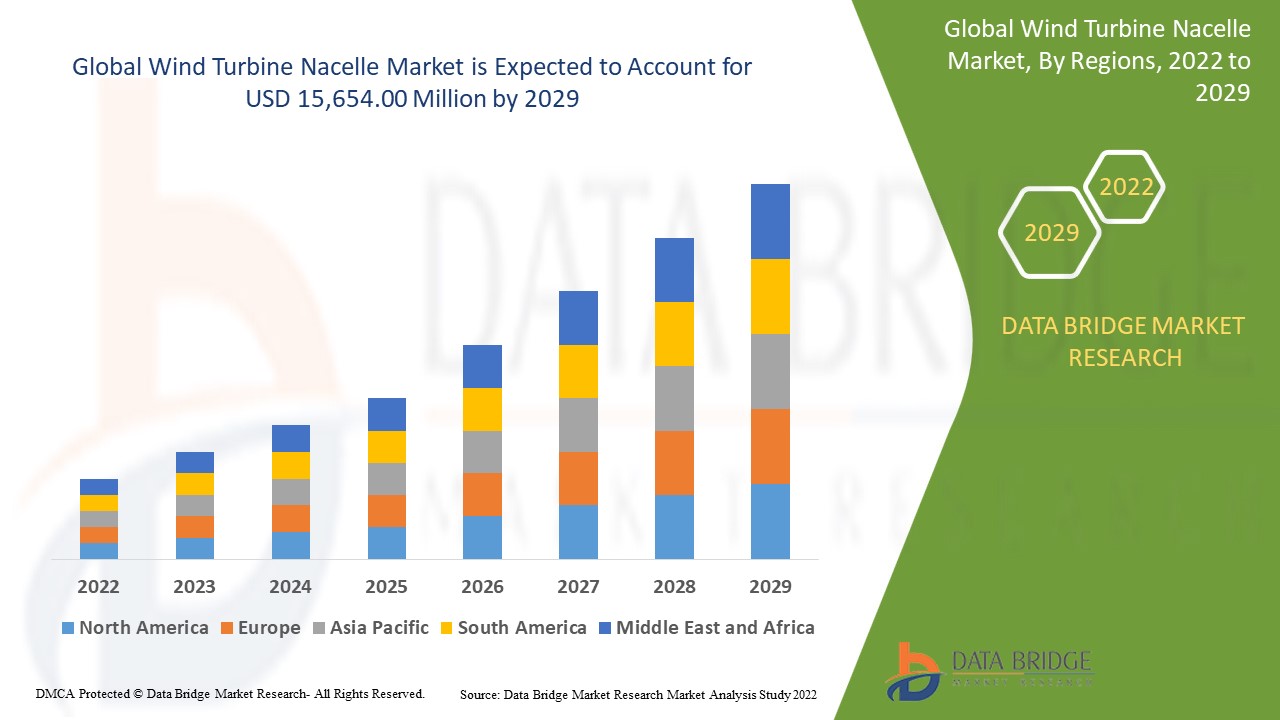
Wind Turbine Nacelle Market Analysis and Size
The wind industry is expected to grow at a rapid pace over the forecast period owing to the increased investments within the industry. For instance, GE has invested more than $400 million in developing the most potent offshore wind turbine in an effort to lower the level cost of energy (LCOE) of offshore wind farms and boost the affordability of offshore wind energy for our clients. The increase in investments accelerates the market's overall expansion. Additionally, it is expected that offshore wind farms would undoubtedly be essential in facilitating the expansion of installed infrastructure in a future era based on renewable energy sources. These elements will greatly aid the market's momentum over the forecast term.
Global wind turbine nacelle market was valued at USD 6,600.00 million in 2021 and is expected to reach USD 15,654.00 million by 2029, registering a CAGR of 11.40% during the forecast period of 2022-2029. The market report curated by the Data Bridge Market Research team includes technological advancements, regulatory framework, PESTEL, porter's five forces analysis, industry standards-at a glance, raw material costs/ operational expenditure-overview, supply chain analysis, vendor selection criteria, pricing analysis, production analysis, and climate chain scenario.
Wind Turbine Nacelle Market Scope and Segmentation
|
Report Metric |
Details |
|
Forecast Period |
2022 to 2029 |
|
Base Year |
2021 |
|
Historic Years |
2020 (Customizable to 2019 - 2014) |
|
Quantitative Units |
Revenue in USD Million, Volumes in Units, Pricing in USD |
|
Segments Covered |
Deployment (Onshore, Offshore), Turbine Capacity (Less than 1.5 MW, 1.5 to 2MW, 2 to 2.5 MW, Greater than 2.5 MW), Application (Residential, Utility, Industrial, Commercial) |
|
Countries Covered |
U.S., Canada, Mexico, Brazil, Argentina, Rest of South America, Germany, France, Italy, U.K., Belgium, Spain, Russia, Turkey, Netherlands, Switzerland, Poland, Norway, Finland, Rest of Europe, Japan, China, India, South Korea, Australia, Singapore, Malaysia, Thailand, Indonesia, Philippines, Rest of Asia-Pacific, U.A.E, Saudi Arabia, Egypt, South Africa, Israel, Nigeria, Algeria, Angola, Ghana, Rest of Middle East and Africa |
|
Market Players Covered |
General Electric (U.S.), Vestas (Denmark), Siemens (Spain), Goldwind (China), Shanghai Electric (China), ABB (Switzerland), Doosan Corporation (South Korea), Hitachi Ltd. (Japan), Nordex SE (Germany), EEW Group (Germany), Nexans (France), DEME (Belgium), Ming Yang Smart Energy Group Co (China), Envision (China), Rockwell Automation Inc., (U.S.), Hyundai Motor Company (South Korea), Schneider Electric (France), Zhejiang Windey Co., Ltd.,.(China), Taiyuan Heavy Industry Co., (China), Sinovel Wind Group Co., Ltd. (China) |
|
Market Opportunities |
|
Market Definition
Wind turbine nacelle is basically a part of wind turbine where the drive train and other tower-top parts of a wind turbine are housed. It rotates as the wind direction changes because a yaw bearing supports it. For maintenance and repairs, the nacelle must be reachable. Typically, an elevator inside the tower and ladders are used for access.
Wind Turbine Nacelle Market Dynamics
This section deals with understanding the market drivers, advantages, opportunities, restraints and challenges. All of this is discussed in detail as below:
Drivers
- Abundant Benefits of Wind Energy
Wind energy offers a variety of benefits and is one of the energy sources with the fastest pace of expansion globally, this has a significant economic impact in rural areas because most of the best wind sites are found there. Farmers and ranchers can continue to make a living off of the land because wind turbines only take up a little portion of it. The rent increases landowners' income that farmers and ranchers receive from wind power plant owners for the use of their land. As a result of wind energy's unlimited supply, the industry is expanding more swiftly. Additionally, a large section of the population is employed by it. For instance, over 100,000 people are employed in the United States as wind turbine technicians, one of the professions with the quickest growth rates. As a result, these advantageous qualities ultimately increase demand for wind turbine nacelles, accelerating the market's overall growth rate.
- Acceleration of Sustainable and Eco-Friendly Electricity Source
The wind turbines harness the power of the wind to produce electricity by constructing wind farms in aquatic bodies. This energy-producing technology is one of the most cutting-edge, economic, and environmentally friendly ones. They are larger, can withstand stronger winds, and offer a variety of advantages. The depletion of fossil fuel resources, climate change, and others, the energy sector has also seen a notable shift toward renewable and green energy due to complexities such as the need to reduce carbon emissions. Consequently, these environment-friendly features boost the demand for wind turbine, which directly impacts the market growth over the forecast period.
Furthermore, the usage of renewable energy sources will encourage industry expansion. Additionally, the factors such as rapid urbanization along with the mounting awareness regarding the benefits of using wind energy will further foster the market's growth.
Opportunities
- Mounting Technological Advancements
Furthermore, the technological advancements in the design of wind turbine materials, such as glass composites, to reduce the cost of maintenance and installation will further extend profitable opportunities to the market players in the forecast period of 2022 to 2029. Smaller, less expensive, and simpler to carry and assemble components are built using contemporary glass composites. These parts are additionally simple to install and fix. As a result, installation and upkeep costs are decreased, which will aid the market expansion.
- Numerous Favourable Government Policies
Environment-friendly initiatives by the government are estimated to boost the expansion rate of the market over the forecast period. Governments offer a variety of tax perks and incentives that are lowering component prices, which is predicted to improve the market for wind turbines. As a result, the favorable government policies and regulations associated with greener energy initiatives and the carbon footprint reduction generate various opportunities for the market.
Restraints/Challenges
- Dearth of Technical Expertise
According to analyses of the failure rates of various elements of the turbine, the electrical systems have the highest yearly failure rates of any fixed-base wind turbine component, exceeding 0.5 in some cases with an average downtime of just under two days per failure. This results from many technical problems that also need qualified specialists. Improved analysis techniques for combined wind and wave loading present on FOWT installations, adaptation of current manufacturing techniques to improve the performance of turbine blades, and optimization of power cabling connections for deep water offshore operations all contribute to an increased need for experts and professionals. The lack of technical skills is a significant obstacle to the expansion of the offshore wind business.
- High Overall Costs
The wind turbine nacelle's growth rate is slowed by its high capital cost. Furthermore, there are typically additional logistical challenges associated with wind turbines. The high capital cost of the wind turbine nacelle combined with the maintenance and installation costs, maintenance-related, and transportation costs. As a result, the cost limitations will present another significant challenge to the market expansion for wind turbine nacelles.
This wind turbine nacelle market report provides details of new recent developments, trade regulations, import-export analysis, production analysis, value chain optimization, market share, impact of domestic and localized market players, analyses opportunities in terms of emerging revenue pockets, changes in market regulations, strategic market growth analysis, market size, category market growths, application niches and dominance, product approvals, product launches, geographic expansions, technological innovations in the market. To gain more info on the wind turbine nacelle market contact Data Bridge Market Research for an Analyst Brief, our team will help you take an informed market decision to achieve market growth.
COVID-19 Impact on Wind Turbine Nacelle Market
The coronavirus pandemic had an adverse impact on the wind turbine nacelle market. The epidemic greatly hampered the production of wind turbines in countries such as China and Germany, which directly impacted the nacelle wind turbine. For instance, the German business Nordex SE reported negative EBITDA of $86.5 million, down from positive EBITDA of $21 million the prior. The shortage of maintenance workers and spare parts is a significant obstacle preventing the growth of the wind turbine nacelle industry. During the peak wind season, planned maintenance for industrial players became a major issue because of a labor shortage and social distance norms. Project delays and order cancellations have had an effect on the main markets for the installation of wind turbines and the production of blades. Also, due to a shortage of a large labor force and delays in obtaining permits, most of these projects are either at a standstill or postponed until the second half of the fiscal year.
Although the trend toward domestic supply chains may increase domestic wind turbine output, it may also reduce dependency on imports. This will further positively impact the wind turbine nacelle market. Furthermore, putting digitization into practice will enable remote project monitoring, minimizing the workforce as much as feasible. Furthermore, renewable energy has the power to stimulate the economy by creating "green" jobs, ensuring energy security, and enhancing resilience. By including energy transition into the overall recovery strategy, nations can develop the crucial capacity to absorb shocks from pandemics or other disturbances. As a result, it is anticipated that the market will grow quickly employing these strategies post- COVID period.
Recent Developments
- In November 2021, Vestas, the manufacturers of wind turbines, unveiled the first-ever modular nacelle design that allowed for customization. The product is said to shorten the time to market and simplify the different operations, building and maintenance processes. The manufacturer also believes that the modularized nacelle units, which make up the forthcoming product, may be moved over rail systems, bridge heights, and tunnels with a great deal less need for specialized handling
- In September 2021, A new nacelle assembly factory was officially opened by Siemens Gamesa Renewable Energy of Spain and Orsted of Denmark at the Port of Taichung in Taiwan. The facility serves as the duo's first base outside of Europe and is the first manufacturing plant in the Asia Pacific. The production plant will probably manufacture the nacelles for Orsted's 900MW Greater Changua 1 & 2a offshore wind farms in Taiwan.
Global Wind Turbine Nacelle Market Scope
The wind turbine nacelle market is segmented on the basis of deployment, turbine capacity and application. The growth amongst these segments will help you analyze meagre growth segments in the industries and provide the users with a valuable market overview and market insights to help them make strategic decisions for identifying core market applications.
Deployment
- Onshore
- Offshore
Turbine Capacity
- Less than 1.5 MW
- 1.5 to 2MW
- 2 to 2.5 MW
- Greater than 2.5 MW
Application
- Residential
- Utility
- Industrial
- Commercial
Wind Turbine Nacelle Market Regional Analysis/Insights
The wind turbine nacelle market is analyzed, and market size insights and trends are provided by country, deployment, turbine capacity and application as referenced above.
The countries covered in the wind turbine nacelle market report are U.S., Canada and Mexico in North America, Germany, France, U.K., Netherlands, Switzerland, Belgium, Russia, Italy, Spain, Turkey, Poland, Norway, Finland, Rest of Europe in Europe, China, Japan, India, South Korea, Singapore, Malaysia, Australia, Thailand, Indonesia, Philippines, Rest of Asia-Pacific (APAC) in the Asia-Pacific (APAC), Saudi Arabia, U.A.E, Israel, Egypt, South Africa, Nigeria, Algeria, Angola, Ghana, Rest of Middle East and Africa (MEA) as a part of Middle East and Africa (MEA), Brazil, Argentina and Rest of South America as part of South America.
Asia-Pacific dominates the wind turbine nacelle market in terms of market share and market revenue and will continue to flourish its dominance during the forecast period due to the rapid increase in demand for renewable sources of energy. The large consumer base will also foster the market growth in the region in the forecast period of 2022 to 2029.
North America, on the other hand, is estimated to show lucrative growth over the forecast period of 2022 to 2029 due to the region's increased wind power installation capacity. The market for wind turbine nacelles in these regions is anticipated to grow due to the growing promotion of power generation through renewable energy sources.
The country section of the report also provides individual market impacting factors and changes in market regulation that impact the current and future trends of the market. Data points like down-stream and upstream value chain analysis, technical trends and porter's five forces analysis, case studies are some of the pointers used to forecast the market scenario for individual countries. Also, the presence and availability of global brands and their challenges faced due to large or scarce competition from local and domestic brands, impact of domestic tariffs and trade routes are considered while providing forecast analysis of the country data.
Competitive Landscape and Wind Turbine Nacelle Market Share Analysis
The wind turbine nacelle market competitive landscape provides details by competitor. Details included are company overview, company financials, revenue generated, market potential, investment in research and development, new market initiatives, global presence, production sites and facilities, production capacities, company strengths and weaknesses, product launch, product width and breadth, application dominance. The above data points provided are only related to the companies' focus related to wind turbine nacelle market.
Some of the major players operating in the wind turbine nacelle market are
- General Electric (U.S.)
- Vestas (Denmark)
- Siemens (Spain)
- Goldwind (China)
- Shanghai Electric (China)
- ABB (Switzerland)
- Doosan Corporation (South Korea)
- Hitachi Ltd. (Japan)
- Nordex SE (Germany)
- EEW Group (Germany)
- Nexans (France)
- DEME (Belgium)
- Ming Yang Smart Energy Group Co (China)
- Envision (China)
- Rockwell Automation Inc., (U.S.)
- Hyundai Motor Company (South Korea)
- Schneider Electric (France)
- Zhejiang Windey Co., Ltd., (China)
- Taiyuan Heavy Industry Co., (China)
- Sinovel Wind Group Co., Ltd. (China)
SKU-
Obtenha acesso online ao relatório sobre a primeira nuvem de inteligência de mercado do mundo

- Painel interativo de análise de dados
- Painel de análise da empresa para oportunidades de elevado potencial de crescimento
- Acesso de analista de pesquisa para personalização e customização. consultas
- Análise da concorrência com painel interativo
- Últimas notícias, atualizações e atualizações Análise de tendências
- Aproveite o poder da análise de benchmark para um rastreio abrangente da concorrência
Metodologia de Investigação
A recolha de dados e a análise do ano base são feitas através de módulos de recolha de dados com amostras grandes. A etapa inclui a obtenção de informações de mercado ou dados relacionados através de diversas fontes e estratégias. Inclui examinar e planear antecipadamente todos os dados adquiridos no passado. Da mesma forma, envolve o exame de inconsistências de informação observadas em diferentes fontes de informação. Os dados de mercado são analisados e estimados utilizando modelos estatísticos e coerentes de mercado. Além disso, a análise da quota de mercado e a análise das principais tendências são os principais fatores de sucesso no relatório de mercado. Para saber mais, solicite uma chamada de analista ou abra a sua consulta.
A principal metodologia de investigação utilizada pela equipa de investigação do DBMR é a triangulação de dados que envolve a mineração de dados, a análise do impacto das variáveis de dados no mercado e a validação primária (especialista do setor). Os modelos de dados incluem grelha de posicionamento de fornecedores, análise da linha de tempo do mercado, visão geral e guia de mercado, grelha de posicionamento da empresa, análise de patentes, análise de preços, análise da quota de mercado da empresa, normas de medição, análise global versus regional e de participação dos fornecedores. Para saber mais sobre a metodologia de investigação, faça uma consulta para falar com os nossos especialistas do setor.
Personalização disponível
A Data Bridge Market Research é líder em investigação formativa avançada. Orgulhamo-nos de servir os nossos clientes novos e existentes com dados e análises que correspondem e atendem aos seus objetivos. O relatório pode ser personalizado para incluir análise de tendências de preços de marcas-alvo, compreensão do mercado para países adicionais (solicite a lista de países), dados de resultados de ensaios clínicos, revisão de literatura, mercado remodelado e análise de base de produtos . A análise de mercado dos concorrentes-alvo pode ser analisada desde análises baseadas em tecnologia até estratégias de carteira de mercado. Podemos adicionar quantos concorrentes necessitar de dados no formato e estilo de dados que procura. A nossa equipa de analistas também pode fornecer dados em tabelas dinâmicas de ficheiros Excel em bruto (livro de factos) ou pode ajudá-lo a criar apresentações a partir dos conjuntos de dados disponíveis no relatório.











