


Segmentação do Mercado Global de Conectividade Sem Fio, por Tecnologia de Conectividade (Wi-Fi, Bluetooth Clássico, Bluetooth 4X, Bluetooth 5X, ZigBee, Z-Wave, Thread, NFC, GNSS, EnOcean, Tecnologias Celulares M2M, UWB, LoRa, SigFox, NB-IoT, LTE CATM1 e Outras), Tipo (WLAN, WPAN, Satélite, LPWAN e Celular M2M), Uso Final (Dispositivos Vestíveis, Saúde, Eletrônicos de Consumo, Automação Predial, Automotivo e Transporte e Outros) - Tendências e Previsões do Setor até 2033
Qual é o tamanho e a taxa de crescimento do mercado global sem fio
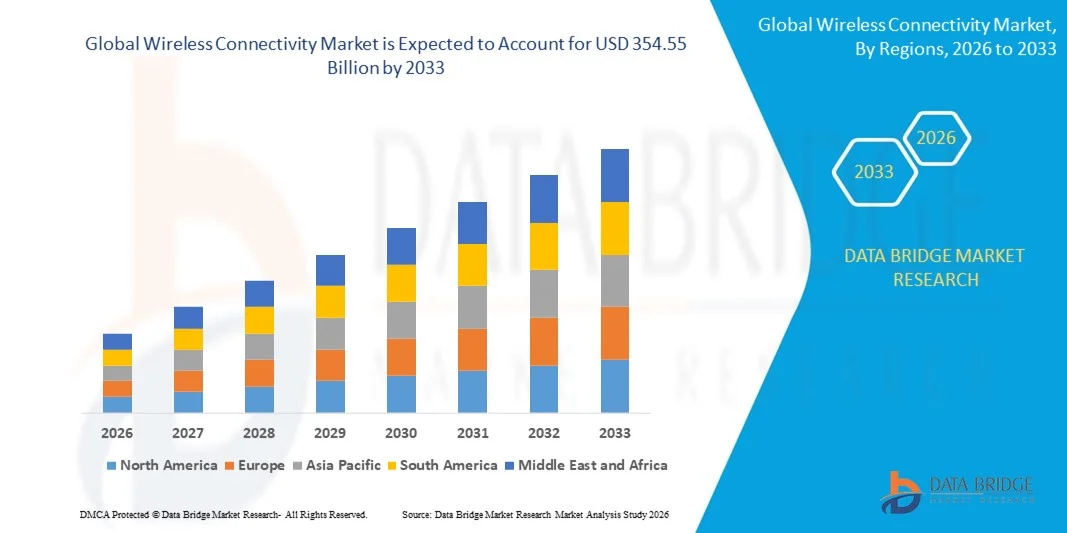
- Como por Data Bridge Market Research Analysis o tamanho global do mercado de conectividade sem fio foi avaliado em115,10 mil milhões de dólares em 2025e espera-se alcançarUSD 354,55 mil milhões até 2033, em umaCAGR de 15,10%durante o período de previsão
- O aumento da demanda por redes de sensores sem fio no desenvolvimento de infraestrutura inteligente atua como um dos principais fatores que impulsionam o mercado de conectividade sem fio
- O aumento da demanda por smartphones e outros dispositivos de tecnologia sem fio, como Wi-Fi, Bluetooth e ZigBee, e o aumento das tendências, tais como o trabalho em casa e aprendizagem virtual referente à pandemia COVID-19 dentro da região impulsionam o crescimento do mercado
Tamanho e previsão do mercado
- Valor de mercado global (2025):115,10 mil milhões de USD
- Valor de mercado previsto (2033):354,55 mil milhões de USD
- Previsões CAGR (2026-2033):15.10%
Quais são as principais opções do mercado de conectividade sem fio
- O aumento da procura de redes de área larga (LPWA) de baixa potência nas aplicações IoT e o aumento da taxa de penetração na Internet, influenciam ainda mais o mercado
- Além disso, a urbanização e digitalização, a adoção da Internet das Coisas (IoT) e o advento de avanços rápidos nas frequências de rádio afetam positivamente o mercado de conectividade sem fio. Além disso, o desenvolvimento da rede 5G e o apoio dos governos em todo o mundo para I&D na Internet das Coisas estendem oportunidades lucrativas aos intervenientes no mercado
- A América do Norte dominou o mercado de conectividade sem fio com uma quota de receita de 40,8% em 2025, impulsionada pela forte implantação de Wi-Fi 6/6E, infraestrutura Bluetooth 5X, 5G e ecossistemas avançados de IoT nos EUA e Canadá
- Asia-Pacific é projetado para registrar o CAGR mais rápido de 9,36% de 2026 a 2033, alimentado pela expansão rápida da fabricação de semicondutores, implantação em larga escala de 5G e forte produção de eletrônicos de consumo em toda a China, Japão, Índia, Coreia do Sul e Sudeste Asiático
- O segmento Wi-Fi dominou o mercado com uma participação estimada de 34,7% em 2025, impulsionada pela implantação generalizada em smartphones, laptops, Smart TVs, gateways industriais e sistemas de rede empresarial
Alcance do relatório e segmentação do mercado sem fio
|
Atributos |
Insights de mercado chave de conectividade sem fio |
|
Segmentos Cobertos |
|
|
Países abrangidos |
América do Norte
Europa
Ásia- Pacífico
Médio Oriente e África
América do Sul
|
|
Jogadores do mercado chave |
|
|
Oportunidades de Mercado |
|
|
Informações sobre o Valor Adicionado |
Além dos insights sobre cenários de mercado, como valor de mercado, taxa de crescimento, segmentação, cobertura geográfica e principais atores, os relatórios de mercado curados pela Data Bridge Market Research também incluem análise de especialistas em profundidade, análise de preços, análise de compartilhamento de marca, inquérito ao consumidor, análise demografia, análise da cadeia de suprimentos, análise da cadeia de valor, visão geral da matéria-prima/consumíveis, critérios de seleção de fornecedores, Análise de PESTLE, Análise de Porter e marco regulatório. |
Qual é a tendência chave no mercado de conectividade sem fio
Acelerando a integração de tecnologias sem fio de alta velocidade, baixa potência e multiprotocolo
- O mercado de conectividade sem fio está presenciando rápida integração de Wi-Fi 6/6E, Bluetooth Low Energy (BLE), 5G, Zigbee e UWB em chipsets compactos projetados para dispositivos IoT, casas inteligentes, automação industrial e eletrônicos de consumo
- Os fabricantes estão focando em arquiteturas de baixa potência, inteligência de borda e soluções multiprotocolo System-on-Chip (SoC) que permitem conectividade perfeita, latência reduzida e interoperabilidade aprimorada do dispositivo
- A crescente demanda por módulos sem fio compactos, eficientes em bateria e de alto rendimento está conduzindo a adoção em wearables inteligentes, veículos conectados, dispositivos de saúde e implantações industriais de IoT
- Por exemplo, empresas como a Qualcomm Technologies, Inc., MediaTek Inc., NXP Semicondutores e Nordic Semicondutor ASA introduziram SoCs sem fio avançados multi-padrão que suportam o processamento de bordas habilitados por IA e conectividade segura
- Aumentar a implantação de infraestrutura inteligente, soluções da indústria 4.0 e ecossistemas de consumo conectados está acelerando a mudança para plataformas de comunicação sem fio de alta velocidade e escalável
- À medida que os ecossistemas digitais se expandem globalmente, as tecnologias de conectividade sem fio continuarão a ser fundamentais para permitir o intercâmbio de dados em tempo real, a interoperabilidade dos dispositivos e as aplicações inteligentes de última geração
Quais são os principais drivers do mercado de conectividade sem fio
- A demanda crescente por dispositivos habilitados para IoT, eletrônica de consumo inteligente, equipamentos de saúde conectados e sistemas de telemática EV está aumentando significativamente o chipset sem fio e a adoção de módulos
- Por exemplo, em 2025, empresas líderes como a Broadcom Inc., a Texas Instruments Incorporated e a Renesas Electronics Corporation expandiram seus portfólios de conectividade com soluções avançadas de Wi-Fi, BLE e sub-GHz para aplicações industriais e automotivas
- O crescimento da implantação de redes 5G, projetos de cidades inteligentes e sistemas industriais conectados à nuvem nos EUA, Europa e Ásia-Pacífico está impulsionando a implantação de infraestrutura sem fio em larga escala
- Avanços na comunicação de baixa latência, na rede de malhas, na formação de vigas e na eficiência do espectro fortaleceram o desempenho, confiabilidade e cobertura
- A adoção crescente de dispositivos de borda alimentados por IA, protocolos de transferência de dados de alta velocidade e tecnologias seguras de autenticação sem fio está criando demanda por soluções avançadas de conectividade
- Apoiado por investimentos constantes em I&D de semicondutores, infraestrutura de telecomunicações e iniciativas de transformação digital, o mercado de conectividade sem fio é projetado para experimentar um crescimento sustentado a longo prazo
Qual fator está desafiando o crescimento do mercado de conectividade sem fio
- Altos custos de desenvolvimento e integração associados com chipsets avançados 5G, Wi-Fi 6/6E e multiprotocolo limitam a adoção entre fabricantes de dispositivos de pequena escala
- Por exemplo, durante 2024-2025, as flutuações nas cadeias de fornecimento de semicondutores e os preços dos componentes de RF afetaram os prazos de produção e os custos totais do dispositivo para vários fornecedores globais
- O aumento da complexidade na gestão de interferências, congestionamento do espectro, ameaças de cibersegurança e conformidade regulamentar levanta desafios técnicos e operacionais
- Infra-estrutura de rede limitada em certas economias emergentes restringe a penetração de tecnologia sem fios de alta velocidade
- A concorrência entre os padrões de conectividade e a rápida evolução tecnológica criam ciclos curtos de vida do produto e pressão de preços para os fabricantes de chipsets
- Para resolver essas questões, as empresas estão investindo em projetos de chip otimizados em custos, em frameworks de segurança aprimorados, em arquiteturas eficientes em termos energéticos e em soluções de interoperabilidade entre plataformas para fortalecer a adoção global de tecnologias de conectividade sem fio
Como é segmentado o mercado de conectividade sem fio
O mercado é segmentado com base emtecnologia de conectividade, tipo e uso final.
- Por Tecnologia de Conectividade
Com base na tecnologia de conectividade, o mercado de conectividade sem fio é segmentado em Wi-Fi, Bluetooth Classic, Bluetooth 4X, Bluetooth 5X, ZigBee, Z-Wave, Thread, NFC, GNSS, EnOcean, Cellular M2M Technologies, UWB, LoRa, SigFox, NB-IoT, LTE CAT-M1 e Outros. O segmento Wi-Fi dominou o mercado com uma participação estimada de 34,7% em 2025, impulsionada pela implantação generalizada em smartphones, laptops, Smart TVs, gateways industriais e sistemas de rede empresarial. Avanços contínuos, como Wi-Fi 6 e Wi-Fi 6E, melhoraram a produtividade, a latência e a eficiência do espectro, tornando o Wi-Fi a espinha dorsal da comunicação sem fio de alta velocidade. A adoção forte em casas inteligentes, escritórios e infraestrutura pública apoia ainda mais a liderança do segmento.
O segmento Cellular M2M Technologies é projetado para crescer no CAGR mais rápido de 2026 a 2033, alimentado pelo aumento da implantação de veículos conectados, medidores inteligentes, IoT industrial, rastreamento de ativos e monitoramento remoto de saúde. A expansão das redes 5G, NB-IoT e LTE CAT-M1 está acelerando a comunicação máquina-máquina em grande escala globalmente.
- Por Tipo
Com base no tipo, o mercado de conectividade sem fio é segmentado em WLAN, WPAN, Satellite, LPWAN e Cellular M2M. O segmento WLAN dominou o mercado com uma participação de 38,9% em 2025, principalmente devido à forte dependência em redes locais baseadas em Wi-Fi em ambientes residenciais, comerciais e industriais. As tecnologias WLAN fornecem altas taxas de transferência de dados, baixa latência e integração perfeita com a infraestrutura de TI empresarial. Aumentar a adoção de nuvem, modelos de trabalho híbridos e penetração de dispositivos inteligentes continuam a impulsionar a demanda de WLAN em economias desenvolvidas e emergentes.
Espera-se que o segmento LPWAN cresça no CAGR mais rápido de 2026 para 2033, apoiado pela expansão de implantações de IoT que exigem comunicação de longo alcance e baixa potência. Tecnologias como LoRa e SigFox estão ganhando ímpeto na agricultura inteligente, cidades inteligentes, logística e monitoramento de utilidades, onde a vida útil prolongada da bateria e a cobertura ampla da área são fundamentais.
- Por Uso Final
Com base no uso final, o mercado de conectividade sem fio é segmentado em dispositivos de uso, saúde, eletrônica de consumo, automação de construção, automotivo e transporte, e outros. O segmento Consumer Electronics dominou o mercado com 41,3% de participação em 2025, impulsionado pela alta penetração de smartphones, tablets, dispositivos domésticos inteligentes, consoles de jogos e sistemas de áudio sem fio. A rápida inovação do produto, o aumento da penetração na internet e a crescente demanda por interoperabilidade do dispositivo sem costura contribuem significativamente para o crescimento do segmento. A integração de Wi-Fi, Bluetooth 5X e UWB em dispositivos de próxima geração fortalece ainda mais a adoção de conectividade.
O segmento Automotive & Transportation é projetado para crescer no CAGR mais rápido de 2026 a 2033, impulsionado pelo aumento da integração de plataformas de carros conectados, comunicação V2X, telemática EV, sistemas ADAS e infotainment no veículo. A digitalização crescente das arquiteturas de veículos e a ênfase regulatória na conectividade de veículos estão acelerando a implantação de tecnologia sem fio no setor automotivo.
Qual região detém a maior parte do mercado de conectividade sem fio
- A América do Norte dominou o mercado de conectividade sem fio com uma quota de receita de 40,8% em 2025, impulsionada pela forte implantação de Wi-Fi 6/6E, infraestrutura Bluetooth 5X, 5G e ecossistemas avançados de IoT nos EUA e Canadá. Alta adoção de dispositivos conectados, tecnologias caseiras inteligentes, plataformas industriais de IoT e sistemas de comunicação integrados à nuvem continuam a abastecer a demanda regional
- Empresas líderes como a Qualcomm Technologies, Inc., Broadcom Inc. e Texas Instruments Incorporated estão continuamente introduzindo chipsets multiprotocolo avançados, módulos front-end RF e plataformas de conectividade seguras, fortalecendo a liderança tecnológica
- Forte infraestrutura de telecomunicações, implantação inicial de 5G, elevados gastos em I&D e rápida transformação digital entre empresas reforçam ainda mais a posição dominante do mercado norte-americano
U.S. Wireless Conectivity Market Insight
Os EUA representam o maior contribuinte na América do Norte, apoiado por ampla inovação em semicondutores, implantação em larga escala de 5G e integração generalizada de módulos sem fio em setores automotivos, de saúde, eletrônicos de consumo e de automação industrial. Aumentar o desenvolvimento de dispositivos de borda habilitados para IA, sistemas de conectividade EV, redes de cidades inteligentes e plataformas de nuvem empresarial intensifica a demanda por soluções sem fio de alta velocidade e baixa latência. Presença de fabricantes líderes de chipsets, ecossistemas startup fortes e investimentos contínuos em infraestrutura de telecomunicações de próxima geração impulsionam expansão sustentada do mercado.
Canadá Wireless Conectivity Market Insight
O Canadá contribui significativamente para o crescimento regional, impulsionado pela expansão da adoção de IoT, modernização das telecomunicações e implantação crescente de projetos de infraestrutura inteligentes. O uso crescente de módulos sem fio em sistemas de monitoramento de saúde, automação industrial e gerenciamento de energia suporta a demanda constante. Iniciativas de transformação digital apoiadas pelo governo, universidades de pesquisa fortes e cobertura crescente 5G aceleram ainda mais a adoção de conectividade sem fio em aplicações comerciais e públicas.
Mercado de conectividade sem fio Ásia-Pacífico
Asia-Pacific é projetado para registrar o CAGR mais rápido de 9,36% de 2026 a 2033, alimentado pela expansão rápida da fabricação de semicondutores, implantação em larga escala de 5G, e forte produção de eletrônicos de consumo em toda a China, Japão, Índia, Coreia do Sul e Sudeste Asiático. A produção maciça de smartphones, dispositivos IoT, eletrônicos automotivos e sensores industriais aumenta significativamente a demanda por tecnologias sem fio escaláveis e eficientes em termos de custos. Aumentar os investimentos em hardware de IA, fabricação inteligente e infraestrutura digital acelera ainda mais o crescimento do mercado regional.
China Wireless Conectividade Market Insight
A China lidera a região Ásia-Pacífico devido à sua base de fabricação de eletrônicos dominante e expansão agressiva de infraestrutura 5G. Forte apoio do governo para auto-confiança de semicondutores, desenvolvimento de IoT e iniciativas de cidades inteligentes impulsionam a adoção de tecnologias Wi-Fi, M2M celulares e LPWAN. Capacidades de produção competitivas e grande demanda interna fortalecem a posição da China no ecossistema global de conectividade sem fio.
Japan Wireless Conectivity Market Insight
O Japão demonstra crescimento constante apoiado por redes de telecomunicações avançadas, inovação automotiva e desenvolvimento de robótica. Aumentar a integração da comunicação sem fio em veículos conectados, fábricas inteligentes e sistemas de saúde alimenta a demanda. Foco na confiabilidade, padrões de comunicação de alta velocidade e engenharia de precisão sustenta a expansão de longo prazo do mercado.
Índia Wireless Conectivity Market Insight
A Índia está emergindo como um mercado de alto crescimento impulsionado pela penetração de smartphones, programas digitais apoiados pelo governo e implantação crescente de IoT. O crescimento da infraestrutura de telecomunicações, conectividade EV e automação industrial fortalece a demanda por chipsets e módulos sem fio. Expandir os centros de design de semicondutores e os ecossistemas startup suportam ainda mais a aceleração do mercado.
Visão do mercado de conectividade sem fio da Coreia do Sul
A Coreia do Sul contribui significativamente devido à forte liderança 5G, fabricação avançada de semicondutores e alta adoção de eletrônica de consumo inteligente. A rápida inovação em processadores de IA, dispositivos de memória e plataformas automotivas conectadas aumenta a confiança em soluções sem fio de alto desempenho. O progresso tecnológico e a produção electrónica orientada para as exportações continuam a reforçar o crescimento regional.
Quais são as principais empresas no mercado de conectividade sem fio
A indústria de conectividade sem fio é liderada principalmente por empresas bem estabelecidas, incluindo:
- Corporação Intel (EUA)
- Texas Instruments Incorporated (EUA)
- Qualcomm Technologies, Inc. (EUA)
- Broadcom Inc. (EUA)
- STMicroelectrónica (Suíça)
- Semicondutores NXP (Países Baixos)
- Microchip Technology Inc. (EUA)
- MediaTek Inc. (Taiwan)
- Cypress Semiconductor Corporation (EUA)
- Renessas Electronics Corporation (Japão)
- EnOcean GmbH (Alemanha)
- NEXCOM International Co., Ltd. (Taiwan)
- Skyworks Solutions, Inc. (EUA)
- Murata Manufacturing Co., Ltd. (Japão)
- Marvell Technology, Inc. (EUA)
- Semicondutor nórdico ASA (Noruega)
- SISTEMAS DE ESPRESSÃO (SHANGHAI) CO., LTD. (China)
- CEVA, Inc. (EUA)
- Quantenna Communications, Inc. (EUA)
- PERASO TECNOLOGIAS INC. (Canadá)
- Panasonic Corporation (Japão)
Quais são os recentes desenvolvimentos no mercado global de conectividade sem fio
- Em maio de 2024, a AST SpaceMobile anunciou planos para implantar cinco satélites comerciais em órbita baixa da Terra para permitir uma rede de banda larga baseada no espaço que se conecta diretamente aos telefones celulares através da rede AT&T, fortalecendo a conectividade direta ao dispositivo global e ampliando a cobertura em regiões remotas e carentes, acelerando assim a evolução da comunicação sem fio via satélite em todo o mundo
- Em maio de 2024, a Lightstorm entrou em uma colaboração estratégica com o Console Connect para oferecer conectividade de rede aprimorada e acesso contínuo à nuvem em mais de 180 data centers globalmente, melhorando a infraestrutura digital de nível empresarial e permitindo soluções escaláveis de conectividade sob demanda para empresas em todo o mundo
- Em maio de 2024, Elisa revelou seu plano de introduzir novas assinaturas de banda larga de rede independente 5G para empresas e consumidores, desbloqueando recursos avançados de 5G, como ultra-baixa latência e corte de rede, criando assim oportunidades comerciais mais fortes e acelerando a adoção sem fio de próxima geração
- Em maio de 2024, Blues, em parceria com Arduino, lançou o módulo de expansão “Blues Wireless for Arduino Opta” na Automate em Chicago, aprimorando as capacidades de conectividade para o Arduino Opta micro-PLC e possibilitando uma integração industrial mais eficiente da IoT, fortalecendo assim soluções de automação sem fio em ambientes de fabricação inteligentes
SKU-
Obtenha acesso online ao relatório sobre a primeira nuvem de inteligência de mercado do mundo

- Painel interativo de análise de dados
- Painel de análise da empresa para oportunidades de elevado potencial de crescimento
- Acesso de analista de pesquisa para personalização e customização. consultas
- Análise da concorrência com painel interativo
- Últimas notícias, atualizações e atualizações Análise de tendências
- Aproveite o poder da análise de benchmark para um rastreio abrangente da concorrência
Metodologia de Investigação
A recolha de dados e a análise do ano base são feitas através de módulos de recolha de dados com amostras grandes. A etapa inclui a obtenção de informações de mercado ou dados relacionados através de diversas fontes e estratégias. Inclui examinar e planear antecipadamente todos os dados adquiridos no passado. Da mesma forma, envolve o exame de inconsistências de informação observadas em diferentes fontes de informação. Os dados de mercado são analisados e estimados utilizando modelos estatísticos e coerentes de mercado. Além disso, a análise da quota de mercado e a análise das principais tendências são os principais fatores de sucesso no relatório de mercado. Para saber mais, solicite uma chamada de analista ou abra a sua consulta.
A principal metodologia de investigação utilizada pela equipa de investigação do DBMR é a triangulação de dados que envolve a mineração de dados, a análise do impacto das variáveis de dados no mercado e a validação primária (especialista do setor). Os modelos de dados incluem grelha de posicionamento de fornecedores, análise da linha de tempo do mercado, visão geral e guia de mercado, grelha de posicionamento da empresa, análise de patentes, análise de preços, análise da quota de mercado da empresa, normas de medição, análise global versus regional e de participação dos fornecedores. Para saber mais sobre a metodologia de investigação, faça uma consulta para falar com os nossos especialistas do setor.
Personalização disponível
A Data Bridge Market Research é líder em investigação formativa avançada. Orgulhamo-nos de servir os nossos clientes novos e existentes com dados e análises que correspondem e atendem aos seus objetivos. O relatório pode ser personalizado para incluir análise de tendências de preços de marcas-alvo, compreensão do mercado para países adicionais (solicite a lista de países), dados de resultados de ensaios clínicos, revisão de literatura, mercado remodelado e análise de base de produtos . A análise de mercado dos concorrentes-alvo pode ser analisada desde análises baseadas em tecnologia até estratégias de carteira de mercado. Podemos adicionar quantos concorrentes necessitar de dados no formato e estilo de dados que procura. A nossa equipa de analistas também pode fornecer dados em tabelas dinâmicas de ficheiros Excel em bruto (livro de factos) ou pode ajudá-lo a criar apresentações a partir dos conjuntos de dados disponíveis no relatório.











