



Middle East and Africa Hospital Workforce Management Software market, By Offering (Solutions and Services), Deployment Model (Cloud and On-Premise), Organization Size (Large Organization (Multi-Chain) and Small & Medium Organization), Application (Recruitment, Time and Attendance Management, Scheduling, Training & Development, Compliance Management, Inventory Management, HR and Payroll, Salary & Compensation Management, Analytics, and Others), Pricing Category (Subscription and One Time License), Ownership (Public and Private), End-User (General Medical & Surgical Hospitals, Teaching Hospitals, Community Hospitals, Specialty Hospitals, and Others) - Industry Trends and Forecast to 2030.
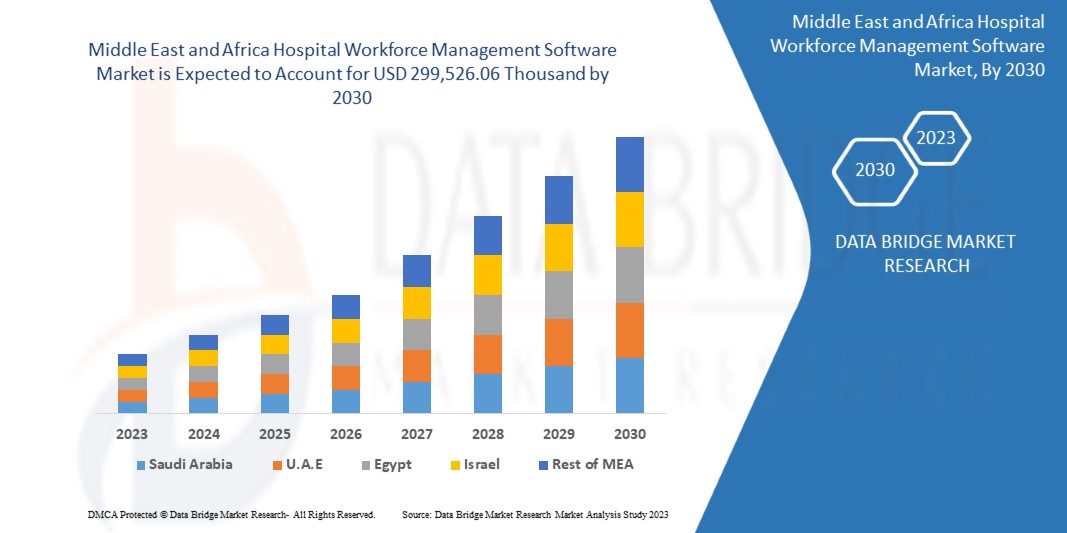
Middle East and Africa Hospital Workforce Management Software Market Analysis and Size
Growing demand for healthcare services drives the Middle East and Africa hospital workforce management software market. However, complexities in integrating different workforce management are restraining the growth of the Middle East and Africa hospital workforce management software market. The upsurge of development and integration of new technologies is estimated to provide opportunities for Middle East and Africa hospital workforce management software market growth. However, the higher probability of data breaches has become a market growth challenges.
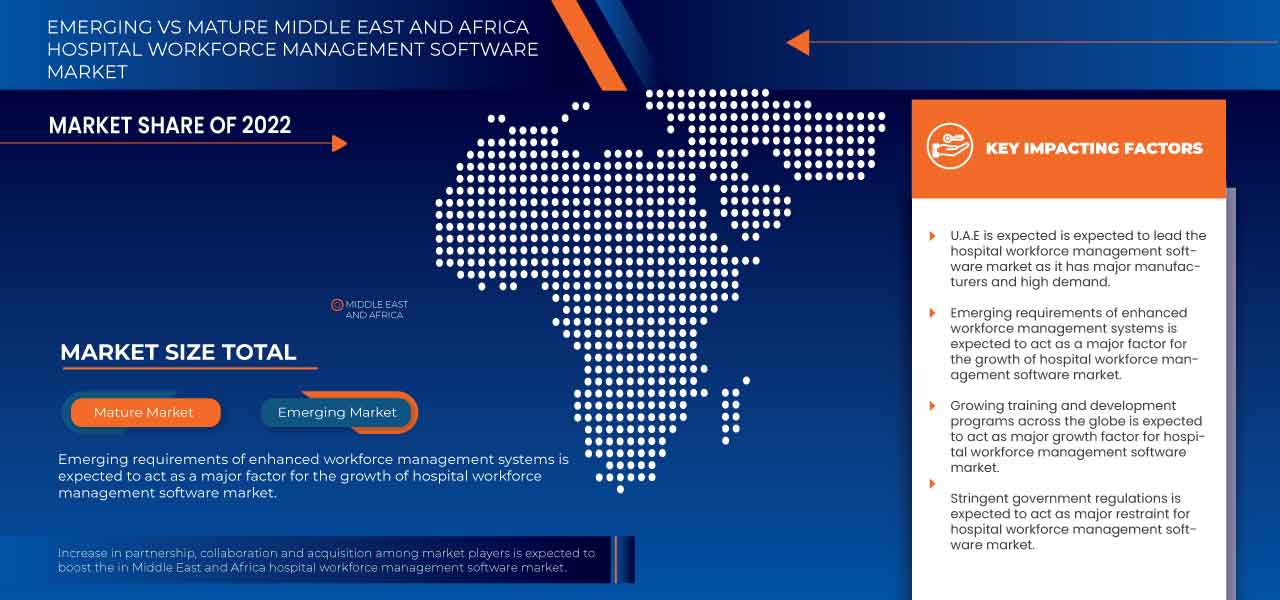
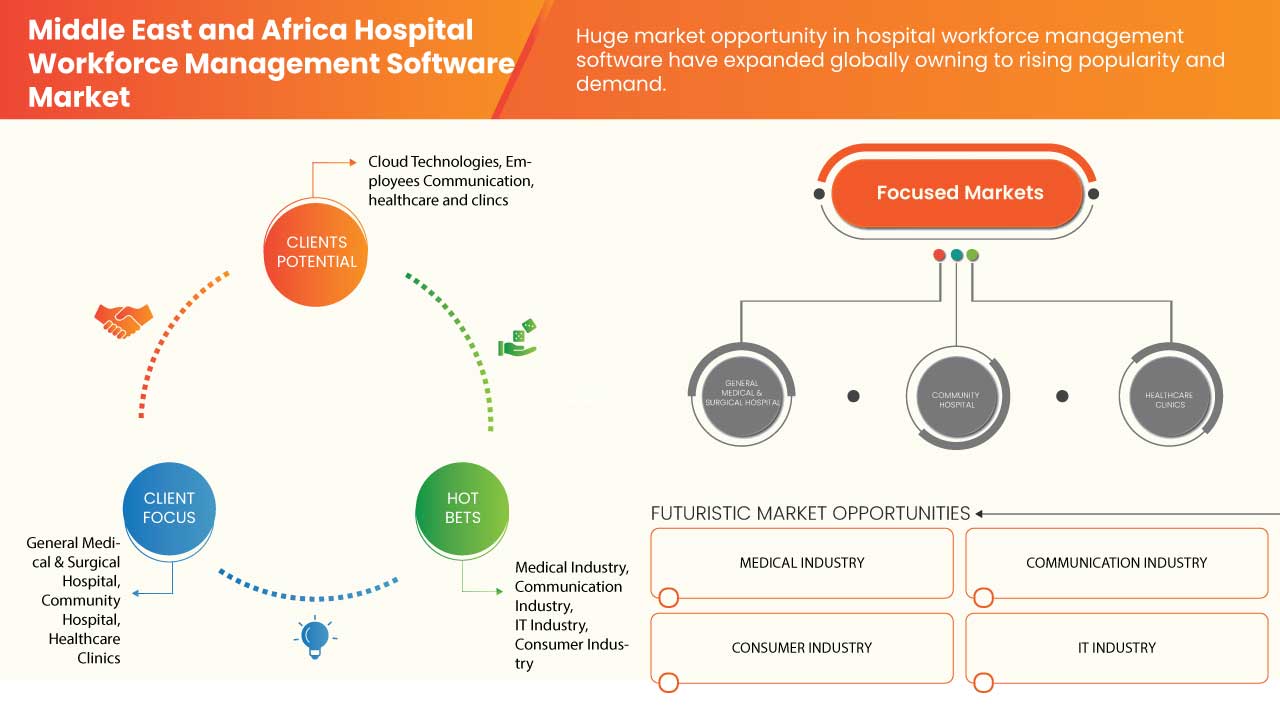
Data Bridge Market Research analyses that the Middle East and Africa hospital workforce management software market is expected to reach a value of USD 299,526.06 thousand by 2030, at a CAGR of 11.8% during the forecast period. The Middle East and Africa hospital workforce management software market report also comprehensively covers pricing analysis, patent analysis, and technological advancements.
|
Report Metric |
Details |
|
Forecast Period |
2023 to 2030 |
|
Base Year |
2022 |
|
Historic Years |
2021 (Customizable to 2015-2020) |
|
Quantitative Units |
Revenue in Thousand, Pricing in USD |
|
Segments Covered |
Offering (Solutions and Services), Deployment Model (Cloud and On-Premise), Organization Size (Large Organization (Multi-Chain) and Small & Medium Organization), Application (Recruitment, Time and Attendance Management, Scheduling, Training & Development, Compliance Management, Inventory Management, HR and Payroll, Salary & Compensation Management, Analytics, and Others), Pricing Category (Subscription and One Time License), Ownership (Public and Private), End-User (General Medical & Surgical Hospitals, Teaching Hospitals, Community Hospitals, Specialty Hospitals, and Others) |
|
Countries Covered |
South Africa, Egypt, Saudi Arabia, Kuwait, Egypt, U.A.E, Israel and Rest of Middle East and Africa |
|
Market Players Covered |
ATOSS Software AG, Cornerstone, WorkForce Software, LLC, Quinyx AB, Timeware Inc, Zebra Technologies Corp, Workday, Inc., GE HealthCare, Oracle, BM Corporation, SAP SE, Verint Systems Inc., Infor, ADP, Inc., NICE, UKG Inc., and ROUBLER |
Market Definition
Workforce management (WFM) is a set of processes that aim to maximize performance and productivity for an organization and its staff members. It involves scheduling, forecasting, data collection, training, and analytics. It can be used across different industries and operations. It may also be called HRM systems, workforce asset management, or part of ERP systems. Workforce management creates a consistent framework for all the activities needed to operate efficiently and align with an organization's top priorities and goals. Inconsistent policies and practices come at a price, from high turnover to reputational damage and non-compliance issues.
Workforce management software can come as a standalone program or as part of a broader HR system, such as a human resource information system (HRIS) with data management capabilities or a human resource management system (HRMS) that unifies all human resource processes and data from core HR and payroll to talent management.
The functions of workforce management solutions are enhanced when integrated into smart HRMS and ERP systems that combine and analyze workforce and other business datasets. Integration, a key consideration while selecting software, is its ability to support total workforce management.
Middle East and Africa Hospital workforce management software Market Dynamics
This section deals with understanding the market drivers, advantages, opportunities, restraints, and challenges. All of this is discussed in detail below:
DRIVERS
- GROWING DEMAND FOR HEALTHCARE SERVICES ACROSS THE GLOBE
The healthcare services consist of medical assistance from professionals, organizations, and ancillary healthcare workers. These services include different types of care and providers. The different healthcare services include mental health care, dental care, prenatal care, pharmaceutical care, laboratory and diagnostic care, and others.
- RISE IN THE OPTIMIZATION OF THE WORKFORCE
Workforce optimization is a management practice and strategic imperative that focuses on improving a company's employees' efficiency, productivity, and performance. The overall goal is to improve organizational success. Optimizing the workforce will empower human resources and keep track of peak performance.
OPPORTUNITY
- RISE IN THE DIGITALIZATION TREND ACROSS THE GLOBE
The digitalization of hospital workforce management software is an important step toward improving the efficiency and effectiveness of healthcare operations. This software can help hospital administrators manage healthcare facilities' complex and ever-changing staffing requirements, such as scheduling, payroll, and compliance with labor regulations.
RESTRAINTS/CHALLENGES
- COMPLEXITIES IN THE INTEGRATION OF DIFFERENT WORKFORCE MANAGEMENT
Workforce management is getting recognized in the market because of the benefits of the business process and operations. Moreover, there are numerous providers in the market and different types of workforce management software and tools. The consumer has to understand the requirement and then decide on the tools and techniques required for the existing business model.
- HIGH COST ASSOCIATED WITH DEPLOYMENT
Workforce management is an umbrella term for various instruments and arrangements utilized by organizations to deal with their labour force, from building their lists, making work timetables, and movements for shift-based organizations to following work hours and securing work proof of work for remote or field laborers.
Recent Developments
- In November 2020, Elite Dynamics announced a partnership with Microsoft Gold. The partnership help demonstrates expertise in delivering quality solutions for the Middle East and Africa holiday park sector. This partnership will be providing first-class software solutions to transform the holiday parks industry and evolve digitally transformation. This will help to improve the brand image of the company.
- In October 2020, MYOB acquired workforce management capabilities with a roubles investment. The company develops an end-to-end business management platform across Australia and New Zealand. The company built an artificial intelligence (AI) enabled workforce management solutions for its customer base.
Middle East and Africa Hospital Workforce Management Software Market Scope
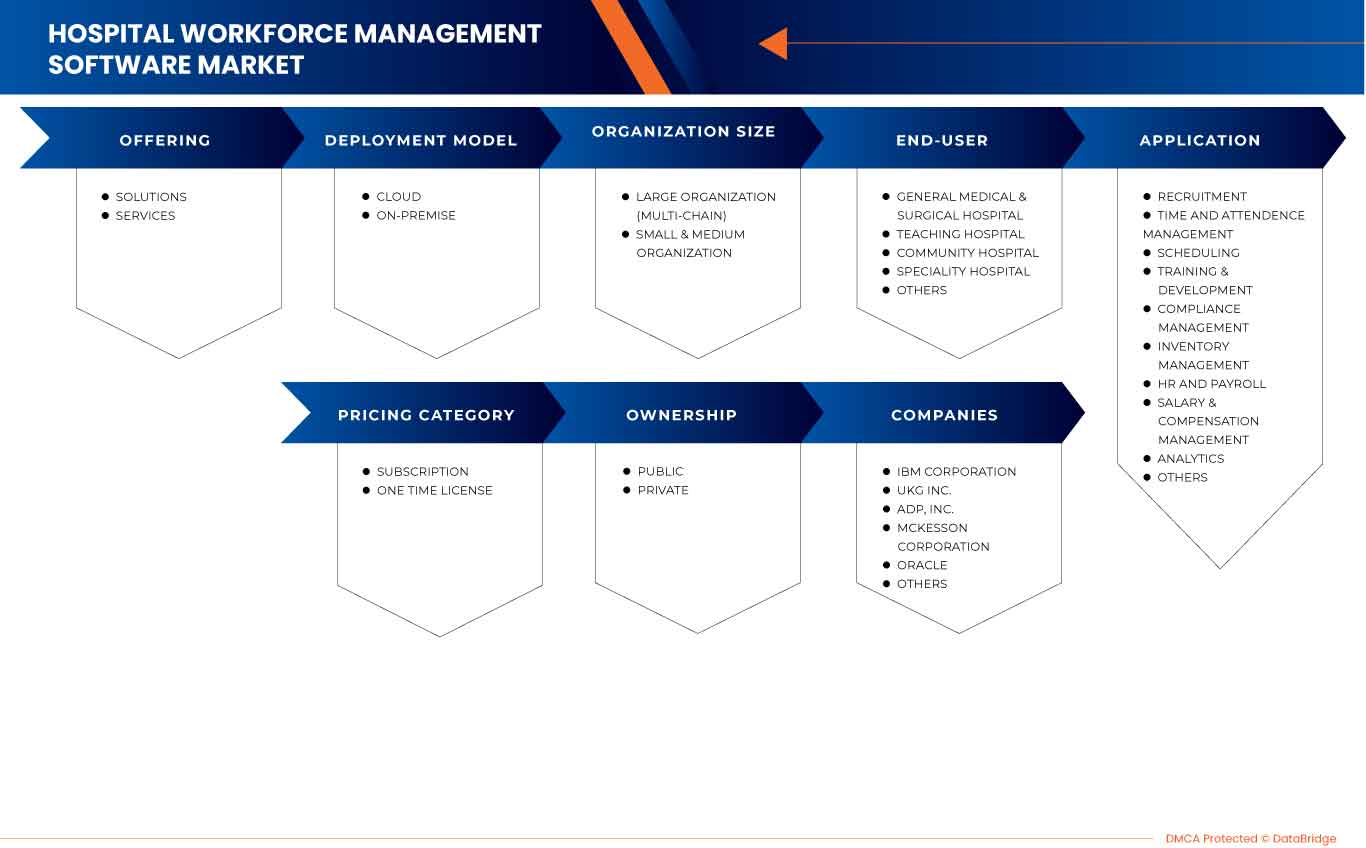
Middle East and Africa hospital workforce management software market is segmented into seven notable segments which is based on offering, deployment model, organization size, application, pricing category, ownership, and end-user. The growth amongst these segments will help you analyze meager growth segments in the industries and provide the users with a valuable market overview and insights to help them make strategic decisions for identifying core market applications.
Offering
- Solutions
- Services
On the basis of offering, the Middle East and Africa hospital workforce management software market is segmented into solutions and services.
Deployment Model
- Cloud
- On-Premise
On the basis of deployment model, the Middle East and Africa hospital workforce management software market is segmented into cloud and on-premises.
Organization Size
- Large Organization (Multi-Chain)
- Small & Medium Organization
On the basis of organization size, the Middle East and Africa hospital workforce management software market is segmented into large organization (multi-chain) and small & medium organization.
Application
- Recruitment
- Time and Attendance Management
- Scheduling
- Training & Development
- Compliance Management
- Inventory Management
- HR and Payroll
- Salary & Compensation Management
- Analytics
- Others
On the basis of application, the Middle East and Africa hospital workforce management software market is segmented into recruitment, time and attendance management, scheduling, training & development, compliance management, inventory management, HR and payroll, salary & compensation management, analytics, and others.
Pricing Category
- Subscription
- One Time License
On the basis of pricing category, the Middle East and Africa hospital workforce management software market is segmented into subscription and one time license.
Ownership
- Public
- Private
On the basis of ownership, the Middle East and Africa hospital workforce management software market is segmented into public and private.
End-User
- General Medical & Surgical Hospital
- Teaching Hospital
- Community Hospital
- Specialty Hospital
- Others
On the basis of end-user, the Middle East and Africa hospital workforce management software market is segmented into general medical & surgical hospitals, teaching hospitals, community hospitals, specialty hospitals, and others.
Middle East and Africa Hospital Workforce Management Software Market Regional Analysis/Insights
Middle East and Africa hospital workforce management software market is analyzed, and market size insights and trends are provided by region, offering, deployment model, organization size, application, pricing category, ownership, and end-user as referenced above.
The countries covered in the Middle East and Africa hospital workforce management software market report are U.A.E., Saudi Arabia, Israel, Qatar, Egypt, Kuwait, South Africa, and rest of Middle East and Africa.
U.A.E. is expected to dominate in the Middle East and Africa region because governments in the country are taking steps to promote the growth of the healthcare industry with initiatives such as tax incentives, subsidies, and support for research and development. Less availability of resources and high-cost systems are restraining factors for market growth.
The region section of the report also provides individual market-impacting factors and market regulation changes that impact the market's current and future trends. Data points like downstream and upstream value chain analysis, technical trends, porter's five forces analysis, and case studies are some pointers used to forecast the market scenario for individual countries. Also, the presence and availability of Middle East and Africa brands and their challenges faced due to large or scarce competition from local and domestic brands, the impact of domestic tariffs, and trade routes are considered while providing forecast analysis of the region data.
Competitive Landscape and Middle East and Africa Hospital Workforce Management Software Market Share Analysis
Middle East and Africa hospital workforce management software market competitive landscape provide competitor details. Details included are company overview, company financials, revenue generated, market potential, investment in research and development, new market initiatives, Middle East and Africa presence, production sites and facilities, production capacities, company strengths and weaknesses, product launch, product width and breadth, and application dominance. The above data points provided are only related to the companies' focus related to Middle East and Africa hospital workforce management software market.
Some of the major players operating in the Middle East and Africa hospital workforce management software market are ATOSS Software AG, Cornerstone, WorkForce Software, LLC, Quinyx AB, Timeware Inc, Zebra Technologies Corp, Workday, Inc., GE HealthCare, Oracle, BM Corporation, SAP SE, Verint Systems Inc., Infor, ADP, Inc., NICE, UKG Inc., and ROUBLER among others.
SKU-
Obtenha acesso online ao relatório sobre a primeira nuvem de inteligência de mercado do mundo

- Painel interativo de análise de dados
- Painel de análise da empresa para oportunidades de elevado potencial de crescimento
- Acesso de analista de pesquisa para personalização e customização. consultas
- Análise da concorrência com painel interativo
- Últimas notícias, atualizações e atualizações Análise de tendências
- Aproveite o poder da análise de benchmark para um rastreio abrangente da concorrência
Metodologia de Investigação
A recolha de dados e a análise do ano base são feitas através de módulos de recolha de dados com amostras grandes. A etapa inclui a obtenção de informações de mercado ou dados relacionados através de diversas fontes e estratégias. Inclui examinar e planear antecipadamente todos os dados adquiridos no passado. Da mesma forma, envolve o exame de inconsistências de informação observadas em diferentes fontes de informação. Os dados de mercado são analisados e estimados utilizando modelos estatísticos e coerentes de mercado. Além disso, a análise da quota de mercado e a análise das principais tendências são os principais fatores de sucesso no relatório de mercado. Para saber mais, solicite uma chamada de analista ou abra a sua consulta.
A principal metodologia de investigação utilizada pela equipa de investigação do DBMR é a triangulação de dados que envolve a mineração de dados, a análise do impacto das variáveis de dados no mercado e a validação primária (especialista do setor). Os modelos de dados incluem grelha de posicionamento de fornecedores, análise da linha de tempo do mercado, visão geral e guia de mercado, grelha de posicionamento da empresa, análise de patentes, análise de preços, análise da quota de mercado da empresa, normas de medição, análise global versus regional e de participação dos fornecedores. Para saber mais sobre a metodologia de investigação, faça uma consulta para falar com os nossos especialistas do setor.
Personalização disponível
A Data Bridge Market Research é líder em investigação formativa avançada. Orgulhamo-nos de servir os nossos clientes novos e existentes com dados e análises que correspondem e atendem aos seus objetivos. O relatório pode ser personalizado para incluir análise de tendências de preços de marcas-alvo, compreensão do mercado para países adicionais (solicite a lista de países), dados de resultados de ensaios clínicos, revisão de literatura, mercado remodelado e análise de base de produtos . A análise de mercado dos concorrentes-alvo pode ser analisada desde análises baseadas em tecnologia até estratégias de carteira de mercado. Podemos adicionar quantos concorrentes necessitar de dados no formato e estilo de dados que procura. A nossa equipa de analistas também pode fornecer dados em tabelas dinâmicas de ficheiros Excel em bruto (livro de factos) ou pode ajudá-lo a criar apresentações a partir dos conjuntos de dados disponíveis no relatório.











