Middle East and Africa Persistent Corneal Epithelial Defects Treatment Market, By Clinical Causes (Inflammatory Disease, Neurotrophic Keratitis (NK), Epithelial/Limbal Stem Cell Deficiency, Others), Type (Devices, Medication), End User (Hospital/Clinical Laboratories, Physician Offices, Reference Laboratories and Other End Users), Distribution Channel (Direct Tender, Retail Sales and Other) – Industry Trends and Forecast to 2030.
Middle East and Africa Persistent Corneal Epithelial Defects Treatment Market Analysis and Size
Persistent corneal epithelial defects treatment market is projected to witness significant growth during the forecast period. Although several therapies exist and an increasing number of novel approaches are evolving, treatment of this disease can still be quite challenging. It is essential to treat the underlying causative condition, which includes infection, limbal stem cell deficiency, or diabetes, to facilitate wound healing. The introduction of the latest technology development that offers numerous therapies for treating several complications caused by the disorder and the increase in incidence of market growth.
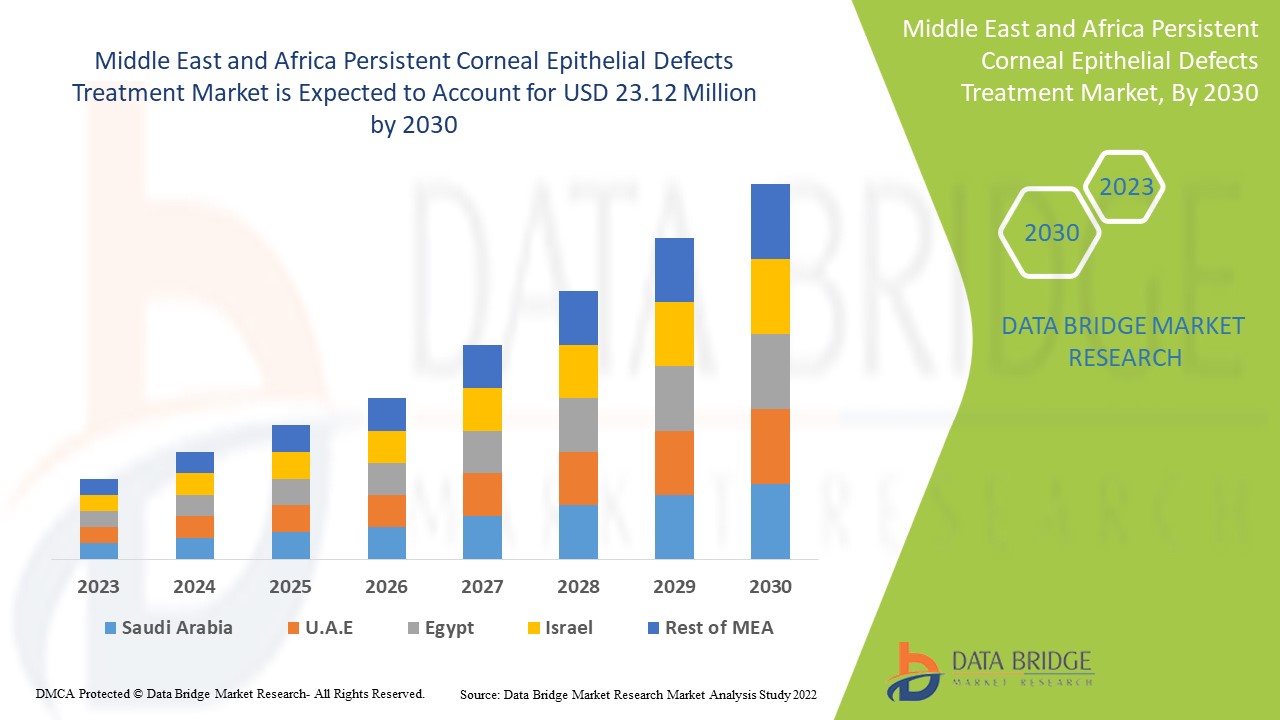
Data Bridge Market Research analyses a growth rate in the persistent corneal epithelial defects treatment market in the forecast period 2023-2030. The expected CAGR of persistent corneal epithelial defects treatment market is tend to be around 2.9% in the mentioned forecast period. The market was valued at USD 18.39 million in 2022, and it would grow upto USD 23.12 million by 2030. In addition to the market insights such as market value, growth rate, market segments, geographical coverage, market players, and market scenario, the market report curated by the Data Bridge Market Research team also includes in-depth expert analysis, patient epidemiology, pipeline analysis, pricing analysis, and regulatory framework.
Middle East and Africa Persistent Corneal Epithelial Defects Treatment Market Scope and Segmentation
|
Report Metric |
Details |
|
Forecast Period |
2023 to 2030 |
|
Base Year |
2022 |
|
Historic Years |
2021 (Customizable to 2015 - 2020) |
|
Quantitative Units |
Revenue in USD Million, Volumes in Units, Pricing in USD |
|
Segments Covered |
Clinical Causes (Inflammatory Disease, Neurotrophic Keratitis, Epithelial/Limbal Stem Cell Deficiency, Others), Type (Devices, Medication), End User (Hospital/Clinical Laboratories, Physician Offices, Reference Laboratories and Other End Users), Distribution Channel (Direct Tender, Retail Sales and Other) |
|
Countries Covered |
Saudi Arabia, U.A.E, Egypt, Israel South Africa, Rest of Middle East and Africa |
|
Market Players Covered |
Dompé farmaceutici S.p.A (Italy), Novartis AG (Switzerland), Abbvie,Inc (U.S.), Johnson & Johnson Services, Inc. (India), Laboratoires Théa. (France), Almirall, S.A (Spain), Ocular Science (U.S.), Kala Pharmaceuticals (U.S.), Bausch Health Companies Inc (Canada), Integra LifeSciences (U.S.), BioTissue (Florida) |
|
Market Opportunities |
|
Market Definition
Persistent Corneal Epithelial Defects (PCED/ PED) are typically characterized by the failure of rapid re-epithelialization and closure within the range of 10-14 days after a corneal injury, that is combined with standard supportive treatment. This corneal condition results in the disturbance of the corneal surface and the exposed eyes are susceptible to stromal ulceration, scarring, and infections.
Middle East and Africa Persistent Corneal Epithelial Defects Treatment Market Dynamics
Drivers
- Higher Demand of Hospitals
The increasing demand of hospitals surge the market growth rapidly. Most chronic disease diagnostics are majorly carried out in hospitals as they are very complex and it requires technologically advanced products and thus this is boosting the market for hospital/clinical laboratories.
Opportunities
- Increase in Eye Surgeries and Contact Lenses
Growing cases of eye surgeries and the higher usage of contact lenses is projected to boost the market growth. For instance, in 2019, Cindy Tromans published a study on “Therapeutic Contact Lenses”. The study expected that a persistent epithelial defect (PED) can have several different etiologies that includes viral or fungal corneal, bacterial infections PED can occur after thermal or chemical burns that leads to slow healing after surgery. Development of novel therapeutics will increase the market and create new opportunities for the growth.
- Increasing Demand of Treatment Types
Lubricant eye drops are the first line treatment for the PCED treatment, but are usually insufficient to treat PCED. Oxervate is one of the most effective treatment methods for persistent corneal epithelial defects treatment was launched in January 2019, so the acceptability is very low for this product and the pharmaceutical product are more costly compared to device such as Oxervate costs USD 47,200, whereas punctal plug costs nearly USD 27 and bandage contact lens cost about USD 57. Thus, increasing demand for the treatment types boost the market growth.
Restraints/Challenges
- Lack of skilled professionals
The lack of qualified healthcare professionals who cannot treat the patients with appropriate treatments could reduce the growth of the persistent corneal epithelial defects treatment market over a forecast period.
- High Cost of Treatment
The vast expenditure required for developing these techniques impede the market growth. Numerous market players make huge investment in manufacturing new and advanced machines to faster the process and in return the cost is increased.
This persistent corneal epithelial defects treatment market report provides details of new recent developments, trade regulations, import-export analysis, production analysis, value chain optimization, market share, impact of domestic and localized market players, analyses opportunities in terms of emerging revenue pockets, changes in market regulations, strategic market growth analysis, market size, category market growths, application niches and dominance, product approvals, product launches, geographic expansions, technological innovations in the market. To gain more info on the persistent corneal epithelial defects treatment market contact Data Bridge Market Research for an Analyst Brief, our team will help you take an informed market decision to achieve market growth.
Middle East and Africa Persistent Corneal Epithelial Defects Treatment Market
The persistent corneal epithelial defects treatment market is segmented on the basis of clinical causes, type, end-user and distribution channel. The growth amongst these segments will help you analyze meagre growth segments in the industries and provide the users with a valuable market overview and market insights to help them make strategic decisions for identifying core market applications.
Clinical Causes
- Inflammatory Disease
- Neurotrophic Keratitis (NK)
- Epithelial/Limbal Stem Cell Deficiency
- Others
Type
- Devices
- Medication
End User
- Hospital/Clinical Laboratories
- Physician Offices
- Reference Laboratories
- Others
Distribution Channel
- Direct Tender
- Retail Sales
- Other
Middle East and Africa Persistent Corneal Epithelial Defects Treatment Market Regional Analysis/Insights
The persistent corneal epithelial defects treatment market is analyzed and market size insights and trends are provided by clinical causes, type, end-user and distribution channel as referenced above.
The major countries covered in the persistent corneal epithelial defects treatment market report are the Saudi Arabia, U.A.E, Egypt, Israel South Africa, Rest of Middle East and Africa.
U.A.E dominates the persistent corneal epithelial defects treatment market because of strong infrastructure base as well as increased consumption of persistent corneal epithelial defects treatments.
The country section of the report also provides individual market impacting factors and changes in regulation in the market domestically that impacts the current and future trends of the market. Also, the presence and availability of global brands and their challenges faced due to large or scarce competition from local and domestic brands, impact of domestic tariffs and trade routes are considered while providing forecast analysis of the country data.
Competitive Landscape and Middle East and Africa Persistent Corneal Epithelial Defects Treatment Market Share Analysis
The persistent corneal epithelial defects treatment market competitive landscape provides details by competitor. Details included are company overview, company financials, revenue generated, market potential, investment in research and development, new market initiatives, global presence, production sites and facilities, production capacities, company strengths and weaknesses, product launch, product width and breadth, application dominance. The above data points provided are only related to the companies' focus related to persistent corneal epithelial defects treatment market
Key players operating in the persistent corneal epithelial defects treatment market include:
- Dompé farmaceutici S.p.A (Italy)
- Novartis AG (Switzerland)
- Abbvie,Inc (U.S.)
- Johnson & Johnson Services, Inc. (India)
- Laboratoires Théa. (France)
- Almirall, S.A (Spain)
- Ocular Science (U.S.)
- Kala Pharmaceuticals (U.S.)
- Bausch Health Companies Inc (Canada)
- Integra LifeSciences (U.S.)
- BioTissue (Florida)
SKU-
Obtenha acesso online ao relatório sobre a primeira nuvem de inteligência de mercado do mundo
- Painel interativo de análise de dados
- Painel de análise da empresa para oportunidades de elevado potencial de crescimento
- Acesso de analista de pesquisa para personalização e customização. consultas
- Análise da concorrência com painel interativo
- Últimas notícias, atualizações e atualizações Análise de tendências
- Aproveite o poder da análise de benchmark para um rastreio abrangente da concorrência
Metodologia de Investigação
A recolha de dados e a análise do ano base são feitas através de módulos de recolha de dados com amostras grandes. A etapa inclui a obtenção de informações de mercado ou dados relacionados através de diversas fontes e estratégias. Inclui examinar e planear antecipadamente todos os dados adquiridos no passado. Da mesma forma, envolve o exame de inconsistências de informação observadas em diferentes fontes de informação. Os dados de mercado são analisados e estimados utilizando modelos estatísticos e coerentes de mercado. Além disso, a análise da quota de mercado e a análise das principais tendências são os principais fatores de sucesso no relatório de mercado. Para saber mais, solicite uma chamada de analista ou abra a sua consulta.
A principal metodologia de investigação utilizada pela equipa de investigação do DBMR é a triangulação de dados que envolve a mineração de dados, a análise do impacto das variáveis de dados no mercado e a validação primária (especialista do setor). Os modelos de dados incluem grelha de posicionamento de fornecedores, análise da linha de tempo do mercado, visão geral e guia de mercado, grelha de posicionamento da empresa, análise de patentes, análise de preços, análise da quota de mercado da empresa, normas de medição, análise global versus regional e de participação dos fornecedores. Para saber mais sobre a metodologia de investigação, faça uma consulta para falar com os nossos especialistas do setor.
Personalização disponível
A Data Bridge Market Research é líder em investigação formativa avançada. Orgulhamo-nos de servir os nossos clientes novos e existentes com dados e análises que correspondem e atendem aos seus objetivos. O relatório pode ser personalizado para incluir análise de tendências de preços de marcas-alvo, compreensão do mercado para países adicionais (solicite a lista de países), dados de resultados de ensaios clínicos, revisão de literatura, mercado remodelado e análise de base de produtos . A análise de mercado dos concorrentes-alvo pode ser analisada desde análises baseadas em tecnologia até estratégias de carteira de mercado. Podemos adicionar quantos concorrentes necessitar de dados no formato e estilo de dados que procura. A nossa equipa de analistas também pode fornecer dados em tabelas dinâmicas de ficheiros Excel em bruto (livro de factos) ou pode ajudá-lo a criar apresentações a partir dos conjuntos de dados disponíveis no relatório.