



North America Amino Acids Market, By Type of Amino Acid (Glutamic Acid, Methionine, Cysteine, Lysine, Arginine, Tyrosine, Alanine, Leucine, Histidine, Phenylalanine, Valine, Proline, Tryptophan, Glycine, Serine, Isoleucine Threonine, Glutamine, Aspartic Acid, Asparagine, and Others), Purity Level (Amino Acid 99%, Amino Acid More Than 99%, Amino Acid 90%, Amino Acid 80%, Amino Acid 70%, and Amino Acid Less Than 60%), Form (Powder, Granules, Liquid, Pellet, and Others), Product Category (Microbial Amino Acid, Plant-Based Amino Acid, and Synthetic Amino Acid), Function (Fortification, Energy Booster, Flavour Enhancer, Preservative, Muscle Growth, Immunity Booster, and Others), Application (Animal Feed, Food & Beverages, Pharmaceutical, Dietary Supplements, Sports Nutrition, Cell Culture Media, Cosmetic, and Personal Care), Distribution Channel (Direct and Indirect) Industry Trends and Forecast to 2029
Market Analysis and Insights
Increasing demand for amino acid in various industries such as food and beverages, dietary supplements, cosmetics, and animal feed is driving the global amino acids market growth. In addition, advancement in biotechnology used for production of amino acids is further enhancing the market growth. Furthermore, increasing acceptability of amino acids for medicinal properties is boosting the sales and profit of the players operating in the market, which is expected to further drive the market growth for amino acids market.
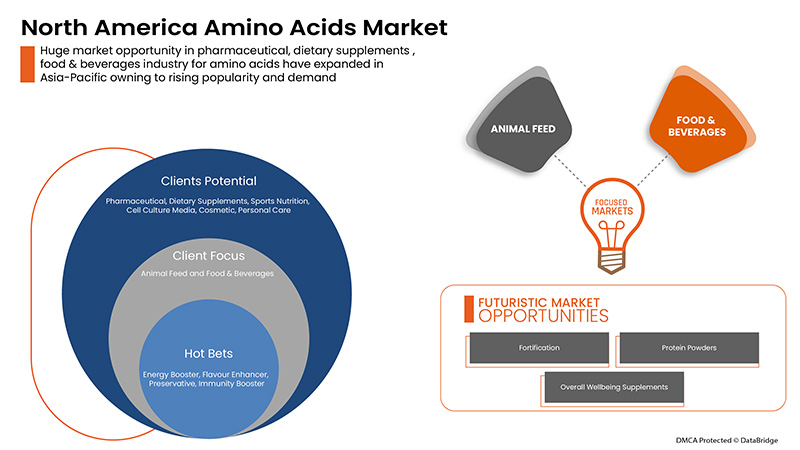
The major restraint impacting the market growth is the complicated manufacturing process. Further, high logistic cost of amino acids production will also restrain the market growth. On the other hand, availability of different types of amino acids is expected to act as an opportunity for the growth of the global amino acids market. Whereas, the challenge for the market growth is the implementation of strict regulations for commercialization of amino acids products.
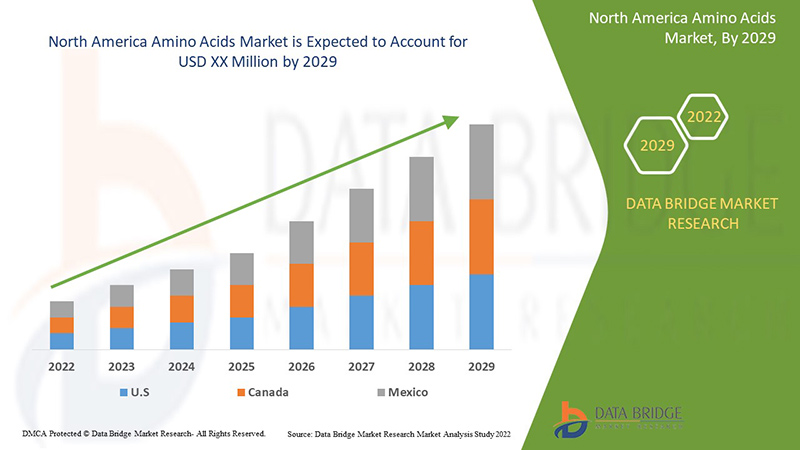
Data Bridge Market Research analyses that the North America amino acids market will grow at a CAGR of 5.9% during the forecast period of 2022 to 2029.
|
Report Metric |
Details |
|
Forecast Period |
2022 to 2029 |
|
Base Year |
2021 |
|
Historic Year |
2020 (Customizable to 2019- 2015) |
|
Quantitative Units |
Revenue in USD Million |
|
Segments Covered |
By Type of Amino Acid (Glutamic Acid, Methionine, Cysteine, Lysine, Arginine, Tyrosine, Alanine, Leucine, Histidine, Phenylalanine, Valine, Proline, Tryptophan, Glycine, Serine, Isoleucine Threonine, Glutamine, Aspartic Acid, Asparagine, and Others), Purity Level (Amino Acid 99%, Amino Acid More Than 99%, Amino Acid 90%, Amino Acid 80%, Amino Acid 70%, and Amino Acid Less Than 60%), Form (Powder, Granules, Liquid, Pellet, and Others), Product Category (Microbial Amino Acid, Plant-Based Amino Acid, and Synthetic Amino Acid), Function (Fortification, Energy Booster, Flavour Enhancer, Preservative, Muscle Growth, Immunity Booster, and Others), Application (Animal Feed, Food & Beverages, Pharmaceutical, Dietary Supplements, Sports Nutrition, Cell Culture Media, Cosmetic, and Personal Care), Distribution Channel (Direct and Indirect), |
|
Countries Covered |
U.S., Canada, Mexico |
|
Market Players Covered |
Merck KGaA, Ajinomoto Co., Inc., KYOWA HAKKO BIO CO., LTD., Evonik Industries AG, ADM, Prinova Group LLC., NOVUS INTERNATIONAL, Qingdao Samin Chemical Co.,Ltd., PACIFIC RAINBOW INTERNATIONAL, INC., Daesang, Adisseo, CJ CheilJedang Corp., Global Bio-chem Technology Group Company Limited., Sunrise Nutrachem Group Co.,LTD, Kingchem Life Science LLC, NIPPON RIKA Co., LTD., Sichuan Tongsheng Amino acid Co., Ltd, FUFENG GROUP, Asiamerica Group, Inc., Sumitomo Chemical Co., Ltd. |
Market Definition
Amino acids are molecules that combine to form proteins. Amino acids and proteins are the building blocks of life. Amino acids form a substantial part of both animal and human nutrition. In the human body, they are necessary for vital processes for instance the synthesis of neurotransmitters and hormones. They are advantageous for nourishing the immune system, fighting arthritis and cancer, and treating rectal diseases and tinnitus. Nowadays, the demand for amino acids is increasing as they assist in improving conditions such as depression, sleep disorders, premenstrual dysphoric disorder (PMDD), smoking cessation, bruxism and attention deficit-hyperactivity disorder (ADHD). Amino acids are also found in abundance in red meat, seafood, eggs, dairy products, and soy products.
North America Amino Acids Market Dynamics
Drivers
- Strong supply chain
As the availability of quality raw materials is vital for the manufacturing of amino acids. So as to ensure a continuous supply of raw materials, prominent market participants are using forward and backward integration techniques targeted at ensuring high quality and reliable supply of raw materials. Such vertical integration processes provide greater reliability of raw material supply and chances for the development of new and creative products from current raw materials. Therefore, a strong supply chain is established for the feasible production of amino acids.
Also, the strong and fast direct and indirect distribution channels established by the manufacturers ensure the timely delivery of products leading to increased demand for amino acids. Therefore, the strong supply chain is boosting the demand for amino acids in the market as it ensures the timely availability of amino acids.
- Availability of different types of amino acids in the market
Amino acids can be placed in three groups, non-essential amino acids, essential amino acids, and conditional amino acids. These groups consist of different types of amino acids based on their requirements. As each essential amino acid has a distinct function in the organism, the symptoms of shortage vary correspondingly. Therefore, the availability of different types of amino acids and their varying requirements has led to the production of products having different amino acids.
Therefore, the demand for different types of amino acids has led to the production of different products with different compositions and benefits, eventually leading to the growth of the amino acids market.
Opportunity
-
Increase in number of initiatives taken by amino acid manufacturers
An increase in the number of initiatives taken by the manufacturers for amino acids such as product launches, expansion, investments, and others will create a great opportunity for the growth of the global amino acids market.
For instance,
-
In October 2020, Evonik announced to cluster its MetAMINO (DL-methionine) production at three international hubs (Americas, Europe, and Asia). The step is taken by the company to maximize economies of scale and utilize robust processes. The company aims to strengthen its position by improving its cost position
Thus, the increase in the number of amino acid launches, expansion, investment to increase the production, and other initiatives by manufacturers coupled with rising demand for amino acids in different industries, are expected to create a huge opportunity for amino acids in the market globally.
Restraint/Challenge
- Strict government regulations
Regulations are applied to the manufacturing of amino acids and products containing amino acids in order to maintain the quality and purity of the products. The regulations are also applied to the daily consumption of amino acids to avoid their side effects. Along with that regulations are also put on amino acid use in foods and dietary supplements in order to ensure the right consumption of amino acids.
Hence, the increasing regulation on the consumption of amino acids might hamper the market growth as these regulations limit the usage of amino acids in various products and supplements.
Post-COVID-19 Impact on North America Amino Acids Market
Post the pandemic, the demand for health supplements and healthy food products has increased as there won't be any restrictions on movement; hence, the supply of products would be easy. The persistence of COVID-19 for a longer period has affected the supply chain as it got disrupted, and it became difficult to supply the food products to the consumers, initially decreasing the demand for products. However, post COVID, the demand for health and wellness food products has increased significantly owing to increased awareness about the benefits of amino acids in healthy and nutritious food in the long term, increasing the demand for amino acids products. Consumers are trying to lead a healthy lifestyle and are more inclined toward the healthiest food products, such as plant-based, vegan, and nutritional food and beverages as they are fortified with amino acids.
Recent Developments
- In December 2021, Bayer introduces Ambition, the first amino acid biostimulant, to the Chinese market. The product investigates agricultural development potential, such that crops would grow energetically with great stress resistance toward high yield and high quality, benefiting farmers' harvesting, soil protection, and consumer safety. Ambition is appropriate for organic farming
- In October 2017, Daesang, a South Korean food manufacturing company, claimed that it has successfully created L-Histidine, a high value-added amino acid, for the first time in the nation. L-Histidine is abundant in red-flesh and exterior blue-colored fish. It is frequently utilized in pharmaceuticals, nutritional supplements, and animal feed
North America Amino Acids Market Scope
The North America amino acids market is segmented into seven notable segments which are types of amino acids, purity level, form, product category, function, application and distribution channel.
The growth amongst these segments will help you analyze major growth segments in the industries and provide the users with a valuable market overview and market insights to make strategic decisions to identify core market applications.
Types of amino acids
- Glutamic Acid
- Methionine
- Cysteine
- Lysine
- Arginine
- Tyrosine
- Alanine
- Leucine
- Histidine
- Phenylalanine
- Valine
- Proline
- Tryptophan
- Glycine
- Serine
- Isoleucine
- Threonine
- Glutamine
- Aspartic Acid
- Asparagine
- Others
On the basis of types of amino acids, the North America amino acids market is segmented into alanine, arginine, aspartic acid, cysteine, glutamic acid, glutamine, glycine, histidine, isoleucine, leucine, lysine, methionine, phenylalanine, proline, serine, asparagine, threonine, tyrosine, tryptophan, valine, and others.
Purity level
- Amino Acid 99%
- Amino Acid More Than 99%
- Amino Acid 90%
- Amino Acid 80%
- Amino Acid 70%
- Amino Acid Less Than 60%
On the basis of purity level, the North America amino acids market is segmented into the amino acid less than 60%, amino acid 70%, amino acid 80%, amino acid 90%, amino acid 99%, and amino acid more than 99%.
Form
- Powder
- Granules
- Liquid
- Pellet
- Others
On the basis of form, the North America amino acids market is segmented into liquid, crystal, powder, pellet, and others.
Fat content
- No Fat
- Low Fat
- Reduced-Fat
On the basis of fat content, the North America health and wellness food market is segmented into no fat, low fat, and reduced-fat.
Product category
- Microbial Amino Acid
- Plant-Based Amino Acid
- Synthetic Amino Acid
On the basis of product category, the North America amino acids market is segmented into plant based amino acids, microbial based amino acids, and synthetic amino acids.
Function
- Fortification
- Energy Booster
- Flavor Enhancer
- Preservative
- Muscle Growth
- Immunity Booster
- Others
On the basis of function, the amino acids market is divided into immunity booster, preservative, flavor enhancer, fortification, muscle growth, energy booster, and others.
Application
- Animal Feed
- Food & Beverages
- Pharmaceutical
- Dietary Supplements
- Sports Nutrition
- Cell Culture Media
- Cosmetic
- Personal Care
On the basis of application, the North America amino acids market is segmented into the food & beverages, dietary supplements, pharmaceutical, sports nutrition, animal feed, personal care, cosmetic and cell culture media.
Distribution Channel
- Direct
- Indirect
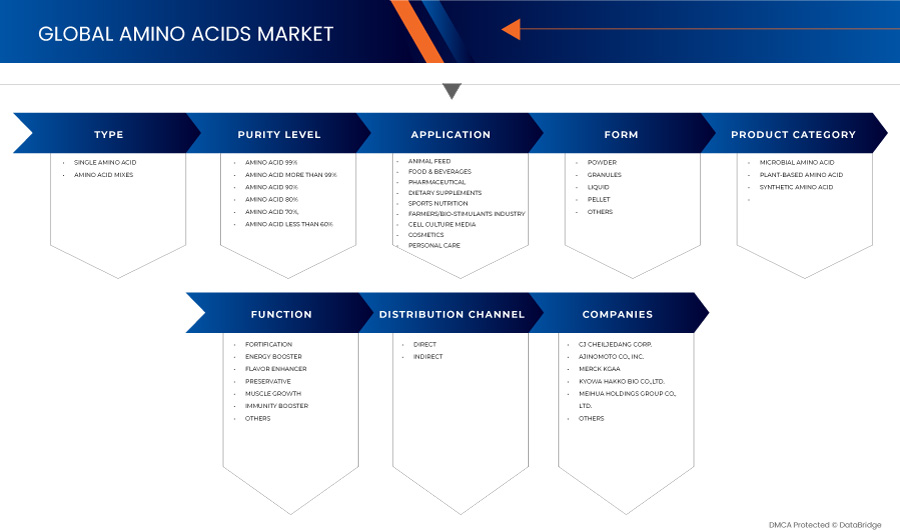
On the basis of distribution channel, North America amino acids market is segmented into direct and indirect.
North America Amino Acids Markets Regional Analysis/Insights
The North America amino acids market is analyzed, and market size insights and trends are provided based on as referenced above.
The countries covered in the North America health and wellness food Markets report are U.S., Canada and Mexico.
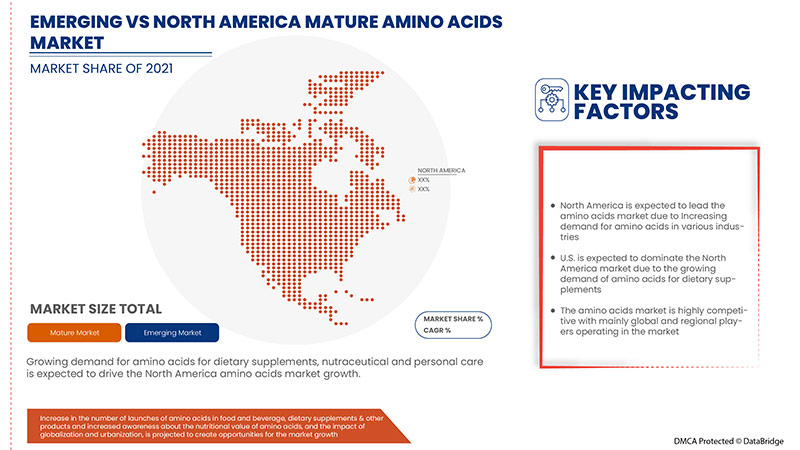
The U.S. dominates the North America amino acids market in terms of market share and market revenue and will continue to flourish its dominance during the forecast period. This is due to the industrialization of the livestock industry and the economic growth of the country. The North America region's demand for meat-based food items is increasing, which is boosting the region's amino acid market.
The country section of the report also provides individual market impacting factors and changes in regulations in the market that impact the current and future trends of the market. Data points, such as new and replacement sales, country demographics, disease epidemiology, and import-export tariffs, are some of the major pointers used to forecast the market scenario for individual countries. In addition, the presence and availability of North America brands, their challenges faced due to high competition from local and domestic brands, and the impact of sales channels are considered while providing forecast analysis of the country data.
Competitive Landscape and North America Amino Acids Market Share Analysis
The competitive North America amino acids market details the competitors. Details included are company overview, company financials, revenue generated, market potential, investment in research and development, new market initiatives, North America presence, production sites and facilities, production capacities, company strengths and weaknesses, product launch, product width, and breadth, and application dominance. The above data points only relate to the companies' focus on the North America amino acids market.
Some of the major players operating in the North America amino acids market are Merck KGaA, Ajinomoto Co., Inc., KYOWA HAKKO BIO CO., LTD., Evonik Industries AG, ADM, Prinova Group LLC., NOVUS INTERNATIONAL, Qingdao Samin Chemical Co.,Ltd., PACIFIC RAINBOW INTERNATIONAL, INC., Daesang, Adisseo, CJ CheilJedang Corp., Global Bio-chem Technology Group Company Limited., Sunrise Nutrachem Group Co.,LTD, Kingchem Life Science LLC, NIPPON RIKA Co., LTD., Sichuan Tongsheng Amino acid Co., Ltd, FUFENG GROUP, Asiamerica Group, Inc. and Sumitomo Chemical Co., Ltd. among others.
Research Methodology
Data collection and base year analysis are done using data collection modules with large sample sizes. The market data is analyzed and estimated using market statistical and coherent models. In addition, market share analysis and key trend analysis are the major success factors in the market report. The key research methodology used by the DBMR research team is data triangulation which involves data mining, analysis of the impact of data variables on the market, and primary (industry expert) validation. Apart from this, data models include Vendor Positioning grids, Market Time Line Analysis, Market Overview and Guide, Company Positioning Grid, Company Market Share Analysis, Standards of Measurement, North America Vs Regional, and Vendor Share Analysis. Please request an analyst call in case of further inquiry.
SKU-
Obtenha acesso online ao relatório sobre a primeira nuvem de inteligência de mercado do mundo

- Painel interativo de análise de dados
- Painel de análise da empresa para oportunidades de elevado potencial de crescimento
- Acesso de analista de pesquisa para personalização e customização. consultas
- Análise da concorrência com painel interativo
- Últimas notícias, atualizações e atualizações Análise de tendências
- Aproveite o poder da análise de benchmark para um rastreio abrangente da concorrência
Metodologia de Investigação
A recolha de dados e a análise do ano base são feitas através de módulos de recolha de dados com amostras grandes. A etapa inclui a obtenção de informações de mercado ou dados relacionados através de diversas fontes e estratégias. Inclui examinar e planear antecipadamente todos os dados adquiridos no passado. Da mesma forma, envolve o exame de inconsistências de informação observadas em diferentes fontes de informação. Os dados de mercado são analisados e estimados utilizando modelos estatísticos e coerentes de mercado. Além disso, a análise da quota de mercado e a análise das principais tendências são os principais fatores de sucesso no relatório de mercado. Para saber mais, solicite uma chamada de analista ou abra a sua consulta.
A principal metodologia de investigação utilizada pela equipa de investigação do DBMR é a triangulação de dados que envolve a mineração de dados, a análise do impacto das variáveis de dados no mercado e a validação primária (especialista do setor). Os modelos de dados incluem grelha de posicionamento de fornecedores, análise da linha de tempo do mercado, visão geral e guia de mercado, grelha de posicionamento da empresa, análise de patentes, análise de preços, análise da quota de mercado da empresa, normas de medição, análise global versus regional e de participação dos fornecedores. Para saber mais sobre a metodologia de investigação, faça uma consulta para falar com os nossos especialistas do setor.
Personalização disponível
A Data Bridge Market Research é líder em investigação formativa avançada. Orgulhamo-nos de servir os nossos clientes novos e existentes com dados e análises que correspondem e atendem aos seus objetivos. O relatório pode ser personalizado para incluir análise de tendências de preços de marcas-alvo, compreensão do mercado para países adicionais (solicite a lista de países), dados de resultados de ensaios clínicos, revisão de literatura, mercado remodelado e análise de base de produtos . A análise de mercado dos concorrentes-alvo pode ser analisada desde análises baseadas em tecnologia até estratégias de carteira de mercado. Podemos adicionar quantos concorrentes necessitar de dados no formato e estilo de dados que procura. A nossa equipa de analistas também pode fornecer dados em tabelas dinâmicas de ficheiros Excel em bruto (livro de factos) ou pode ajudá-lo a criar apresentações a partir dos conjuntos de dados disponíveis no relatório.











