



U.S. Pancreatic Cancer Diagnostics Market, By Test Type (Imaging Test, Biopsy, Blood Test, Genomic Test, and Others), Cancer Stage (Stage 0, Stage I, Stage II, Stage III, and Stage IV), Tumor Type (Exocrine Tumors and Neuroendocrine Tumors), Product (Instrument-Based Products, Platform-Based Products, Kits and Reagents, and Other Consumables), Technology (Fluorescent In Situ Hybridization, Next Generation Sequencing, Fluoroimmunoassay, Comparative Genomic Hybridization, Immunohistochemical, and Others), Application (Screening, Diagnostic and Predictive, Prognostic, and Research), End User (Hospitals, Diagnostic Centers, Cancer Research Centers, Academic Institutes, Ambulatory Surgical Centers, and Others), Distribution Channel (Direct Tender, Retail Sales, and Others) - Industry Trends and Forecast to 2030.
U.S. Pancreatic Cancer Diagnostics Market Analysis and Insights
The growing prevalence of pancreatic cancer as well as the increasing need for diagnostic products for these conditions have enhanced the market demand. The advancement in technology for easy supply of products and fast manufacturing facilities are also attributing to market growth. The major market players are highly focused on product launches and product approvals during this crucial period. In addition, the government and regulatory bodies are supporting market players with product approval due to surging emergence.
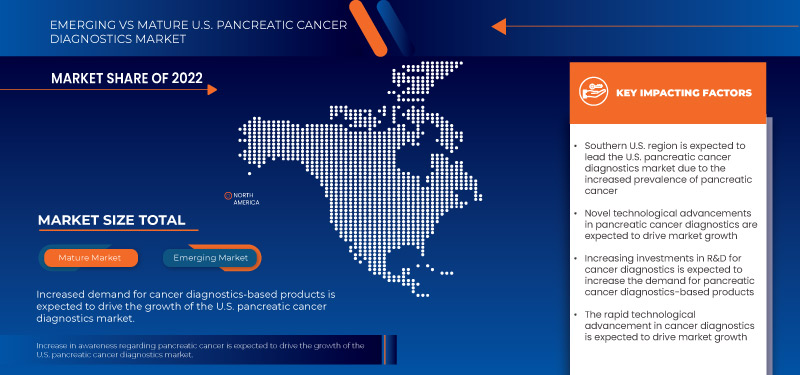
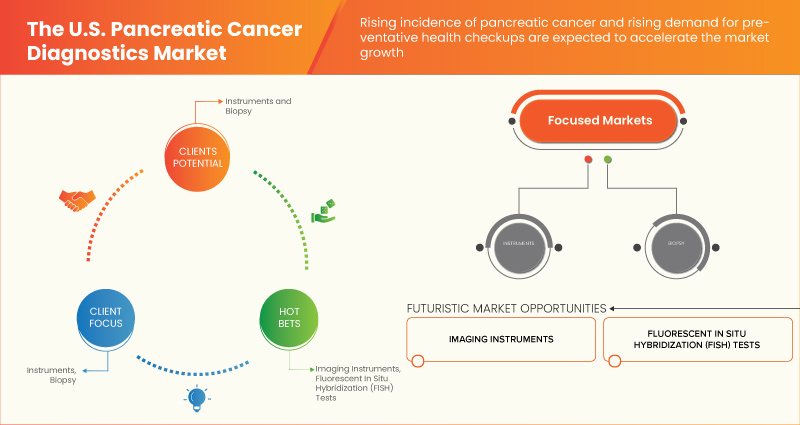
The U.S. pancreatic cancer diagnostics market is expected to grow in the forecast year due to the rise in market players and the availability of advanced services. Along with this, manufacturers are engaged in R&D activity for launching novel services in the market. The increasing research in the field of leukemia diagnosis and development is expected to further boost the market growth.
However, difficulties in leukemia screening techniques are expected to restrain market growth in the forecast period. Increasing healthcare expenditure on cancer diagnosis and treatment are expected to give opportunities to the market to enhance the treatment. The improvement in awareness about regular healthcare checkups, upcoming diagnostic centers, and advancements in diagnostic methods for pancreatic cancer and technological developments is expected to boost the market growth. However, the high cost of testing and strict regulations and standards for the approval and commercialization of cancer diagnostic products and instruments is expected to challenge market growth.
The U.S. pancreatic cancer diagnostics market is supportive and aims to reduce the disease thereby improving the recovery and performance of individuals. Data Bridge Market Research analyzes that the U.S. pancreatic cancer diagnostics market will grow at a CAGR of 8.3% during the forecast period of 2023 to 2030.
|
Report Metric |
Details |
|
Forecast Period |
2023 to 2030 |
|
Base Year |
2022 |
|
Historic Years |
2021 (Customizable to 2020 – 2015) |
|
Quantitative Units |
Revenue in USD Million and Pricing in USD |
|
Segments Covered |
By Test Type (Imaging Test, Biopsy, Blood Test, Genomic Test, and Others), Cancer Stage (Stage 0, Stage I, Stage II, Stage III, and Stage IV), Tumor Type (Exocrine Tumors and Neuroendocrine Tumors), Product (Instrument-Based Products, Platform-Based Products, Kits and Reagents, and Other Consumables), Technology (Fluorescent In Situ Hybridization, Next Generation Sequencing, Fluoroimmunoassay, Comparative Genomic Hybridization, Immunohistochemical, and Others), Application (Screening, Diagnostic and Predictive, Prognostic, and Research), End User (Hospitals, Diagnostic Centers, Cancer Research Centers, Academic Institutes, Ambulatory Surgical Centers, and Others), Distribution Channel (Direct Tender, Retail Sales, and Others) |
|
Regions Covered |
Southern U.S., Western U.S., Mid-Western U.S., and North-Eastern U.S. |
|
Market Players Covered |
Agilent Technologies, Inc., BD, Biological Dynamics, CANON MEDICAL SYSTEMS CORPORATION, ClearNote Health, CTK Biotech, Inc., Danaher., Exact Sciences Corporation, F. Hoffman- La Roche Ltd, FUJIFILM Holdings America Corporation, GRAIL, Immunovia, Koninklijke Philips N.V., Laboratory Corporation of America Holdings, MP BIOMEDICALS, Myriad Genetics, Inc., QIAGEN, Quest Diagnostics Incorporated, Siemens Healthcare GmbH, and Thermo Fisher Scientific Inc. among others |
Market Definition
Pancreatic cancer is fatal, and the diagnosis process of pancreatic cancer also has safety issues. It is not cost-effective. One of the costliest medical disorders to treat cancer. Cancer patients may be hospitalized and receive a variety of therapies for tumors, such as surgery, radiation treatment, and systemic therapy. Health insurance premiums for cancer patients are now more expensive than in the past. In addition, their copayment, deductible, and coinsurance costs are rising. Diagnosis of pancreatic cancer includes ultrasound, biopsy procedures, and blood tests. Pancreatic cancer is one of the leading causes of death worldwide, and the prevalence of this disease has increased at an alarming rate. The cancer is confined to the top layers of pancreatic duct cells and has not invaded deeper tissues. It has not spread outside of the pancreas. These tumors are sometimes referred to as carcinoma in situ. It has not spread to nearby lymph nodes or to distant sites.
Pancreatic cancer can be difficult to diagnose because, despite its wide range of signs and symptoms, they are non-specific and can be linked to other, more widespread medical conditions. Pancreatic cancer is the eighth most common cancer in women and the tenth most common cancer in men. Incidence rates of pancreatic cancer have gone up by around 1% each year. It occurs less frequently. It is slightly more common among women than men, however, the average lifetime risk of getting pancreatic cancer in both sexes is about ½ of 1% on average. However, the High cost associated with the treatment and diagnostic procedure is expected to restrain the market growth.
U.S. Pancreatic Cancer Diagnostics Market Dynamics
This section deals with understanding the market drivers, opportunities, restraints, and challenges. All of these are discussed in detail below:
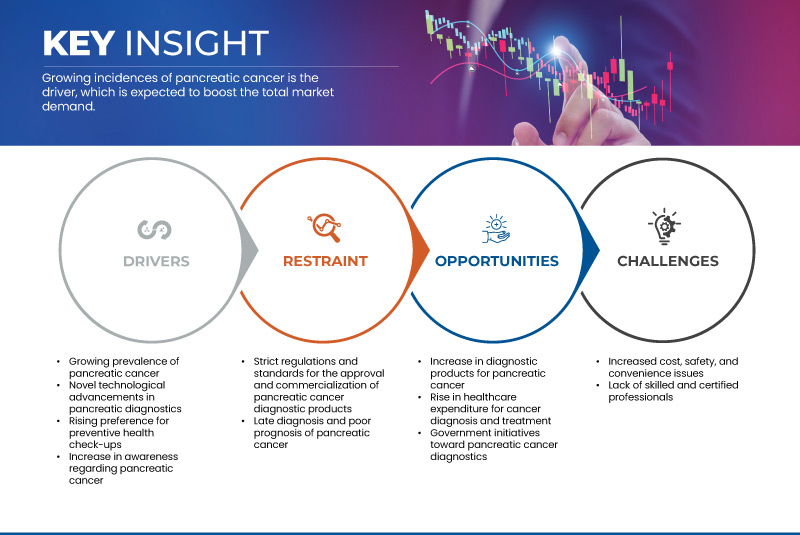
DRIVERS
- Increasing Prevalence of Pancreatic Cancer
All ages can be affected by this type of cancer. Pancreatic cancer can be difficult to diagnose because, despite its wide range of signs and symptoms, they are non-specific and can be linked to other, more widespread medical conditions. Pancreatic cancer is the eighth most common cancer in women and the tenth most common cancer in men. Incidence rates of pancreatic cancer have gone up by around 1% each year. It occurs less frequently. It is slightly more common among women than men, however, the average lifetime risk of getting pancreatic cancer in both sexes is about ½ of 1% on average. These conditions include abdominal pain, loss of appetite or unintended weight loss, yellowing of the skin and the whites of the eyes (jaundice), light-colored stools, dark-colored urine, and itchy skin. It is the eighth most common type of cancer diagnosed in adults and children, but most cases occur in adults. Although it can be diagnosed at any age, it is uncommon before age 45. The average age of diagnosis is age 68. Due to various risk factors, pancreatic cancer incidence has been becoming a significant socio-economic issue. This is expected to act as a driver for market growth.
- Novel Technological Advancements for Pancreatic Cancer
Pancreatic cancer is seldom detected at its early stages when it is most curable. This is because it often does not cause symptoms until after it has spread to other organs. Specialists must manually diagnose cancer and non-cancer cells by examining cell images under a microscope and providing labels through annotation. However, this hand microscopic examination is time-consuming and could give an incorrect diagnosis. The risk of prescribing the incorrect drugs was then reduced using computerized software. The creation of an automatic and reliable classification system became vital to stop the pancreatic disease's devastating effects. Multiple segmentation techniques constituted the foundation of the existing pancreatic cancer classification algorithms.
The manual examination of stained blood smear microscopy pictures used in current practice for the initial diagnosis of pancreatic cancer is time-consuming and prone to error. A potent tool for aiding doctors in making medical decisions has emerged which is deep learning-based human-centric biomedical diagnostics. Various computer-aided diagnostic techniques have been created to recognize blood pictures automatically. Advancement in pancreatic cancer diagnostic methods has become a well-accepted technology allowing high-quality diagnostic tests. The development of several new diagnostic methods will increase the market growth as many new and advanced products are launched. Hence, it is expected to create demand for pancreatic cancer diagnostic products in the market.
OPPORTUNITY
- Rising Healthcare Expenditure for Cancer Diagnosis and Treatment
Across the globe, R&D activities are escalating owing to the public health expenditure with economic performances. Whereas the healthcare industry ranks second among all industries when it comes to the amount spent on healthcare. Rising healthcare expenditure can result in better provision of R&D opportunities. It is anticipated to increase the demand for pancreatic cancer diagnostics. Increasing the healthcare expenditure for pancreatic cancer treatment also helps the patient take hassle-free advanced diagnostics and treatment for fast recovery. The spending on healthcare is made up of the combination of out-of-pocket payments (people paying for their care), government expenditure, and sources. It also includes health insurance and activities by non-governmental organizations. This increasing healthcare expenditure for cancer treatment is expected to act as an opportunity for market growth.
Henceforth, the rising healthcare expenditure is positively associated with product development, product registration, and product launch. Thus, the rising healthcare expenditure and government support are further expected to drive market growth in the coming years. The increase in healthcare expenditure also impacts the increasing implementation of advanced cancer diagnostic products and better treatment for cancer patients. For this reason, increasing healthcare expenditure for pancreatic cancer treatment is projected to act as an opportunity for market growth.
RESTRAINT/CHALLENGE
- Late Diagnosis and Poor Prognosis of Pancreatic Cancer
Late diagnosis of the disease is due to the increasing number of pancreatic cancer tumors which do not respond well to commonly used cancer therapies as other, less lethal types of cancer. But there are treatment options, including surgery, chemotherapy, and radiation. There are different types of pancreatic cancer. Most pancreatic cancers are the exocrine type. This means that they start in cells that produce pancreatic digestive juices. About 30% of patients are smokers, and 5% have a history of pancreatitis, an inflammation of the pancreas, which can be caused by stones or heavy alcohol intake.
Cancer is the leading cause of death worldwide. By 2030, it is anticipated that there will be 13.1 million more cancer-related deaths per year. However, if they are identified early on and given the right care, some cancers can be cured. The diagnostic process may experience delays in cancer diagnosis. When patients overlook or fail to respond to potentially cancerous signs, patient delays may result. The main cause of delayed presentation is a lack of public knowledge of early cancer signs, especially if such symptoms are unusual. The late diagnosis often results from these factors, which result in poor prognosis. Thus, these are expected to act as a restraint for market growth.
Post-COVID-19 Impact on U.S. Pancreatic Cancer Diagnostics Market
COVID-19 has negatively affected the market growth as patients suffering from pancreatic cancer postponed their surgery due to a rapid surge in COVID-19 cases across geographies. Additionally, people having pancreatic cancer were at risk of becoming severely ill. The fear of coronavirus infection affected the market growth amid the pandemic.
Recent Developments
- In December 2022, FUJIFILM Holdings America Corporation announced the company has a purchase agreement asset with Inspirata, Inc. to acquire a digital pathology business to expand its robust enterprise imaging offering. This results in enabling the integration of pathology images and data into a healthcare organization’s electronic health record system to streamline care delivery for oncology patients
- In August 2020, Siemens Healthcare GmbH announced that it has entered into an agreement with Varian Medical Systems, Inc. With this acquisition, Siemens Healthcare GmbH has helped in developing advanced solutions to treat cancer and strengthen its position in the healthcare industry
- In May 2020, F. Hoffmann- La Roche Ltd announced that it has acquired Stratos Genomics. With this acquisition, the company will also deal with the development of DNA-based sequencing for diagnostics use. This has enhanced the healthcare diagnosis segment of the company, thus, leading to more revenue generation for the company.
U.S. Pancreatic Cancer Diagnostics Market Scope
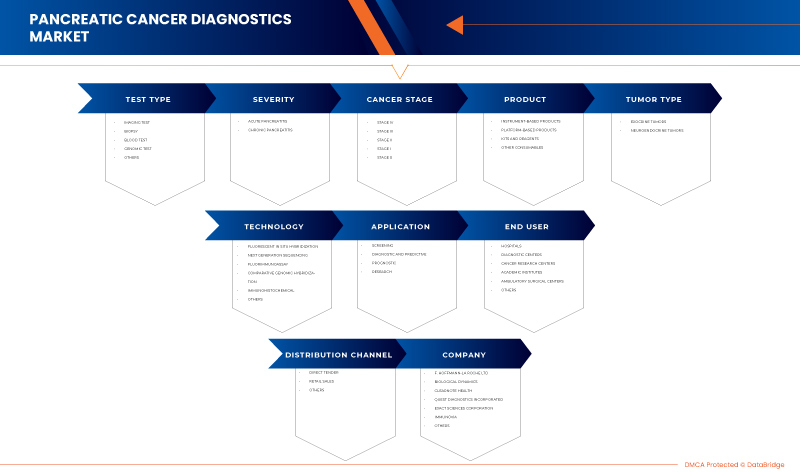
The U.S. pancreatic cancer diagnostics market is segmented into eight notable segments based on test type, cancer stages, tumor type, product, application, technology, end user, and distribution channel. The growth among segments helps you analyze niche pockets of growth and strategies to approach the market and determine your core application areas and the difference in your target markets.
Test Type
- Imaging Test
- Biopsy
- Blood Test
- Genomic Test
- Others
On the basis of test type, the market is segmented into imaging test, biopsy, blood test, genomic test, and others.
Cancer Stages
- Stage 0
- Stage I
- Stage II
- Stage III
- Stage IV
On the basis of cancer stages, the market is segmented into stage 0, stage I, stage II, stage III, and stage IV.
Tumor Type
- Exocrine Tumors
- Neuroendocrine Tumors
On the basis of tumor type, the market is segmented into exocrine tumors and neuroendocrine tumors.
Product
- Instrument-Based Products
- Platform-Based Products
- Kits and Reagents
- Other Consumables
On the basis of product, the market is segmented into instrument-based products, platform-based products, kits and reagents, and other consumables.
Application
- Screening
- Diagnostic And Predictive
- Prognostic
- Research
On the basis of application, the market is segmented into screening, diagnostic and predictive, prognostic, and research.
Technology
- Fluorescent In Situ Hybridization
- Next Generation Sequencing
- Fluoroimmunoassay
- Comparative Genomic Hybridization
- Immunohistochemical
- Others
On the basis of technology, the market is segmented into fluorescent in situ hybridization, next generation sequencing, fluoroimmunoassay, comparative genomic hybridization, immunohistochemical, and others.
End User
- Hospitals
- Diagnostic Centers
- Cancer Research Centers
- Academic Institutes
- Ambulatory Surgical Centers
- Others
On the basis of end user, the market is segmented into hospitals, diagnostic centers, cancer research centers, academic institutes, ambulatory surgical centers, and others.
Distribution Channel
- Direct Tender
- Retail Sales
- Others
On the basis of distribution channel, the market is segmented into direct tender, retail sales, and others.
U.S. Pancreatic Cancer Diagnostics Market Country Analysis/Insights
The U.S. pancreatic cancer diagnostics market is analyzed, and market size insights and trends are provided by the test type, cancer stages, tumor type, product, application, technology, end user, and distribution channel as referenced above.
The regions covered in the market are Southern U.S., Western U.S., Mid-Western U.S., and North-Eastern U.S.
The Southern U.S. pancreatic cancer diagnostics market is expected to grow due to the rise in the prevalence and incidence of pancreatic cancer and the increase in awareness about pancreatic cancer diagnostics. These are the key contributing factors which is expected to boost the market growth in the country.
The region section of the report also provides individual market-impacting factors and changes in market regulation that impact the current and future trends of the market. Data points such as downstream and upstream value chain analysis, technical trends, Porter's five forces analysis, and case studies are some of the pointers used to forecast the market scenario for individual countries. Also, the presence and availability of U.S. brands and their challenges faced due to large or scarce competition from local and domestic brands, and the impact of domestic tariffs and trade routes are considered while providing forecast analysis of the country data.
Competitive Landscape and U.S. Pancreatic Cancer Diagnostics Market Share Analysis
The U.S. pancreatic cancer diagnostics market competitive landscape provides details of competitors. Details included are company overview, company financials, revenue generated, market potential, investment in R&D, new market initiatives, U.S. presence, production sites and facilities, production capacities, company strengths and weaknesses, product launch, product width and breadth, and application dominance. The above data points provided are only related to the company’s focus on the market.
Some of the major market players operating in the U.S. pancreatic cancer diagnostics market are Agilent Technologies, Inc., BD, Biological Dynamics, CANON MEDICAL SYSTEMS CORPORATION, ClearNote Health, CTK Biotech, Inc., Danaher., Exact Sciences Corporation, F. Hoffman- La Roche Ltd, FUJIFILM Holdings America Corporation, GRAIL, Immunovia, Koninklijke Philips N.V., Laboratory Corporation of America Holdings, MP BIOMEDICALS, Myriad Genetics, Inc., QIAGEN, Quest Diagnostics Incorporated, Siemens Healthcare GmbH, and Thermo Fisher Scientific Inc. among others.
SKU-
Obtenha acesso online ao relatório sobre a primeira nuvem de inteligência de mercado do mundo

- Painel interativo de análise de dados
- Painel de análise da empresa para oportunidades de elevado potencial de crescimento
- Acesso de analista de pesquisa para personalização e customização. consultas
- Análise da concorrência com painel interativo
- Últimas notícias, atualizações e atualizações Análise de tendências
- Aproveite o poder da análise de benchmark para um rastreio abrangente da concorrência
Metodologia de Investigação
A recolha de dados e a análise do ano base são feitas através de módulos de recolha de dados com amostras grandes. A etapa inclui a obtenção de informações de mercado ou dados relacionados através de diversas fontes e estratégias. Inclui examinar e planear antecipadamente todos os dados adquiridos no passado. Da mesma forma, envolve o exame de inconsistências de informação observadas em diferentes fontes de informação. Os dados de mercado são analisados e estimados utilizando modelos estatísticos e coerentes de mercado. Além disso, a análise da quota de mercado e a análise das principais tendências são os principais fatores de sucesso no relatório de mercado. Para saber mais, solicite uma chamada de analista ou abra a sua consulta.
A principal metodologia de investigação utilizada pela equipa de investigação do DBMR é a triangulação de dados que envolve a mineração de dados, a análise do impacto das variáveis de dados no mercado e a validação primária (especialista do setor). Os modelos de dados incluem grelha de posicionamento de fornecedores, análise da linha de tempo do mercado, visão geral e guia de mercado, grelha de posicionamento da empresa, análise de patentes, análise de preços, análise da quota de mercado da empresa, normas de medição, análise global versus regional e de participação dos fornecedores. Para saber mais sobre a metodologia de investigação, faça uma consulta para falar com os nossos especialistas do setor.
Personalização disponível
A Data Bridge Market Research é líder em investigação formativa avançada. Orgulhamo-nos de servir os nossos clientes novos e existentes com dados e análises que correspondem e atendem aos seus objetivos. O relatório pode ser personalizado para incluir análise de tendências de preços de marcas-alvo, compreensão do mercado para países adicionais (solicite a lista de países), dados de resultados de ensaios clínicos, revisão de literatura, mercado remodelado e análise de base de produtos . A análise de mercado dos concorrentes-alvo pode ser analisada desde análises baseadas em tecnologia até estratégias de carteira de mercado. Podemos adicionar quantos concorrentes necessitar de dados no formato e estilo de dados que procura. A nossa equipa de analistas também pode fornecer dados em tabelas dinâmicas de ficheiros Excel em bruto (livro de factos) ou pode ajudá-lo a criar apresentações a partir dos conjuntos de dados disponíveis no relatório.











