


Asia-Pacific Building Integrated Photovoltaics (BIPV) Glass Market, By Product (Standard, Coloured), Technology (Crystalline, Thin Film, Mounting Systems), Module type (Monocrystalline, Polycrystalline, Thin Film, Others), Raw Material (Crystalline Silicon, Amorphous Silicon, Organic photo Voltaic Cell, Dye Sensitized Solar Cells, Cadmium Telluride, Copper Indium Gallium Selenide, Others), Appearance (Interior, Exterior), Glazing Type (Single Module, Double Module), Applications (Atriums, Canopies, Facades, Skylight or Solar Glazing, Others), End Users (Residential Buildings, Commercial Buildings, Institutional Buildings, Infrastructural Buildings) – Industry Trends and Forecast to 2030.
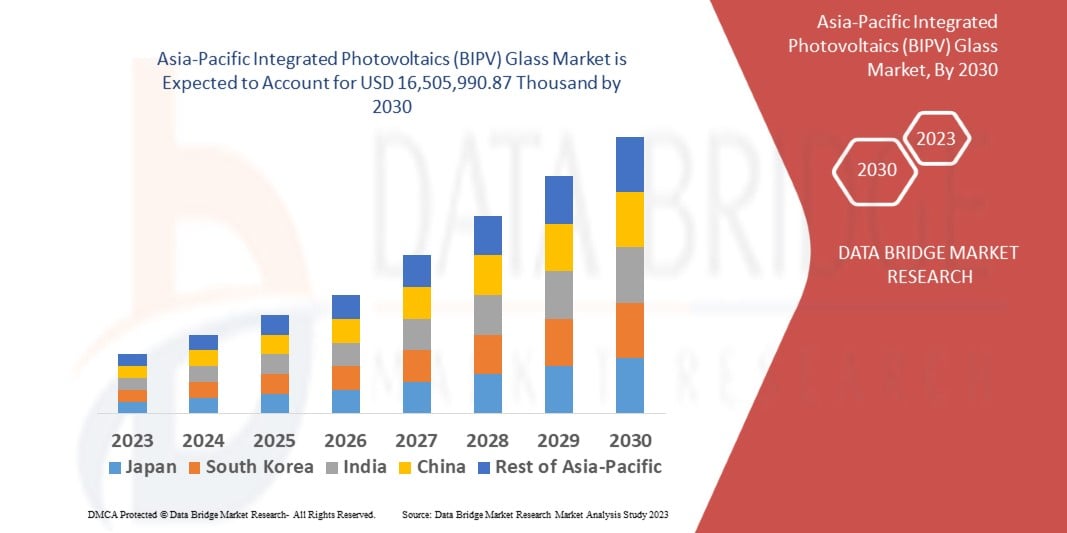
Asia-Pacific Building Integrated Photovoltaics (BIPV) Glass Market Analysis and Size
In areas such as skylights, facade, roof and other structures, building-integrated photovoltaics glass takes the role of conventional building materials. Technology is progressively employed as a major electrical power source to make new facilities. The use of solar energy to attain Nearly Zero Energy Building (NZEB) levels and higher energy ratings for commercial buildings is becoming more popular among developers, architects, owners of new construction and renovations. Thus the growing demand for the building integrated photovoltaics (BIPV) glass with no environmental harm is expected to increase the market growth in coming years.
Data Bridge Market Research analyses that the building integrated photovoltaics (BIPV) glass market is expected to reach USD 16,505,990.87 thousand by 2030, which is USD 1,205,118.94 thousand in 2022, registering a CAGR of 38.70% during the forecast period of 2023 to 2030. In addition to the insights on market scenarios such as market value, growth rate, segmentation, geographical coverage, and major players, the market reports curated by the Data Bridge Market Research also include in-depth expert analysis, geographically represented company-wise production and capacity, network layouts of distributors and partners, detailed and updated price trend analysis and deficit analysis of supply chain and demand..
Asia-Pacific Building Integrated Photovoltaics (BIPV) Glass Market Scope and Segmentation
|
Report Metric |
Details |
|
Forecast Period |
2023 to 2030 |
|
Base Year |
2022 |
|
Historic Years |
2021 (Customizable to 2015 – 2020) |
|
Quantitative Units |
Revenue in USD Thousand, Volumes in Units, Pricing in USD |
|
Segments Covered |
Product (Standard, Coloured), Technology (Crystalline, Thin Film, Mounting Systems), Module type (Monocrystalline, Polycrystalline, Thin Film, Others), Raw Material (Crystalline Silicon, Amorphous Silicon, Organic photo Voltaic Cell, Dye Sensitized Solar Cells, Cadmium Telluride, Copper Indium Gallium Selenide, Others), Appearance (Interior, Exterior), Glazing Type (Single Module, Double Module), Applications (Atriums, Canopies, Facades, Skylight or Solar Glazing, Others), End Users (Residential Buildings, Commercial Buildings, Institutional Buildings, Infrastructural Buildings) |
|
Countries Covered |
China, Japan, India, South Korea, Singapore, Malaysia, Australia, Thailand, Indonesia, Philippines, Rest of Asia-Pacific (APAC) in the Asia-Pacific (APAC), |
|
Market Players Covered |
Dow (U.S.), Wuxi Suntech Power Co., Ltd. (China), Belectric (Germany), Carmanah Technologies Corp (Canada), Borosil Renewables Ltd. (India), Tesla (U.S.), NanoPV Solar Inc. (U.S.), TAIYO KOGYO CORPORATION (Japan), Onyx Solar Group LLC (Spain), AGC Inc. (Japan), Scheuten (Netherlands), Ascent Solar Technologies, Inc. (U.S.), First Solar (U.S.), Sharp Corporation (U.S.), GoodWe (China) |
|
Market Opportunities |
|
Market Definition
Building-integrated photovoltaics (BIPVs) is a technology that allows the conversion of light into electricity. This glass includes transparent semiconductor-based photovoltaic cells, which are also called solar cells. Normally, these modules include the integration of backup power supply system, photovoltaic modules, charge controller, power storage system, and other supporting hardware. Building-integrated photovoltaics (BIPVs) glass offer numerous benefits over traditional counterparts because they provide onsite zero emissions, high energy conservation, power generation, optimal shading and superior architectural integration.
Building Integrated Photovoltaics (BIPV) Glass Market Dynamics
Drivers
- Rising application of building integrated photovoltaics (BIPV) glass in building roofs
Increasing application of building integrated photovoltaics (BIPV) glass in building roofs due to their minimal maintenance, high output, adaptability and energy-saving characteristics is likely to drive the market growth during the forecast period. Building integrated photovoltaics (BIPV) glass also provides great strength due to its features such as waterproof, system auto-shutdown to avoid fire and resistance to climatic conditions. Hence, all these factors are likely to boost the market growth.
- Growing product developments by major market players widen the market scope
主要市场参与者不断增加的产品开发拓宽了市场范围,并可能在 2023 年至 2030 年的预测期内推动市场增长。例如,2021 年,日本玻璃、化学品和高科技材料制造商 AGC Inc. 宣布其建筑一体化光伏 (BIPV) 玻璃已被选中安装在新加坡理工学院的新榜鹅校区,该校区计划于 2024 年开放。随着这一发展,预计亚太地区将在未来几年实现最高增长率。
机会
- 主要市场参与者纷纷推出新产品,引入先进产品
市场参与者不断推出的产品和其他创新进一步为市场提供了充足的增长机会。例如,总部位于中国的制造公司 GoodWe 于 2022 年推出了其先进的 BIPV 解决方案,该解决方案可与 SEMS、逆变器和电动汽车充电器集成。它提供自动关机功能和 100% 防水效果,可避免火灾发生,并可承受恶劣的气候条件。这种先进的屋顶解决方案可以帮助商业建筑每年节省约 0.18 美元/平方英尺。这种新的建筑一体化光伏解决方案还鼓励用户实现碳中和。这些因素可能会促进该地区的市场增长。
- 政府不断采取举措,宣传绿色资源的优势
亚太地区各地区的政府正在推出激励措施,鼓励采用光伏 (PV) 模块,并传播使用可再生资源优势的意识。建筑一体化光伏 (BIPV) 玻璃从长远来看具有经济效益,同时还能保持建筑的外观,从而吸引更多消费者采用这种解决方案。由于所有这些因素,对建筑一体化光伏 (BIPV) 玻璃的需求增加,在预测期内创造了有利可图的市场增长机会。
限制/挑战
- 消费者认知度不足,效率低下
消费者并不了解政府关于建筑太阳能政策的优势。尽管情况正在迅速变化,系统制造商也在提高认识。此外,与其他光伏材料相比,建筑一体化光伏 (BIPV) 玻璃的能源效率较低。例如,基于建筑一体化光伏 (BIPV) 玻璃的系统的能量转换效率也相对较低,不到 20%,而且受天气模式影响较大。上述因素将成为市场的主要制约因素。
- 屋顶太阳能越来越受欢迎
由于屋顶太阳能光伏技术的发展,大量消费者更喜欢屋顶太阳能而不是建筑一体化光伏 (BIPV) 玻璃,该技术比建筑一体化光伏 (BIPV) 玻璃要好得多。这一因素将对预测期内建筑一体化光伏 (BIPV) 玻璃市场的增长构成重大挑战。
本建筑一体化光伏 (BIPV) 玻璃市场报告详细介绍了最新发展、贸易法规、进出口分析、生产分析、价值链优化、市场份额、国内和本地市场参与者的影响,分析了新兴收入领域的机会、市场法规的变化、战略市场增长分析、市场规模、类别市场增长、应用领域和主导地位、产品批准、产品发布、地域扩展、市场技术创新。如需了解有关建筑一体化光伏 (BIPV) 玻璃市场的更多信息,请联系 Data Bridge Market Research 获取分析师简报,我们的团队将帮助您做出明智的市场决策,实现市场增长。
原材料短缺和运输延误的影响和当前市场状况
Data Bridge Market Research 提供高水平的市场分析,并通过考虑原材料短缺和运输延误的影响和当前市场环境来提供信息。这意味着评估战略可能性、制定有效的行动计划并协助企业做出重要决策。
除了标准报告外,我们还提供从预测的运输延迟、按区域划分的分销商映射、商品分析、生产分析、价格映射趋势、采购、类别绩效分析、供应链风险管理解决方案、高级基准测试等角度对采购层面的深入分析,以及其他采购和战略支持服务。
经济放缓对产品定价和供应的预期影响
当经济活动放缓时,行业开始受到影响。DBMR 提供的市场洞察报告和情报服务考虑了经济衰退对产品定价和可获得性的预测影响。借助这些,我们的客户通常可以领先竞争对手一步,预测他们的销售额和收入,并估算他们的盈亏支出。
近期发展
- 2022 年,东方日升推出了一系列新型异质结和建筑一体化光伏 (BIPV) 组件,与以前的产品相比,这些组件有助于提高发电性能并减少碳排放。新型异质结组件称为 Hyper-ion,采用 210 毫米 HJT 半切 120 微米电池和微晶技术,效率达到 25.2% 以上。
- 2021 年,瑞士光伏组件制造商梅耶博格 (Meyer Burger) 购买了将其业务组合扩展到 BIPV 系统的权利。该公司将提供屋顶太阳能系统。他们在 2021 年的智能电子欧洲博览会上展示了他们的第一款自制太阳能瓦片。预计第一批交付给消费者的时间是 2022 年下半年。
- 2020 年,高效光伏发电和有机光伏技术开发商 NanoFlex Power Corporation (NFP) 与建筑覆层制造商 True Metal Solutions (TMS) 成立合资企业,扩展用于建筑外墙覆层的有机光伏薄膜材料业务。
亚太建筑一体化光伏 (BIPV) 玻璃市场范围
建筑一体化光伏 (BIPV) 玻璃市场根据产品、技术、模块类型、原材料、外观、玻璃类型、应用和最终用户进行细分。这些细分市场之间的增长将帮助您分析行业中增长微弱的细分市场,并为用户提供有价值的市场概览和市场洞察,帮助他们做出战略决策,确定核心市场应用。
产品
- 标准
- 有色
技术
- 结晶
- 薄膜
- 安装系统
模块类型
- 单晶硅
- 多晶硅
- 薄膜
- 其他的
原料
- 晶体硅
- 非晶硅
- 有机光伏电池
- 染料敏化太阳能电池
- 碲化镉
- 铜铟镓硒
- 其他的
外貌
- 内部的
- 外部的
玻璃类型
- 单模块
- 双模块
应用
- 中庭
- 檐篷
- 立面
- 天窗或太阳能玻璃
- 其他的
最终用户
- 住宅建筑
- 商业建筑
- 机构建筑
- 基础设施建筑
建筑一体化光伏 (BIPV) 玻璃市场区域分析/见解
对建筑一体化光伏 (BIPV) 玻璃市场进行了分析,并按国家、产品、技术、模块类型、原材料、外观、玻璃类型、应用和最终用户提供了市场规模见解和趋势。
建筑一体化光伏(BIPV)玻璃市场报告涵盖的国家包括亚太地区(APAC)的中国、日本、印度、韩国、新加坡、马来西亚、澳大利亚、泰国、印度尼西亚、菲律宾、亚太地区(APAC)其他地区。
中国在亚太地区建筑一体化光伏 (BIPV) 玻璃市场占据主导地位,因为他们被鼓励采用新的创新制造技术来承受市场的增长。此外,该地区的消费者对可再生能源的需求很大,以减少不可再生能源对环境的负面影响,这将进一步促进该地区的市场增长。
报告的国家部分还提供了影响市场当前和未来趋势的各个市场影响因素和市场监管变化。下游和上游价值链分析、技术趋势和波特五力分析、案例研究等数据点是用于预测各个国家市场情景的一些指标。此外,在提供国家数据的预测分析时,还考虑了亚太品牌的存在和可用性以及它们因来自本地和国内品牌的激烈或稀缺竞争而面临的挑战、国内关税和贸易路线的影响。
竞争格局和建筑一体化光伏 (BIPV) 玻璃市场份额分析
建筑一体化光伏 (BIPV) 玻璃市场竞争格局按竞争对手提供详细信息。详细信息包括公司概况、公司财务状况、收入、市场潜力、研发投资、新市场计划、亚太地区业务、生产基地和设施、生产能力、公司优势和劣势、产品发布、产品宽度和广度、应用主导地位。以上提供的数据点仅与公司对建筑一体化光伏 (BIPV) 玻璃市场的关注有关。
建筑一体化光伏(BIPV)玻璃市场的一些主要参与者包括:
- 陶氏(美国)
- 无锡尚德太阳能电力有限公司 (中国)
- Belectric(德国)
- Carmanah Technologies Corp(加拿大)
- Borosil Renewables Ltd.(印度)、特斯拉(美国)
- NanoPV Solar Inc.(美国)
- 太阳工业株式会社(日本)
- Onyx Solar Group LLC(西班牙)
- AGC 公司 (日本)
- 斯凯滕(荷兰)
- Ascent Solar Technologies, Inc.(美国)
- First Solar(美国)
- 夏普公司(美国)
- 固德威(中国)
SKU-

研究方法
数据收集和基准年分析是使用具有大样本量的数据收集模块完成的。该阶段包括通过各种来源和策略获取市场信息或相关数据。它包括提前检查和规划从过去获得的所有数据。它同样包括检查不同信息源中出现的信息不一致。使用市场统计和连贯模型分析和估计市场数据。此外,市场份额分析和关键趋势分析是市场报告中的主要成功因素。要了解更多信息,请请求分析师致电或下拉您的询问。
DBMR 研究团队使用的关键研究方法是数据三角测量,其中包括数据挖掘、数据变量对市场影响的分析和主要(行业专家)验证。数据模型包括供应商定位网格、市场时间线分析、市场概览和指南、公司定位网格、专利分析、定价分析、公司市场份额分析、测量标准、全球与区域和供应商份额分析。要了解有关研究方法的更多信息,请向我们的行业专家咨询。
可定制
Data Bridge Market Research 是高级形成性研究领域的领导者。我们为向现有和新客户提供符合其目标的数据和分析而感到自豪。报告可定制,包括目标品牌的价格趋势分析、了解其他国家的市场(索取国家列表)、临床试验结果数据、文献综述、翻新市场和产品基础分析。目标竞争对手的市场分析可以从基于技术的分析到市场组合策略进行分析。我们可以按照您所需的格式和数据样式添加您需要的任意数量的竞争对手数据。我们的分析师团队还可以为您提供原始 Excel 文件数据透视表(事实手册)中的数据,或者可以帮助您根据报告中的数据集创建演示文稿。











