


Global Electroencephalography Devices Market Segmentation, By Product Type (Devices, Accessories, and Consumables), Type (Portable, Standalone, and Wearable), Usability (Disposable, Semi disposable, and Reusable), Procedure (Routine EEG, Sleep-Deprived EEG, Ambulatory EEG, and Others), Function (Standard EEG, Ambulatory EEG, Video EEG), Signal Frequency (Delta (3 Hz or Below), Theta (3.5 to 7.5 Hz), Alpha (7.5 and 13 Hz), Beta (14 and Greater Hz)), Filtering Settings (Low Frequency Filter (1 Hz), High Frequency Filter (50-70 Hz), Notch Filter, and Bandpass Filter), Age Group (Pediatric, Adult, and Geriatric), Application (Disease Diagnosis, Sleep Monitoring, Anesthesia Monitoring, Trauma & Surgery, and Others), End User (Hospitals, Neurology Centers, Ambulatory Surgical Centers, Diagnostic Centers, Academic and Research Organizations, and Others), Distribution Channel (Direct Tender and Retail Sales) - Industry Trends and Forecast to 2032
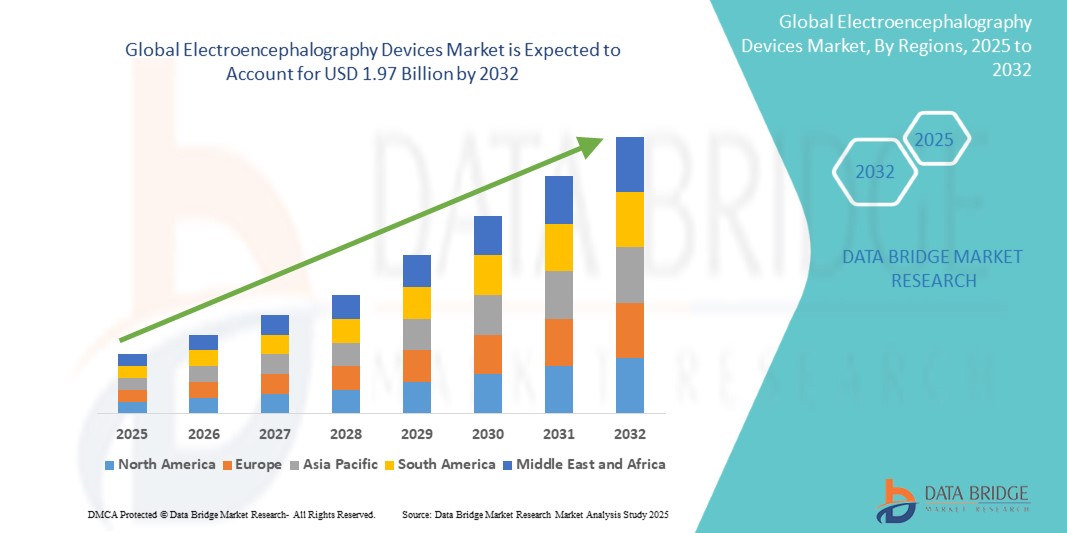
Electroencephalography Devices Market Size
- The global electroencephalography devices market size was valued atUSD 1.30 billion in 2024and is expected to reachUSD 1.97 billion by 2032, at aCAGR of 5.40%during the forecast period
- This growth is driven by factors such as the increasing prevalence of neurological disorders, advancements in EEG technology, integration of artificial intelligence (AI), expansion of research applications, and rising demand for non-invasive and portable devices
Electroencephalography Devices Market Analysis
- An electroencephalogram refers to a test that makes the use of small metal discs (electrodes) connected to the scalp for detecting activity in the brain. The increase in the prevalence of neurological disorders is escalating the growth of electroencephalography devices market
- Electroencephalography equipment refers to the equipment that is utilized for monitoring the electrical signals of the brain. The readings from these devices are used for diagnosing neurological disorders and monitoring neurological disorders, and sleep disorders
- North America is expected to dominate the electroencephalography devices market with 36% due Increasing occurrences of sleep and neurodegenerative conditions, along with improved insurance coverage, are critical drivers of regional expansion
- Asia-Pacific is expected to be the fastest growing region in the electroencephalography devices market during the forecast period due to region's substantial population, increasing healthcare expenditure, and increasing demand for advanced medical treatments and technologies
- 32 channel EEG is expected to dominate the market with a market share of 28.1% due to the device’s enhanced diagnostic capabilities and higher spatial resolution. As healthcare providers seek more comprehensive insights into brain activity, the demand for EEG systems with increased channel capacity is rising
Report Scope and Electroencephalography Devices Market Segmentation
|
Attributes |
Electroencephalography Devices Key Market Insights |
|
Segments Covered |
|
|
Countries Covered |
North America
Europe
Asia-Pacific
Middle East and Africa
South America
|
|
Key Market Players |
|
|
Market Opportunities |
|
|
Value Added Data Infosets |
In addition to the insights on market scenarios such as market value, growth rate, segmentation, geographical coverage, and major players, the market reports curated by the Data Bridge Market Research also include in-depth expert analysis, patient epidemiology, pipeline analysis, pricing analysis, and regulatory framework. |
Electroencephalography Devices Market Trends
“Growth in Research Applications”
- EEG devices are increasingly utilized in cognitive neuroscience, psychology research, and neuromarketing, expanding their application beyond clinical settings
- EEG devices are pivotal in cognitive neuroscience and psychology, facilitating the study of brain activities associated with perception, attention, memory, and decision-making
- Researchers employ EEG to investigate neural correlates of cognitive processes, providing insights into how the brain processes information
- For instance, studies have utilized EEG to explore the neural mechanisms underlying attention and working memory, enhancing our understanding of these cognitive functions
- In neuromarketing, EEG technology is employed to assess consumer responses to advertisements, products, and branding. By analyzing brainwave patterns, companies can gauge emotional reactions and cognitive engagement, informing marketing strategies
Electroencephalography Devices Market Dynamics
Driver
“Increasing Incidence of Neurological Disorders”
- The escalating prevalence of neurological disorders is a primary driver of the EEG devices market
- Conditions such as epilepsy, Alzheimer's disease, and sleep disorders are becoming more common globally, necessitating advanced diagnostic tools
- For instance, the World Health Organization reports that over 50 million people worldwide are affected by epilepsy
- These statistics underscore the growing need for effective diagnostic solutions, propelling the demand for EEG devices
Opportunity
“Expansion of Telemedicine and Remote Monitoring”
- The rise of telemedicine presents a significant opportunity for the EEG devices market
- The COVID-19 pandemic accelerated the adoption of remote healthcare services, highlighting the need for portable and user-friendly diagnostic tools
- EEG devices equipped with wireless connectivity and real-time data transmission capabilities are well-suited for remote monitoring of neurological conditions
- This shift enables continuous patient monitoring, timely interventions, and improved patient outcomes, particularly in underserved or rural areas where access to healthcare facilities may be limited
Restraint/Challenge
“High Cost and Accessibility Issues”
- Despite their benefits, the high cost of advanced EEG devices poses a significant challenge to their widespread adoption
- The initial purchase price, coupled with maintenance, software upgrades, and training costs, can be prohibitive, especially for healthcare providers in developing regions
- Additionally, the complexity of EEG data interpretation requires specialized training, and the shortage of skilled personnel can hinder the effective use of EEG devices
- These factors contribute to accessibility issues, limiting the reach of EEG technology to a broader patient population
Electroencephalography Devices Market Scope
The market is segmented on the basis of product type, type, usability, procedure, function, signal frequency, filtering settings, age group, application, end user, and distribution channel
|
Segmentation |
Sub-Segmentation |
|
By Product Type |
|
|
By Type |
|
|
By Usability |
|
|
By Procedure |
|
|
By Function |
|
|
By Signal Frequency |
|
|
By Filtering Settings |
|
|
By Age Group |
|
|
By Application |
|
|
By End User |
|
|
By Distribution Channel |
|
In 2025, the 32 channel EEG is projected to dominate the market with a largest share in procedure segment
The 32 channel EEG is expected to dominate the Electroencephalography Devices market with the largest share of 28.1% in 2025 due to the device’s enhanced diagnostic capabilities and higher spatial resolution. As healthcare providers seek more comprehensive insights into brain activity, the demand for EEG systems with increased channel capacity is rising. The 32-channel configuration allows simultaneous monitoring of multiple brain regions, enabling more accurate assessments of cognitive function and neurological disorders
The standalone is expected to account for the largest share during the forecast period in type market
In 2025, the standalone segment is expected to dominate the market with the largest market share of 32.4% due to EEG devices play a crucial role in diagnosing various neurological disorders, such as epilepsy, Alzheimer's disease, and Parkinson's disease. The rising prevalence of these conditions and the growing awareness about the importance of early diagnosis are likely to drive the demand for EEG devices for disease diagnosis.
Electroencephalography Devices Market Regional Analysis
“North America Holds the Largest Share in the Electroencephalography Devices Market”
- North America led the global EEG devices market with 36% of the global share
- U.S. dominate the global electroencephalography devices market. This dominance is attributed to its regulatory environments and reimbursement policies have facilitated the introduction and widespread use of EEG devices in clinical settings
- The region boasts cutting-edge healthcare infrastructure and a high adoption rate of advanced medical technologies, including 32-channel and multichannel EEG systems
- Significant investments in R&D by key players such as Medtronic and Natus Medical have fostered innovation and product development
- Favorable regulatory environments and reimbursement policies have facilitated the introduction and widespread use of EEG devices in clinical settings
“Asia-Pacific is Projected to Register the Highest CAGR in the Electroencephalography Devices Market”
- China, India, and Japan are leading the growth, driven by increasing healthcare investments and a rising elderly population
- 32-channel EEG systems were the largest revenue-generating product , with multichannel EEG systems registering the fastest growth during the forecast period
- Ongoing improvements in healthcare infrastructure and accessibility are contributing to the market expansion
- The region's growth is further supported by increasing prevalence of neurological disorders and a shift towards non-invasive diagnostic methods
Electroencephalography Devices Market Share
The market competitive landscape provides details by competitor. Details included are company overview, company financials, revenue generated, market potential, investment in research and development, new market initiatives, global presence, production sites and facilities, production capacities, company strengths and weaknesses, product launch, product width and breadth, application dominance. The above data points provided are only related to the companies' focus related to market.
The Major Market Leaders Operating in the Market Are:
- Cadwell Industries Inc. (U.S.)
- Compumedics Limited(Australia)
- NeuroWave Systems Inc. (U.S.)
- Natus Medical Incorporated(U.S.)
- Medtronic(Ireland)
- NIHON KOHDEN CORPORATION (Japan)
- NeuroSky (China)
- Bio-Signal Group Corp. (U.S.)
- Elekta AB (Sweden)
- Lifelines Neuro (U.S.)
- Neurosoft S.A. (Greece)
- EMS Handels Gesellschaft mbH (Austria)
- Jordan NeuroScience, Inc. (U.S.)
- BrainScope Company Inc. (U.S.)
- Advanced Brain Monitoring, Inc. (U.S.)
- EB Neuro S.p.A. (Italy)
- g.tec medical engineering GmbH Austria (Austria)
- Bitbrain Technologies (Spain)
- Electrical Geodesics, Inc. (U.S.)
- Masimo (U.S.)
- ELMIKO MEDICAL sp. Z oo (Poland)
- Micromed (Italy)
Latest Developments in Global Electroencephalography Devices Market
- In March 2025, PiEEG Box is a multifunctional, compact, and mobile device that allows for the measurement of EEG, EMG, EOG, and EKG signals. It incorporates a Raspberry Pi-based EEG shield, an EEG electrode cap, a display screen, additional sensors for body parameters, and other necessary peripherals into a single, portable unit
- In October 2024, Neurable introduced the MW75 Neuro, a pair of active noise-cancelling wireless headphones equipped with EEG sensors to monitor brain activity and assess focus levels.
- In February 2024, Neurotechnology's enhanced BrainAccess EEG solutions showcased upgraded headwear, expanded software functionalities, and the introduction of a novel 32-channel system
- In January 2024, Gate entered into a collaboration with Beacon to employ EEG biomarkers in its Phase II trial for Major Depressive Disorder (MDD). The trial is expected to utilize Beacon's Dreem 3S headband device for exploratory EEG and sleep analyses in participants. Scheduled to commence in mid-2024, the Phase II investigation of Gate's zelquistine aims to advance understanding and potential treatments for MDD.
- In January 2024, Aditxt, a biotechnology company headquartered in the U.S., collected EEG brain monitoring technologies and devices from Brain Scientific. The acquisition comprised a portfolio of 16 patents, which includes a disposable NeuroCap and a portable NeuroEEG.
- In July 2023, a significant USD 1.5 million funding boost to the universities of Bath and Bristol was expected to help patients and & families with an easy-to-use Fastball EEG test to improve the early detection of dementia and Alzheimer's disease.
SKU-

研究方法
数据收集和基准年分析是使用具有大样本量的数据收集模块完成的。该阶段包括通过各种来源和策略获取市场信息或相关数据。它包括提前检查和规划从过去获得的所有数据。它同样包括检查不同信息源中出现的信息不一致。使用市场统计和连贯模型分析和估计市场数据。此外,市场份额分析和关键趋势分析是市场报告中的主要成功因素。要了解更多信息,请请求分析师致电或下拉您的询问。
DBMR 研究团队使用的关键研究方法是数据三角测量,其中包括数据挖掘、数据变量对市场影响的分析和主要(行业专家)验证。数据模型包括供应商定位网格、市场时间线分析、市场概览和指南、公司定位网格、专利分析、定价分析、公司市场份额分析、测量标准、全球与区域和供应商份额分析。要了解有关研究方法的更多信息,请向我们的行业专家咨询。
可定制
Data Bridge Market Research 是高级形成性研究领域的领导者。我们为向现有和新客户提供符合其目标的数据和分析而感到自豪。报告可定制,包括目标品牌的价格趋势分析、了解其他国家的市场(索取国家列表)、临床试验结果数据、文献综述、翻新市场和产品基础分析。目标竞争对手的市场分析可以从基于技术的分析到市场组合策略进行分析。我们可以按照您所需的格式和数据样式添加您需要的任意数量的竞争对手数据。我们的分析师团队还可以为您提供原始 Excel 文件数据透视表(事实手册)中的数据,或者可以帮助您根据报告中的数据集创建演示文稿。
常见问题












