


Global Medical Terminology Software Market, By Products (Services, Platform), Application (Data Aggregation, Reimbursement, Public Health Surveillance, Data Integration, Decision Support, Clinical Trials, Quality Reporting, and Clinical Guidelines), End Users (Healthcare Providers, Healthcare Payers, Healthcare IT Vendors) – Industry Trends and Forecast to 2029
Market Analysis and Size
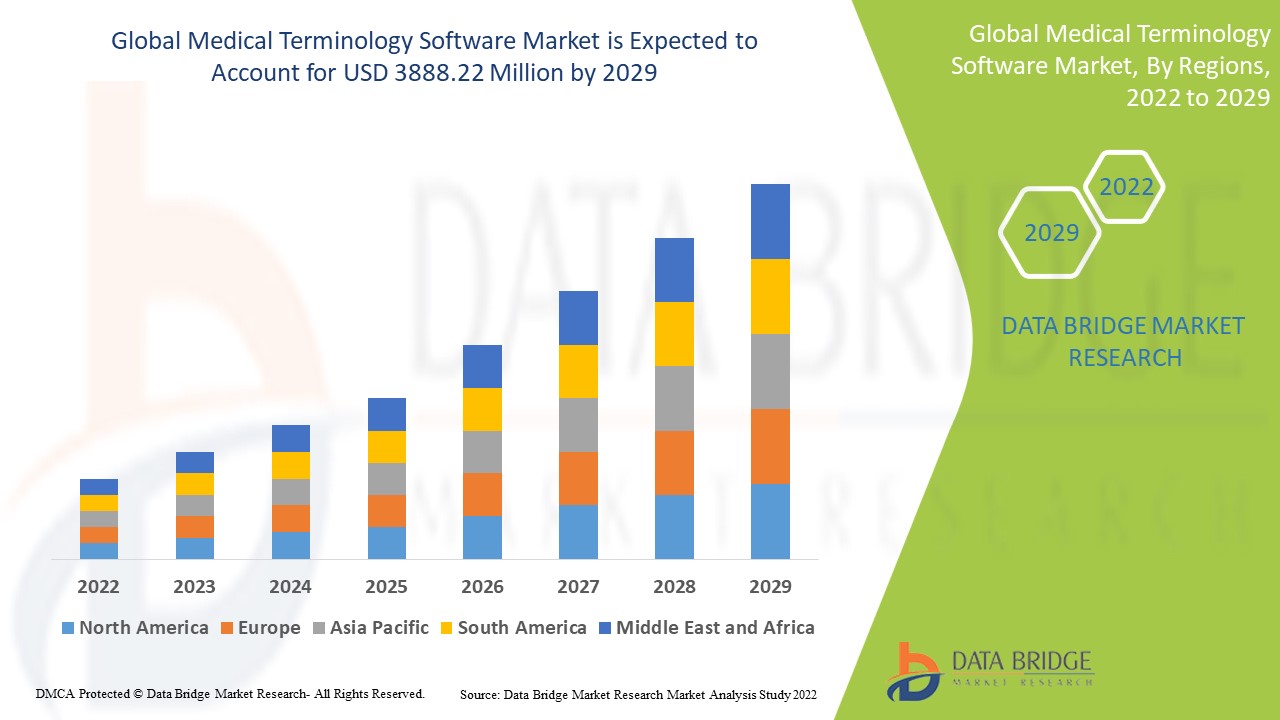
The medical terminology software market is estimated to grow at a CAGR of roughly 18.52 % during the forecast period of 2022-2029. The market is being propelled forward by the growing demand to standardize patient data and decrease medical errors, as well as different government initiatives aimed at encouraging the implementation of healthcare information technology (HCIT). Another important factor driving the worldwide market is the major market players' significant investments in multiple R&D operations in order to produce new software and products that are integrated with modern technologies and so increase their position in the industry.
Data Bridge Market Research analyses that the medical terminology software market which was USD 998.66 million in 2021, would rocket up to USD 3888.22 million by 2029, and is expected to undergo a CAGR of 18.52% during the forecast period 2022 to 2029. In addition to the market insights such as market value, growth rate, market segments, geographical coverage, market players, and market scenario, the market report curated by the Data Bridge Market Research team also includes in-depth expert analysis, patient epidemiology, pipeline analysis, pricing analysis, and regulatory framework.
Report Scope and Market Segmentation
|
Report Metric |
Details |
|
Forecast Period |
2022 to 2029 |
|
Base Year |
2021 |
|
Historic Years |
2020 (Customizable to 2014 - 2019) |
|
Quantitative Units |
Revenue in USD Million, Volumes in Units, Pricing in USD |
|
Segments Covered |
Products (Services, Platform), Application (Data Aggregation, Reimbursement, Public Health Surveillance, Data Integration, Decision Support, Clinical Trials, Quality Reporting, and Clinical Guidelines), End Users (Healthcare Providers, Healthcare Payers, Healthcare IT Vendors) |
|
Countries Covered |
U.S., Canada and Mexico in North America, Germany, France, U.K., Netherlands, Switzerland, Belgium, Russia, Italy, Spain, Turkey, Rest of Europe in Europe, China, Japan, India, South Korea, Singapore, Malaysia, Australia, Thailand, Indonesia, Philippines, Rest of Asia-Pacific (APAC) in the Asia-Pacific (APAC), Saudi Arabia, U.A.E, South Africa, Egypt, Israel, Rest of Middle East and Africa (MEA) as a part of Middle East and Africa (MEA), Brazil, Argentina and Rest of South America as part of South America |
|
Market Players Covered |
Wolters Kluwer N.V (Netherlands), 3M (U.S), Intelligent Medical Objects Inc. (U.S), Apelon Inc. (U.S), Clinical Architecture, LLC. (U.S), BITAC Inc. (India), QA Healthcare Pte Ltd (Singapore), Carecom Co Ltd (U.K), HiveWorx (U.K), BT Clinical Computing (Canada), Medocomp Systems (U.S), Spellex Corporation (U.S), West Coast Informatics LLC (U.S), B2i Healthcare (Singapore) |
|
Market Opportunities |
|
Market Definition
The need for medical terminology software to reduce healthcare errors and enable proper patient treatment is rise sharply around the world. It's widely used in clinical trials, insurance claims and reimbursements, public health monitoring, and other areas, and it helps healthcare facilities handle patient records more efficiently.
Medical terminology software Market Dynamics
Drivers
- Growing need to prevent medical blunders
The understanding or describing of the human body, its components, workings, processes, and conditions influencing it is known as medical terminology. Medical language is used in the field of medicine, and medical terminology software assists in conveying all of this information in a straightforward manner and acting as a link to fill in the gaps. It streamlines the documentation and clinical information for the patient. Medical terminology software is intended to standardise patient data and manage the huge amounts of healthcare data that accumulate over time. It also addresses the growing need to prevent medical blunders. The market's growth may be hampered by a refusal to utilise linguistic solutions over traditional techniques. Growing markets, along with a growing need to ensure data integrity, may present a plethora of options in the market.
- Surging Need to Reduce Medical Errors to Save Patient Lives
The growing demand for medical terminology solutions in hospitals throughout the world to organise patient data, reduce medical errors, and retain extensive healthcare information in order to save patients' lives is expected to drive the market. Moreover, several government initiatives pushing the implementation of HCIT to better clinical data operations would aid the global market's growth in the coming years.
Opportunities
The growing worry about medical errors is fueling the expansion of the medical terminology software industry in a positive way. The medical terminology software market is also increasing due to various government agencies implementing steps for HCIT adoption, as well as disparity and fragmentation in the terminology content of healthcare organisations. During the projection period, the growing need for data integrity is expected to provide additional growth possibilities for market players. Medical terminology software market growth is expected to be boosted by rising demand for reliable data sharing between healthcare providers and payers to streamline workflow.
Restraints/Challenges
- Doubtful Attitude toward Using New-Age Healthcare Solutions
The lack of awareness among healthcare professionals about how to utilise this software, as well as apprehension about using new healthcare solutions over old techniques, may limit the growth of the global medical terminology software market between 2021 and 2026.
The unwillingness to adopt terminology software packages over traditional procedures, on the other hand, could pose a severe threat to the medical terminology software market's growth over the projection period.
This medical terminology software market report provides details of new recent developments, trade regulations, import-export analysis, production analysis, value chain optimization, market share, impact of domestic and localized market players, analyses opportunities in terms of emerging revenue pockets, changes in market regulations, strategic market growth analysis, market size, category market growths, application niches and dominance, product approvals, product launches, geographic expansions, technological innovations in the market. To gain more info on the medical terminology software market contact Data Bridge Market Research for an Analyst Brief, our team will help you take an informed market decision to achieve market growth.
Covid-19 impact on Medical Terminology Software Market
With its high prevalence, the arrival of Covid-19 in 2020 shocked the worldwide healthcare market, especially in the first months of the year. The Global Medical Terminology Market, on the other hand, has seen promising growth prospects. Many people became ill as a result of the virus's rapid spread, and because the symptoms were not yet known, a large amount of patient data was gathered. As a result, there has been a considerable increase in the demand for medical terminology software in order to reliably acquire and organise information and give better therapy and care to patients. Furthermore, the public's growing interest in Covid-19 testing, treatments, and vaccination dissemination has fueled the demand for medical terminology software. Furthermore, numerous governments from across the world have been supporting the usage of this software to maintain continuity in healthcare operations with accurate and timely updates, i.e., forecasting profitable growth potential for the global market in the next years.
Global Medical Terminology Software Market Scope
The medical terminology software market is segmented on the basis of product type, application and end-user. The growth amongst these segments will help you analyze meagre growth segments in the industries and provide the users with a valuable market overview and market insights to help them make strategic decisions for identifying core market applications.
Products
- Services
- Platform
End-user
- Healthcare Providers
- Healthcare Payers
- Others
Application
- Data Aggregation
- Reimbursement
- Public Health Surveillance
- Data Integration
- Decision Support
- Clinical Trials
- Quality Reporting
- Clinical Guidelines
Medical Terminology Software Market Regional Analysis/Insights
The medical terminology software market is analysed and market size insights and trends are provided by country, product type, application and end-user as referenced above.
The countries covered in the medical terminology software market report are U.S., Canada and Mexico in North America, Germany, France, U.K., Netherlands, Switzerland, Belgium, Russia, Italy, Spain, Turkey, Rest of Europe in Europe, China, Japan, India, South Korea, Singapore, Malaysia, Australia, Thailand, Indonesia, Philippines, Rest of Asia-Pacific (APAC) in the Asia-Pacific (APAC), Saudi Arabia, U.A.E, South Africa, Egypt, Israel, Rest of Middle East and Africa (MEA) as a part of Middle East and Africa (MEA), Brazil, Argentina and Rest of South America as part of South America.
North America has witnessed largest market share and also expected to dominate the market in the forecast period as the region is investing huge amount in biotechnology along with the adoption of HCIT technologies.
Asia-Pacific market is expected to register the highest growth rate during the forecast period due to improving healthcare infrastructure, rising healthcare insurance coverage, and growing medical tourism.
The country section of the report also provides individual market impacting factors and changes in regulation in the market domestically that impacts the current and future trends of the market. Data points like down-stream and upstream value chain analysis, technical trends and porter's five forces analysis, case studies are some of the pointers used to forecast the market scenario for individual countries. Also, the presence and availability of global brands and their challenges faced due to large or scarce competition from local and domestic brands, impact of domestic tariffs and trade routes are considered while providing forecast analysis of the country data.
Competitive Landscape and Medical Terminology Software Market Share Analysis
The medical terminology software market competitive landscape provides details by competitor. Details included are company overview, company financials, revenue generated, market potential, investment in research and development, new market initiatives, global presence, production sites and facilities, production capacities, company strengths and weaknesses, product launch, product width and breadth, application dominance. The above data points provided are only related to the companies' focus related to medical terminology software market.
Some of the major players operating in the medical terminology software market are:
- Wolters Kluwer N.V (Netherlands)
- 3M (U.S)
- Intelligent Medical Objects Inc. (U.S)
- Apelon Inc. (U.S)
- Clinical Architecture, LLC. (U.S)
- BITAC Inc. (India)
- QA Healthcare Pte Ltd (Singapore)
- Carecom Co Ltd (U.K)
- HiveWorx (U.K)
- BT Clinical Computing (Canada)
- Medocomp Systems (U.S)
- Spellex Corporation (U.S)
- West Coast Informatics LLC (U.S)
- B2i Healthcare (Singapore)
SKU-

研究方法
数据收集和基准年分析是使用具有大样本量的数据收集模块完成的。该阶段包括通过各种来源和策略获取市场信息或相关数据。它包括提前检查和规划从过去获得的所有数据。它同样包括检查不同信息源中出现的信息不一致。使用市场统计和连贯模型分析和估计市场数据。此外,市场份额分析和关键趋势分析是市场报告中的主要成功因素。要了解更多信息,请请求分析师致电或下拉您的询问。
DBMR 研究团队使用的关键研究方法是数据三角测量,其中包括数据挖掘、数据变量对市场影响的分析和主要(行业专家)验证。数据模型包括供应商定位网格、市场时间线分析、市场概览和指南、公司定位网格、专利分析、定价分析、公司市场份额分析、测量标准、全球与区域和供应商份额分析。要了解有关研究方法的更多信息,请向我们的行业专家咨询。
可定制
Data Bridge Market Research 是高级形成性研究领域的领导者。我们为向现有和新客户提供符合其目标的数据和分析而感到自豪。报告可定制,包括目标品牌的价格趋势分析、了解其他国家的市场(索取国家列表)、临床试验结果数据、文献综述、翻新市场和产品基础分析。目标竞争对手的市场分析可以从基于技术的分析到市场组合策略进行分析。我们可以按照您所需的格式和数据样式添加您需要的任意数量的竞争对手数据。我们的分析师团队还可以为您提供原始 Excel 文件数据透视表(事实手册)中的数据,或者可以帮助您根据报告中的数据集创建演示文稿。











