



Global Pharmaceutical Robots Market, By Product Type (Traditional Robots, Collaborative Pharmaceutical Robots), Application (Picking and Packaging, Inspection of Pharmaceutical Drugs, Laboratory Applications), End User (Pharmaceutical Companies, Research Laboratories) – Industry Trends and Forecast to 2030.
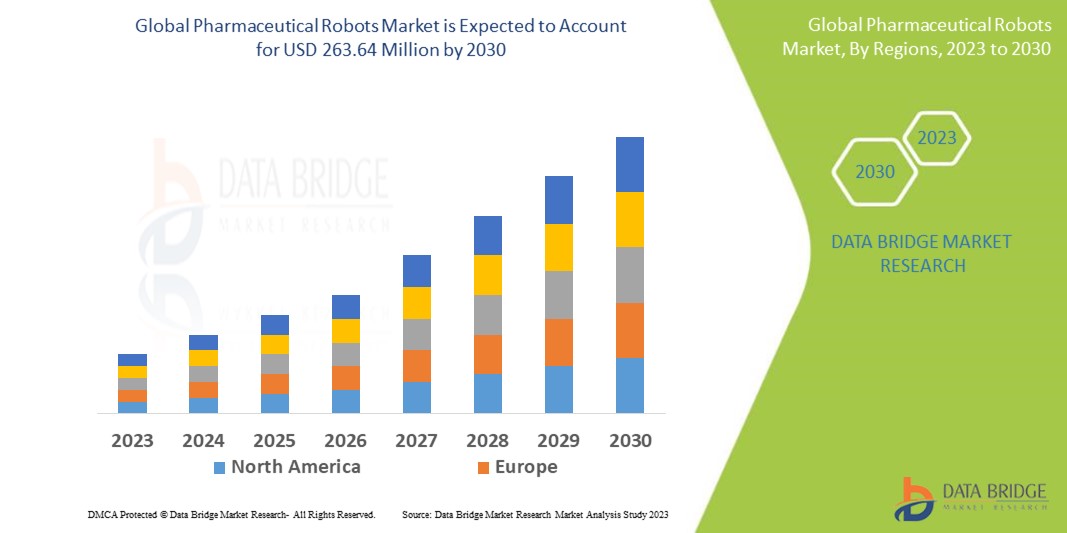
Pharmaceutical Robots Market Analysis and Size
The increasing number of medical research activities and the need for automation at the healthcare facilities have paved the way for the market's growth. Traditional robots, such as cartesian, articulated, and SCARA robots, have been in the market for a long time, serving great benefits. There are various benefits associated with these robots in the pharmaceutical sector. The collaborative robot segment is expected to grow the fastest during the forecast period.
Data Bridge Market Research analyses that the pharmaceutical robots market, which was USD 130.38 million in 2022, would rise to USD 263.64 million by 2030 and is expected to undergo a CAGR of 9.20% during the forecast period 2023 to 2030. In addition to the insights on market scenarios such as market value, growth rate, segmentation, geographical coverage, and major players, the market reports curated by the Data Bridge Market Research also include depth expert analysis, patient epidemiology, pipeline analysis, pricing analysis, and regulatory framework.
Pharmaceutical Robots Market Scope and Segmentation
|
Report Metric |
Details |
|
Forecast Period |
2023 to 2030 |
|
Base Year |
2022 |
|
Historic Years |
2021 (Customizable to 2015 - 2020) |
|
Quantitative Units |
Revenue in USD Million, Volumes in Units, Pricing in USD |
|
Segments Covered |
Product Type (Traditional Robots, Collaborative Pharmaceutical Robots), Application (Picking and Packaging, Inspection of Pharmaceutical Drugs, Laboratory Applications), End User (Pharmaceutical Companies, Research Laboratories) |
|
Countries Covered |
U.S., Canada, and Mexico in North America, Germany, France, U.K., Netherlands, Switzerland, Belgium, Russia, Italy, Spain, Turkey, Rest of Europe in Europe, China, Japan, India, South Korea, Singapore, Malaysia, Australia, Thailand, Indonesia, Philippines, Rest of Asia-Pacific (APAC) in the Asia-Pacific (APAC), Saudi Arabia, U.A.E, South Africa, Egypt, Israel, Rest of Middle East and Africa (MEA) as a part of Middle East and Africa (MEA), Brazil, Argentina and Rest of South America as part of South America |
|
Market Players Covered |
Kawasaki Heavy Industries Ltd. (Japan), FANUC Corporation (Japan), KUKA AG (Germany), Mitsubishi Electric Corporation (Japan), ABB (Switzerland), DENSO CORPORATION (Japan), Seiko Epson Corporation (Japan), Marchesini Group S.p.A (Italy), Universal Robots A/S (Denmark), Yaskawa Electric Corporation (Japan), Shibuya Corporation (Japan), Remtec Automation, LLC (U.S.), Gridbots Technologies Private Limited (India), Lockheed Martin Corporation (U.S.), and Robert Bosch GmbH (Germany) |
|
Market Opportunities |
|
Market Definition
Pharmaceutical robots are artificial intelligence robots that are widely used in a huge range of applications. Pharmaceutical robots offer a high degree of automation and minimize the dependence on human or manual work consuming less time and reducing human efforts. This means that pharmaceutical robots provide a higher degree of accuracy and automation.
Global Pharmaceutical Robots Market Dynamics
Drivers
- Increasing Partnerships between Market Players
There have been increasing partnerships between market players of pharmaceutical robots that enhance the market's growth. For instance, Multiply Labs, a robotics business, has partnered with Thermo Fisher Scientific and Charles River Pharmaceuticals to automate cell treatment production. Multiply Labs is armed itself with two more pieces of industry-leading technology to automate manual elements of the cell therapy production process. Thus, this factor boosts market growth.
- Increasing Demand for Automation Robots in Pharma Sector
With automation becoming essential to pharmaceutical manufacturing, robotics greatly helps. For instance, Gilead Sciences, a Fortune 500 company, showed the high growth potential of the global pharmaceutical industry through its 5-year revenue growth rate of 28.8%. This is projected to surge the need for pharmaceutical robotics to automate tasks and reduce work pressure generated by such major companies, and thus, this factor boosts the market growth.
Opportunities
- Increasing Demand for Traditional Robots
The traditional robots segment is preferred over other robots, which are used greatly in many sectors. Several benefits associated with the adoption of these products in numerous industrial automation applications include loading and unloading, packaging, picking and placing material handling, palletizing and depalletizing, product placement, stacking, storing and retrieving, cutting, sorting, process-to-process transferring, scribing, and precision spot welding, are positively leading to the market growth.
- High Role of Laboratory Automation
Laboratory automation through robotic machines reduces the potential for human contamination and enhances market growth. For instance, MYS850L, developed by YASKAWA Europe GmbH, uses laboratory automation. Other laboratory applications include vial handling. Robots can handle 10 vials at a time. Therefore, pharmaceutical robots used in laboratories help increase the efficacy and quality of the products with high throughput analysis. Thus, this factor increases the market growth.
Restraints/Challenges
- Software Issues Related to Pharmaceutical robots
Pharmaceutical robots are run by computer programs, which can fail at any point in time without warning. Installing software updates and securing the machine to the pharmacy's record management system can take a lot of time and must be done properly to avoid errors in the future. Thus, this factor impedes market growth.
This pharmaceutical robots market report provides details of new recent developments, trade regulations, import-export analysis, production analysis, value chain optimization, market share, impact of domestic and localized market players, analyses opportunities in terms of emerging revenue pockets, changes in market regulations, strategic market growth analysis, market size, category market growths, application niches and dominance, product approvals, product launches, geographic expansions, technological innovations in the market. To gain more info on the pharmaceutical robots market contact Data Bridge Market Research for an Analyst Brief, our team will help you take an informed market decision to achieve market growth.
Recent Development
- In 2021, ABB launched two additions to its robot portfolio with the rising demand for automated production. The company is stated to have witnessed around 90% increase in robots sales in China at the end of 2020 and will also use cobots to keep up with the demand in the pharmaceutical sector.
Global Pharmaceutical Robots Market Scope
The pharmaceutical robots market is segmented on the basis of product type, application and end user. The growth amongst these segments will help you analyze meagre growth segments in the industries and provide the users with a valuable market overview and market insights to help them make strategic decisions for identifying core market applications.
Product Type
- Traditional Robots
- Articulated robots
- SCARA robots
- Delta/parallel robots
- Dual-arm robots
- Cartesian robots
- Other robots
- Collaborative Pharmaceutical Robots
Application
- Picking and Packaging
- Inspection of Pharmaceutical Drugs
- Laboratory Applications
End User
- Pharmaceutical Companies
- Research Laboratories
Pharmaceutical Robots Market Regional Analysis/Insights
The pharmaceutical robots market is analyzed and market size insights and trends are provided by product type, application and end user as referenced above.
The countries covered in the pharmaceutical robots market report are U.S., Canada, and Mexico in North America, Germany, France, U.K., Netherlands, Switzerland, Belgium, Russia, Italy, Spain, Turkey, Rest of Europe in Europe, China, Japan, India, South Korea, Singapore, Malaysia, Australia, Thailand, Indonesia, Philippines, Rest of Asia-Pacific (APAC) in the Asia-Pacific (APAC), Saudi Arabia, U.A.E, South Africa, Egypt, Israel, Rest of Middle East and Africa (MEA) as a part of Middle East and Africa (MEA), Brazil, Argentina and Rest of South America as part of South America.
North America dominates the pharmaceutical robots market due to the high presence of many local pharmaceutical companies in countries such as Japan and the huge local presence of top pharmaceutical companies within the region. North America has a considerably high penetration of pharmaceutical robots, and this number is anticipated to grow in the future due to the number of pharmaceutical companies in the country.
Asia-Pacific is expected to witness significant growth because of the huge presence of global pharmaceutical companies in the U.S. and the high adoption of production automation within this region.
The country section of the report also provides individual market impacting factors and changes in regulation in the market domestically that impacts the current and future trends of the market. Data points like down-stream and upstream value chain analysis, technical trends and porter's five forces analysis, case studies are some of the pointers used to forecast the market scenario for individual countries. Also, the presence and availability of global brands and their challenges faced due to large or scarce competition from local and domestic brands, impact of domestic tariffs and trade routes are considered while providing forecast analysis of the country data.
Healthcare Infrastructure growth Installed base and New Technology Penetration
The pharmaceutical robots market also provides you with detailed market analysis for every country growth in healthcare expenditure for capital equipment, installed base of different kind of products for pharmaceutical robots market, impact of technology using life line curves and changes in healthcare regulatory scenarios and their impact on the pharmaceutical robots market. The data is available for historic period 2011-2021.
Competitive Landscape and Pharmaceutical Robots Market Share Analysis
The pharmaceutical robots market competitive landscape provides details by competitor. Details included are company overview, company financials, revenue generated, market potential, investment in research and development, new market initiatives, global presence, production sites and facilities, production capacities, company strengths and weaknesses, product launch, product width and breadth, application dominance. The above data points provided are only related to the companies' focus related to pharmaceutical robots market.
Some of the major players operating in the pharmaceutical robots market are:
- Kawasaki Heavy Industries Ltd. (Japan)
- FANUC Corporation (Japan)
- KUKA AG (Germany
- Mitsubishi Electric Corporation (Japan)
- ABB (Switzerland)
- DENSO CORPORATION (Japan)
- Seiko Epson Corporation (Japan)
- Marchesini Group S.p.A (Italy)
- Universal Robots A/S (Denmark)
- Yaskawa Electric Corporation (Japan)
- Shibuya Corporation (Japan)
- Remtec Automation, LLC (U.S.)
- Gridbots Technologies Private Limited (India)
- Lockheed Martin Corporation (U.S.)
- Robert Bosch GmbH (Germany)
SKU-

研究方法
数据收集和基准年分析是使用具有大样本量的数据收集模块完成的。该阶段包括通过各种来源和策略获取市场信息或相关数据。它包括提前检查和规划从过去获得的所有数据。它同样包括检查不同信息源中出现的信息不一致。使用市场统计和连贯模型分析和估计市场数据。此外,市场份额分析和关键趋势分析是市场报告中的主要成功因素。要了解更多信息,请请求分析师致电或下拉您的询问。
DBMR 研究团队使用的关键研究方法是数据三角测量,其中包括数据挖掘、数据变量对市场影响的分析和主要(行业专家)验证。数据模型包括供应商定位网格、市场时间线分析、市场概览和指南、公司定位网格、专利分析、定价分析、公司市场份额分析、测量标准、全球与区域和供应商份额分析。要了解有关研究方法的更多信息,请向我们的行业专家咨询。
可定制
Data Bridge Market Research 是高级形成性研究领域的领导者。我们为向现有和新客户提供符合其目标的数据和分析而感到自豪。报告可定制,包括目标品牌的价格趋势分析、了解其他国家的市场(索取国家列表)、临床试验结果数据、文献综述、翻新市场和产品基础分析。目标竞争对手的市场分析可以从基于技术的分析到市场组合策略进行分析。我们可以按照您所需的格式和数据样式添加您需要的任意数量的竞争对手数据。我们的分析师团队还可以为您提供原始 Excel 文件数据透视表(事实手册)中的数据,或者可以帮助您根据报告中的数据集创建演示文稿。











