



Global Portable Food Allergen Sensor Market Segmentation, By Source (Peanut and Soy, Wheat, Milk, Egg, Tree Nuts, Seafood, and Others), Technology (Polymerase Chain Reaction (PCR), Immunoassay-Based /ELISA, and Others), Food Tested (Bakery and Confectionery, Infant Food, Processed Foods, Dairy Products and Alternatives, Seafood and Meat Products, and Others) - Industry Trends and Forecast to 2033
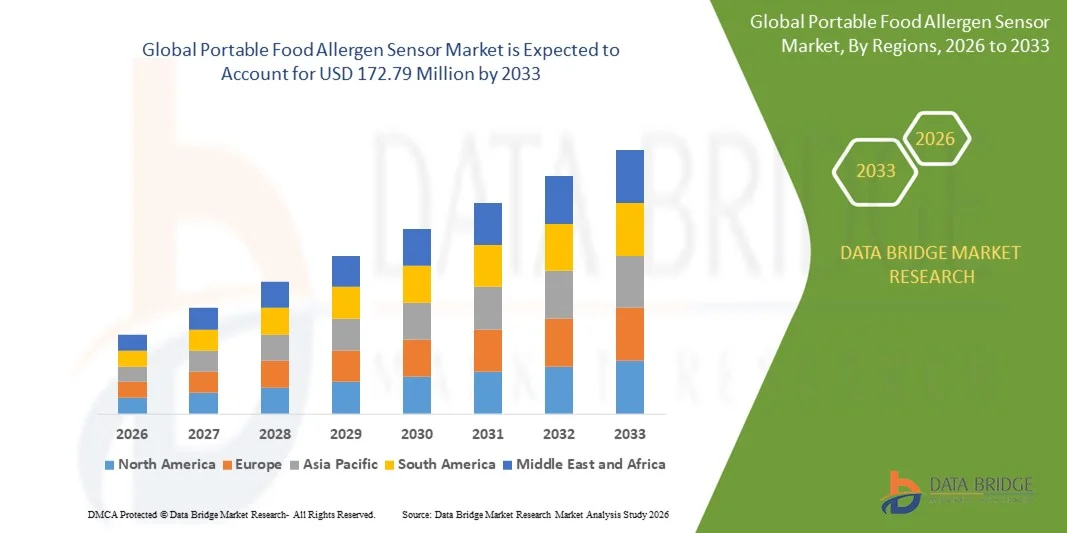
Portable Food Allergen Sensor Market Size
- The global portable food allergen sensor market size was valued at USD 123.38 million in 2025 and is expected to reach USD 172.79 million by 2033, at a CAGR of 4.30% during the forecast period
- The market growth is largely fueled by increasing awareness of food allergies and the rising demand for rapid, on-site allergen detection solutions across residential, commercial, and institutional settings
- Furthermore, the growing adoption of portable, easy-to-use sensors by food manufacturers, restaurants, and catering services is establishing these devices as essential tools for ensuring food safety, compliance with regulations, and consumer confidence, thereby significantly boosting market expansion
Portable Food Allergen Sensor Market Analysis
- Portable food allergen sensors, enabling rapid detection of allergens in various food matrices, are becoming crucial for food safety and quality control in production facilities, restaurants, and households due to their convenience, speed, and accuracy
- The escalating demand for these sensors is primarily driven by heightened consumer health awareness, stringent regulatory requirements for allergen labeling, and the need for quick, reliable testing to prevent contamination and ensure safe consumption
- Europe dominated the portable food allergen sensor market with a share of 37.3% in 2025, due to heightened consumer awareness regarding food allergies, stringent regulatory standards for allergen labeling, and widespread adoption of portable testing solutions across foodservice and manufacturing sectors
- Asia-Pacific is expected to be the fastest growing region in the portable food allergen sensor market during the forecast period due to rising urbanization, increasing disposable incomes, and growing awareness of food allergies in countries such as China, Japan, and India
- Immunoassay-based /ELISA segment dominated the market with a market share of 41.7% in 2025, due to its proven accuracy, ease of use, and adaptability for detecting multiple allergens simultaneously. Immunoassay sensors provide rapid, on-site results, which are critical for food manufacturers and service providers in avoiding contamination and ensuring regulatory compliance. For instance, companies such as Neogen leverage ELISA technology to offer portable allergen detection kits widely adopted in food processing units and restaurants. The segment benefits from advancements in miniaturization and automation, allowing faster and more user-friendly testing. Its compatibility with a broad range of food matrices, including processed foods, bakery products, and dairy, enhances versatility
Report Scope and Portable Food Allergen Sensor Market Segmentation
|
Attributes |
Portable Food Allergen Sensor Key Market Insights |
|
Segments Covered |
|
|
Countries Covered |
North America
Europe
Asia-Pacific
Middle East and Africa
South America
|
|
Key Market Players |
|
|
Market Opportunities |
|
|
Value Added Data Infosets |
In addition to the insights on market scenarios such as market value, growth rate, segmentation, geographical coverage, and major players, the market reports curated by the Data Bridge Market Research also include in-depth expert analysis, pricing analysis, brand share analysis, consumer survey, demography analysis, supply chain analysis, value chain analysis, raw material/consumables overview, vendor selection criteria, PESTLE Analysis, Porter Analysis, and regulatory framework. |
Portable Food Allergen Sensor Market Trends
Rising Adoption of Rapid, On-Site Food Allergen Detection Technologies
- The increasing prevalence of food allergies globally and the growing need for immediate detection solutions in homes, restaurants, and food manufacturing facilities are driving the adoption of portable food allergen sensors, enabling safer consumption, reducing the risk of allergen exposure, and helping businesses maintain compliance with safety standards
- For instance, Neogen Corporation introduced lateral-flow portable allergen assays for peanut, soy, and milk in 2025, allowing food manufacturers, catering services, and restaurants to quickly test products on-site, which is expected to accelerate adoption across commercial kitchens, institutional food providers, and residential users
- Advancements in sensor technology, including miniaturization, improved sensitivity, faster response times, and greater specificity for multiple allergens, are enhancing the practicality, reliability, and accuracy of portable allergen detection devices, making them more appealing for everyday consumer use and professional applications in large-scale food production
- The integration of digital connectivity, mobile applications, and cloud-based data tracking with portable sensors allows real-time monitoring, automated data logging, and alert notifications, facilitating proactive allergen management, traceability, and enhanced decision-making for users across diverse environments
- Rising consumer awareness about food allergies, stricter labeling regulations, and the growing demand for allergen-free diets are prompting foodservice providers, schools, hospitals, and households to adopt on-site detection solutions, further fueling widespread market growth
- The cumulative impact of technological advancements, heightened awareness, regulatory support, and practical convenience is steadily establishing portable food allergen sensors as essential tools for ensuring food safety, reducing liability, and protecting consumer health across multiple settings
Portable Food Allergen Sensor Market Dynamics
Driver
Growing Awareness and Regulatory Compliance for Food Allergy Safety
- Increasing awareness of food allergy risks among consumers, coupled with the critical need to prevent severe allergic reactions and ensure public safety, is a key driver for the adoption of portable food allergen sensors in households, schools, restaurants, and food manufacturing facilities
- For instance, in 2025, Thermo Fisher Scientific launched a next-generation ELISA-based allergen detection kit enabling rapid multi-allergen testing, providing food manufacturers, catering companies, and institutional kitchens with tools to meet stringent regulatory requirements, enhance operational efficiency, and strengthen consumer trust
- Regulatory frameworks mandating accurate allergen labeling, routine testing, and traceability are compelling food producers, restaurants, and caterers to implement portable detection solutions, as non-compliance can lead to penalties, recalls, and reputational damage
- The growing emphasis on proactive allergen management by institutional food providers, such as schools, hospitals, and airline catering services, is increasing demand for portable sensors that offer reliable, rapid, and on-site testing capabilities, ensuring immediate intervention when allergens are detected
- The combination of rising consumer awareness, regulatory pressure, and the practical advantages of rapid on-site detection, including convenience, efficiency, and safety, is significantly propelling the market growth for portable food allergen sensors, establishing them as indispensable tools for modern food safety management
Restraint/Challenge
High Cost and Technical Complexity of Advanced Portable Allergen Sensors
- The high cost of advanced portable allergen detection devices poses a barrier for widespread adoption, particularly among small and medium-sized food producers, budget-conscious households, and emerging market consumers where cost sensitivity is high
- For instance, the development of multiplex detection devices integrating biosensors, AI analytics, and cloud-enabled reporting by companies such as Amulet in 2024, while technologically advanced and highly efficient, remains expensive and may limit market penetration in cost-sensitive regions or smaller businesses
- The technical complexity of operating certain advanced sensors, including the need for calibration, sample preparation, precise measurement, and interpretation of results, can deter end-users from adopting these solutions without adequate training or support
- Although prices are gradually decreasing, user interfaces are improving, and portable devices are becoming more intuitive, the perceived premium for advanced allergen detection technology continues to challenge market expansion, particularly for users seeking affordable, simple solutions
- Addressing cost barriers, simplifying device operation, providing training or support, and educating consumers on the health, safety, and compliance benefits of portable allergen sensors will be critical to overcoming these challenges and sustaining long-term growth in the market
Portable Food Allergen Sensor Market Scope
The market is segmented on the basis of source, technology, and food tested.
- By Source
On the basis of source, the portable food allergen sensor market is segmented into peanut and soy, wheat, milk, egg, tree nuts, seafood, and others. The peanut and soy segment dominated the market with the largest revenue share in 2025, driven by the high prevalence of peanut and soy allergies globally and the severe health risks associated with accidental exposure. Consumers and food manufacturers increasingly prioritize detection solutions for these allergens due to strict regulatory mandates and the need for accurate labeling. The segment benefits from advanced sensor technologies capable of rapid detection in diverse food matrices, enhancing consumer safety. Moreover, portable sensors for peanut and soy detection are widely adopted in restaurants, schools, and food processing facilities to prevent cross-contamination. The segment also sees strong demand due to growing awareness campaigns and the rising incidence of food allergy-related hospitalizations. Manufacturers continuously innovate to offer sensitive, user-friendly devices, further consolidating the segment’s market leadership.
The tree nuts segment is anticipated to witness the fastest growth rate from 2026 to 2033, fueled by increasing consumption of nut-based snacks and processed foods globally. Tree nuts pose a significant allergenic threat, prompting foodservice providers and consumers to seek quick and reliable detection solutions. Portable sensors targeting tree nuts offer convenience, accuracy, and rapid results, making them highly suitable for on-the-go testing in both commercial and home environments. Rising adoption in high-risk populations, coupled with stringent food safety regulations, drives the growth of this segment. The development of multi-allergen sensors incorporating tree nut detection further accelerates its market expansion. Enhanced portability, digital connectivity, and real-time alerts boost user confidence and adoption.
- By Technology
On the basis of technology, the portable food allergen sensor market is segmented into polymerase chain reaction (PCR), immunoassay-based/ELISA, and others. The immunoassay-based/ELISA segment dominated the market with the largest revenue share of 41.7% in 2025, driven by its proven accuracy, ease of use, and adaptability for detecting multiple allergens simultaneously. Immunoassay sensors provide rapid, on-site results, which are critical for food manufacturers and service providers in avoiding contamination and ensuring regulatory compliance. For instance, companies such as Neogen leverage ELISA technology to offer portable allergen detection kits widely adopted in food processing units and restaurants. The segment benefits from advancements in miniaturization and automation, allowing faster and more user-friendly testing. Its compatibility with a broad range of food matrices, including processed foods, bakery products, and dairy, enhances versatility. Market players continuously invest in R&D to improve sensitivity and reduce cross-reactivity, strengthening the segment’s leadership. Immunoassay-based portable sensors also offer cost-effective solutions for small and medium-sized enterprises, driving widespread adoption.
The PCR segment is expected to witness the fastest CAGR from 2026 to 2033, fueled by its high specificity and sensitivity in detecting trace allergen DNA in complex food samples. PCR-based portable sensors enable highly accurate allergen identification, making them suitable for high-risk environments such as infant food manufacturing and specialized dietary product testing. Rising regulatory pressure and consumer demand for highly reliable allergen testing drive the adoption of PCR technology. Innovations in portable PCR devices, including reduced size, faster turnaround, and digital connectivity, accelerate its market growth. PCR sensors also benefit from integration with automated sample preparation, enhancing convenience for non-technical users. The segment gains traction among premium food manufacturers and quality assurance labs requiring rigorous allergen detection.
- By Food Tested
On the basis of food tested, the portable food allergen sensor market is segmented into bakery and confectionery, infant food, processed foods, dairy products and alternatives, seafood and meat products, and others. The bakery and confectionery segment dominated the market with the largest revenue share in 2025, driven by the high incidence of peanut, milk, and egg allergens in these products and the increasing consumption of baked goods globally. Food manufacturers and retailers prioritize on-site allergen detection to prevent recalls, maintain brand reputation, and comply with food safety regulations. For instance, companies such as 3M offer portable allergen sensors widely adopted in bakery production lines for rapid detection. The segment benefits from the versatility of portable sensors capable of testing various product forms, from cakes to chocolates. Consumer demand for allergen-safe confectionery products and awareness campaigns further strengthen adoption. Technological advancements in sensor sensitivity and portability enhance reliability, boosting market penetration.
The infant food segment is expected to witness the fastest growth rate from 2026 to 2033, fueled by heightened awareness among parents regarding allergen exposure risks in infant nutrition. Infant food products require stringent allergen control due to the vulnerability of the target population, prompting widespread adoption of portable detection solutions. Sensors designed for infant food offer rapid, accurate testing with minimal sample preparation, ensuring safety and regulatory compliance. Rising demand for allergen-free infant formulas, cereals, and snacks drives market expansion. Portable sensors enable caregivers and manufacturers to perform on-the-spot verification, reducing contamination risk. Technological innovations in miniaturization, user interface, and real-time digital reporting support faster adoption in both home and professional settings.
Portable Food Allergen Sensor Market Regional Analysis
- Europe dominated the portable food allergen sensor market with the largest revenue share of 37.3% in 2025, driven by heightened consumer awareness regarding food allergies, stringent regulatory standards for allergen labeling, and widespread adoption of portable testing solutions across foodservice and manufacturing sectors
- Consumers and businesses in the region highly value the accuracy, rapid detection, and convenience offered by portable allergen sensors, supporting safer food handling practices and compliance with food safety regulations
- This strong adoption is further reinforced by advanced food industry infrastructure, rising demand for allergen-free products, and proactive measures by governments and health organizations to reduce allergen exposure, establishing Europe as a key market for portable food allergen testing solutions
Germany Portable Food Allergen Sensor Market Insight
The Germany market captured the largest revenue share in Europe in 2025, fueled by robust food safety regulations, high consumer awareness, and widespread presence of leading sensor manufacturers. German food producers and restaurants increasingly adopt portable allergen testing solutions to ensure compliance, prevent recalls, and maintain brand reputation. The demand for rapid and reliable allergen detection is strengthened by the country’s well-developed food processing infrastructure and emphasis on high-quality standards. Moreover, the integration of portable sensors into routine quality control processes across bakeries, confectionery units, and processed food manufacturers is boosting market growth.
France Portable Food Allergen Sensor Market Insight
The France market is projected to expand at a substantial CAGR during the forecast period, driven by increasing food allergy prevalence and stringent labeling regulations. Consumers and foodservice providers are prioritizing quick allergen detection to ensure safety and maintain trust. Rising adoption in both residential and commercial settings, coupled with government-led awareness initiatives, is propelling market growth. French manufacturers are increasingly incorporating portable sensors into food testing protocols, strengthening the country’s position as a key regional market.
U.K. Portable Food Allergen Sensor Market Insight
The U.K. market is expected to grow at a noteworthy CAGR during the forecast period, driven by rising awareness of allergen-related health risks and growing demand for allergen-safe food products. Portable sensors are gaining traction in restaurants, catering, and food manufacturing units to facilitate on-the-spot allergen detection. The country’s well-established food safety framework and strong consumer focus on health and wellness further support market expansion. The increasing availability of user-friendly, rapid allergen testing devices is enhancing adoption across small and medium-sized enterprises.
North America Portable Food Allergen Sensor Market Insight
The North America market is poised to grow steadily, driven by technological advancements, regulatory emphasis on food allergen labeling, and high consumer awareness regarding allergen safety. The U.S. accounts for the largest share in the region, fueled by proactive food safety measures in schools, restaurants, and manufacturing facilities. Growing adoption of portable allergen sensors in commercial kitchens and food processing units, along with rising consumer demand for allergen-safe products, is supporting market growth.
Asia-Pacific Portable Food Allergen Sensor Market Insight
The Asia-Pacific market is anticipated to witness the fastest CAGR during the forecast period of 2026-2033, driven by rising urbanization, increasing disposable incomes, and growing awareness of food allergies in countries such as China, Japan, and India. Government initiatives promoting food safety, coupled with expanding retail and foodservice sectors, are driving adoption of portable allergen sensors. The region is emerging as a key manufacturing hub for food safety devices, enhancing affordability and accessibility for end users.
China Portable Food Allergen Sensor Market Insight
The China market accounted for the largest revenue share in Asia-Pacific in 2025, attributed to rapid urbanization, a growing middle class, and heightened awareness regarding allergen safety. Portable sensors are increasingly used across bakeries, processed food units, and catering services to ensure compliance and prevent allergen contamination. The rise of modern retail formats and food delivery services further supports the adoption of portable allergen detection solutions.
Japan Portable Food Allergen Sensor Market Insight
The Japan market is gaining momentum due to increasing consumer awareness of food allergies, government regulations, and demand for convenient, on-the-go allergen detection. Portable sensors are increasingly integrated into both commercial and residential food testing practices. Technological advancements and the country’s emphasis on precision and reliability are driving adoption across foodservice and manufacturing sectors. Moreover, Japan’s aging population is encouraging the development of easy-to-use, rapid detection devices for safe food consumption.
Portable Food Allergen Sensor Market Share
The portable food allergen sensor industry is primarily led by well-established companies, including:
- Danaher Corporation (U.S.)
- Crystal Chem, Inc (U.S.)
- MXNS Corporation (U.S.)
- Omega Diagnostics Group PLC (U.K.)
- PerkinElmer, Inc (U.S.)
- SGS SA (Switzerland)
- Intertek Group plc (U.K.)
- Eurofins Scientific SE (Luxembourg)
- Alsure Inc (U.S.)
- Neogen Corporation (U.S.)
- Diagnostische Systeme & Technologien GmbH (Germany)
- Thermo Fisher Scientific Inc (U.S.)
Latest Developments in Global Portable Food Allergen Sensor Market
- In September 2025, Thermo Fisher Scientific introduced a next-generation ELISA-based allergen testing kit designed for rapid, multi-allergen detection in processed foods. This development significantly enhances the efficiency and reliability of allergen screening for food manufacturers and processors, allowing for faster quality control, improved compliance with stringent safety regulations, and broader adoption of portable and lab-based allergen testing solutions
- In August 2025, Neogen Corporation expanded its allergen testing portfolio by launching lateral-flow assays for peanut, soy, and milk allergens. These assays enable on-site, rapid testing for food producers, restaurants, and catering services, reducing the risk of cross-contamination and improving food safety. The innovation also supports faster decision-making during production and service, fostering trust among consumers and driving increased market demand for portable allergen detection devices
- In April 2025, Beckman Coulter Life Sciences introduced the Next-Generation Basophil Activation Test (BAT) for research use to more effectively characterize food allergies without exposing individuals to potentially harmful allergens. This innovation enhances laboratory and research capabilities for allergen testing, facilitating safer study of allergic reactions and supporting development of advanced allergen detection technologies in the market
- In August 2024, Amulet raised US $5.8 million in Series A funding to support the launch and scaling of its portable molecular-detection allergen sensor platform. This funding accelerates the company’s market penetration and enables broader distribution of devices to consumers and foodservice establishments. By providing convenient on-the-go allergen detection, Amulet strengthens overall market adoption and highlights growing demand for personal and professional allergen testing solutions
SKU-

研究方法
数据收集和基准年分析是使用具有大样本量的数据收集模块完成的。该阶段包括通过各种来源和策略获取市场信息或相关数据。它包括提前检查和规划从过去获得的所有数据。它同样包括检查不同信息源中出现的信息不一致。使用市场统计和连贯模型分析和估计市场数据。此外,市场份额分析和关键趋势分析是市场报告中的主要成功因素。要了解更多信息,请请求分析师致电或下拉您的询问。
DBMR 研究团队使用的关键研究方法是数据三角测量,其中包括数据挖掘、数据变量对市场影响的分析和主要(行业专家)验证。数据模型包括供应商定位网格、市场时间线分析、市场概览和指南、公司定位网格、专利分析、定价分析、公司市场份额分析、测量标准、全球与区域和供应商份额分析。要了解有关研究方法的更多信息,请向我们的行业专家咨询。
可定制
Data Bridge Market Research 是高级形成性研究领域的领导者。我们为向现有和新客户提供符合其目标的数据和分析而感到自豪。报告可定制,包括目标品牌的价格趋势分析、了解其他国家的市场(索取国家列表)、临床试验结果数据、文献综述、翻新市场和产品基础分析。目标竞争对手的市场分析可以从基于技术的分析到市场组合策略进行分析。我们可以按照您所需的格式和数据样式添加您需要的任意数量的竞争对手数据。我们的分析师团队还可以为您提供原始 Excel 文件数据透视表(事实手册)中的数据,或者可以帮助您根据报告中的数据集创建演示文稿。











