


Global Radio Frequency (RF) Energy Harvesting Market, By Component and Sensor Type (Wireless Sensor Network, Others), Energy Source (Electric, Gravitational, Magnetic, Nuclear, Thermal, Chemical, Mechanical, Radiation), Component (Transducer, Power Management Integrated Circuit, Secondary Battery), Application (Building and Home Automation, Industrial, Transportation, Security, Retail, Bicycle Dynamo, Military and Aerospace, Consumer Electronics), End Use (Wireless Switching System, Wireless HVAC System, Wireless Sensing and Telematics System, Tire Pressure Monitoring System, Asset Tracking System, Remote Health Monitoring System, Regenerative Energy Harvesting System) - Industry Trends and Forecast to 2029
Market Analysis and Size
Radio frequency (RF) energy harvesting is being highly deployed in electrical utilities that consume minimal energy such as watches, sensors, and other home appliances.
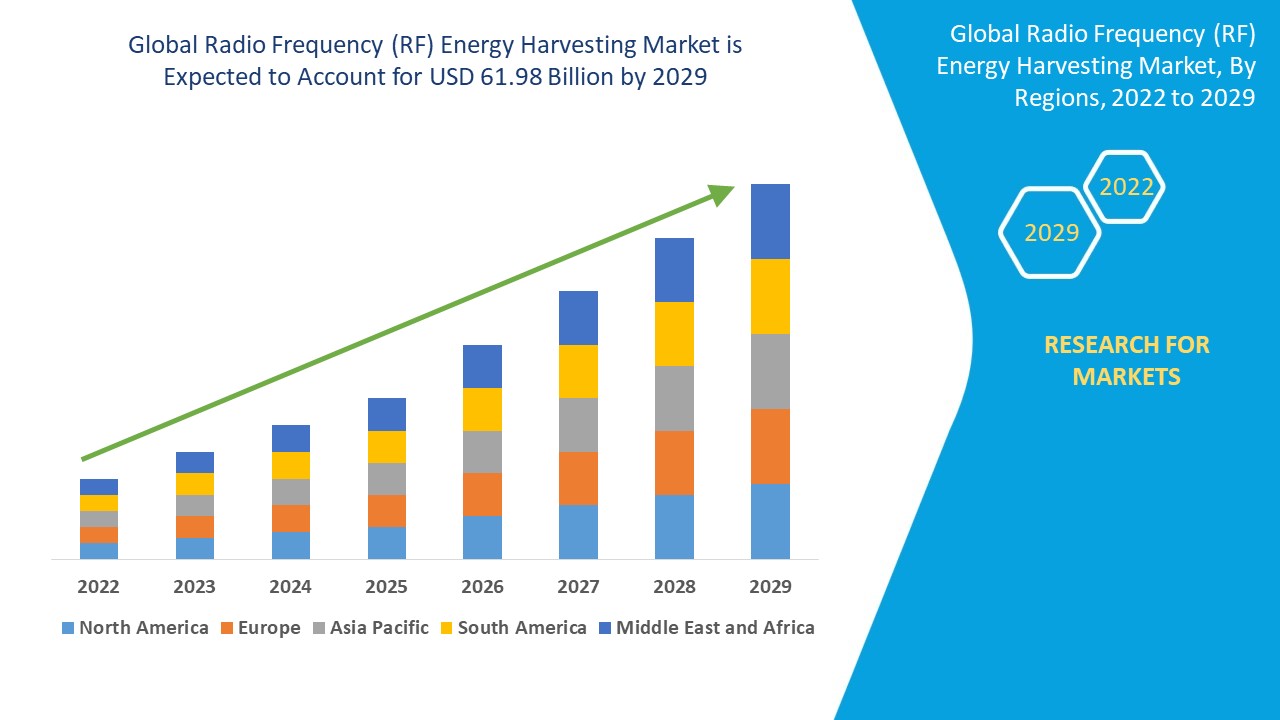
Global Radio Frequency (RF) Energy Harvesting Market was valued at USD 10.27 billion in 2021 and is expected to reach USD 61.98 billion by 2029, registering a CAGR of 25.20%during the forecast period of 2022-2029. Regenerative Energy Harvesting System is expected to witness high growth in the end use segments owing to the increase in environmental concerns. The market report curated by the Data Bridge Market Research team includes in-depth expert analysis, import/export analysis, pricing analysis, production consumption analysis, and pestle analysis.
Market Definition
Radio frequency (RF) energy harvesting refers to a process where radio frequency energy emitted by sources that generate high electromagnetic fields. These are used in wireless radio networks, TV signals, and cell phone towers.
Report Scope and Market Segmentation
|
Report Metric |
Details |
|
Forecast Period |
2022 to 2029 |
|
Base Year |
2021 |
|
Historic Years |
2020 (Customizable to 2019 - 2014) |
|
Quantitative Units |
Revenue in USD Billion, Volumes in Units, Pricing in USD |
|
Segments Covered |
Component and Sensor Type (Wireless Sensor Network, Others), Energy Source (Electric, Gravitational, Magnetic, Nuclear, Thermal, Chemical, Mechanical, Radiation), Component (Transducer, Power Management Integrated Circuit, Secondary Battery), Application (Building and Home Automation, Industrial, Transportation, Security, Retail, Bicycle Dynamo, Military and Aerospace, Consumer Electronics), End Use (Wireless Switching System, Wireless HVAC System, Wireless Sensing and Telematics System, Tire Pressure Monitoring System, Asset Tracking System, Remote Health Monitoring System, Regenerative Energy Harvesting System) |
|
Countries Covered |
U.S., Canada and Mexico in North America, Germany, France, U.K., Netherlands, Switzerland, Belgium, Russia, Italy, Spain, Turkey, Rest of Europe in Europe, China, Japan, India, South Korea, Singapore, Malaysia, Australia, Thailand, Indonesia, Philippines, Rest of Asia-Pacific (APAC) in the Asia-Pacific (APAC), Saudi Arabia, U.A.E, Israel, Egypt, South Africa, Rest of Middle East and Africa (MEA) as a part of Middle East and Africa (MEA), Brazil, Argentina and Rest of South America as part of South America. |
|
Market Players Covered |
ABB (Sweden), Linear Technology (US), Convergence Wireless (US), Cymbet (US), Enocean GmbH (Germany), Fujitsu (Japan), Honeywell International Inc (US), Powercast Corp (US), Stmicroelectronics (Switzerland), Texas Instruments (US), Microchip Technology Inc. (US), GreenPeak Technologies (US), Voltree Power LLC (US), Cypress Semiconductor Corporation (US), Laird PLC (UK), Mide Technology Corp. (US), Lord Microstrain (US), Ixys Corporation (US), Bionic Power Inc. (Canada), and O-Flexx Technologies (Germany), among others |
|
Market Opportunities |
|
Radio Frequency (RF) Energy Harvesting Market Dynamics
This section deals with understanding the market drivers, advantages, opportunities, restraints and challenges. All of this is discussed in detail as below:
Drivers
- Modern Energy Services
The rise in economic growth acts as one of the major factors driving the radio frequency (RF) energy harvesting market. Also, increase in the need for reducing poverty and improving the quality of life with the help of modern energy services has a positive impact on the market.
- Trend for Green Energy
The rise in trend for green energy and growing favourable initiatives by governments accelerate the market growth. Also, high adoption of wireless sensor networks equipped with energy harvesting system has a positive impact on the market.
- Instances of Vehicle Recalls
The increase in the instances of vehicle recalls due to component failures further influence the market. The rise in the automobile production in emerging economies along with growing need to curb carbon emissions drive the market.
Additionally, rapid urbanization, change in lifestyle, surge in investments and increased consumer spending positively impact the radio frequency (RF) energy harvesting market.
Opportunities
Furthermore, use of sensors in wearable electronics extend profitable opportunities to the market players in the forecast period of 2022 to 2029. Also, usage of human energy harvesting for implantable biomedical devices will further expand the market.
Restraints/Challenges
On the other hand, limitations of remotely installed networking modules and higher initial price are expected to obstruct market growth. Also, consistency of communication protocols and environmental reparation to energy harvesting device are projected to challenge the radio frequency (RF) energy harvesting market in the forecast period of 2022-2029.
This radio frequency (RF) energy harvesting market report provides details of new recent developments, trade regulations, import-export analysis, production analysis, value chain optimization, market share, impact of domestic and localized market players, analyses opportunities in terms of emerging revenue pockets, changes in market regulations, strategic market growth analysis, market size, category market growths, application niches and dominance, product approvals, product launches, geographic expansions, technological innovations in the market. To gain more info on radio frequency (RF) energy harvesting market contact Data Bridge Market Research for an Analyst Brief, our team will help you take an informed market decision to achieve market growth.
COVID-19 Impact on Radio Frequency (RF) Energy Harvesting Market
The COVID-19 had a negative impact on the radio frequency (RF) energy harvesting market owing to the strict lockdowns and social distancing to contain the spread of the virus. The economic uncertainty, partial shutdown of the business and low consumer confidence impacted demand radio frequency (RF) energy harvesting technology. The supply chain got hampered during the pandemic along with delay logistics activities. However, the radio frequency (RF) energy harvesting market is expected to regain its pace during the post pandemic scenario due to the easing on the restrictions.
Global Radio Frequency (RF) Energy Harvesting Market Scope and Market Size
The radio frequency (RF) energy harvesting market is segmented on the basis of component and sensor type, energy source, component, application and end use. The growth amongst these segments will help you analyze meager growth segments in the industries and provide the users with a valuable market overview and market insights to help them make strategic decisions for identifying core market applications.
Component and Sensor Type
- Wireless Sensor Network
- Others
Energy Source
- Electric
- Gravitational
- Magnetic
- Nuclear
- Thermal
- Chemical
- Mechanical
- Radiation
Component
- Transducer
- Photovoltaic and Electrodynamic
- Thermoelectric And Radio Frequency (RF) transducer
- Power Management Integrated Circuit
- Secondary Battery
- Application
- Building and Home Automation
- Industrial
- Transportation
- Security
- Retail
- Bicycle Dynamo
- Military and Aerospace
- Consumer Electronics
- Mobile Phones
- Wrist Watches
- Calculators
- Piezoelectric Gas Lighters
End Use
- Wireless Switching System
- Wireless Hvac System
- Wireless Sensing and Telematics System
- Tire Pressure Monitoring System
- Asset Tracking System
- Remote Health Monitoring System
- Regenerative Energy Harvesting System
Radio Frequency (RF) Energy Harvesting Market Regional Analysis/Insights
The radio frequency (RF) energy harvesting market is analysed and market size insights and trends are provided by country, component and sensor type, energy source, component, application and end use as referred above.
The countries covered in the radio frequency (RF) energy harvesting market report are U.S., Canada and Mexico in North America, Germany, France, U.K., Netherlands, Switzerland, Belgium, Russia, Italy, Spain, Turkey, Rest of Europe in Europe, China, Japan, India, South Korea, Singapore, Malaysia, Australia, Thailand, Indonesia, Philippines, Rest of Asia-Pacific (APAC) in the Asia-Pacific (APAC), Saudi Arabia, U.A.E, Israel, Egypt, South Africa, Rest of Middle East and Africa (MEA) as a part of Middle East and Africa (MEA), Brazil, Argentina and Rest of South America as part of South America.
North America dominates the radio frequency (RF) energy harvesting market because of the growing use of renewable energy sources for powering small electronic devices and rising penetration of building automation in new construction sites within the region.
Asia-Pacific (APAC) is expected to witness significant growth during the forecast period of 2022 to 2029 because of the high adoption of clean energy sources in this region.
The country section of the report also provides individual market impacting factors and changes in regulation in the market domestically that impacts the current and future trends of the market. Data points like down-stream and upstream value chain analysis, technical trends and porter's five forces analysis, case studies are some of the pointers used to forecast the market scenario for individual countries. Also, the presence and availability of global brands and their challenges faced due to large or scarce competition from local and domestic brands, impact of domestic tariffs and trade routes are considered while providing forecast analysis of the country data.
Competitive Landscape and Radio Frequency (RF) Energy Harvesting Market
The radio frequency (RF) energy harvesting market competitive landscape provides details by competitor. Details included are company overview, company financials, revenue generated, market potential, investment in research and development, new market initiatives, global presence, production sites and facilities, production capacities, company strengths and weaknesses, product launch, product width and breadth, application dominance. The above data points provided are only related to the companies' focus related to radio frequency (RF) energy harvesting market.
Some of the major players operating in radio frequency (RF) energy harvesting market are
- ABB (Sweden)
- Linear Technology (US)
- Convergence Wireless (US)
- Cymbet (US)
- Enocean GmbH (Germany)
- Fujitsu (Japan)
- Honeywell International Inc (US)
- Powercast Corp (US)
- Stmicroelectronics (Switzerland)
- Texas Instruments (US)
- Microchip Technology Inc. (US)
- GreenPeak Technologies (US)
- Voltree Power LLC (US)
- Cypress Semiconductor Corporation (US)
- Laird PLC (UK)
- Mide Technology Corp. (US)
- Lord Microstrain (US)
- Ixys Corporation (US)
- Bionic Power Inc. (Canada)
- O-Flexx Technologies (Germany)
SKU-

研究方法
数据收集和基准年分析是使用具有大样本量的数据收集模块完成的。该阶段包括通过各种来源和策略获取市场信息或相关数据。它包括提前检查和规划从过去获得的所有数据。它同样包括检查不同信息源中出现的信息不一致。使用市场统计和连贯模型分析和估计市场数据。此外,市场份额分析和关键趋势分析是市场报告中的主要成功因素。要了解更多信息,请请求分析师致电或下拉您的询问。
DBMR 研究团队使用的关键研究方法是数据三角测量,其中包括数据挖掘、数据变量对市场影响的分析和主要(行业专家)验证。数据模型包括供应商定位网格、市场时间线分析、市场概览和指南、公司定位网格、专利分析、定价分析、公司市场份额分析、测量标准、全球与区域和供应商份额分析。要了解有关研究方法的更多信息,请向我们的行业专家咨询。
可定制
Data Bridge Market Research 是高级形成性研究领域的领导者。我们为向现有和新客户提供符合其目标的数据和分析而感到自豪。报告可定制,包括目标品牌的价格趋势分析、了解其他国家的市场(索取国家列表)、临床试验结果数据、文献综述、翻新市场和产品基础分析。目标竞争对手的市场分析可以从基于技术的分析到市场组合策略进行分析。我们可以按照您所需的格式和数据样式添加您需要的任意数量的竞争对手数据。我们的分析师团队还可以为您提供原始 Excel 文件数据透视表(事实手册)中的数据,或者可以帮助您根据报告中的数据集创建演示文稿。











