



全球X射线探测器市场分割,按类型划分(Flat面板探测器、计算出射线探测器、线扫描探测器、充电偶联装置探测器和移动探测器)、面板尺寸(小面积和大面积)、可移动性(Fixed探测器和可移植探测器)、应用(医疗成像、牙科应用、安全应用、兽用应用和工业应用)、终端用户(医院、诊断实验室、原始设备制造商(OEM'S)、诊所和ICU) -- -- 工业趋势和预测至2032年
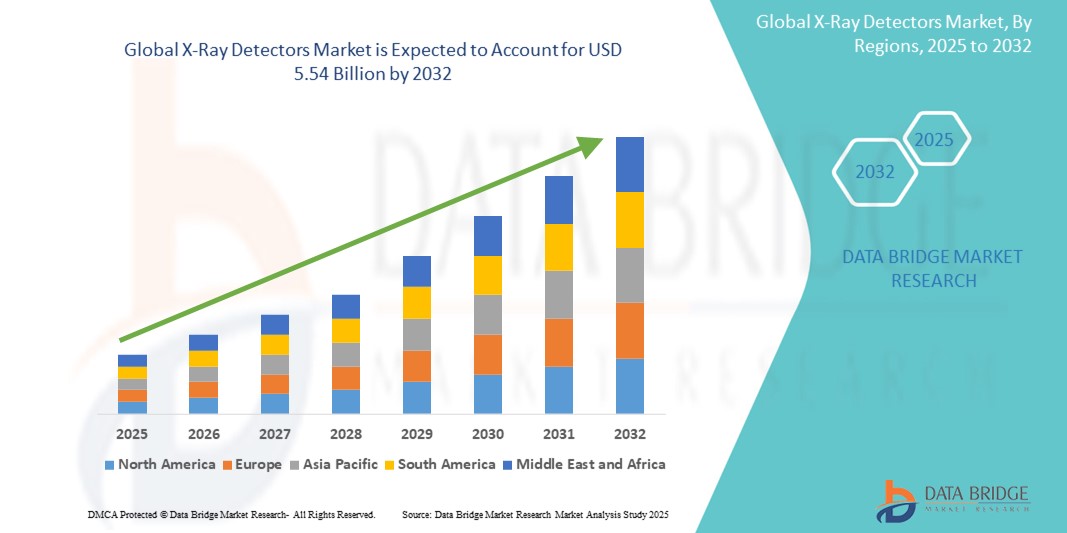
X-Ray Detectors Market Size
- The global X-Ray detectors market size was valued atUSD 3.45 billion in 2024and is expected to reachUSD 5.54 billion by 2032, at aCAGR of 6.08 %during the forecast period
- This growth is driven by factors such as the increasing demand for early and accurate diagnosis, advancements in digital imaging technologies, and the rising number of diagnostic imaging procedures globally
X-Ray Detectors Market Analysis
- The x-ray detectors market is experiencing steady growth due to increased usage across medical imaging, dentistry, and veterinary diagnostics, supported by the shift from traditional to digital systems
- The market is also seeing rising demand for portable and wireless x-ray detectors, as healthcare providers seek more flexible and efficient diagnostic solutions
- North America is expected to dominate the x-ray detectors market due to its advanced healthcare infrastructure, high adoption of innovative medical technologies, and increasing demand for diagnostic imaging systems in hospitals and healthcare facilities
- Asia-Pacific is expected to be the fastest growing region in the x-ray detectors market during the forecast period due to rapid healthcare advancements, expanding medical imaging adoption, and increasing investments in healthcare infrastructure across emerging economies such as China and India
- The flat panel detectors segment is expected to dominate the x-ray detectors market with the largest share of 64.3% in 2025 due to its superior image quality, faster processing speed, and ability to capture detailed images with higher resolution, making it highly suitable for various medical and dental imaging applications.
Report Scope and X-Ray Detectors Market Segmentation
|
Attributes |
X-Ray Detectors Key Market Insights |
|
Segments Covered |
|
|
Countries Covered |
North America
Europe
Asia-Pacific
Middle East and Africa
South America
|
|
Key Market Players |
|
|
Market Opportunities |
|
|
Value Added Data Infosets |
In addition to the insights on market scenarios such as market value, growth rate, segmentation, geographical coverage, and major players, the market reports curated by the Data Bridge Market Research also include depth expert analysis, patient epidemiology, pipeline analysis, pricing analysis, and regulatory framework. |
X-Ray Detectors Market Trends
“Widespread Adoption of Digital Imaging Technologies”
- A major trend in the x-ray detectors market is the transition from traditional film-based systems to digital imaging technologies such as flat-panel detectors
- Digital detectors provide enhanced image quality and faster acquisition, allowing healthcare professionals to diagnose conditions more accurately and efficiently
- The adoption of artificial intelligence in x-ray detectors supports automated image analysis and aids in early detection of conditions such as fractures or tumors
- These innovations are not limited to hospitals but are also expanding to dental clinics and veterinary practices, where precise and rapid imaging is essential for diagnosis and treatment planning
- The demand for compact, wireless, and mobile x-ray detectors continues to grow, enabling point-of-care imaging in remote or non-clinical environments, further boosting market penetration across healthcare sectors
X-Ray Detectors Market Dynamics
Driver
“Rising Geriatric Population Globally”
- The increasing global elderly population is significantly boosting the demand for X-ray detectors, as aging individuals are more vulnerable to chronic diseases requiring frequent imaging
- For instances, Japan has one of the highest aging populations globally, with over 28% of its citizens aged 65 and above, leading to a surge in diagnostic imaging services
- Conditions such as osteoporosis, arthritis, and heart disease, which are prevalent among older adults, often necessitate repeated X-ray examinations for diagnosis and ongoing management
- For instances In Germany, a high incidence of osteoporosis among elderly women has contributed to a growing need for bone density and fracture detection using advanced imaging tools
- Hospitals and clinics are increasingly investing in digital and portable X-ray detectors to manage the rising number of elderly patients efficiently and minimize hospital stays
- Portable detectors are particularly beneficial in geriatric care as they reduce the need to move immobile patients, allowing for bedside diagnostics and enhancing patient comfort
- Healthcare systems in aging nations are under pressure to improve diagnostic speed and accuracy, further driving the adoption of advanced X-ray detector technologies in primary and specialized care settings
Opportunity
“Increasing Demand for Portable and Wireless X-Ray Detectors”
- The increasing demand for portable and wireless X-ray detectors is creating strong growth opportunities due to their flexibility, ease of use, and suitability for point-of-care diagnostics
- For instance, companies such as Varex Imaging have launched wireless flat panel detectors aimed at mobile imaging in emergency and rural care settings
- These detectors are ideal for use in emergency services, home healthcare, and remote regions where conventional imaging infrastructure may be limited
- Wireless technology allows for real-time image transmission and rapid diagnostics, which helps improve care coordination and patient outcomes
- For instance, The Fujifilm FDR D-EVO III, supports fast wireless image transfer, enabling quicker clinical decisions in critical settings
- The global shift toward personalized medicine and telehealth services is boosting the relevance and need for portable diagnostic tools such as mobile X-ray detectors
- Emerging economies with evolving healthcare systems offer large untapped potential, particularly when supported by R&D efforts focused on affordability, portability, and ease of operation
Restraint/Challenge
“High Upfront Cost of Advanced Digital X-Ray Detectors”
- The high upfront cost of advanced digital X-ray detectors poses a major restraint, particularly for smaller healthcare facilities with limited resources
- For instance, the initial cost of a digital radiography system can range from tens of thousands to over a hundred thousand dollars, which can be prohibitive for small clinics
- In addition to the purchase price, ongoing maintenance and operational expenses can be burdensome for healthcare providers, further limiting access to these technologies
- Stringent regulatory requirements for approval, such as extensive testing and documentation, can delay the introduction of new products and increase costs
- For instance, In the U.S., the FDA's approval process for medical devices involves extensive trials and clinical data, adding complexity to bringing new X-ray detectors to market
- The integration of new X-ray detector technologies into existing healthcare infrastructure can be complex, requiring specialized training for healthcare professionals
- For instance, hospitals must train their radiologists and technicians to use new digital detectors effectively, which can require significant time and resources
- To overcome these challenges, manufacturers, regulatory agencies, and healthcare providers must collaborate on cost-effective solutions, streamline approval processes, and invest in user training programs
X-Ray Detectors Market Scope
The market is segmented on the basis of type, panel size, portability, application, and end user
|
Segmentation |
Sub-Segmentation |
|
By Type |
|
|
By Panel Size |
|
|
By Portability |
|
|
By Application |
|
|
By End User |
|
In 2025, the flat panel detectors is projected to dominate the market with a largest share in type segment
The flat panel detectors segment is expected to dominate the X-Ray Detectors market with the largest share of 64.3% in 2025 due to its superior image quality, faster processing speed, and ability to capture detailed images with higher resolution, making it highly suitable for various medical and dental imaging applications.
The medical imaging is expected to account for the largest share during the forecast period in application market
In 2025, the medical imaging segment is expected to dominate the market with the largest market share of 59.8% due to its growing demand for accurate diagnostic tools, the rising incidence of chronic diseases, and advancements in imaging technologies that improve early disease detection and patient outcomes.
X-Ray Detectors Market Regional Analysis
“North America Holds the Largest Share in the X-Ray Detectors Market”
- North America is dominating the X-ray detectors market with the largest share, projected to be around 45.2% in 2025, due to its advanced healthcare infrastructure, high adoption of cutting-edge medical technologies, and strong presence of key market players
- The region's healthcare facilities invest heavily in state-of-the-art diagnostic equipment, driving the demand for X-ray detectors
- The U.S. is a major contributor to the dominance, with a high demand for advanced imaging solutions in hospitals, clinics, and diagnostic centers
- North America's regulatory environment ensures strict adherence to quality standards, which boosts consumer confidence in the products
- The region benefits from a high rate of technological adoption, with healthcare providers frequently upgrading to digital X-ray systems
- Public and private funding for healthcare innovations, including X-ray detectors, supports the region's leading market position
“Asia-Pacific is Projected to Register the Highest CAGR in the X-Ray Detectors Market”
- Asia-Pacific is the fastest-growing region in the X-ray detectors market due to its expanding healthcare infrastructure and rising demand for medical imaging in countries such as China and India
- This growth is also fuelled by increasing healthcare awareness and government investments in improving healthcare accessibility
- The region's large population base drives the demand for medical imaging, particularly for the diagnosis of diseases prevalent in the region
- Rapid advancements in healthcare technology and increased investment in modern medical facilities are key growth drivers
- Governments are focusing on expanding healthcare coverage, which includes adopting modern diagnostic equipment such as X-ray detectors
- The affordability of technology and rising disposable income in emerging markets are expected to further boost market growth
X-Ray Detectors Market Share
The market competitive landscape provides details by competitor. Details included are company overview, company financials, revenue generated, market potential, investment in research and development, new market initiatives, global presence, production sites and facilities, production capacities, company strengths and weaknesses, product launch, product width and breadth, application dominance. The above data points provided are only related to the companies' focus related to market.
The Major Market Leaders Operating in the Market Are:
- GENERAL ELECTRIC COMPANY(U.S.)
- TOSHIBA CORPORATION(Japan)
- Koninklijke Philips N.V.(Netherlands)
- Carestream Health. (U.S.)
- Shenzhen Mindray Bio-Medical Electronics Co., Ltd.(China)
- Ziehm Imaging GmbH (Germany)
- Canon Inc. (Japan)
- FUJIFILM Holdings Corporation (Japan)
- GMM PFAUDLER (India)
- Danaher (U.S.)
- PLANMECA OY (Finland)
- VATECH (India)
- Villa Sistemi Medicali Spa (Italy)
- Midmark Corporation (U.S.)
- Apteryx Imaging Inc (Canada)
- Varian Medical Systems, Inc (U.S.)
- Hamamatsu Photonics K.K. (Japan)
- KA Imaging (Canada)
Latest Developments in Global X-Ray Detectors Market
- In May 2023, Varex Imaging Corporation launched the XRD 3131N digital X-ray detector, a high-speed, large-area flat panel detector designed for high-dose industrial applications. This detector features a 31 x 31 cm² field of view, operates at up to 150 frames per second with a 100 µm pixel pitch, and supports energies up to 450 kV. Its capabilities make it ideal for high-throughput, 24/7 manufacturing environments, particularly in electric vehicle battery production. The XRD 3131N enhances non-destructive testing processes by enabling rapid, detailed inline 3D-CT imaging, thereby improving inspection quality and safety while meeting stringent customer requirements. This advancement positions Varex to support the growing demand for EV battery manufacturing and other high-precision industrial applications
SKU-

研究方法
数据收集和基准年分析是使用具有大样本量的数据收集模块完成的。该阶段包括通过各种来源和策略获取市场信息或相关数据。它包括提前检查和规划从过去获得的所有数据。它同样包括检查不同信息源中出现的信息不一致。使用市场统计和连贯模型分析和估计市场数据。此外,市场份额分析和关键趋势分析是市场报告中的主要成功因素。要了解更多信息,请请求分析师致电或下拉您的询问。
DBMR 研究团队使用的关键研究方法是数据三角测量,其中包括数据挖掘、数据变量对市场影响的分析和主要(行业专家)验证。数据模型包括供应商定位网格、市场时间线分析、市场概览和指南、公司定位网格、专利分析、定价分析、公司市场份额分析、测量标准、全球与区域和供应商份额分析。要了解有关研究方法的更多信息,请向我们的行业专家咨询。
可定制
Data Bridge Market Research 是高级形成性研究领域的领导者。我们为向现有和新客户提供符合其目标的数据和分析而感到自豪。报告可定制,包括目标品牌的价格趋势分析、了解其他国家的市场(索取国家列表)、临床试验结果数据、文献综述、翻新市场和产品基础分析。目标竞争对手的市场分析可以从基于技术的分析到市场组合策略进行分析。我们可以按照您所需的格式和数据样式添加您需要的任意数量的竞争对手数据。我们的分析师团队还可以为您提供原始 Excel 文件数据透视表(事实手册)中的数据,或者可以帮助您根据报告中的数据集创建演示文稿。











