North America Dry Eye Syndrome Market Segmentation, By Product Type (Tear stimulators, Artificial Tears, Secretagogue, Others), Dosage Type (Liquid, Semi-solid, Others), Drug Class (Lubricating Agent, Cholinergics, Anti-Inflammatory, Anti-Infectives, Anti-Allergics, Others), Dose (Unit dose, Multi-dose), Medication Type (Prescription (Rx) Drugs, Over The Counter (OTC) Drugs), Container Type (Unit-Dose Vials, Bottles, Tubes), Packaging Type (Plastic, Aluminium, Glass), Type (Brands, Generics), Distribution Channel (Hospital Pharmacy, Retail Pharmacy, Online Pharmacy), End-Users (Hospitals, Homecare, Specialty Clinics, Other - Industry Trends and Forecast to 2032
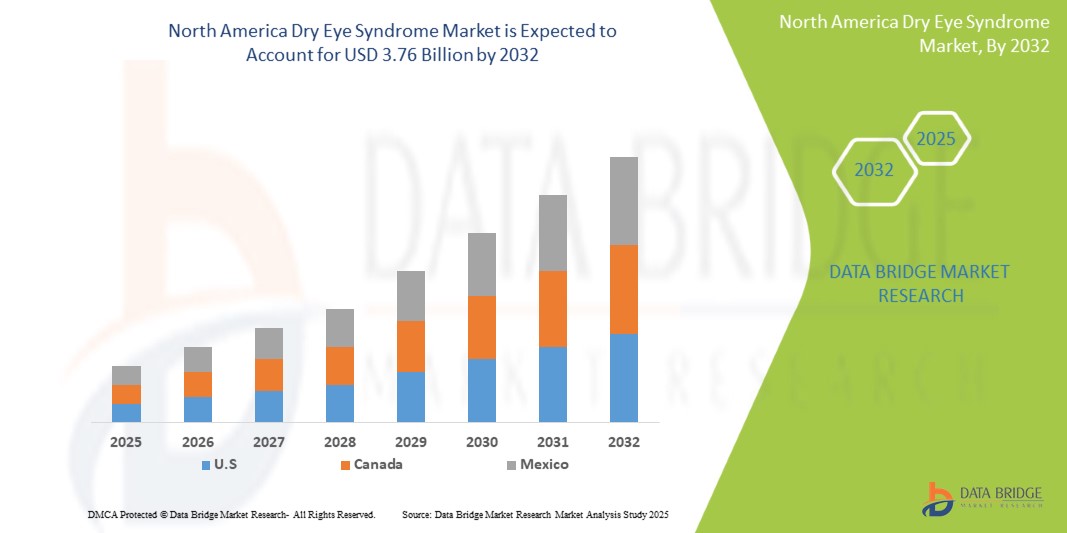
Dry Eye Syndrome Market Size
- The North America Dry Eye Syndrome Market size was valued atUSD 2.36 Billion in 2024and is expected to reachUSD 3.76 Billion by 2032, at aCAGR of 6.00%during the forecast period
- This growth is driven by factors such as the Increasing prevalence of dry eyes among people, Increasing screen time
Dry Eye Syndrome Market Analysis
- Dry eye syndrome, also known as keratoconjunctivitis sicca (KCS), is a condition in which the surface of the affected person's eyes lacks lubrication or moisture. It's a common ailment that can strike anyone at any time.
- The demand for microscopes in the North America Dry Eye Syndrome market is significantly driven by the increasing prevalence of age-related eye conditions and advancements in surgical techniques
- North America is expected to dominate the Dry Eye Syndromes market due to its advanced healthcare infrastructure and growing demand for eye surgeries
- The tear stimulators segment is expected to hold a significant market share of 56.22%, attributed to its high prevalence and the need for precision in treatments
Report Scope and Dry Eye Syndrome Market Segmentation
|
Attributes |
Dry Eye Syndrome Key Market Insights |
|
Segments Covered |
|
|
Countries Covered |
North America
|
|
Key Market Players |
|
|
Market Opportunities |
|
|
Value Added Data Infosets |
In addition to the insights on market scenarios such as market value, growth rate, segmentation, geographical coverage, and major players, the market reports curated by the Data Bridge Market Research also include import export analysis, production capacity overview, production consumption analysis, price trend analysis, climate change scenario, supply chain analysis, value chain analysis, raw material/consumables overview, vendor selection criteria, PESTLE Analysis, Porter Analysis, and regulatory framework. |
Dry Eye Syndrome Market Trends
“Advancements in Operating Microscopes & 3D Visualization for Intraocular Surgery”
- One prominent trend in the evolution of operating microscopes and 3D visualization systems for intraocular surgery is the increasing integration of advanced optics and digital enhancements
- These innovations enhance surgical precision by offering high-definition, real-time visualization of intraocular structures, improving accuracy in delicate procedures
- For instance, modern 3D visualization systems provide superior depth perception, enabling surgeons to navigate complex intraocular anatomy with greater clarity, which is particularly beneficial for vitreoretinal surgeries and minimally invasive glaucoma procedures.
- These advancements are transforming intraocular surgery, improving patient outcomes, and driving the demand for next-generation surgical microscopes with cutting-edge visualization capabilities
Dry Eye Syndrome Market Dynamics
Driver
“Increasing prevalence of dry eyes among people”
- The rising prevalence of dry eyes among people is a primary driver of the dry eye syndrome market's growth. Thyroid disorders, lupus, Sjogren’s syndrome, diabetes, rheumatoid arthritis, scleroderma, and others are the various diseases contributing to the high prevalence of dry eyes among people
- As the global population ages, the incidence of these conditions continues to grow, with older adults being more prone to various vision impairments that require surgical intervention
- As more individuals seek treatment for these conditions, the demand for operational microscopes rises, ensuring improved surgical outcomes and reducing the risks associated with eye surgeries
For instance,
- In December 2021, according to the article published by National Center for Biotechnology Information, the global population is aging rapidly, with Australia projected to have nearly 25% of its population aged 65 years and older by 2066. Older individuals experience significantly higher healthcare needs, including eye diseases
- As a result of the rising prevalence of eye diseases such as cataracts, glaucoma, macular degeneration, and diabetic retinopathy, there is a significant increase in the demand for Dry Eye Syndromes
Opportunity
“Development of innovative treatments”
- There is an opportunity for pharmaceutical companies to invest in research and development of new and more effective treatments for dry eye syndrome. Novel medications and therapies can help address the unmet needs of patients with severe or chronic dry eye conditions.
- AI algorithms can analyze real-time images and provide instant feedback on surgical procedures, helping surgeons identify potential complications, such as retinal tears or detachment
- Additionally, AI-powered microscopes can also assist in image analysis, enabling surgeons to review and compare images, track patient progress, and make more accurate diagnoses
For instance,
- In January 2025, according to an article published in the JMA Journal, AI algorithms, particularly those based on deep learning, can analyze retinal images with high accuracy, identifying and grading the severity of DR. These systems can quickly and efficiently process large volumes of images, reducing the burden on ophthalmologists and improving screening coverage. The ability of AI to detect early-stage DR and predict disease progression is crucial for timely intervention, which can significantly delay or even reverse the progression of the disease
- The integration ofAIin ophthalmic microscopes can also lead to improved patient outcomes, reduced recovery times, and enhanced quality of life. By leveraging AI-powered image analysis, surgeons can identify patients at risk for complications and take proactive measures to prevent them.
Restraint/Challenge
“High treatment costs”
- The high cost of Dry Eye Syndromes poses a significant challenge for the market, particularly affecting the purchasing decisions of healthcare facilities, especially in developing regions
- These microscopes, which are essential for performing intricate eye surgeries, can often range from tens of thousands to several hundred thousand dollars
- This substantial financial barrier can deter smaller clinics and hospitals with limited budgets from upgrading their equipment or investing in new technologies, leading to a reliance on outdated tools
For instance,
- In November 2024, according to an article published by the Ningbo Haishu HONYU Opto-Electro Co., Ltd, one of the main concerns surrounding the high cost of ophthalmic surgical microscopes is its potential impact on healthcare affordability and accessibility. The high cost of ophthalmic surgical microscopes adds to this burden, as it limits the ability of healthcare facilities to invest in the latest technology and equipment, thereby affecting the quality of care provided to patients
- Consequently, such limitations can result in disparities in the quality of care and access to advanced surgical procedures, ultimately hindering the overall growth of the market
Dry Eye Syndrome Market Scope
The market is segmented on the basis product type, dosage type, drug class, dose, medication type, container type, packaging type, type, end-users and distribution channel.
|
Segmentation |
Sub-Segmentation |
|
By Product Type |
|
|
By Dosage Type |
|
|
By Drug Class |
|
|
By Dose |
|
|
By Medication Type |
|
|
By Container Type |
|
|
By Packaging Type |
|
|
By Type |
|
|
By End User |
|
|
By Distribution Channel
|
|
In 2025, the Tear stimulators is projected to dominate the market with a largest share in application segment
The Tear Stimulators segment is anticipated to lead the North America Dry Eye Syndrome market, capturing a significant share of 56.22% by 2025, driven by its widespread prevalence and the demand for precision treatments. As a primary method for vision restoration, advancements in surgical techniques and microscope technologies will improve outcomes, fueling market expansion. Additionally, the growing aging population and increasing rates of cataracts are expected to further solidify its dominance in the market.
The Lubricating Agent is expected to account for the largest share during the forecast period in technology market
In 2025, the Lubricating Agent segment is projected to dominate the North America Dry Eye Syndrome market, securing the largest share at 51.31% due to its high prevalence and demand for precision care. As a primary therapeutic option for alleviating symptoms, improvements in formulation and delivery methods will enhance treatment outcomes, driving market growth. Additionally, the aging population and an increase in cataract cases will further support the segment's market leadership.
Dry Eye Syndrome Market Regional Analysis
“U.S. Holds the Largest Share in the Dry Eye Syndrome Market”
- U.S. dominates theDry Eye Syndrome market, driven by advanced healthcare infrastructure, high adoption of cutting-edge medical technologies, and strong presence of key market players
- The U.S. holds a significant share in the North America Dry Eye Syndrome market due to increased demand for high-precision ophthalmic procedures, a rising prevalence of eye disorders such as cataracts and glaucoma, and continuous advancements in surgical techniques
- The availability of well-established reimbursement policies and growing investments in research & development by leading medical device companies further strengthen the market.
- In addition, the increasing number of ophthalmic surgeries, including cataract and refractive procedures, along with a high rate of adoption of minimally invasive techniques, is fueling market expansion across the region
“Canada is Projected to Register the Highest CAGR in the Dry Eye Syndrome Market”
- Canada is expected to witness the highest growth rate in theDry Eye Syndrome market, driven by rapid expansion in healthcare infrastructure, increasing awareness about eye health, and rising surgical volumes
- Countries such asU.S. and Canadaare emerging as key markets due to thegrowing aging population, which is more susceptible to conditions such as cataracts, diabetic retinopathy, and macular degeneration
- Canada, with its advanced medical technology and increasing number of ophthalmic surgeons, remains a crucial market for ophthalmic microscopes. The country continues to lead in the adoption of premium surgical equipment to enhance precision and efficiency in eye surgeries
- Canada with their large populations and rising cases of vision-related disorders, are witnessing increased government and private sector investments in modern ophthalmic surgical setups. The expanding presence of global medical device manufacturers and improving accessibility to advanced ophthalmic care further contribute to market growth
Dry Eye Syndrome Market Share
The market competitive landscape provides details by competitor. Details included are company overview, company financials, revenue generated, market potential, investment in research and development, new market initiatives, global presence, production sites and facilities, production capacities, company strengths and weaknesses, product launch, product width and breadth, application dominance. The above data points provided are only related to the companies' focus related to market.
The Major Market Leaders Operating in the Market Are:
- Eli Lilly and Company (U.S.)
- Novartis AG (Switzerland)
- Johnson & Johnson Private Limited (U.S.)
- Teva Pharmaceutical Industries Ltd.(Jerusalem)
- Allergan (Ireland)
- Bausch Health Companies Inc. (Canada)
- Akorn Operating Company LLC (U.S.)
- Santen Pharmaceuticals Co. Ltd., (Japan)
- Novaliq GmbH (Germany)
- Cardinal Health, Inc. (U.S.)
- Perrigo Company plc (Ireland)
- Sun Pharmaceutical Industries Ltd. (India)
- Cipla Inc. (U.S.)
- Alembic Pharmaceuticals Limited (India)
- Senju Pharmaceutical Co. Ltd. (Japan)
- Horus Pharma (France)
- ROHTO Pharmaceutical Co.,Ltd. (Japan)
Latest Developments in North America Dry Eye Syndrome Market
- In October 2024, Novaliq and Laboratoires Théa announced that, Vevizye received approval from Europen commission to market the product for treating dry eye disease in adults. It is the first and only water-free ciclosporin 0.1% eye drop solution to receive approval in Europe.
- In June 2024, Oculis reported Phase 2b positive results for licaminlimab, anti-TNFα eye drop, shows significant improvement in multiple DED signs. The drug, effective in patients with a specific TNFR1 genetic biomarker, demonstrated rapid and notable reduction in corneal inflammation. Licaminlimab was well tolerated with similar side effects to a vehicle.
- In May 2024, Nordic Pharma, Inc. launched LACRIFILL Canalicular Gel, a novel dry eye treatment cleared by the FDA. This cross-linked hyaluronic acid gel temporarily blocks tear drainage by occluding the canalicular system, allowing natural tears to bathe the eyes. Administered via a simple in-office procedure, it lasts for six months and is reimbursed under CPT code 68761. Nordic Pharma is showcasing LACRIFILL at Kiawah Eye 2024, highlighting its potential to enhance ophthalmic practices. Nordic Pharma, part of SEVER Life Sciences, focuses on specialty pharmaceuticals and has a global presence.
SKU-
研究方法
数据收集和基准年分析是使用具有大样本量的数据收集模块完成的。该阶段包括通过各种来源和策略获取市场信息或相关数据。它包括提前检查和规划从过去获得的所有数据。它同样包括检查不同信息源中出现的信息不一致。使用市场统计和连贯模型分析和估计市场数据。此外,市场份额分析和关键趋势分析是市场报告中的主要成功因素。要了解更多信息,请请求分析师致电或下拉您的询问。
DBMR 研究团队使用的关键研究方法是数据三角测量,其中包括数据挖掘、数据变量对市场影响的分析和主要(行业专家)验证。数据模型包括供应商定位网格、市场时间线分析、市场概览和指南、公司定位网格、专利分析、定价分析、公司市场份额分析、测量标准、全球与区域和供应商份额分析。要了解有关研究方法的更多信息,请向我们的行业专家咨询。
可定制
Data Bridge Market Research 是高级形成性研究领域的领导者。我们为向现有和新客户提供符合其目标的数据和分析而感到自豪。报告可定制,包括目标品牌的价格趋势分析、了解其他国家的市场(索取国家列表)、临床试验结果数据、文献综述、翻新市场和产品基础分析。目标竞争对手的市场分析可以从基于技术的分析到市场组合策略进行分析。我们可以按照您所需的格式和数据样式添加您需要的任意数量的竞争对手数据。我们的分析师团队还可以为您提供原始 Excel 文件数据透视表(事实手册)中的数据,或者可以帮助您根据报告中的数据集创建演示文稿。