


Global Magnetic Resonance Imaging (MRI) Devices Market Segmentation, By Type (Conventional and Bio-based), Process (Trans-Esterification and Direct Esterification), Field Strength High-Field Magnetic Resonance Imaging (MRI) Systems (1.5t to 3t), Low-To-Mid-Field Magnetic Resonance Imaging (MRI) Systems (
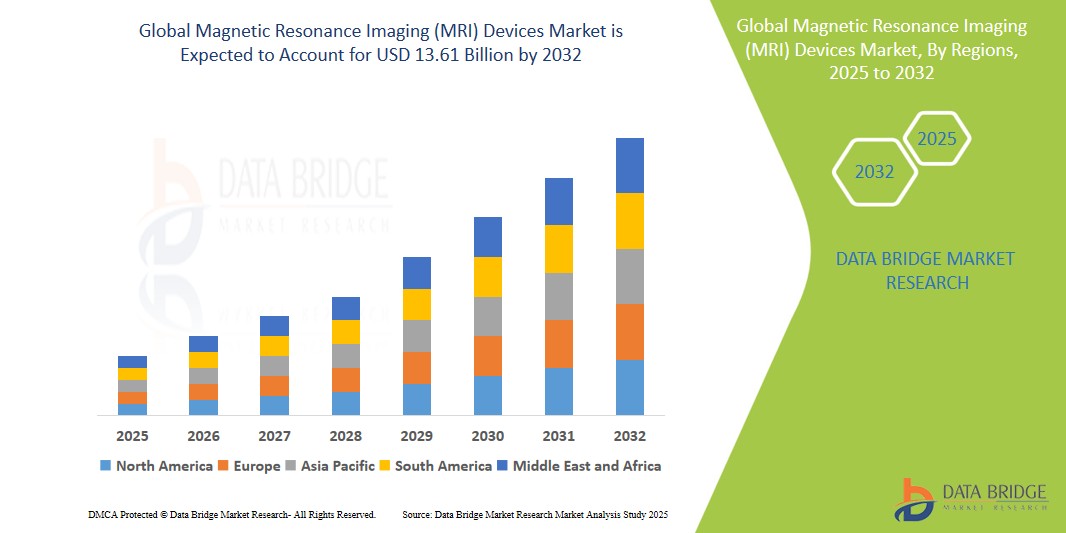 Magnetic Resonance Imaging (MRI) Devices Market Size
- The global magnetic resonance imaging (MRI) devices market size was valued atUSD 8.59 billion in 2024 and is expected to reachUSD 13.61 billion by 2032, at aCAGR of 5.91%during the forecast period
- This growth is driven by continuous advancement in magnetic resonance imaging technologies
Magnetic Resonance Imaging (MRI) Devices Market Analysis
- Magnetic Resonance Imaging (MRI) Devices are critical diagnostic imaging tools used to generate detailed anatomical images through magnetic fields and radio waves
- The demand for MRI Devices is primarily driven by technological advancements in imaging resolution, increasing prevalence of chronic diseases such as cancer and neurological disorders, and the growing emphasis on non-invasive diagnostic techniques
- North America is expected to dominate the magnetic resonance imaging (MRI) devices market with a largest market share of 37.44%, owing to the presence of leading medical technology firms, robust research and development infrastructure, and high healthcare expenditure
- Asia-Pacific is projected to register the highest CAGR in the MRI Devices market during the forecast period, fueled by rapid improvements in healthcare infrastructure, increasing accessibility to advanced diagnostics, and rising government investments in public health systems
- The closed magnetic resonance imaging (MRI) systems segment is expected to dominate the market with a largest market share of 76.71%, due to exceptional capability to provide increased safety, minimize contamination risks, and create more controlled environments for imaging procedures. These systems function within a sealed environment, ensuring ideal conditions for precise diagnostic imaging
Report Scope andMagnetic Resonance Imaging (MRI) Devices Market Segmentation
|
Attributes |
Magnetic Resonance Imaging (MRI) Devices KeyMarket Insights |
|
Segments Covered |
|
|
Countries Covered |
North America
Europe
Asia-Pacific
Middle East and Africa
South America
|
|
Key Market Players |
|
|
Market Opportunities |
|
|
Value Added Data Infosets |
In addition to the insights on market scenarios such as market value, growth rate, segmentation, geographical coverage, and major players, the market reports curated by the Data Bridge Market Research also include import export analysis, production capacity overview, production consumption analysis, price trend analysis, climate change scenario, supply chain analysis, value chain analysis, raw material/consumables overview, vendor selection criteria, PESTLE Analysis, Porter Analysis, and regulatory framework. |
Magnetic Resonance Imaging (MRI) Devices Market Trends
“Integration of Artificial Intelligence (AI) in MRI Scanning”
- A major trend in the MRI Devices market is the rapid integration ofartificial intelligence (AI) and machine learning algorithms to enhance image quality, speed up scanning time, and improve diagnostic accuracy
- AI-enabled MRI systems can automatically detect anomalies, segment organs, and reconstruct high-quality images from minimal data, reducing the burden on radiologists and optimizing workflow efficiency
- For instance, in 2023, GE HealthCare introduced its AIR Recon DL, a deep learning-based image reconstruction tool that accelerates MRI exams and enhances image clarity without extending scan time
- These innovations are revolutionizing radiology practices by delivering faster, more accurate, and patient-friendly imaging solutions, ultimately driving market growth and healthcare outcomes
Magnetic Resonance Imaging (MRI) Devices Market Dynamics
Driver
“Rising Incidence of Chronic Diseases Requiring Imaging”
- The increased prevalence of chronic diseases such as neurological disorders, cardiovascular conditions, and cancer is a strong driver for MRI adoption, as these conditions require detailed and repeated imaging for diagnosis and monitoring
- As the global population ages, the demand for non-invasive and radiation-free imaging tools such as MRI systems is rising significantly, especially in developed and developing economies
- For instance, the World Health Organization (WHO) reported in 2023 that over 55 million people worldwide are living with dementia, a condition that heavily relies on MRI for brain imaging and diagnosis
- This rising disease burden is prompting both public and private sectors to invest in advanced diagnostic tools, thereby fueling growth in the MRI Devices market
Opportunity
“Growing Demand for Portable and Point-of-Care MRI Systems”
- One of the emerging opportunities in the MRI Devices market is the development and adoption of portable or point-of-care MRI machines, which provide greater flexibility, faster access to diagnostics, and utility in critical care or rural settings
- These compact systems enable scanning at the bedside or in smaller clinics, reducing patient wait times and expanding the reach of MRI technology
- For instance, Hyperfine’s Swoop Portable MRI system received FDA clearance and has been used across U.S. hospitals for rapid brain imaging at the point of care, especially in emergency and intensive care units
- The shift toward decentralized and patient-centric healthcare models is likely to drive higher adoption of such compact MRI technologies across global markets
Restraint/Challenge
“Infrastructure and Operational Barriers in Emerging Markets”
- Despite the growing demand, limited access to skilled radiologists, inadequate infrastructure, and high installation requirements of MRI systems remain key challenges in low- and middle-income regions
- MRI machines require significant power supply, cooling systems, and specialized room shielding, which adds to setup complexity and cost in underdeveloped areas
- For instance, a 2022 report by the International Atomic Energy Agency (IAEA) indicated that several low-income countries have less than one MRI scanner per million population, highlighting the accessibility gap
- These operational and infrastructural barriers may slow down the expansion of MRI systems in emerging regions and restrict their full potential in global healthcare delivery
Magnetic Resonance Imaging (MRI) Devices Market Scope
The market is segmented on the basis of type, process, field strength, architecture, application, and end-user.
|
Segmentation |
Sub-Segmentation |
|
By Type |
|
|
By Process |
|
|
By Field Strength |
|
|
By Architecture |
|
|
By Application |
|
|
By End-Users |
|
In 2025, the closed magnetic resonance imaging (MRI) systems is projected to dominate the market with a largest share in architecture segment
The closed magnetic resonance imaging (MRI) systems segment is expected to dominate the magnetic resonance imaging (MRI) devices market with the largest share of 76.71% in 2025 due to its exceptional capability to provide increased safety, minimize contamination risks, and create more controlled environments for imaging procedures. These systems function within a sealed environment, ensuring ideal conditions for precise diagnostic imaging.
The high-field magnetic resonance imaging (MRI) systems is expected to account for the largest share during the forecast period in field strength segment
In 2025, the high-field magnetic resonance imaging (MRI) systems segment is expected to dominate the market with the largest market share of 37.91% due to technological advancements in high-field strength MRI have enhanced image quality, reduced distortion, and shortened scan times.
Magnetic Resonance Imaging (MRI) Devices Market Regional Analysis
“North America Holds the Largest Share in the Magnetic Resonance Imaging (MRI) Devices Market”
- North America dominates the magnetic resonance imaging (MRI) devices market with a largest market share of 37.44%, driven by the presence of key market players, leading academic institutions, pharmaceutical companies, and research centers, along with strong funding opportunities for R&D in healthcare and medical technologies.
- The U.S. holds the largest share due to continuous technological innovations, increased demand from the healthcare sector, substantial investments in diagnostic imaging advancements, and the rising adoption of MRI systems for a wide range of medical conditions.
- Significant investments in clinical and diagnostic imaging technologies, along with the expansion of healthcare facilities, are expected to foster numerous growth opportunities in the MRI devices market
“Asia-Pacific is Projected to Register the Highest CAGR in the Magnetic Resonance Imaging (MRI) Devices Market”
- Asia-Pacific is expected to witness the highest growth rate in the magnetic resonance imaging (MRI) devices market, driven by rapid improvements in healthcare infrastructure, greater adoption of advanced diagnostic technologies, and increasing research and development activities in pharmaceutical andbiotechnology sectors
- Countries such as China, India, and Japan are emerging as key markets due to the rising demand for high-tech imaging solutions, expanding healthcare investments, and a growing focus on personalized medicine and healthcare advancements
- Japan, recognized for its innovation in healthcare and medical technologies, is seeing strong adoption of magnetic resonance imaging (MRI) devices across clinical, research, and pharmaceutical sectors, bolstered by substantial government funding for the development of medical technologies
- China and India, with large and growing populations, are benefitting from increased government investments in healthcare infrastructure, expansion of pharmaceutical research, and improved access to advanced diagnostic technologies, driving the growth of the MRI devices market in the region
Magnetic Resonance Imaging (MRI) Devices Market Share
The market competitive landscape provides details by competitor. Details included are company overview, company financials, revenue generated, market potential, investment in research and development, new market initiatives, global presence, production sites and facilities, production capacities, company strengths and weaknesses, product launch, product width and breadth, application dominance. The above data points provided are only related to the companies' focus related to market.
The Major Market Leaders Operating in the Market Are:
- Siemens (Germany)
- General Electric Company (U.S.)
- Koninklijke Philips N.V. (Netherlands)
- Hitachi Ltd. (Japan)
- CANON MEDICAL SYSTEMS CORPORATION (Japan)
- Sanrad (India)
- Esaote SPA (Italy)
- Aspect Imaging Ltd. (Israel)
- FONAR Corp. (U.S.)
- Shenzhen Anke High-tech Co., Ltd. (China)
- Neusoft Corporation (China)
- Aurora Health Care (U.S.)
Latest Developments in Global Magnetic Resonance Imaging (MRI) Devices Market
- In March 2025, Polarean Imaging plc expanded its Xenon MRI imaging platform to support pharma-sponsored research. In collaboration with VIDA Diagnostics, this expansion introduced a new service model, enabling the device’s application in enhanced research settings, which is expected to contribute significantly to the future of medical imaging research
- In October 2023, Siemens Healthineers and Cardiff University entered a strategic partnership to advance medical technologies, building on their decade-long collaboration in diagnostics. The partnership focuses on advancing imaging research and precision diagnostics, with Cardiff’s Brain Research Imaging Centre (CUBRIC) leading innovation in MR technology and brain mapping, further enhancing the potential of brain imaging
- In June 2023, Imagion Biosystems Limited extended its collaboration with Siemens Healthineers, prolonging their existing agreement with Siemens Healthcare Pty Ltd in Australia for an additional two years. The expanded partnership now includes collaboration in the U.S. through Siemens Medical Solutions USA, marking a significant step in their global expansion and medical imaging development
- In April 2023, Siemens Healthineers strengthened its manufacturing presence in India by opening a new MRI facility in Bengaluru, supported by the Government of India’s PLI scheme. The new facility also features a production line dedicated to the manufacturing of MRI machines, expanding Siemens Healthineers' capacity to meet growing demand in the region
- In November 2021, Fujifilm Healthcare Americas Corporation introduced its Velocity MRI system at the Radiological Society of North America. This advanced high-field MRI scanner is specifically designed to improve patient experience, marking a notable advancement in MRI technology aimed at enhancing diagnostic imaging
SKU-
احصل على إمكانية الوصول عبر الإنترنت إلى التقرير الخاص بأول سحابة استخبارات سوقية في العالم

- لوحة معلومات تحليل البيانات التفاعلية
- لوحة معلومات تحليل الشركة للفرص ذات إمكانات النمو العالية
- إمكانية وصول محلل الأبحاث للتخصيص والاستعلامات
- تحليل المنافسين باستخدام لوحة معلومات تفاعلية
- آخر الأخبار والتحديثات وتحليل الاتجاهات
- استغل قوة تحليل المعايير لتتبع المنافسين بشكل شامل
منهجية البحث
يتم جمع البيانات وتحليل سنة الأساس باستخدام وحدات جمع البيانات ذات أحجام العينات الكبيرة. تتضمن المرحلة الحصول على معلومات السوق أو البيانات ذات الصلة من خلال مصادر واستراتيجيات مختلفة. تتضمن فحص وتخطيط جميع البيانات المكتسبة من الماضي مسبقًا. كما تتضمن فحص التناقضات في المعلومات التي شوهدت عبر مصادر المعلومات المختلفة. يتم تحليل بيانات السوق وتقديرها باستخدام نماذج إحصائية ومتماسكة للسوق. كما أن تحليل حصة السوق وتحليل الاتجاهات الرئيسية هي عوامل النجاح الرئيسية في تقرير السوق. لمعرفة المزيد، يرجى طلب مكالمة محلل أو إرسال استفسارك.
منهجية البحث الرئيسية التي يستخدمها فريق بحث DBMR هي التثليث البيانات والتي تتضمن استخراج البيانات وتحليل تأثير متغيرات البيانات على السوق والتحقق الأولي (من قبل خبراء الصناعة). تتضمن نماذج البيانات شبكة تحديد موقف البائعين، وتحليل خط زمني للسوق، ونظرة عامة على السوق ودليل، وشبكة تحديد موقف الشركة، وتحليل براءات الاختراع، وتحليل التسعير، وتحليل حصة الشركة في السوق، ومعايير القياس، وتحليل حصة البائعين على المستوى العالمي مقابل الإقليمي. لمعرفة المزيد عن منهجية البحث، أرسل استفسارًا للتحدث إلى خبراء الصناعة لدينا.
التخصيص متاح
تعد Data Bridge Market Research رائدة في مجال البحوث التكوينية المتقدمة. ونحن نفخر بخدمة عملائنا الحاليين والجدد بالبيانات والتحليلات التي تتطابق مع هدفهم. ويمكن تخصيص التقرير ليشمل تحليل اتجاه الأسعار للعلامات التجارية المستهدفة وفهم السوق في بلدان إضافية (اطلب قائمة البلدان)، وبيانات نتائج التجارب السريرية، ومراجعة الأدبيات، وتحليل السوق المجدد وقاعدة المنتج. ويمكن تحليل تحليل السوق للمنافسين المستهدفين من التحليل القائم على التكنولوجيا إلى استراتيجيات محفظة السوق. ويمكننا إضافة عدد كبير من المنافسين الذين تحتاج إلى بيانات عنهم بالتنسيق وأسلوب البيانات الذي تبحث عنه. ويمكن لفريق المحللين لدينا أيضًا تزويدك بالبيانات في ملفات Excel الخام أو جداول البيانات المحورية (كتاب الحقائق) أو مساعدتك في إنشاء عروض تقديمية من مجموعات البيانات المتوفرة في التقرير.











