


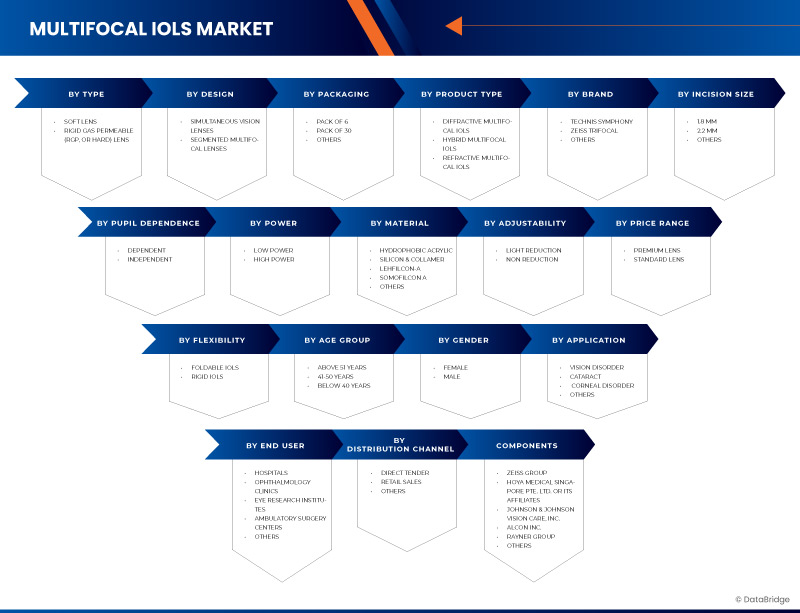
Global Multifocal IOLs Market Segmentation, By Type (Soft Lens and Rigid Gas Permeable (RGP, or Hard) Lens), Design (Simultaneous Vision Lenses and Segmented Multifocal Lenses), Packaging (Pack of 6, Pack of 30, and Others), ProductType (Diffractive Multifocal IOLs, Hybrid Multifocal IOLs and Refractive Multifocal IOLs), Brand (Technis Symphony, Zeiss Trifocal, and Others), Incision Size (1.8 MM, 2.2 MM, and Others), Pupil Dependence (Dependent and Independent), Power (Low Power and High Power), Material (Hydrophobic Acrylic, Silicon & Collamer, Lehfilcon-A, Somofilcon A and Others), Adjustability (Light Reduction and Non Reduction), PriceRange (Premium Lens and Standard Lens), Flexibility (Foldable IOLs and Rigid IOLs), AgeGroup (Above 51 Years, 41-50 Years and Below 40 Years), Gender (Female and Male), Application (Vision Disorder, Cataract, Corneal Disorder, and Others), End User (Hospitals, Ophthalmology Clinics, Eye Research Institutes, Ambulatory Surgery Centers and Others), Distribution Channel (Direct Tender, Retail Sales and Others) - Industry Trends and Forecast to 2031.
Multifocal IOL Market Analysis and Insights
Increasing prevalence of cataracts is expected to drive rising prevalence of heat-related illnesses in the global multifocal IOLs market.
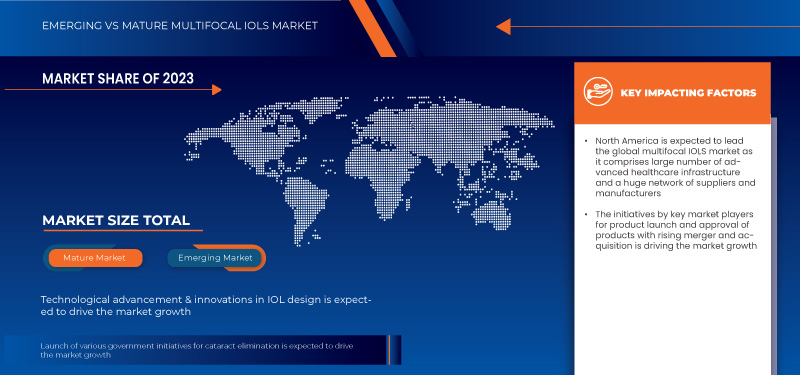
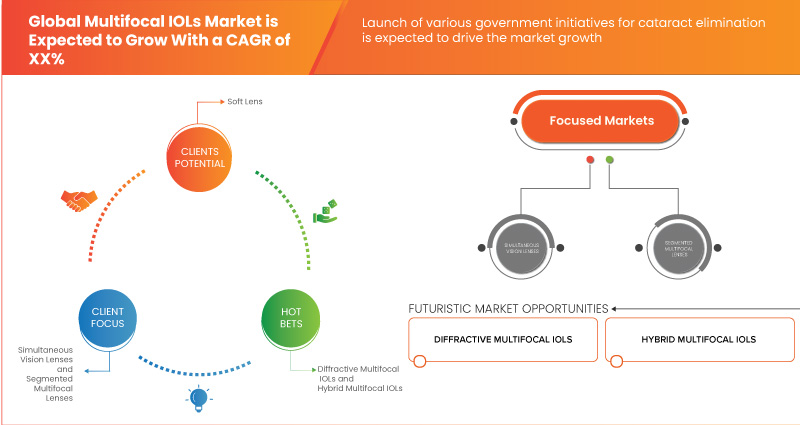
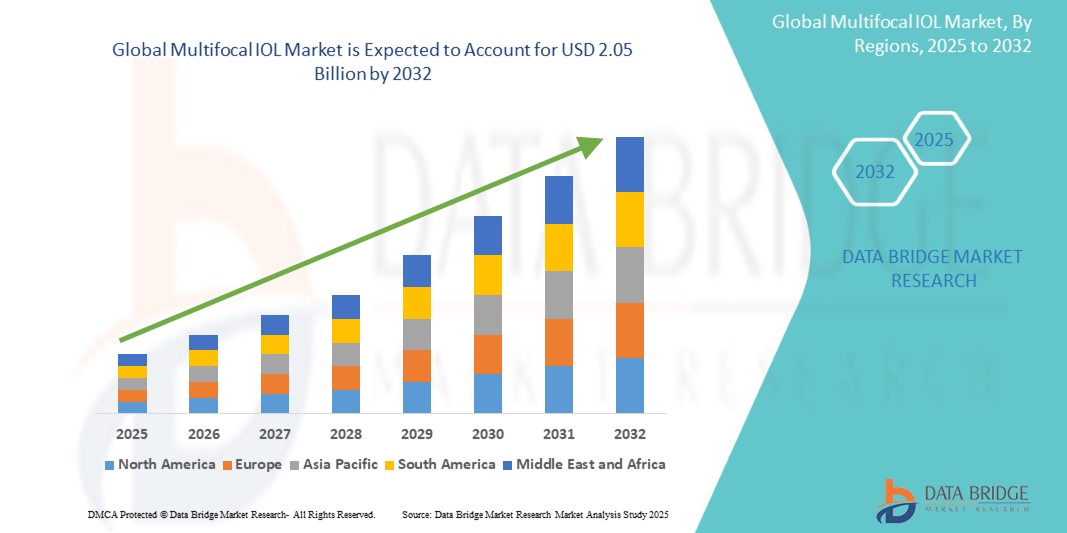
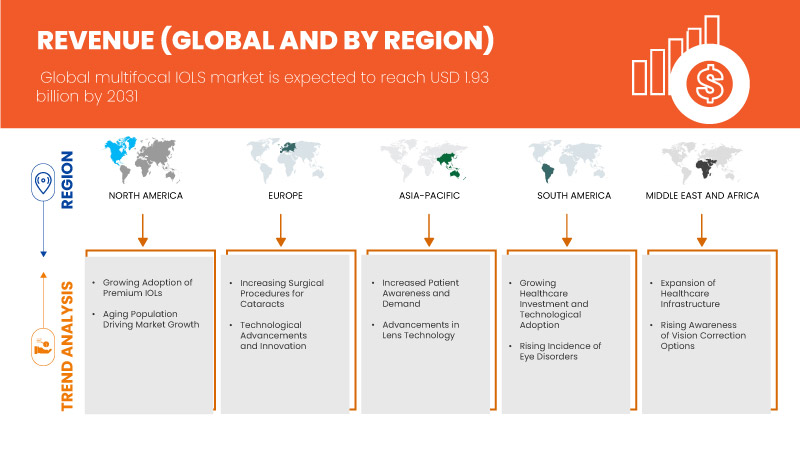
Data Bridge Market Research analyzes that the global multifocal IOLs market is expected to reach USD 1.93 billion by 2031 from USD 1.22 billion in 2023, growing with a CAGR of 6.4% in the forecast period of 2024 to 2031.
|
Report Metric |
Details |
|
Forecast Period |
2024 to 2031 |
|
Base Year |
2023 |
|
Historic Years |
2022 (Customizable to 2016–2021) |
|
Quantitative Units |
Revenue in USD Billion |
|
Segments Covered |
Type (Soft Lens and Rigid Gas Permeable (RGP, or Hard) Lens), Design (Simultaneous Vision Lenses and Segmented Multifocal Lenses), Packaging (Pack of 6, Pack of 30, and Others), Product Type (Diffractive Multifocal IOLs, Hybrid Multifocal IOLs and Refractive Multifocal IOLs), Brand (Technis Symphony, Zeiss Trifocal, and Others), Incision Size (1.8 MM, 2.2 MM, and Others), Pupil Dependence (Dependent and Independent), Power (Low Power and High Power), Material (Hydrophobic Acrylic, Silicon & Collamer, Lehfilcon-A, Somofilcon A and Others), Adjustability (Light Reduction and Non Reduction), Price Range (Premium Lens and Standard Lens), Flexibility (Foldable IOLs and Rigid IOLs), Age Group (Above 51 Years, 41-50 Years and Below 40 Years), Gender (Female and Male), Application (Vision Disorder, Cataract, Corneal Disorder, and Others), End User (Hospitals, Ophthalmology Clinics, Eye Research Institutes, Ambulatory Surgery Centers and Others), Distribution Channel (Direct Tender, Retail Sales and Others) |
|
Countries Covered |
China, India, Australia, South Korea, Japan, Indonesia, Malaysia, Singapore, Thailand, Philippines, Vietnam, Rest of Asia-Pacific, Brazil, Argentina, Peru, Rest of South America, France, Germany, U.K., Italy, Spain, Russia, Switzerland, Netherlands, Hungary, Lithuania, Turkey, Ireland, Austria, Poland, Norway, Rest of Europe, U.S., Canada, Mexico, South Africa, U.A.E., Egypt, Kuwait, Israel, and Rest of Middle East and Africa
|
|
Market Players Covered |
Johnson & Johnson, Inc., Hoya Medical Singapore Pte. Ltd. or Its Affiliates, Zeiss Group, Alcon Inc., Rayner Group, Lenstec, Inc., Aurolab, Excellent Hi-Care Pvt Ltd, Sav-Iol SA, Vsy Biotechnology Gmbh, Hanita Lenses Ltd, Care Group, Iolart, Omni Lens Pvt. Ltd., Ophtec BV and, among others. |
Market Definition
The global multifocal (IOLs) market refers to the segment of the ophthalmic industry that focuses on the development, production, and distribution of advanced intraocular lenses designed to correct presbyopia and other vision impairments in patients undergoing cataract surgery or lens replacement procedures. Multifocal IOLs are engineered to provide clear vision at multiple distances—near, intermediate, and far—reducing or eliminating the need for glasses or contact lenses after surgery. This market is driven by an aging global population, increasing prevalence of cataracts, advancements in lens technology, rising awareness of premium IOL options, and growing demand for improved quality of life among patients seeking better visual outcomes post-surgery.
Global Multifocal (IOLs) Market Dynamics
This section deals with understanding the market drivers, opportunities, restraints, and challenges. All of this is discussed in detail below:
Driver
- Increasing Prevalence of Cataracts
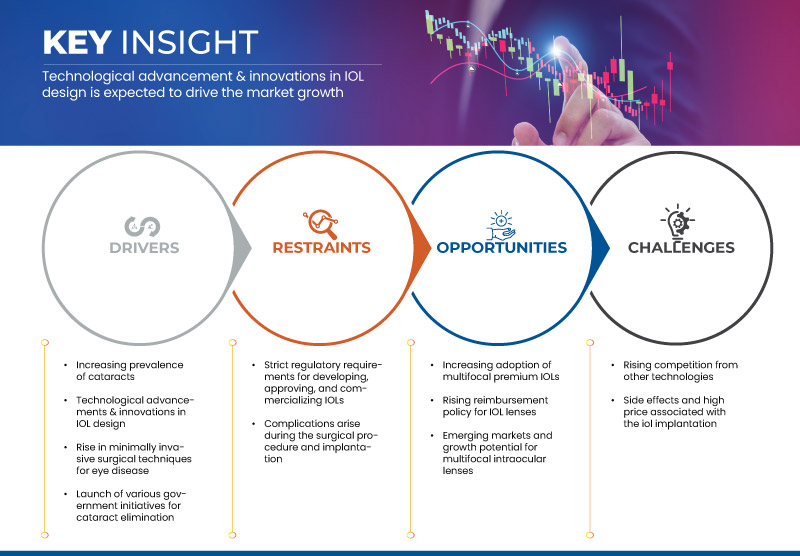
The increasing prevalence of cataracts, particularly among the aging population, serves as a significant driver for the global multifocal intraocular lenses (IOLs) market. As cataracts remain the leading cause of blindness and visual impairment worldwide, the demand for effective and long-lasting solutions has surged. Multifocal IOLs offer a compelling alternative to traditional lenses by enabling patients to focus at multiple distances without the need for additional corrective eyewear. This capability is particularly appealing to a growing demographic of older adults who wish to maintain an active lifestyle post-cataract surgery. With the global population aging and the incidence of cataracts rising in tandem, healthcare providers and patients alike are increasingly turning to advanced multifocal IOLs to restore clear vision across different focal points. Furthermore, technological advancements in lens design, such as improved light distribution and reduced halos and glare, have enhanced patient outcomes, driving greater adoption. The convergence of these factors, coupled with an increasing awareness of the benefits of multifocal IOLs, is propelling market growth as more individuals opt for these innovative lenses to improve their quality of life following cataract surgery.
For instance,
- In May 2023, according to the article published in NCBI, this study calculated the age-standardized prevalence rate (ASR) and annual percentage change (EAPC) to show the trends of cataracts in China and different regions. The result indicates that the ASR increased from 867.09 in 1990 to 991.56 in 2019 per 100,000, with an EAPC of 0.88 in China. The projective model suggests that the ASR for cataracts will rise to 1101.35×106 for males and 1616.63×106 for females by 2030. The trends from 1990 to 2030 indicated that the burden of cataracts remains high in China. This data shows that the number of cataracts is more and will increase in the future, which will divert the growth of the market
Restraint
- Strict Regulatory Requirements for Developing, Approving, and Commercializing IOLS
Stringent regulatory challenges present a significant and multifaceted restraint in the global multifocal intraocular lenses (IOLs) market, as the pathway to developing, obtaining approval, and commercializing these advanced medical devices is fraught with complex, time-consuming, and costly hurdles that vary significantly across different regions. Regulatory bodies such as the U.S. Food and Drug Administration (FDA), the European Medicines Agency (EMA), and their counterparts in other parts of the world impose stringent requirements for the clinical evaluation of multifocal IOLs, necessitating robust and comprehensive safety and efficacy data to ensure that these devices meet the highest standards of patient care. This process often involves multiple phases of clinical trials, extensive pre-market approval submissions, and rigorous post-market surveillance, each step of which demands significant financial investment, human resources, and time. Companies are required to meticulously document every aspect of their product development, from the initial design and manufacturing processes to the long-term performance of the IOLs in diverse patient populations. This extensive documentation must not only prove the device's safety and effectiveness but also demonstrate compliance with the ever-evolving regulatory guidelines, which can differ significantly between regions, further complicating the approval process. The variability in regulatory standards and the necessity to obtain approval in multiple jurisdictions can lead to protracted delays in bringing new multifocal IOLs to market, as companies must often tailor their submissions to meet the specific requirements of each regulatory authority. These delays can stifle innovation, as the lengthy approval processes may dissuade companies from investing in the development of new technologies, knowing that the return on investment may be uncertain or significantly delayed. Also, the costs associated with navigating these regulatory landscapes, ranging from conducting large-scale clinical trials to legal and administrative expenses involved in preparing regulatory submissions, can be prohibitively high, particularly for smaller companies or new market entrants. The financial burden and uncertainty associated with meeting these stringent regulatory requirements may lead some companies to focus their efforts on markets with more predictable or lenient regulatory environments, thereby limiting the global availability of the latest multifocal IOL innovations
Opportunities
- Increasing Adoption of Multifocal Premium IOLS
The adoption of premium multifocal intraocular lenses (IOLs) is steadily increasing as patients and healthcare providers recognize their advanced capabilities in restoring vision across multiple distances. These lenses offer significant improvement over standard IOLs by reducing or even eliminating the need for glasses after cataract surgery, enhancing patients' quality of life. As awareness grows about the benefits of premium multifocal IOLs—such as clearer vision at near, intermediate, and far distances, more patients are opting for these advanced lenses, particularly those who prioritize maintaining an active lifestyle without the burden of corrective eyewear. This trend is supported by technological advancements that continues to refine the visual outcomes of these lenses, making them a more attractive choice for both patients and surgeons.
- Rising Reimbursement Policy for IOL Lenses
The rising reimbursement policies for intraocular lenses (IOLs) represents a significant factor contributing to the expansion of potential market in the future. As healthcare systems and insurance providers increasingly recognize the value of advanced IOL technologies, there has been a notable shift towards enhancing coverage for these premium lenses. The policy remarks the benefits of IOLs to patients, including improved vision quality and reduced dependence on corrective eyewear. By broadening reimbursement options, more patients can access advanced IOLs, thus driving demand in the market. Insurance companies and healthcare systems are gradually expanding their reimbursement policies to include a wider range of IOLs, such as multifocal and extended depth-of-focus lenses, which were previously considered elective or outside the scope of standard coverage.
For instance,
- In March 2023, according to an article published by the American Academy of Ophthalmology, Reimbursement policies for IOL lenses, mainly when dealing with Medicare, are clearly defined by the Centers for Medicare & Medicaid Services (CMS). CMS covers conventional IOLs implanted during cataract surgery, along with the associated facility and physician services. However, CMS does not cover presbyopia-correcting or astigmatism-correcting IOLs, nor any new technology IOLs. If a patient opts for a premium IOL not covered by Medicare, they must be informed about the out-of-pocket costs beforehand. The facility can bill the patient for the additional expenses related to premium lenses while Medicare continues to cover the cost of the conventional lens
Challenge
- Rising Competition from Other Technologies
The multifocal intraocular lens (IOL) market faces significant challenges in the coming years, primarily due to the rise of alternative vision correction technologies that are increasingly gaining attraction. Technologies such as extended depth-of-focus (EDOF) IOLs, accommodative IOLs, and trifocal IOLs are presenting viable alternatives to traditional multifocal lenses, each offering distinct advantages that caters to specific patient needs. EDOF IOLs, for instance, provides a continuous range of vision with fewer visual disturbances like halos and glare, which are common concerns with multifocal IOLs. Accommodative IOLs mimic the eye's natural focusing ability, offering a more seamless visual experience without the need for multiple focal points. Trifocal IOLs, on the other hand, offers a broader range of clear vision across all distances, further reducing the need for multifocal lenses.
Recent Developments
- In June 2024, the ZEISS Group actively promotes eye health during Cataract Awareness Month by conducting educational campaigns and free eye screenings. Their initiatives aim to raise awareness about cataract prevention and treatment, emphasizing the importance of early detection and modern surgical solutions. ZEISS's efforts include partnerships with local healthcare providers to improve access to quality eye care and support communities in managing and preventing vision impairment
- In December 2024, Pfizer Inc. announced the successful completion of its acquisition of Seagen Inc., a global biotechnology company known for discovering, developing, and commercializing transformative cancer medicines. Pfizer acquired all outstanding common stock of Seagen for USD 229 per share in cash, totalling In March 2023, The ZEISS Group design and innovate IOL and OVD Portfolio to address both patient needs and surgeon preferences. Combining innovation and precision, it offers a comprehensive selection of cataract consumables and implants, tailored for monofocal, toric, and refractive cataract surgeries
- In April 2024, Alcon, the global leader in eye care dedicated to helping people see brilliantly, showcased approximately 100 company-supported and investigator-led data presentations demonstrating its latest innovative efforts aimed at optimizing patient outcomes at the 2024 American Society of Cataract and Refractive Surgery (ASCRS) Annual Meeting, April 5-8 in Boston. In addition, the company hosts multiple peer-to-peer symposia and in-booth demonstrations of its industry-leading implantables and devices, including the Clareon intraocular lens (IOL) portfolio, cloud-based SMARTCataract surgical planner, Hydrus Microstent and more
Der globale Markt für multifokale IOLs ist in siebzehn wichtige Segmente unterteilt, die auf Typ, Design, Verpackung, Produkttyp, Marke, Schnittgröße, Pupillenabhängigkeit, Leistung, Material, Einstellbarkeit, Preisspanne, Flexibilität, Altersgruppe, Geschlecht, Anwendung, Endbenutzer und Vertriebskanal basieren . Das Wachstum zwischen den Segmenten hilft Ihnen bei der Analyse von Wachstumsnischen und Strategien zur Marktbearbeitung und zur Bestimmung Ihrer wichtigsten Anwendungsbereiche und der Unterschiede in Ihren Zielmärkten.
Typ
- Weiche Linse
- Starre, gasdurchlässige (RGP- oder harte) Linse
Auf der Grundlage des Typs ist der Markt in weiche Linsen und starre, gasdurchlässige (RGP oder harte) Linsen segmentiert.
Design
- Simultansichtgläser
- Segmentierte Multifokallinsen
Auf der Grundlage des Designs ist der Markt in Simultansichtlinsen und segmentierte Multifokallinsen segmentiert.
Verpackung
- 6er Packung
- 30 Stück
- Sonstiges
Auf Grundlage der Verpackung ist der Markt in 6er-Packungen, 30er-Packungen und Sonstige segmentiert.
Produkttyp
- Diffraktive multifokale IOLs
- Hybride multifokale IOLs
- Refraktive multifokale IOLs
Auf der Grundlage des Produkttyps ist der Markt in diffraktive multifokale IOLs, hybride multifokale IOLs und refraktive multifokale IOLs segmentiert.
Marke
- Technis Symphony
- Zeiss Trifokal
- Sonstiges
Auf der Grundlage der Marke ist der Markt in Technis Symphony, Zeiss Trifocal und andere segmentiert.
Größe der Inzision
- 8 MM
- 2 MM
- Sonstiges
Auf der Grundlage der Einschnittgröße ist der Markt in 1,8 mm, 2,2 mm und andere segmentiert.
Schülerabhängigkeit
- Abhängig
- Unabhängig
Auf der Grundlage der Schülerabhängigkeit wird der Markt in abhängige und unabhängige Schüler segmentiert.
Leistung
- Geringer Stromverbrauch
- Hohe Leistung
Auf der Grundlage der Leistung ist der Markt in Niedrigleistung und Hochleistung segmentiert.
Material
- Hydrophobes Acryl
- Silizium & Collamer
- Lehfilcon-A
- Somofilcon A
- Sonstiges
Auf der Grundlage des Materials ist der Markt in hydrophobes Acryl, Silikon und Collamer, Lehfilcon-A, Somofilcon A und andere segmentiert.
Verstellbarkeit
- Lichtreduzierung
- Keine Reduzierung
Auf der Grundlage der Einstellbarkeit wird der Markt in leichte Reduzierung und keine Reduzierung segmentiert.
Preisklasse
- Premium-Objektiv
- Standardobjektiv
Auf der Grundlage der Preisspanne ist der Markt in Premiumobjektive und Standardobjektive segmentiert.
Flexibilität
- Faltbare IOLs
- Starre IOLs
Auf der Grundlage der Flexibilität ist der Markt in faltbare IOLs und starre IOLs segmentiert.
Altersgruppe
- Über 51 Jahre
- 41-50 Jahre
- Unter 40 Jahren
Auf der Grundlage der Altersgruppen ist der Markt in über 51 Jahre, 41–50 Jahre und unter 40 Jahre segmentiert.
Geschlecht
- Weiblich
- Männlich
Auf der Grundlage des Geschlechts ist der Markt in weiblich und männlich segmentiert.
Anwendung
- Sehstörung
- Katarakt
- Hornhauterkrankung
- Sonstiges
Auf der Grundlage der Anwendung wird der Markt in Sehstörungen, Katarakt, Hornhauterkrankungen und Sonstige segmentiert.
Endbenutzer
- Krankenhäuser
- Augenkliniken
- Augenforschungsinstitute
- Ambulante Chirurgiezentren
- Sonstiges
Auf der Grundlage des Endbenutzers ist der Markt in Krankenhäuser, Augenkliniken, Augenforschungsinstitute, ambulante Operationszentren und andere segmentiert.
Vertriebskanal
- Direkte Ausschreibung
- Einzelhandelsumsätze
- Sonstiges
Auf der Grundlage des Vertriebskanals wird der Markt in Direktausschreibungen, Einzelhandelsverkäufe und Sonstiges segmentiert.
Globaler multifokaler IOL-Markt – Regionale Analyse/Einblicke
Der globale Markt für multifokale IOLs ist in siebzehn wichtige Segmente unterteilt, die auf Typ, Design, Verpackung, Produkttyp, Marke, Schnittgröße, Pupillenabhängigkeit, Leistung, Material, Einstellbarkeit, Preisspanne, Flexibilität, Altersgruppe, Geschlecht, Anwendung, Endbenutzer und Vertriebskanal basieren.
Die in diesem Marktbericht abgedeckten Länder sind China, Indien, Australien, Südkorea, Japan, Indonesien, Malaysia, Singapur, Thailand, Philippinen, Vietnam, übriger Asien-Pazifik-Raum, Brasilien, Argentinien, Peru, übriges Südamerika, Frankreich, Deutschland, Großbritannien, Italien, Spanien, Russland, Schweiz, Niederlande, Ungarn, Litauen, Türkei, Irland, Österreich, Polen, Norwegen, übriges Europa, USA, Kanada, Mexiko, Südafrika, Vereinigte Arabische Emirate, Ägypten, Kuwait, Israel und übriger Naher Osten und Afrika.
Aufgrund der starken Regierungsinitiativen wird Nordamerika voraussichtlich die dominierende und am schnellsten wachsende Region auf diesem Markt sein. Die steigende Zahl der Verbraucher in der Region trägt zu einer starken Nachfrage nach multifokalen IOLs bei.
Der Länderabschnitt des Berichts enthält auch einzelne marktbeeinflussende Faktoren und Änderungen der Regulierung auf dem Inlandsmarkt, die sich auf die aktuellen und zukünftigen Markttrends auswirken. Datenpunkte wie Neuverkäufe, Ersatzverkäufe, Länderdemografie, Regulierungsgesetze und Import-/Exportzölle sind einige der wichtigsten Anhaltspunkte, die zur Prognose des Marktszenarios für einzelne Länder verwendet werden. Bei der Prognoseanalyse der Länderdaten werden auch die Präsenz und Verfügbarkeit globaler Marken und ihre Herausforderungen aufgrund großer oder geringer Konkurrenz durch lokale und inländische Marken sowie die Auswirkungen der Vertriebskanäle berücksichtigt.
Wettbewerbsumfeld und globale Marktdynamik für multifokale IOLs Analyse der Marktanteile
Die Wettbewerbslandschaft des globalen Marktes für multifokale IOLs liefert Einzelheiten zu den Wettbewerbern. Zu den enthaltenen Einzelheiten gehören Unternehmensübersicht, Unternehmensfinanzen, erzielter Umsatz, Marktpotenzial, Investitionen in Forschung und Entwicklung, neue Marktinitiativen, Produktionsstandorte und -anlagen, Stärken und Schwächen des Unternehmens, Produkteinführung, Produktzulassungen, Produktbreite und -umfang, Anwendungsdominanz und Produkttyp-Lebenslinienkurve. Die oben angegebenen Datenpunkte beziehen sich nur auf den Fokus des Unternehmens auf dem Markt.
Zu den wichtigsten Marktteilnehmern auf dem Markt zählen unter anderem Johnson & Johnson, Inc., Hoya Medical Singapore Pte. Ltd. oder seine Tochtergesellschaften, Zeiss Group, Alcon Inc., Rayner Group, Lenstec, Inc., Aurolab, Excellent Hi-Care Pvt Ltd, Sav-Iol SA, Vsy Biotechnology Gmbh, Hanita Lenses Ltd, Care Group, Iolart, Omni Lens Pvt. Ltd., Ophtec BV und andere.
SKU-
Erhalten Sie Online-Zugriff auf den Bericht zur weltweit ersten Market Intelligence Cloud

- Interaktives Datenanalyse-Dashboard
- Unternehmensanalyse-Dashboard für Chancen mit hohem Wachstumspotenzial
- Zugriff für Research-Analysten für Anpassungen und Abfragen
- Konkurrenzanalyse mit interaktivem Dashboard
- Aktuelle Nachrichten, Updates und Trendanalyse
- Nutzen Sie die Leistungsfähigkeit der Benchmark-Analyse für eine umfassende Konkurrenzverfolgung
Forschungsmethodik
Die Datenerfassung und Basisjahresanalyse werden mithilfe von Datenerfassungsmodulen mit großen Stichprobengrößen durchgeführt. Die Phase umfasst das Erhalten von Marktinformationen oder verwandten Daten aus verschiedenen Quellen und Strategien. Sie umfasst die Prüfung und Planung aller aus der Vergangenheit im Voraus erfassten Daten. Sie umfasst auch die Prüfung von Informationsinkonsistenzen, die in verschiedenen Informationsquellen auftreten. Die Marktdaten werden mithilfe von marktstatistischen und kohärenten Modellen analysiert und geschätzt. Darüber hinaus sind Marktanteilsanalyse und Schlüsseltrendanalyse die wichtigsten Erfolgsfaktoren im Marktbericht. Um mehr zu erfahren, fordern Sie bitte einen Analystenanruf an oder geben Sie Ihre Anfrage ein.
Die wichtigste Forschungsmethodik, die vom DBMR-Forschungsteam verwendet wird, ist die Datentriangulation, die Data Mining, die Analyse der Auswirkungen von Datenvariablen auf den Markt und die primäre (Branchenexperten-)Validierung umfasst. Zu den Datenmodellen gehören ein Lieferantenpositionierungsraster, eine Marktzeitlinienanalyse, ein Marktüberblick und -leitfaden, ein Firmenpositionierungsraster, eine Patentanalyse, eine Preisanalyse, eine Firmenmarktanteilsanalyse, Messstandards, eine globale versus eine regionale und Lieferantenanteilsanalyse. Um mehr über die Forschungsmethodik zu erfahren, senden Sie eine Anfrage an unsere Branchenexperten.
Anpassung möglich
Data Bridge Market Research ist ein führendes Unternehmen in der fortgeschrittenen formativen Forschung. Wir sind stolz darauf, unseren bestehenden und neuen Kunden Daten und Analysen zu bieten, die zu ihren Zielen passen. Der Bericht kann angepasst werden, um Preistrendanalysen von Zielmarken, Marktverständnis für zusätzliche Länder (fordern Sie die Länderliste an), Daten zu klinischen Studienergebnissen, Literaturübersicht, Analysen des Marktes für aufgearbeitete Produkte und Produktbasis einzuschließen. Marktanalysen von Zielkonkurrenten können von technologiebasierten Analysen bis hin zu Marktportfoliostrategien analysiert werden. Wir können so viele Wettbewerber hinzufügen, wie Sie Daten in dem von Ihnen gewünschten Format und Datenstil benötigen. Unser Analystenteam kann Ihnen auch Daten in groben Excel-Rohdateien und Pivot-Tabellen (Fact Book) bereitstellen oder Sie bei der Erstellung von Präsentationen aus den im Bericht verfügbaren Datensätzen unterstützen.











