


Global Plastic Tumblers Market Segmentation, By Material Type (Polypropylene (PP), Polyethylene (PE), Low Density Polyethylene (LDPE), High Density Polyethylene (HDPE), Polystyrene (PS), Polyethylene Terephthalate (PET), Polylactic Acid (PLA), Biodegradable Plastic, and Others), Capacity (Less than 10oz, 10oz to 20oz, 20oz to 35oz and 35oz, and Above), Sales Channel (Convenience Store, Hyper Market, Super Market, and E-commerce) - Industry Trends and Forecast to 2032
What is the Global Plastic Tumblers Market Size and Growth Rate?
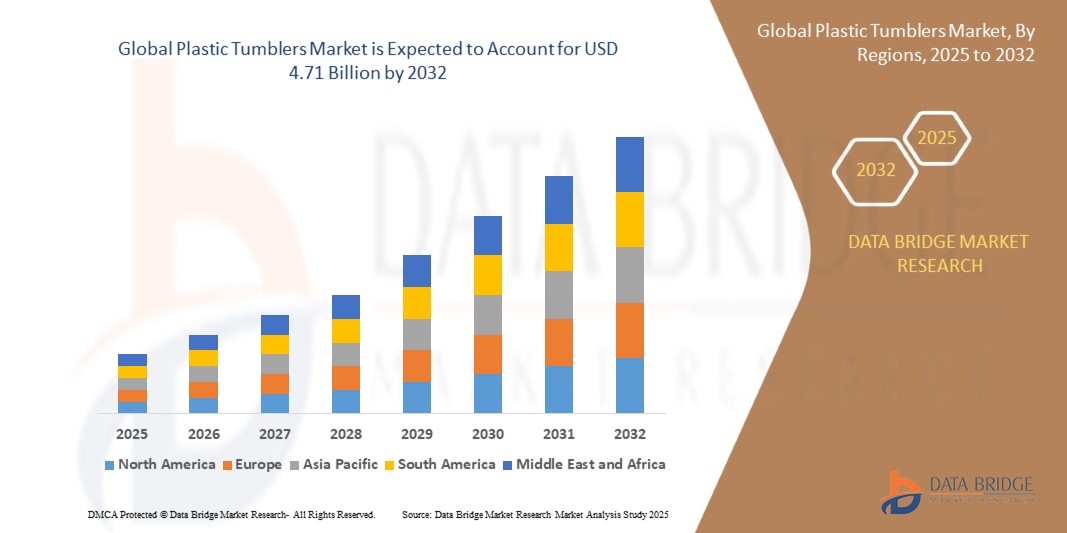
- The global plastic tumblers market size was valued at USD 3.71billion in 2024 and is expected to reach USD 4.71 billion by 2032, at a CAGR of 3.02% during the forecast period
- The plastic tumblers market is experiencing significant growth driven by the increasing demand for versatile and durable drinkware solutions across various sectors. As consumer preferences shift towards affordable and lightweight alternatives to glass and ceramic, plastic tumblers are becoming a popular choice in both residential and commercial setting
- The convenience of plastic tumblers, including their resistance to breakage and ease of cleaning, appeals to a wide range of consumers, from households to hospitality businesses. Additionally, the growing trend towards outdoor activities and picnics has further bolstered the demand for these practical drinkware options. The market is also witnessing innovation in design and functionality, with advancements in plastic materials enhancing the aesthetic appeal and performance of tumblers
What are the Major Takeaways of Plastic Tumblers Market?
- The growing preference for cost-effective and durable drinkware solutions is a significant driver of the plastic tumblers market. Consumers increasingly seek budget-friendly alternatives to traditional glass and ceramic tumblers, which can be more expensive and prone to breakage
- Plastic tumblers offer a practical solution with their lower cost, durability, and convenience, making them an attractive option for both households and businesses. This demand is further fueled by the need for drinkware that can withstand frequent use and handling without compromising on quality
- North America dominated the plastic tumblers market with the largest revenue share of 38.5% in 2024, driven by high consumption of reusable beverage containers and growing environmental awareness across the U.S. and Canada
- Asia-Pacific plastic tumblers market is set to grow at the fastest CAGR of 13.1% from 2025 to 2032, supported by rising health awareness, urban lifestyles, and increasing demand for affordable, reusable drinkware
- The Polypropylene (PP) segment dominated the plastic tumblers market with the largest market revenue share of 34.6% in 2024, attributed to its excellent durability, flexibility, and resistance to heat and chemical corrosion
Report Scope and Plastic Tumblers Market Segmentation
|
Attributes |
Plastic Tumblers Key Market Insights |
|
Segments Covered |
|
|
Countries Covered |
North America
Europe
Asia-Pacific
Middle East and Africa
South America
|
|
Key Market Players |
|
|
Market Opportunities |
|
|
Value Added Data Infosets |
In addition to the insights on market scenarios such as market value, growth rate, segmentation, geographical coverage, and major players, the market reports curated by the Data Bridge Market Research also include in-depth expert analysis, pricing analysis, brand share analysis, consumer survey, demography analysis, supply chain analysis, value chain analysis, raw material/consumables overview, vendor selection criteria, PESTLE Analysis, Porter Analysis, and regulatory framework. |
What is the Key Trend in the Plastic Tumblers Market?
“Sustainability and Smart Design in Everyday Drinkware”
- A major trend reshaping the global plastic tumblers market is the rising consumer preference for eco-friendly materials and multifunctional design. As sustainability becomes a core value among modern consumers, manufacturers are shifting from traditional plastics toward recyclable, BPA-free, and plant-based polymers, while also enhancing usability features like insulation and smart lids
- For example, Tupperware introduced Eco+ tumblers made from sustainable, recycled materials, and Hydro Flask expanded its tumbler line with stainless steel interiors and sweat-proof exteriors, aiming at reducing single-use cup consumption
- Smart design trends include double-wall insulation, spill-resistant lids, stackable shapes, and ergonomic grips to enhance portability and convenience, especially for on-the-go consumers. Some brands are even exploring temperature-sensing lids and embedded NFC tags for branding or traceability
- With consumers increasingly conscious of health and environmental impact, tumblers made from non-toxic, microwave-safe, and dishwasher-friendly materials are gaining traction. Customization through vibrant colors, prints, and logo-friendly surfaces has also boosted their appeal in both personal and promotional product segments
- Key brands like Yeti, CamelBak, and Cool Gear are investing in design patents, brand collaborations, and retail visibility to meet the growing demand for versatile, sustainable tumblers in both home and commercial use
- This convergence of eco-conscious design and functional innovation is setting new expectations for daily-use drinkware, making sustainability a permanent cornerstone of consumer decision-making in the tumbler category
What are the Key Drivers of Plastic Tumblers Market?
- The growing demand for reusable, eco-friendly drinkware amid rising environmental awareness is a primary growth driver. Consumers are moving away from single-use cups and opting for plastic tumblers that offer durability, portability, and reduced environmental impact
- For example, in February 2024, CamelBak launched a new line of BPA-free plastic tumblers with recycled content and modular lids, targeting both outdoor and office-going users. This aligns with wider global movements toward sustainable lifestyle products
- The rise of health and fitness culture is also boosting demand, with consumers using plastic tumblers to track hydration, carry smoothies, or support active routines. Their lightweight, shatter-resistant build makes them ideal for travel, school, and gym use
- Furthermore, branding opportunities have made plastic tumblers popular as promotional products for corporates, events, and hospitality businesses. Custom printing and mass production capabilities help brands like Pelican and Bubba tap into the marketing value of reusable tumblers
- Growth in online retail platforms, especially during seasonal campaigns and flash sales, has expanded consumer access and accelerated product discovery, offering value-added bundles, multipacks, and limited-edition designs. This has further supported volume sales and category awareness
Which Factor is challenging the Growth of the Plastic Tumblers Market?
- A major challenge in the plastic tumblers market is the environmental concern over conventional plastics, particularly in regions with stringent recycling policies or growing anti-plastic sentiment. Consumers often conflate all plastic products as harmful, even when some tumblers use safe, recyclable materials
- Der öffentlichkeitswirksame Einsatz gegen die Umweltverschmutzung durch Plastik hat dazu geführt, dass einige Einzelhändler Trinkgefäße aus Kunststoff einschränken oder sogar kritisch hinterfragen. Dies wirkt sich auf die Regalfläche und die öffentliche Wahrnehmung aus. Darüber hinaus stellt die Konkurrenz durch Alternativen aus Edelstahl, Glas und Silikon, die als hochwertiger oder umweltfreundlicher gelten, eine Substitutionsgefahr dar.
- Klean Kanteen und Hydro Flask beispielsweise haben mit ihren Stahlbechern, die oft als nachhaltige und stilvolle Alternativen vermarktet werden, Marktanteile gewonnen. Dies hat die Hersteller von Kunststoffbechern unter Druck gesetzt, sich durch Innovation und zertifizierte Umweltzeichen deutlich abzuheben.
- Eine weitere Herausforderung ist die Preissensibilität in Entwicklungsländern, wo hochwertige Plastikbecher oft als nicht unbedingt notwendig angesehen werden. Infolgedessen könnten lokale Hersteller mit kostengünstigen Alternativen dominieren und den Markteintritt globaler Öko-Marken einschränken.
- Schließlich können Qualitätsbedenken, wie z. B. das Auslaugen minderwertiger Kunststoffe oder der Verlust der Dichtigkeit von Deckeln, das Vertrauen der Verbraucher untergraben und zu negativer Mundpropaganda oder negativen Bewertungen führen. Um diesem Problem entgegenzuwirken, sind konsequente Qualitätskontrollen, Materialtransparenz und Aufklärung über sichere Anwendung und Pflege erforderlich.
- Um diese Herausforderungen zu meistern, müssen sich Unternehmen auf grüne Zertifizierungen, Sensibilisierungskampagnen für Verbraucher und die Entwicklung hybrider Produkte konzentrieren, um ihre Relevanz zu behalten und Wachstum in einem zunehmend umweltbewussten Markt für Trinkgeschirr zu ermöglichen.
Wie ist der Markt für Plastikbecher segmentiert?
Der Markt ist nach Materialtyp, Kapazität und Vertriebskanal segmentiert.
• Nach Materialtyp
Der Markt für Kunststoffbecher ist nach Materialtyp in Polypropylen (PP), Polyethylen (PE), Polyethylen niedriger Dichte (LDPE), Polyethylen hoher Dichte (HDPE), Polystyrol (PS), Polyethylenterephthalat (PET), Polymilchsäure (PLA), biologisch abbaubaren Kunststoff und andere unterteilt. Das Segment Polypropylen (PP) dominierte den Markt für Kunststoffbecher mit dem größten Marktanteil von 34,6 % im Jahr 2024, was auf seine hervorragende Haltbarkeit, Flexibilität sowie Beständigkeit gegen Hitze und chemische Korrosion zurückzuführen ist. PP wird häufig in wiederverwendbaren Bechern verwendet, ist leicht und kostengünstig und daher bei Herstellern und Verbrauchern gleichermaßen beliebt.
Gleichzeitig wird für das Segment Polymilchsäure (PLA) von 2025 bis 2032 die höchste durchschnittliche jährliche Wachstumsrate erwartet, angetrieben durch die steigende Nachfrage nach nachhaltigen und biologisch abbaubaren Alternativen. PLA-basierte Trinkbecher gewinnen im Zuge globaler Nachhaltigkeitstrends an Bedeutung, insbesondere in Regionen mit strengen Vorschriften für Einwegkunststoffe.
• Nach Kapazität
Der Markt für Kunststoffbecher ist nach Fassungsvermögen in die Größen unter 280 ml, 280 bis 550 ml, 550 bis 900 ml und 900 ml und mehr unterteilt. Das Segment 280 bis 550 ml hatte im Jahr 2024 mit 41,9 % den größten Marktanteil, da es sich sowohl für den Heimgebrauch als auch für unterwegs eignet und ein ausgewogenes Verhältnis zwischen Tragbarkeit und ausreichendem Volumen bietet. Diese Becher werden häufig in Büros, Fitnessstudios und im Haushalt eingesetzt und tragen zu einer starken und konstanten Nachfrage bei.
Das Segment von 20 bis 35 Unzen wird im Prognosezeitraum voraussichtlich die höchste Wachstumsrate verzeichnen, angetrieben durch das steigende Gesundheitsbewusstsein und den zunehmenden Flüssigkeitskonsum. Diese Kategorie ist besonders beliebt bei Fitnessbegeisterten und Verbrauchern, die den ganzen Tag über größere Flüssigkeitslösungen suchen.
• Nach Vertriebskanal
Der Markt für Plastikbecher ist nach Vertriebskanälen in Convenience Stores, Hypermärkte, Supermärkte und E-Commerce unterteilt. Das Supermarktsegment führte den Markt im Jahr 2024 mit dem höchsten Umsatzanteil von 38,2 % an, was auf die große Markenvielfalt, Rabatte und das Vertrauen der Verbraucher in die physische Prüfung vor dem Kauf zurückzuführen ist. Verbraucher bevorzugen Supermärkte häufig für alltägliche Haushaltswaren, einschließlich Plastikbechern, da sie dort Produkte vergleichen und sofort zufriedenstellen können.
Allerdings wird erwartet, dass das E-Commerce-Segment von 2025 bis 2032 die höchste jährliche Wachstumsrate (CAGR) aufweisen wird. Grund hierfür sind die zunehmende Nutzung von Online-Shopping, die bequeme Lieferung nach Hause und die Verfügbarkeit einer größeren Auswahl an Designs und Personalisierungsmöglichkeiten. Influencer-Marketing und saisonale Werbeaktionen beschleunigen den Umsatz über digitale Kanäle zusätzlich.
Welche Region hält den größten Anteil am Markt für Kunststoffbecher?
- Nordamerika dominierte den Markt für Plastikbecher mit dem größten Umsatzanteil von 38,5 % im Jahr 2024, getrieben durch den hohen Verbrauch wiederverwendbarer Getränkebehälter und das wachsende Umweltbewusstsein in den USA und Kanada.
- Die Region profitiert von der starken Verbraucherpräferenz für nachhaltige, BPA-freie und stilvolle Trinkgefäße aus Kunststoff, die in Haushalten, Fitnesscentern, bei Outdoor-Aktivitäten und in der Gastronomie verwendet werden.
- Das wachsende Gesundheitsbewusstsein und die Abkehr von Einwegplastik beschleunigen die Einführung von Plastikbechern weiter, insbesondere aus umweltfreundlichen Materialien wie Tritan und PLA.
Markteinblicke für Plastikbecher in den USA
Der US-Markt für Kunststoffbecher eroberte 2024 einen dominanten Marktanteil in Nordamerika, unterstützt durch die steigende Nachfrage der Verbraucher nach tragbaren und langlebigen Trinkgefäßen. Die Beliebtheit personalisierter Becher, insbesondere in Büros, Schulen und Fitnesseinrichtungen, führte zu einem Nachfrageschub. Darüber hinaus kurbelten E-Commerce-Plattformen und Markenkooperationen mit Influencern den Umsatz an. Der US-Markt zeigt zudem eine starke Tendenz zu doppelwandigen, isolierten Bechern, die sowohl für heiße als auch für kalte Getränke geeignet sind.
Einblicke in den europäischen Markt für Kunststoffbecher
Der europäische Markt für Kunststoffbecher wird im Prognosezeitraum voraussichtlich eine robuste jährliche Wachstumsrate verzeichnen, angetrieben durch zunehmende Nachhaltigkeitsvorschriften und das Interesse der Verbraucher an umweltfreundlichen Alternativen zu Einwegbechern. Der Trend zu Mehrwegbechern in Cafés und öffentlichen Räumen wird durch gesetzliche Verbote von Einwegplastik verstärkt. Designinnovationen und die Nachfrage nach recycelbaren und biologisch abbaubaren Materialien wie PLA und PET drängen Hersteller in wichtigen Ländern wie Deutschland, Frankreich und Großbritannien zu umweltfreundlichen Lösungen.
U.K. Plastic Tumblers Market Insight
The U.K. plastic tumblers market is projected to grow steadily, backed by rising adoption of portable, aesthetic drinkware among students, professionals, and fitness enthusiasts. Trends in health, hydration, and sustainable living—along with a booming café culture—are fostering growth. The popularity of customized tumblers and promotional merchandise is also contributing to increasing demand in retail and corporate gifting sectors.
Germany Plastic Tumblers Market Insight
Germany’s plastic tumblers market is expanding due to the country's strong recycling culture and innovation-driven consumer base. Manufacturers are focusing on BPA-free, dishwasher-safe, and ergonomically designed tumblers that cater to diverse user preferences. Government initiatives promoting reusable packaging across sectors and increasing use of tumblers in schools and public venues support sustained market growth in Germany.
Which Region is the Fastest Growing Region in the Plastic Tumblers Market?
Asia-Pacific plastic tumblers market is set to grow at the fastest CAGR of 13.1% from 2025 to 2032, supported by rising health awareness, urban lifestyles, and increasing demand for affordable, reusable drinkware. Markets in China, India, and Southeast Asia are rapidly shifting toward plastic tumblers for both personal and institutional use, thanks to their cost-efficiency, lightweight design, and availability through both modern retail and online platforms.
Japan Plastic Tumblers Market Insight
Japan’s market is driven by minimalist designs, product compactness, and the high importance of cleanliness and reusability. Japanese consumers prefer tumblers with leak-proof, heat-resistant features for use at work, school, and travel. The cultural emphasis on environmental consciousness and urban convenience positions Japan as a promising market for innovation in plastic tumbler design and material technology.
China Plastic Tumblers Market Insight
China held the largest revenue share in Asia-Pacific in 2024, owing to its large population base, growing middle class, and rapid urbanization. With the surge of online retail platforms, stylish and functional tumblers are increasingly popular among millennials and Gen Z. Government policies advocating green consumption, along with domestic manufacturing dominance, make China a central hub in the global Plastic Tumblers supply chain.
Which are the Top Companies in Plastic Tumblers Market?
The plastic tumblers industry is primarily led by well-established companies, including:
- Tupperware Brands Corporation (U.S.)
- Pelican Products, Inc. (U.S.)
- CamelBak Products, LLC (U.S.)
- Hydro Flask (U.S.)
- Yeti Coolers, LLC (U.S.)
- Cool Gear International, LLC (U.S.)
- Klean Kanteen, Inc. (U.S.)
- O2COOL, LLC (U.S.)
- Bubba Brands, Inc. (U.S.)
What are the Recent Developments in Global Plastic Tumblers Market?
- In April 2025, Hydro Flask Philippines collaborated with the Philippine Football Federation to unveil a limited edition bottle celebrating the achievements of the women’s national football team, reinforcing the brand’s presence in community and sports engagement
- In September 2024, CamelBak, in collaboration with Revelyst and 5 Horizons Group, launched “CamelBak Pro,” a specialized line of hydration products engineered for job site workers, underscoring the brand’s commitment to performance and worker safety
- In March 2024, CamelBak expanded its cycling product lineup by introducing the Podium Steel and Podium Titanium bottles, both featuring vacuum insulation for superior temperature retention, enhancing its appeal among professional and recreational cyclists
- In February 2024, Faerch Group rolled out its new line of recyclable beverage tumblers designed for on-the-go usage, made with a minimum of 30% post-consumer recycled materials, demonstrating its commitment to sustainable packaging through fully recyclable, food-safe solutions
SKU-
Erhalten Sie Online-Zugriff auf den Bericht zur weltweit ersten Market Intelligence Cloud

- Interaktives Datenanalyse-Dashboard
- Unternehmensanalyse-Dashboard für Chancen mit hohem Wachstumspotenzial
- Zugriff für Research-Analysten für Anpassungen und Abfragen
- Konkurrenzanalyse mit interaktivem Dashboard
- Aktuelle Nachrichten, Updates und Trendanalyse
- Nutzen Sie die Leistungsfähigkeit der Benchmark-Analyse für eine umfassende Konkurrenzverfolgung
Forschungsmethodik
Die Datenerfassung und Basisjahresanalyse werden mithilfe von Datenerfassungsmodulen mit großen Stichprobengrößen durchgeführt. Die Phase umfasst das Erhalten von Marktinformationen oder verwandten Daten aus verschiedenen Quellen und Strategien. Sie umfasst die Prüfung und Planung aller aus der Vergangenheit im Voraus erfassten Daten. Sie umfasst auch die Prüfung von Informationsinkonsistenzen, die in verschiedenen Informationsquellen auftreten. Die Marktdaten werden mithilfe von marktstatistischen und kohärenten Modellen analysiert und geschätzt. Darüber hinaus sind Marktanteilsanalyse und Schlüsseltrendanalyse die wichtigsten Erfolgsfaktoren im Marktbericht. Um mehr zu erfahren, fordern Sie bitte einen Analystenanruf an oder geben Sie Ihre Anfrage ein.
Die wichtigste Forschungsmethodik, die vom DBMR-Forschungsteam verwendet wird, ist die Datentriangulation, die Data Mining, die Analyse der Auswirkungen von Datenvariablen auf den Markt und die primäre (Branchenexperten-)Validierung umfasst. Zu den Datenmodellen gehören ein Lieferantenpositionierungsraster, eine Marktzeitlinienanalyse, ein Marktüberblick und -leitfaden, ein Firmenpositionierungsraster, eine Patentanalyse, eine Preisanalyse, eine Firmenmarktanteilsanalyse, Messstandards, eine globale versus eine regionale und Lieferantenanteilsanalyse. Um mehr über die Forschungsmethodik zu erfahren, senden Sie eine Anfrage an unsere Branchenexperten.
Anpassung möglich
Data Bridge Market Research ist ein führendes Unternehmen in der fortgeschrittenen formativen Forschung. Wir sind stolz darauf, unseren bestehenden und neuen Kunden Daten und Analysen zu bieten, die zu ihren Zielen passen. Der Bericht kann angepasst werden, um Preistrendanalysen von Zielmarken, Marktverständnis für zusätzliche Länder (fordern Sie die Länderliste an), Daten zu klinischen Studienergebnissen, Literaturübersicht, Analysen des Marktes für aufgearbeitete Produkte und Produktbasis einzuschließen. Marktanalysen von Zielkonkurrenten können von technologiebasierten Analysen bis hin zu Marktportfoliostrategien analysiert werden. Wir können so viele Wettbewerber hinzufügen, wie Sie Daten in dem von Ihnen gewünschten Format und Datenstil benötigen. Unser Analystenteam kann Ihnen auch Daten in groben Excel-Rohdateien und Pivot-Tabellen (Fact Book) bereitstellen oder Sie bei der Erstellung von Präsentationen aus den im Bericht verfügbaren Datensätzen unterstützen.











