




Global Polylactic Acid Pla Market
Market Size in USD Billion

 USD
1.55 Billion
USD
3.73 Billion
2025
2033
USD
1.55 Billion
USD
3.73 Billion
2025
2033
 Forecast Period Forecast Period |
2026 - 2033 |
 Market Size (Base Year) Market Size (Base Year) |
USD 1.55 Billion |
 Market Size (Forecast Year) Market Size (Forecast Year) |
USD 3.73 Billion |
 CAGR CAGR |
% |
| Major Markets Players |
|
Polylactic Acid (PLA) Market Size
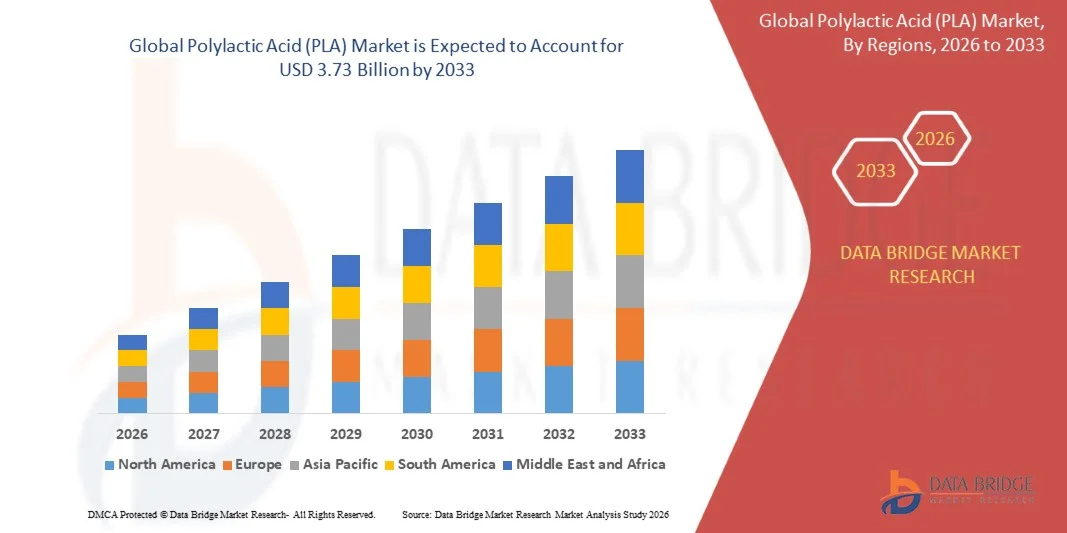
- The global Polylactic Acid (PLA) market size was valued at USD 1.55 billion in 2025 and is expected to reach USD 3.73 billion by 2033, at a CAGR of 11.6% during the forecast period
- The market growth is largely fueled by the increasing demand for sustainable and biodegradable materials, driven by rising environmental concerns and regulatory restrictions on conventional plastics across packaging, agriculture, and consumer goods sectors
- Furthermore, growing consumer preference for eco-friendly products and advancements in bio-based polymer technologies are positioning polylactic acid as a viable alternative to petroleum-based plastics, thereby accelerating its adoption and significantly boosting market growth
Polylactic Acid (PLA) Market Analysis
- Polylactic acid is a biodegradable thermoplastic derived from renewable resources such as corn starch, sugarcane, and cassava, widely used in packaging, textiles, agriculture films, and 3D printing applications due to its compostability and low environmental impact
- The rising demand for Polylactic Acid (PLA) is primarily driven by stringent environmental regulations, increasing focus on circular economy practices, and expanding applications in packaging and biomedical sectors, supported by continuous innovations in material performance and production efficiency
- North America dominated the Polylactic Acid (PLA) market with a share of 41.8% in 2025, due to strong regulatory support for biodegradable plastics and increasing demand for sustainable materials across packaging and consumer goods industries
- Asia-Pacific is expected to be the fastest growing region in the Polylactic Acid (PLA) market during the forecast period due to rapid industrialization, increasing environmental awareness, and rising demand for sustainable materials
- Corn segment dominated the market with a market share of 63.2% in 2025, due to its abundant availability and established infrastructure for starch extraction and fermentation. Corn-based Polylactic Acid (PLA) production benefits from mature agricultural supply chains, particularly in regions with large-scale corn cultivation. The cost efficiency and high yield of fermentable sugars from corn make it a preferred feedstock for manufacturers
Report Scope and Polylactic Acid (PLA) Market Segmentation
|
Attributes |
Polylactic Acid (PLA) Key Market Insights |
|
Segments Covered |
|
|
Countries Covered |
North America
Europe
Asia-Pacific
Middle East and Africa
South America
|
|
Key Market Players |
|
|
Market Opportunities |
|
|
Value Added Data Infosets |
In addition to the insights on market scenarios such as market value, growth rate, segmentation, geographical coverage, and major players, the market reports curated by the Data Bridge Market Research also include import export analysis, production capacity overview, production consumption analysis, price trend analysis, climate change scenario, supply chain analysis, value chain analysis, raw material/consumables overview, vendor selection criteria, PESTLE Analysis, Porter Analysis, and regulatory framework. |
Polylactic Acid (PLA) Market Trends
“Increasing Adoption of Biodegradable Plastics in Packaging Applications”
- A significant trend in the polylactic acid market is the increasing adoption of biodegradable plastics in packaging applications, driven by rising environmental concerns and regulatory pressure to reduce single-use petroleum-based plastics across global markets. This shift is strengthening the position of Polylactic Acid (PLA) as a preferred material for sustainable packaging solutions in food, beverage, and consumer goods industries
- For instance, NatureWorks LLC produces Ingeo Polylactic Acid (PLA) biopolymer that is widely used by packaging manufacturers for compostable food containers and flexible packaging formats. These materials support brand owners in meeting sustainability targets while reducing carbon footprint associated with conventional plastics
- The demand for compostable packaging materials is rising rapidly as governments implement bans and restrictions on single-use plastics, encouraging industries to transition toward renewable alternatives. This is accelerating the integration of Polylactic Acid (PLA) into rigid and flexible packaging formats across multiple end-use sectors
- Food and beverage companies are increasingly adopting Polylactic Acid (PLA) -based packaging solutions to align with consumer expectations for environmentally responsible products. This is contributing to wider commercialization of Polylactic Acid (PLA) in disposable cutlery, cups, and food trays
- Retail and e-commerce sectors are expanding the use of biodegradable packaging materials to enhance sustainability credentials and reduce environmental impact of packaging waste. This is creating strong demand for Polylactic Acid (PLA) films and containers that offer both performance and eco-friendly properties
- The growing emphasis on circular economy practices and sustainable material innovation is reinforcing the long-term adoption of Polylactic Acid (PLA) in packaging applications. This trend is expected to continue shaping the market by promoting wider usage of biodegradable polymers across industries
Polylactic Acid (PLA) Market Dynamics
Driver
“Rising Demand for Sustainable and Bio-Based Materials”
- The increasing global focus on sustainability and reduction of carbon emissions is driving demand for bio-based materials such as polylactic acid derived from renewable resources. Industries are actively shifting toward alternatives that reduce dependency on fossil fuels and support environmentally responsible production systems
- For instance, TotalEnergies Corbion develops Luminy Polylactic Acid (PLA) resins that are used in packaging, textiles, and consumer goods to replace traditional plastics. These materials help manufacturers lower greenhouse gas emissions and align with regulatory and corporate sustainability goals
- The growing awareness among consumers regarding environmental impact of plastic waste is encouraging companies to adopt biodegradable materials in product design and packaging. This is accelerating the commercialization of Polylactic Acid (PLA) across diverse applications
- Government regulations promoting the use of compostable and bio-based plastics are further strengthening market demand by creating favorable policy frameworks. These regulations are supporting investments in Polylactic Acid (PLA) production capacity and innovation
- The continuous push toward sustainable material adoption across industries is reinforcing the growth trajectory of the Polylactic Acid (PLA) market. This driver remains a critical factor shaping long-term expansion and innovation within the industry
Restraint/Challenge
“Limited Heat Resistance and Performance Constraints of PLA”
- The polylactic acid market faces challenges due to its limited heat resistance and mechanical performance compared to traditional petroleum-based plastics, restricting its application in high-temperature and demanding environments. These limitations affect its adoption in sectors requiring durability and thermal stability
- For instance, BASF SE has focused on developing modified biopolymers and blends to enhance the performance characteristics of biodegradable plastics including Polylactic Acid (PLA). Despite such efforts, achieving performance parity with conventional plastics remains a significant technical challenge
- Polylactic Acid (PLA) materials tend to deform under high temperatures, which limits their use in applications such as hot beverage containers and automotive components. This constraint reduces their versatility across certain industrial segments
- The brittleness of Polylactic Acid (PLA) compared to other plastics can impact product durability and lifespan, particularly in applications requiring flexibility and impact resistance. This necessitates blending with other materials, increasing production complexity
- The need to balance sustainability benefits with performance improvements continues to pose a major challenge for the Polylactic Acid (PLA) market. Addressing these limitations is essential for expanding its application scope and ensuring broader industry adoption
Polylactic Acid (PLA) Market Scope
The market is segmented on the basis of type, raw material, form, application, end-user, and grade.
•By Type
On the basis of type, the Polylactic Acid (PLA) market is segmented into Racemic PLLA (Poly-L-Lactic Acid), Regular PLLA (Poly-L-Lactic Acid), PDLA (Poly-D-Lactic Acid), and PDLLA (Poly-DL-Lactic Acid). The Regular PLLA segment dominated the largest market revenue share in 2025, driven by its widespread commercial use and well-established processing characteristics across multiple industries. Regular PLLA offers balanced mechanical strength, biodegradability, and thermal properties, making it suitable for packaging, textiles, and consumer goods applications. Its compatibility with conventional plastic processing technologies has further supported its adoption at scale. In addition, the availability of cost-effective production processes and strong supply chains contributes to its leading position in the market. The segment continues to benefit from growing demand for sustainable alternatives to petroleum-based plastics.
The PDLA segment is anticipated to witness the fastest growth rate from 2026 to 2033, fueled by its superior thermal resistance and ability to enhance the crystallinity of PLA blends. PDLA is increasingly used in high-performance applications where improved heat stability is required, such as in automotive components and advanced packaging. Its role in forming stereocomplex PLA with enhanced mechanical properties further strengthens its demand outlook. Rising research and development activities aimed at improving PLA performance are also supporting segment growth. The increasing focus on expanding PLA applications beyond traditional uses is accelerating the adoption of PDLA.
•By Raw Material
On the basis of raw material, the Polylactic Acid (PLA) market is segmented into Corn, Cassava, Sugarcane, Sugar Beet, and Others. The Corn segment dominated the largest market revenue share of 63.2% in 2025, driven by its abundant availability and established infrastructure for starch extraction and fermentation. Corn-based PLA production benefits from mature agricultural supply chains, particularly in regions with large-scale corn cultivation. The cost efficiency and high yield of fermentable sugars from corn make it a preferred feedstock for manufacturers. In addition, technological advancements in corn processing have improved production efficiency and scalability. The segment continues to lead due to its strong integration with existing bioplastic manufacturing ecosystems.
The Sugarcane segment is expected to witness the fastest growth rate from 2026 to 2033, driven by its higher sugar content and lower environmental footprint compared to conventional feedstocks. Sugarcane enables more efficient fermentation processes, resulting in reduced energy consumption and greenhouse gas emissions. Growing emphasis on sustainable sourcing and carbon reduction is accelerating its adoption in PLA production. In addition, expanding sugarcane cultivation in emerging economies supports raw material availability. The shift toward renewable and eco-friendly inputs is strengthening the growth trajectory of this segment.
•By Form
On the basis of form, the Polylactic Acid (PLA) market is segmented into Films and Sheets, Coatings, Fiber, and Others. The Films and Sheets segment dominated the largest market revenue share in 2025, driven by its extensive use in packaging applications such as food wrapping, containers, and disposable products. PLA films offer transparency, compostability, and good barrier properties, making them suitable for sustainable packaging solutions. Increasing regulatory pressure to reduce single-use plastics has further accelerated their adoption. Manufacturers are also focusing on improving film strength and flexibility to enhance usability. The segment continues to expand with rising demand for eco-friendly packaging materials across industries.
The Fiber segment is anticipated to witness the fastest growth rate from 2026 to 2033, fueled by increasing demand in textile and nonwoven applications. PLA fibers are biodegradable, lightweight, and exhibit moisture-wicking properties, making them suitable for apparel and hygiene products. The shift toward sustainable textiles is encouraging manufacturers to adopt PLA-based fibers. In addition, innovations in fiber processing technologies are enhancing product performance and durability. Growing consumer awareness regarding environmentally responsible clothing is further supporting segment growth.
•By Application
On the basis of application, the Polylactic Acid (PLA) market is segmented into Packaging, Transport, Agriculture, Medical, Electronics, Textile, Hygiene, and Others. The Packaging segment dominated the largest market revenue share in 2025, driven by the widespread adoption of biodegradable materials in food and consumer goods packaging. PLA is extensively used for containers, films, and disposable packaging due to its compostability and regulatory compliance. Increasing restrictions on plastic waste and rising consumer preference for sustainable products are key factors driving demand. Manufacturers are also focusing on improving PLA’s barrier properties to expand its application scope. The segment remains a primary contributor to overall market growth.
The Medical segment is expected to witness the fastest growth rate from 2026 to 2033, driven by increasing use in biodegradable implants, sutures, and drug delivery systems. PLA’s biocompatibility and controlled degradation properties make it highly suitable for medical applications. Advancements in biomedical engineering are expanding its use in tissue engineering and regenerative medicine. In addition, rising healthcare investments and demand for advanced medical materials are supporting growth. The segment is gaining traction as innovation in medical-grade PLA continues to evolve.
•By End User
On the basis of end user, the Polylactic Acid (PLA) market is segmented into Plastic Films, Bottles, and Biodegradable Medical Devices. The Plastic Films segment dominated the largest market revenue share in 2025, driven by high demand from the packaging industry for sustainable film materials. PLA-based plastic films are widely used in food packaging, agricultural films, and consumer goods due to their biodegradability and functional properties. Increasing environmental regulations targeting plastic waste have accelerated adoption across industries. The segment also benefits from continuous improvements in film performance and durability. Strong demand from both developed and emerging markets supports its leading position.
The Biodegradable Medical Devices segment is anticipated to witness the fastest growth rate from 2026 to 2033, fueled by increasing adoption of PLA in healthcare applications. PLA is used in implants, fixation devices, and surgical products due to its ability to safely degrade within the body. Rising demand for minimally invasive procedures and advanced biomaterials is driving segment growth. In addition, ongoing research in medical-grade PLA is expanding its application scope. The segment is expected to grow rapidly as healthcare systems prioritize sustainable and biocompatible solutions.
•By Grade
On the basis of grade, the Polylactic Acid (PLA) market is segmented into Thermoforming, Extrusion, Injection Molding, and Blow Molding. The Thermoforming segment dominated the largest market revenue share in 2025, driven by its extensive use in producing packaging trays, containers, and disposable products. Thermoforming-grade PLA offers ease of processing, cost efficiency, and suitability for high-volume production. The growing demand for sustainable food packaging solutions has further strengthened its adoption. Manufacturers are also optimizing thermoforming processes to enhance product quality and reduce waste. The segment continues to lead due to its strong alignment with packaging industry requirements.
The Injection Molding segment is expected to witness the fastest growth rate from 2026 to 2033, driven by increasing use in consumer goods, electronics, and automotive components. Injection molding-grade PLA provides design flexibility and precision, enabling the production of complex shapes and durable products. Rising demand for biodegradable alternatives in durable applications is supporting its adoption. In addition, technological advancements in molding processes are improving material performance and efficiency. The segment is gaining momentum as industries expand the use of PLA beyond traditional packaging applications.
Polylactic Acid (PLA) Market Regional Analysis
- North America dominated the Polylactic Acid (PLA) market with the largest revenue share of 41.8% in 2025, driven by strong regulatory support for biodegradable plastics and increasing demand for sustainable materials across packaging and consumer goods industries
- Industries in the region prioritize environmentally friendly alternatives, with PLA gaining traction due to its compostability and reduced carbon footprint compared to conventional plastics
- The presence of advanced manufacturing infrastructure, high consumer awareness, and favorable government policies promoting bio-based products further supports market growth, establishing PLA as a preferred material across multiple applications
U.S. Polylactic Acid (PLA) Market Insight
The U.S. Polylactic Acid (PLA) market captured the largest revenue share within North America in 2025, fueled by strong demand from the packaging, medical, and textile sectors. Companies are increasingly adopting PLA to meet sustainability targets and regulatory requirements related to plastic waste reduction. The expansion of bio-refineries and continuous advancements in PLA production technologies are enhancing supply capabilities. Moreover, the growing preference for compostable packaging solutions and increasing investments in circular economy initiatives are further driving market expansion in the country.
Europe Polylactic Acid (PLA) Market Insight
The Europe Polylactic Acid (PLA) market is projected to expand at a substantial CAGR throughout the forecast period, primarily driven by strict environmental regulations and bans on single-use plastics. The region has a strong focus on sustainability, encouraging industries to shift toward biodegradable and bio-based materials such as PLA. Rising adoption across packaging, agriculture, and textile industries, combined with increasing consumer preference for eco-friendly products, is supporting steady market growth across European countries.
U.K. Polylactic Acid (PLA) Market Insight
The U.K. Polylactic Acid (PLA) market is anticipated to grow at a noteworthy CAGR during the forecast period, driven by increasing regulatory pressure to reduce plastic waste and promote sustainable alternatives. Businesses are actively transitioning toward biodegradable materials to align with national sustainability goals and environmental standards. The growth of the food packaging and retail sectors, along with rising awareness among consumers regarding eco-friendly products, is expected to support continued market expansion.
Germany Polylactic Acid (PLA) Market Insight
The Germany Polylactic Acid (PLA) market is expected to expand at a considerable CAGR during the forecast period, fueled by strong industrial demand and emphasis on sustainable manufacturing practices. Germany’s advanced industrial base and focus on innovation are encouraging the adoption of PLA in automotive, packaging, and consumer goods sectors. The country’s commitment to circular economy principles and environmentally responsible production is further promoting the integration of PLA into various applications.
Asia-Pacific Polylactic Acid (PLA) Market Insight
The Asia-Pacific Polylactic Acid (PLA) market is poised to grow at the fastest CAGR during the forecast period of 2026 to 2033, driven by rapid industrialization, increasing environmental awareness, and rising demand for sustainable materials. The region benefits from abundant availability of raw materials such as corn and sugarcane, supporting large-scale PLA production. Growing packaging, textile, and agricultural industries, along with supportive government initiatives promoting biodegradable plastics, are accelerating market growth across key countries.
Japan Polylactic Acid (PLA) Market Insight
The Japan Polylactic Acid (PLA) market is gaining momentum due to strong environmental policies and increasing adoption of biodegradable materials in packaging and consumer products. The country emphasizes innovation and high-quality materials, encouraging the use of PLA in advanced applications such as electronics and medical devices. The integration of sustainable materials into manufacturing processes, along with rising consumer awareness, is driving steady growth in the Japanese market.
China Polylactic Acid (PLA) Market Insight
The China Polylactic Acid (PLA) market accounted for the largest market revenue share in Asia Pacific in 2025, attributed to large-scale manufacturing capabilities and increasing government support for biodegradable plastics. China’s expanding packaging and consumer goods industries are driving strong demand for PLA-based products. The presence of major domestic producers, combined with favorable policies promoting eco-friendly materials and rapid industrial growth, continues to propel the PLA market in the country.
Polylactic Acid (PLA) Market Share
The Polylactic Acid (PLA) industry is primarily led by well-established companies, including:
- BASF SE (Germany)
- Futerro (Belgium)
- NatureWorks LLC (U.S.)
- TotalEnergies Corbion (Netherlands)
- Sulzer Ltd (Switzerland)
- Mitsubishi Chemical Corporation (Japan)
- TORAY INDUSTRIES, INC. (Japan)
- Merck KGaA (Germany)
- Musashino Chemical Laboratory, Ltd. (Japan)
- Evonik Industries AG (Germany)
- UNITIKA LTD. (Japan)
- Shanghai Tong-jie-liang Biomaterials Co., Ltd. (China)
- Zhejiang Hisun Biomaterials Co., Ltd. (China)
- Radici Partecipazioni SpA (Italy)
Latest Developments in Global Polylactic Acid (PLA) Market
- In February 2026, NatureWorks LLC announced capacity expansion initiatives for its Ingeo PLA production facilities in Asia-Pacific, aimed at addressing the rapidly increasing global demand for sustainable and bio-based plastics. This move is expected to improve regional supply chain efficiency, reduce reliance on imports, and lower production lead times for manufacturers. The expansion also supports large-scale adoption of PLA across packaging, textiles, and consumer goods sectors by ensuring consistent material availability. In addition, enhanced production capacity strengthens the company’s competitive positioning while contributing to overall market growth and price stabilization
- In April 2025, TotalEnergies Corbion entered into a strategic partnership with USEON to develop and commercialize EPLA molded products focused on high-performance foam applications. This collaboration enables the development of advanced PLA materials with improved mechanical strength and thermal resistance, expanding their usability in demanding applications such as protective packaging and insulation. The joint effort also accelerates commercialization timelines through combined technical expertise and global distribution networks. As a result, the partnership strengthens innovation within the PLA market and supports its transition into higher-value application segments
- In August 2024, TotalEnergies Corbion appointed Nagase & Co., Ltd. as its distributor for Luminy PLA in Japan, enhancing regional market access for compostable packaging solutions. This strategic move improves supply chain reach and enables faster delivery of PLA products to converters and brand owners in the Japanese market. It also supports the growing demand for low-carbon and sustainable packaging materials driven by regulatory frameworks and consumer awareness. The partnership strengthens local presence and facilitates deeper market penetration, contributing to sustained growth in the Asia-Pacific region
- In April 2023, NatureWorks LLC collaborated with Jabil Inc. to introduce a novel Ingeo PLA-based powder for selective laser sintering 3D printing platforms. This development expands PLA’s application into advanced manufacturing by offering a cost-effective alternative to conventional materials such as PA-12. The innovation enhances design flexibility and supports the production of complex geometries while maintaining sustainability advantages. It also opens new revenue streams in additive manufacturing industries, strengthening the diversification and technological advancement of the PLA market
- In November 2020, Total Corbion PLA released a whitepaper outlining preferred end-of-life options for PLA bioplastics, focusing on recycling and composting pathways. This initiative plays a crucial role in educating stakeholders about sustainable disposal methods and improving lifecycle management of PLA products. It also supports the development of circular economy frameworks by highlighting the environmental benefits of proper waste handling. The whitepaper enhances industry transparency and builds confidence among manufacturers and consumers, reinforcing PLA’s positioning as a sustainable alternative to conventional plastics
SKU-

- Interactive Data Analysis Dashboard
- Company Analysis Dashboard for high growth potential opportunities
- Research Analyst Access for customization & queries
- Competitor Analysis with Interactive dashboard
- Latest News, Updates & Trend analysis
- Harness the Power of Benchmark Analysis for Comprehensive Competitor Tracking
Global Polylactic Acid Pla Market, Supply Chain Analysis and Ecosystem Framework
To support market growth and help clients navigate the impact of geopolitical shifts, DBMR has integrated in-depth supply chain analysis into its Global Polylactic Acid Pla Market research reports. This addition empowers clients to respond effectively to global changes affecting their industries. The supply chain analysis section includes detailed insights such as Global Polylactic Acid Pla Market consumption and production by country, price trend analysis, the impact of tariffs and geopolitical developments, and import and export trends by country and HSN code. It also highlights major suppliers with data on production capacity and company profiles, as well as key importers and exporters. In addition to research, DBMR offers specialized supply chain consulting services backed by over a decade of experience, providing solutions like supplier discovery, supplier risk assessment, price trend analysis, impact evaluation of inflation and trade route changes, and comprehensive market trend analysis.
Data collection and base year analysis are done using data collection modules with large sample sizes. The stage includes obtaining market information or related data through various sources and strategies. It includes examining and planning all the data acquired from the past in advance. It likewise envelops the examination of information inconsistencies seen across different information sources. The market data is analysed and estimated using market statistical and coherent models. Also, market share analysis and key trend analysis are the major success factors in the market report. To know more, please request an analyst call or drop down your inquiry.
The key research methodology used by DBMR research team is data triangulation which involves data mining, analysis of the impact of data variables on the market and primary (industry expert) validation. Data models include Vendor Positioning Grid, Market Time Line Analysis, Market Overview and Guide, Company Positioning Grid, Patent Analysis, Pricing Analysis, Company Market Share Analysis, Standards of Measurement, Global versus Regional and Vendor Share Analysis. To know more about the research methodology, drop in an inquiry to speak to our industry experts.
Data Bridge Market Research is a leader in advanced formative research. We take pride in servicing our existing and new customers with data and analysis that match and suits their goal. The report can be customized to include price trend analysis of target brands understanding the market for additional countries (ask for the list of countries), clinical trial results data, literature review, refurbished market and product base analysis. Market analysis of target competitors can be analyzed from technology-based analysis to market portfolio strategies. We can add as many competitors that you require data about in the format and data style you are looking for. Our team of analysts can also provide you data in crude raw excel files pivot tables (Fact book) or can assist you in creating presentations from the data sets available in the report.












