



Global Primary Cells Market Segmentation, By Type (Human Primary Cells, Animal Primary Cells, and Others), Origin (Hematopoietic Cells, Skin Cells, Gastrointestinal Cells, Liver Cells, Lung Cells, Renal Cells, Heart Cells, Skeletal and Muscle Cells Dermatocytes, and Other Primary Cells), End User (Life Science Research Companies, and Research Institutes)- Industry Trends and Forecast to 2033
Was ist die Primärzellen Marktgröße und Wachstum Rate
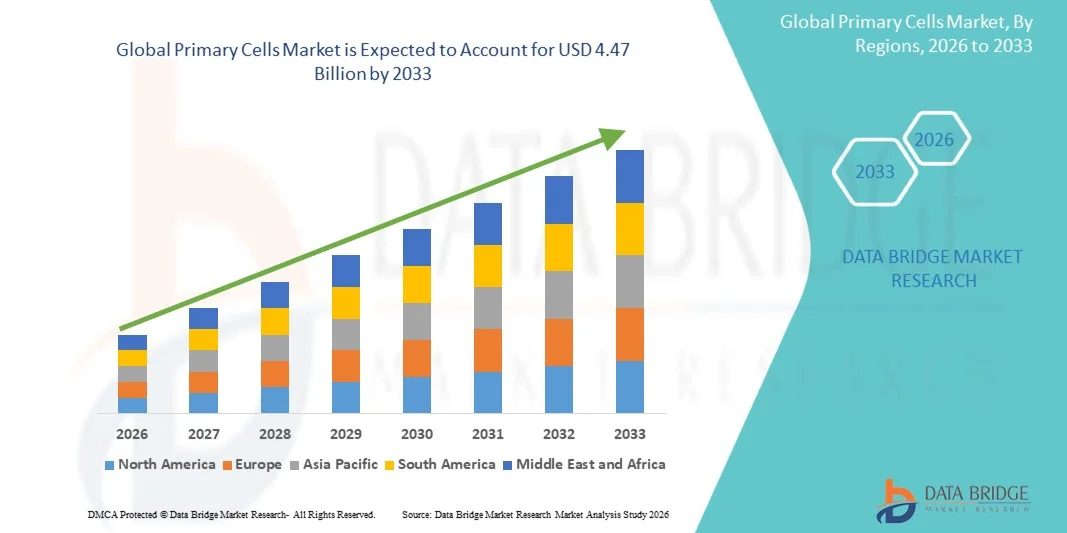
- Wie pro Data Bridge Market Research Analysis wurde die globale Primärzellenmarktgröße bewertet1,90 Mrd. USD im Jahr 2025und wird voraussichtlich erreichen4,47 Milliarden USD bis 2033, beiCAGR von 11.30%während des Prognosezeitraums
- Das Marktwachstum wird in erster Linie von der wachsenden Nachfrage nach tragbaren elektronischen Geräten, einschließlich Fernbedienungen, angetrieben.medizinische Geräte, und tragbare Technologie, die stark auf zuverlässige und langlebige Primärzellen vertrauen
- Die zunehmende Übernahme von energieeffizienten und wartungsarmen Stromquellen in verschiedenen Industrie- und Verbraucheranwendungen treibt zudem die Nachfrage nach Primärzellen an. Diese kombinierten Faktoren fördern die weitverbreitete Nutzung und technologische Weiterentwicklung und fördern damit das Wachstum des Marktes
Marktgröße und Prognose
- Globaler Marktwert (2025):1,90 Mrd. USD
- Voraussichtlicher Marktwert (2033):4,47 Milliarden USD
- Wettervorhersage CAGR (2026–2033):11.30%
Primärzellen Marktanalyse
- Primärzellen, die eine nicht wiederaufladbare Leistung für eine breite Palette von Geräten bieten, sind aufgrund ihrer Zuverlässigkeit, langen Haltbarkeit und geringen Wartungsanforderungen in der modernen Unterhaltungselektronik, Medizinprodukten und industriellen Anwendungen immer wichtiger.
- Die wachsende Nachfrage nach Primärzellen wird weitgehend durch die Verbreitung tragbarer elektronischer Geräte, steigender Bedarf an Backup- und Notstromlösungen und die Vorliebe für kompakte, energiedichte Stromquellen in fernen oder außerbetriebenen Anwendungen getrieben.
- Nordamerika dominierte den Primärzellenmarkt mit dem größten Umsatzanteil von 40,2% im Jahr 2025, gekennzeichnet durch die frühe Annahme fortschrittlicher Elektronik, hohen Verbrauch von medizinischen und industriellen Geräten, und eine starke Präsenz von Schlüssel-Industrie-Spielern, wobei die USA sowohl in der Produktion als auch in der Übernahme von Primärzellen in den Bereichen Verbraucher, Medizin und Industrie führen
- Asia-Pacific wird erwartet, dass die am schnellsten wachsende Region im Primärzellenmarkt während der Prognoseperiode aufgrund der zunehmenden Urbanisierung, steigenden Einwegerträgen und des Ausbaus von Unterhaltungselektronik und Industriesektoren
- Das Segment Human-Primärzellen dominierte den Markt mit einem Anteil von 46,5% im Jahr 2025, angetrieben durch ihren weit verbreiteten Einsatz in der Life Science-Forschung, der Medikamentenentdeckung und der regenerativen Medizin Anwendungen
Report Scope und Primärzellenmarktsegmentierung
|
Attribute |
Primäre Zellen Hauptmarkt Einblicke |
|
Verdeckte Segmente |
|
|
Überarbeitete Länder |
Nordamerika
Europa
Asien-Pazifik
Naher Osten und Afrika
Südamerika
|
|
Key Market Players |
|
|
Marktmöglichkeiten |
|
|
Daten Infos zum Wert hinzugefügt |
Neben den Erkenntnissen über Marktszenarien wie Marktwert, Wachstumsrate, Segmentierung, geographische Erfassung und wichtige Akteure umfassen die Marktberichte, die von der Data Bridge Market Research kuratiert werden, auch eingehende Expertenanalysen, Patientenepidemiologie, Pipelineanalyse, Preisanalyse und regulatorische Rahmenbedingungen. |
Was ist der Haupttrend im Primärzellenmarkt
„Erhöhter Fokus auf menschliche Primärzellen für fortgeschrittene Forschung“
- Ein bemerkenswerter Trend im globalen Primärzellenmarkt ist der wachsende Schwerpunkt auf humanen Primärzellen für Anwendungen inRegenerative Medizin, medikamentöse Entdeckung und personalisierte Therapien, die von ihrer Fähigkeit, in vivo Bedingungen eng imitieren
- Zum Beispiel werden menschliche Leber und hämatopoietische Zellen zunehmend in präklinischen Studien verwendet, um die Drogentoxizität und Wirksamkeit zu bewerten, was genauere Einblicke als herkömmliche Zelllinien bietet.
- Fortschritte in der Zellisolations- und Konservierungstechnologien ermöglichen eine längere Haltbarkeit und eine höhere Rentabilität von Primärzellen, unterstützen komplexe experimentelle Designs und wiederholte Tests
- Integration von Primärzellen mit3D KulturSysteme, Organ-on-a-Chip-Plattformen und High-Throughput-Screening-Methoden verbessern ihr Nutzen in der Life Sciences-Forschung, so dass prädiktivere und physiologisch relevante Ergebnisse
- Dieser Trend zu einem anspruchsvolleren und anwendungsspezifischen Einsatz von Primärzellen gestaltet Forschungsmethoden, die Unternehmen wie Lonza und Thermo Fisher Scientific dazu veranlassen, ihre humanen Primärzellenportfolios zu erweitern
- Die wachsende Nachfrage nach qualitativ hochwertigen, authentifizierten menschlichen Primärzellen steigt rapide in den Bereichen Pharma, Biotech und akademische Forschung, da Wissenschaftler zuverlässigere und Translationsmodelle suchen
- Das wachsende Interesse an genetisch veränderten Primärzellen für gezielte Forschungs- und therapeutische Anwendungen treibt Innovation und spezialisierte Produktentwicklung auf dem Markt
Primärzellen Marktdynamik
Fahrer
„Anforderung von Life Science Research and Pharmaceutical Applications“
- Der zunehmende Einsatz von Primärzellen in der Drogenentdeckung, Toxizitätsprüfung und regenerativer Medizin ist ein wichtiger Treiber für das Marktwachstum
- So startete Thermo Fisher Scientific im März 2025 ein erweitertes Portfolio menschlicher Primärzellen, das für 3D-Kultur und Organoidmodelle optimiert wurde, um die Forschungsproduktivität zu beschleunigen.
- Primärzellen liefern physiologisch relevante Modelle, die die experimentelle Genauigkeit verbessern und die Einhaltung von Tierversuchen reduzieren, Forschungsinstitute und Pharmaunternehmen gleichermaßen ansprechen
- Darüber hinaus machen zunehmende Investitionen in die biomedizinische Forschung und die Entwicklung personalisierter Medizin Primärzellen in modernen Labors unverzichtbar
- Die Fähigkeit, menschliche und tierische Primärzellen in vielfältigen Anwendungen zu verwenden, von der Stammzellforschung bis zur Krankheitsmodellierung, erhöht die Adoption über Life Sciences Research Unternehmen und akademische Institutionen
- Steigende Kooperationen zwischen primären Zelllieferanten und Pharmaunternehmen, um maßgeschneiderte Lösungen für die Drogentests bereitzustellen, beschleunigen das Marktwachstum
- Technologische Fortschritte, die ein hochdurchsatzfähiges Primärzellen-Screening ermöglichen, werden die Adoption weiter vorantreiben und die Marktchancen erweitern
Zurückhaltung/Challenge
„High Cost und Limited Shelf Life Constraints“
- Die relativ hohen Kosten für die Beschaffung, Verarbeitung und Aufrechterhaltung von Primärzellen, verbunden mit ihrer begrenzten Lebensfähigkeit außerhalb der kontrollierten Bedingungen, stellen eine erhebliche Herausforderung für eine breitere Marktakzeptanz dar
- Zum Beispiel benötigen menschliche Hepatozyten und hämatopoietische Zellen oft Kryopräservierung und spezialisierte Handhabung, steigende Betriebskosten für Laboratorien und Forschungseinrichtungen
- Sensibilisierung für Umweltbedingungen, Variabilität von Chargen-zu-Batch und strenge Regulierungsstandards für die Beschaffung von menschlichen und tierischen Zellen können den großtechnischen Einsatz in Forschung und kommerziellen Anwendungen behindern
- Darüber hinaus können logistische Herausforderungen im Zusammenhang mit dem Versand und der Speicherung von lebenden Primärzellen die Zugänglichkeit für kleinere Institutionen oder Schwellenmärkte sicher begrenzen
- Die Überwindung dieser Zwänge durch verbesserte Konservierungsverfahren, standardisierte Qualitätskontrolle und kostengünstige Lösungen ist entscheidend für die Ausweitung der Marktdurchdringung und die Unterstützung der wachsenden globalen Nachfrage nach Primärzellen
- Ethische und regulatorische Komplexitäten, die die Verwendung menschlicher Primärzellen umgeben, können die Zulassungen verlangsamen und die Versorgung für Forschungszwecke begrenzen.
- Die Abhängigkeit von Fachkräften für die ordnungsgemäße Handhabung und Experimentierung führt zu operativen Herausforderungen, insbesondere für kleinere Labore mit eingeschränkter Expertise
Primärzellen Marktbereich
Der Markt wird auf Basis von Art, Herkunft und Endbenutzer segmentiert.
- Typ
Auf Basis des Typs wird der globale Primärzellenmarkt in menschliche Primärzellen, tierische Primärzellen und andere segmentiert. Das Segment der menschlichen Primärzellen dominierte den Markt mit dem größten Umsatzanteil von 46,5% im Jahr 2025, angetrieben durch ihre umfangreiche Verwendung in der regenerativen Medizin, Medikamentenentdeckung und Krankheitsmodellierung. Humane Primärzellen werden von Forschern für ihre physiologische Relevanz bevorzugt, die in vivo-Bedingungen genau nachahmen, was die Genauigkeit der experimentellen Ergebnisse erhöht. Das Segment profitiert auch von technologischen Fortschritten in Isolation, Kryopräservierung und hochlebensfähigen Kulturmethoden, die Konsistenz über Chargen gewährleisten. Pharma- und Biotech-Unternehmen verlassen sich zunehmend auf menschliche Primärzellen für präklinische Tests und beschleunigen den Marktbedarf. Darüber hinaus erhöht die steigende Investition in personalisierte Medizin und Organ-on-Chip-Technologien die Annahme menschlicher Primärzellen. Forschungseinrichtungen bevorzugen diese Zellen auch aufgrund der Breite der Anwendungen bei der Untersuchung organspezifischer Funktionen, Toxizitätstests und therapeutischer Entwicklungen.
Das Tier-Primär-Zellen-Segment wird erwartet, dass das schnellste Wachstum von 2026 bis 2033, die durch den expandierenden Einsatz von Tiermodellen für präklinische Forschung und Translationsstudien. Tier-Primärzellen bieten kostengünstige Alternativen für die Erstabschirmung, Toxizitätsstudien und mechanistische Forschung vor der humanen Zellvalidierung. Ihr Einsatz in der Veterinärforschung und vergleichenden Biologiestudien trägt ebenfalls zum Nachfragewachstum bei. Verbesserungen der Kulturtechniken, der Kryopräservation und der Co-Kultur-Systeme verbessern das Nutzen von tierischen Primärzellen für komplexe Experimente. Unternehmen, die gebrauchsfertige tierische Primärzellen mit standardisierten Protokollen bereitstellen, beobachten eine starke Übernahme zwischen Forschungsinstituten und Pharmalaboren. Das Wachstum des Segments wird durch Kooperationen zwischen Lieferanten und Life Sciences-Unternehmen, die sich auf die Entwicklung von Arzneimitteln und die Modellierung von Krankheiten konzentrieren, weiter beschleunigt.
- Von Ursprung
Auf der Grundlage der Herkunft wird der Markt in hämatopoietische Zellen, Hautzellen, gastrointestinale Zellen, Leberzellen, Lungenzellen, Nierenzellen, Herzzellen, Skelett- und Muskelzellen, Dermatozyten und andere Primärzellen segmentiert. Das Segment hämatopoietische Zellen dominierte den Markt im Jahr 2025 aufgrund ihrer kritischen Rolle in der Stammzellforschung, Immunologiestudien und regenerativen Medizinanwendungen. Hematopoietische Zellen werden in der Entwicklung von Therapien für blutbedingte Erkrankungen, Transplantationsstudien und Immuntherapie-Entwicklung weit verbreitet. Das Segment profitiert von Fortschritten in der Zellisolation, der Expansion und der Kryopräservation, wodurch eine hohe Rentabilität und Funktionalität gewährleistet wird. Pharmazeutische Unternehmen verwenden hämatopoietische Zellen für die Arzneimittel-Screening, Gentherapie-Forschung und Entwicklung von hämatologischen Behandlungen. Forschungseinrichtungen priorisieren auch hämatopoietische Zellen für das Studium der Hämatopoese, Immunantwort und Krankheitsmechanismen. Die steigende Prävalenz von Bluterkrankungen und die Nachfrage nach innovativen Therapielösungen unterstützen die Dominanz des Segments weiter.
Das Segment Hautzellen wird voraussichtlich das schnellste Wachstum von 2026 bis 2033 registrieren, das durch zunehmende Anwendungen in der Dermatologie, kosmetischen Tests, Wundheilstudien und 3D Hautmodellierung angetrieben wird. Hautzellen sind essentiell für die Bewertung topischer Arzneimittelwirkung, Toxizität und regenerativer Therapien. Fortschritte in der Organ-on-Chip- und Gewebe-Engineering-Technologien erweitern den Umfang der Hautzellenforschung. Unternehmen, die prävalidierte, qualitativ hochwertige Hautzellen mit standardisierten Kulturprotokollen anbieten, erleben eine starke Aufnahme von Life Science-Forschungsunternehmen und akademischen Labors. Das wachsende Interesse an personalisierten Hautmodellen und ethischen Alternativen zu Tierversuchen trägt auch zum Marktwachstum bei. Das Segment profitiert von Kooperationen zwischen Zelllieferanten und Forschungseinrichtungen, die sich auf die Entwicklung von kosmetischen und therapeutischen Produkten konzentrieren.
- Mit dem Endbenutzer
Auf der Grundlage des Endverbrauchers wird der Markt in Life Science-Forschungsunternehmen und Forschungsinstitute segmentiert. Das Segment Life-Science-Forschungsunternehmen dominierte den Markt im Jahr 2025, angetrieben von der steigenden Nachfrage nach Primärzellen in der Drogenentdeckung, präklinischen Tests und regenerativen Medizinanwendungen. Diese Unternehmen verlassen sich auf hochwertige menschliche und tierische Primärzellen, um neuartige Therapien zu entwickeln, Arzneimittelformulierungen zu optimieren und mechanistische Studien durchzuführen. Life-Science-Forschungsunternehmen geben häufig Partnerschaften mit primären Zelllieferanten ein, um maßgeschneiderte Lösungen für spezifische Anwendungen zu erhalten, die die Annahme beschleunigen. Das Segment profitiert auch von steigenden Investitionen in biopharmazeutische Forschung, personalisierte Medizin und Translationsstudien. Technologische Fortschritte, wie 3D-Kultursysteme, Co-Kulturmodelle und Organ-on-Chip-Plattformen, treiben die Nachfrage nach Primärzellen weiter. Darüber hinaus priorisieren Life Sciences-Unternehmen menschliche Primärzellen für ihr physiologisches Relevanz- und Translationspotenzial und unterstützen Marktherrschaft.
Das Forschungsinstitute-Segment wird durch den wachsenden Fokus auf akademische Forschung, Stammzellstudien und Krankheitsmodellierung von 2026 bis 2033 das schnellste Wachstum beobachten. Forschungsinstitute benötigen oft eine Vielzahl von Primärzellen, darunter menschliche, tierische und organspezifische Zellen, zur Durchführung von explorativen und Translationsstudien. Die Annahme fortschrittlicher Kultursysteme, Hochdurchsatz-Screening und Organoid-Modelle in akademischen Laboren ist die Nachfrage. Eine verstärkte Förderung der biomedizinischen Forschung, der Zusammenarbeit mit Pharmaunternehmen und der Betonung ethischer Alternativen zu Tierversuchen tragen zum Marktwachstum bei. Für Forschungsinstitute, die wissenschaftliche Entdeckungen beschleunigen wollen, sind gebrauchsfertige, hochwertige Primärzellen mit gleichbleibender Leistung besonders attraktiv.
Primärzellen Markt Regionale Analyse
- Nordamerika dominierte den primären Zellenmarkt mit dem größten Umsatzanteil von 40,2% im Jahr 2025, gekennzeichnet durch die frühe Annahme fortschrittlicher Elektronik, hohen Verbrauch von medizinischen und industriellen Geräten, und eine starke Präsenz der wichtigsten Branchenspieler
- Forscher und Unternehmen in der Region verlassen sich zunehmend auf hochwertige menschliche und tierische Primärzellen für die Drogenentdeckung, präklinische Tests, regenerative Medizin und Krankheitsmodellierung Anwendungen
- Diese weit verbreitete Adoption wird durch fortgeschrittene Laborinfrastruktur, robuste Finanzierung für biomedizinische Forschung und einen starken Fokus auf personalisierte Medizin und Translationsstudien unterstützt, die primäre Zellen als kritische Ressource für akademische und kommerzielle Forschung
US Primärzellenmarkt Insight
Der US-Primärzellenmarkt erfasste den größten Umsatzanteil von 81 % im Jahr 2025 in Nordamerika, der durch die Präsenz führender Pharma-, Biotechnologie- und Life Science-Forschungsunternehmen getrieben wurde. Forscher priorisieren zunehmend hochwertige menschliche und tierische Primärzellen für die Drogenentdeckung, präklinische Tests und regenerative Medizinanwendungen. Der wachsende Fokus auf personalisierte Medizin und Organ-on-Chip-Technologien stärkt die Marktnachfrage. Darüber hinaus verfügt die US über eine etablierte Laborinfrastruktur und eine robuste Finanzierung für biomedizinische Forschung, wodurch eine weit verbreitete Annahme erleichtert wird. Auch die Zusammenarbeit zwischen primären Zelllieferanten und Life Sciences-Unternehmen tragen maßgeblich zur Markterweiterung bei.
Europa Primärzellenmarkt Einblick
Der europäische Primärzellenmarkt wird in der gesamten Vorausschätzungsperiode auf einem beträchtlichen CAGR-Markt ausbauen, der vor allem durch Investitionen in die biomedizinische Forschung und strenge Regulierungsstandards für die Qualität und ethische Beschaffung von Zellen getrieben wird. Die steigende Nachfrage nach menschlichen und tierischen Primärzellen in der Drogenentwicklung, in der Krankheitsmodellierung und in der Stammzellforschung fördert die Adoption in der gesamten Region. Europäische Forschungseinrichtungen und Pharmaunternehmen nutzen primäre Zellen für Translations- und Regenerative Medizinstudien. Darüber hinaus erhöhen die zunehmende Urbanisierung und technologische Fortschritte in Laboranlagen die Forschungseffizienz. Die Integration von Primärzellen in fortgeschrittene Kultursysteme, Organoidmodelle und Hochdurchsatz-Screening unterstützt das Marktwachstum weiter.
US Primärzellenmarkt Insight
Der US-Primärzellenmarkt wird voraussichtlich während der Prognosezeit mit einem bemerkenswerten CAGR wachsen, der durch den steigenden Trend der biomedizinischen Forschung und den Fokus auf regenerative Medizin getrieben wird. Was die Genauigkeit der Krankheitsmodellierung und die Notwendigkeit physiologisch relevanter Modelle betrifft, sind die Ermutigung von Forschungsinstituten und Life Sciences-Unternehmen, menschliche und tierische Primärzellen zu übernehmen. Das starke akademische und pharmazeutische Ökosystem der USA, kombiniert mit kollaborativen Forschungsinitiativen, wird weiterhin das Marktwachstum fördern. Darüber hinaus fördern fortgeschrittene Laborinfrastrukturen und staatliche Unterstützung für Innovation die breitere Übernahme von Primärzellen für die Drogenentdeckung und Translationsstudien.
Deutschland Primärzellenmarkt Einblick
Der deutsche Primärzellenmarkt soll sich während des Prognosezeitraums mit einem beträchtlichen CAGR ausweiten, der durch den Schwerpunkt technologischer Innovation und hochwertiger biomedizinischer Forschung gefördert wird. Die gut ausgebaute Infrastruktur, qualifizierte Arbeitskräfte und der Fokus auf nachhaltige und ethische Beschaffung unterstützen die Einführung von Primärzellen in Forschungsanwendungen. Pharmazeutische und akademische Forschungssektoren nutzen zunehmend Primärzellen für Krankheitsmodellierung, Stammzellenstudien und präklinische Tests. Darüber hinaus wird die Integration mit fortschrittlichen Forschungsplattformen wie 3D-Kulturen, Co-Kultursystemen und Organ-on-Chip-Technologien immer häufiger. Es besteht auch eine starke Nachfrage nach menschlichen Primärzellen in der Translationsmedizin und der personalisierten Therapieforschung.
Asien-Pazifik Primärzellen Markt Insight
Der asiatisch-pazifische Primärzellenmarkt wird während der Prognosezeit von 2026 bis 2033 mit dem schnellsten CAGR von 24% wachsen, der durch die zunehmende biomedizinische Forschung, Urbanisierung und technologische Fortschritte in Ländern wie China, Japan und Indien angetrieben wird. Die Region erlebt eine rasche Expansion von Life-Science-Forschungsunternehmen und Forschungsinstituten, die in Primärzellen für die Drogenentdeckung, Stammzellenforschung und Krankheitsmodellierung investieren. Die staatlichen Initiativen zur Förderung der Biotechnologie und Innovation beschleunigen die Marktakzeptanz. Darüber hinaus erhöht die wachsende Verfügbarkeit von kostengünstigen Primärzellen und einheimischen Lieferanten die Zugänglichkeit in den Forschungseinrichtungen. Die Zusammenarbeit zwischen globalen Lieferanten und lokalen Forschungszentren treibt das Wachstum in APAC weiter voran.
Japan Primärzellenmarkt Einblick
Der Japan-Primärzellenmarkt gewinnt an Dynamik aufgrund des hohen Fokus des Landes auf fortgeschrittene biomedizinische Forschung, technologische Innovation und Nachfrage nach physiologisch relevanten Zellmodellen. Die Annahme menschlicher und tierischer Primärzellen wird durch Drogenentdeckung, regenerative Medizin und Organ-on-Chip-Anwendungen angetrieben. Die Integration mit fortschrittlichen Forschungsplattformen und Hochdurchsatz-Screening-Systemen fördert das Wachstum. Darüber hinaus dürfte die alternde Bevölkerung Japans die Forschungsnachfrage nach Therapien erhöhen, die auf altersbedingte Krankheiten abzielen und die Verwendung von Primärzellen steigern. Die Präsenz etablierter Life Sciences-Unternehmen und Forschungskooperationen unterstützt Markterweiterung in akademischen und kommerziellen Bereichen.
Indien Primärzellenmarkt Einblick
Der indische Primärzellenmarkt entfiel 2025 auf den größten Marktanteil im asiatisch-pazifischen Raum, der dem wachsenden Ökosystem der Biotechnologie und Life Sciences, der wachsenden Investitionen in die biomedizinische Forschung und der schnellen technologischen Annahme des Landes zugeschrieben wurde. Indien entwickelt sich als Hub für die pharmazeutische und regenerative Medizinforschung und erhöht die Nachfrage nach qualitativ hochwertigen menschlichen und tierischen Primärzellen. Der Fokus der Regierung auf Biotechnologie, intelligente Labors und die Zusammenarbeit mit globalen Lieferanten sind wichtige Faktoren, die den Markt fördern. Darüber hinaus unterstützt die Verfügbarkeit von kostengünstigen Primärzellenlösungen und eine starke Inlandsproduktion eine weit verbreitete Adoption in akademischen, kommerziellen und klinischen Forschungsanwendungen.
Primäre Zellen Marktanteil
Die Primärzellenindustrie wird in erster Linie von etablierten Unternehmen geleitet, darunter:
- Thermo Fisher Scientific Inc.(US)
- Lonza(Schweiz)
- STEMCELL Technologies Inc. (Kanada)
- PromoCell GmbH (Deutschland)
- Zellbiologik Inc(US)
- American Type Culture Collection (US)
- Axol Bioscience Ltd (U.K.)
- ZenBio Inc(US)
- AllCells LLC (USA)
- BioIVT (US)
- ScienCell Research Laboratories Inc. (USA)
- Creative Bioarray (USA)
- BPS Bioscience Inc. (USA)
- HemaCare Corporation (USA)
- Cell Applications Inc. (USA)
- Angewandte biologische Materialien Inc. (Kanada)
- Amsbio Ltd (U.K.)
- CellSystems GmbH (Deutschland)
- Epithelix Sarl (Schweiz)
- ReachBio LLC (USA)
Was sind die jüngsten Entwicklungen im globalen Primärzellmarkt
- Im November 2025 hat Tebubio mit Apricell zusammengearbeitet, um den Zugang zu fortgeschrittenen 3D-Zellkulturen und Organoid-Forschungslösungen in ganz Europa zu erweitern, um physiologisch relevantere In-vitro-Modelle für die Drogen- und Krankheitsforschung zu ermöglichen
- Im Juni 2025 kündigte Cellular Origins eine strategische Zusammenarbeit mit Thermo Fisher Scientific an, um die Fertigungsplattform für robotische Zell- und Gen-Therapie mit den Technologien der Zellverarbeitung von Thermo Fisher zu kombinieren, um die industrielle Primärzellennutzung und die fortschrittliche Therapieproduktion zu unterstützen.
- Im April 2025 enthüllte RoosterBio, Inc. eine Zusammenarbeit mit Thermo Fisher Scientific, um die Herstellung von mesenchymalen Stamm-/Stromzellen (hMSCs) und verwandten exosome Therapien zu beschleunigen, die GMP-grade Primärzellversorgung für klinische Studien und regenerative Anwendungen zu verbessern
- Im April 2024 verpflichtete sich Merck, 300 Millionen Euro in ein neues Life Science Advanced Research Center in Darmstadt zu investieren, um Forschungs- und Fertigungsinfrastrukturen zu stärken, die zellbasierte Forschungswerkzeuge und primäre Zellanwendungen unterstützen
- Im Juni 2023 haben iXCells Biotechnologies und Tebubio eine strategische Vertriebspartnerschaft zur Erweiterung der Verfügbarkeit von primären Human-Zellprodukten in ganz Europa und Großbritannien aufgenommen und den Forschungszugang für Labors und Biotech-Unternehmen erweitert.
SKU-
Erhalten Sie Online-Zugriff auf den Bericht zur weltweit ersten Market Intelligence Cloud

- Interaktives Datenanalyse-Dashboard
- Unternehmensanalyse-Dashboard für Chancen mit hohem Wachstumspotenzial
- Zugriff für Research-Analysten für Anpassungen und Abfragen
- Konkurrenzanalyse mit interaktivem Dashboard
- Aktuelle Nachrichten, Updates und Trendanalyse
- Nutzen Sie die Leistungsfähigkeit der Benchmark-Analyse für eine umfassende Konkurrenzverfolgung
Forschungsmethodik
Die Datenerfassung und Basisjahresanalyse werden mithilfe von Datenerfassungsmodulen mit großen Stichprobengrößen durchgeführt. Die Phase umfasst das Erhalten von Marktinformationen oder verwandten Daten aus verschiedenen Quellen und Strategien. Sie umfasst die Prüfung und Planung aller aus der Vergangenheit im Voraus erfassten Daten. Sie umfasst auch die Prüfung von Informationsinkonsistenzen, die in verschiedenen Informationsquellen auftreten. Die Marktdaten werden mithilfe von marktstatistischen und kohärenten Modellen analysiert und geschätzt. Darüber hinaus sind Marktanteilsanalyse und Schlüsseltrendanalyse die wichtigsten Erfolgsfaktoren im Marktbericht. Um mehr zu erfahren, fordern Sie bitte einen Analystenanruf an oder geben Sie Ihre Anfrage ein.
Die wichtigste Forschungsmethodik, die vom DBMR-Forschungsteam verwendet wird, ist die Datentriangulation, die Data Mining, die Analyse der Auswirkungen von Datenvariablen auf den Markt und die primäre (Branchenexperten-)Validierung umfasst. Zu den Datenmodellen gehören ein Lieferantenpositionierungsraster, eine Marktzeitlinienanalyse, ein Marktüberblick und -leitfaden, ein Firmenpositionierungsraster, eine Patentanalyse, eine Preisanalyse, eine Firmenmarktanteilsanalyse, Messstandards, eine globale versus eine regionale und Lieferantenanteilsanalyse. Um mehr über die Forschungsmethodik zu erfahren, senden Sie eine Anfrage an unsere Branchenexperten.
Anpassung möglich
Data Bridge Market Research ist ein führendes Unternehmen in der fortgeschrittenen formativen Forschung. Wir sind stolz darauf, unseren bestehenden und neuen Kunden Daten und Analysen zu bieten, die zu ihren Zielen passen. Der Bericht kann angepasst werden, um Preistrendanalysen von Zielmarken, Marktverständnis für zusätzliche Länder (fordern Sie die Länderliste an), Daten zu klinischen Studienergebnissen, Literaturübersicht, Analysen des Marktes für aufgearbeitete Produkte und Produktbasis einzuschließen. Marktanalysen von Zielkonkurrenten können von technologiebasierten Analysen bis hin zu Marktportfoliostrategien analysiert werden. Wir können so viele Wettbewerber hinzufügen, wie Sie Daten in dem von Ihnen gewünschten Format und Datenstil benötigen. Unser Analystenteam kann Ihnen auch Daten in groben Excel-Rohdateien und Pivot-Tabellen (Fact Book) bereitstellen oder Sie bei der Erstellung von Präsentationen aus den im Bericht verfügbaren Datensätzen unterstützen.











