Global Idiopathic Pulmonary Fibrosis Treatment Market Segmentation, By Drug Class (Tyrosine Inhibitors, MAPK Inhibitors, Autotaxin Inhibitors, Others), Marketed Drugs (Ofev, Esbriet, Pirfenidone, Actimmune, Nintedanib, Interferon Gamma-1b, Others), Medication Type (Generics, Branded), Type (OTC, Prescription), Route of Administration (Oral, Injectable), End-User (Home Healthcare, Hospitals, Clinics, Others), Distribution Channel (Hospital Pharmacy, Retail Pharmacy, Online Pharmacy) - Industry Trends and Forecast to 2032
Idiopathic Pulmonary Fibrosis Treatment Market Size
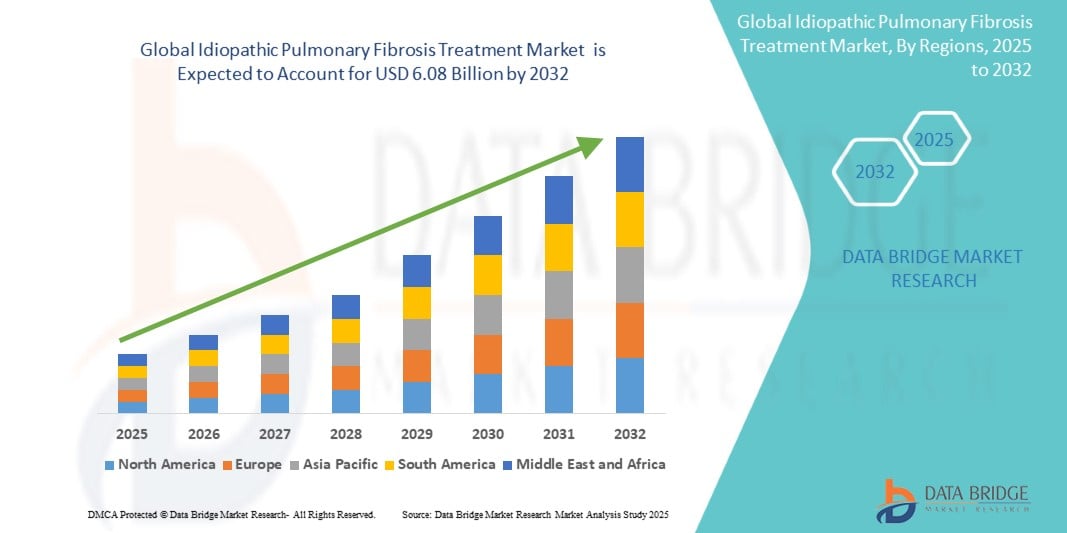
- The Global Idiopathic Pulmonary Fibrosis Treatment Market size was valued at USD 3.12 billion in 2024 and is expected to reach USD 6.08 billion by 2032, at a CAGR of 9.2% during the forecast period
- This growth is driven by factors such as the rising incidence of idiopathic pulmonary fibrosis, an aging global population, and ongoing advancements in diagnostic and therapeutic technologies
Idiopathic Pulmonary Fibrosis Treatment Market Analysis
- Idiopathic pulmonary fibrosis is a chronic, progressive fibrotic interstitial lung disease of unknown cause, characterized by worsening dyspnea and lung function. The increasing incidence of IPF, advancements in diagnostic tools, and growing awareness among physicians and patients are key factors driving the treatment market
- The demand for these microscopes is significantly driven by their disease-modifying potential and regulatory approvals in multiple regions
- North America holds the largest share in the global IPF treatment market, owing to the presence of major pharmaceutical players, favorable reimbursement policies, and strong R&D pipeline
- Asia-Pacific is anticipated to register the highest CAGR due to a growing aging population, increasing diagnostic rates, and improving healthcare infrastructure
- Tyrosine Inhibitors are expected to dominate the market in 2025 with the largest market share of 47.2%, driven by clinical efficacy in slowing disease progression and regulatory support
Report Scope and Idiopathic Pulmonary Fibrosis Treatment Market Segmentation
|
Attributes |
Idiopathic Pulmonary Fibrosis Treatment Key Market Insights |
|
Segments Covered |
|
|
Countries Covered |
North America
Europe
Asia-Pacific
Middle East and Africa
South America
|
|
Key Market Players |
|
|
Market Opportunities |
|
|
Value Added Data Infosets |
In addition to the insights on market scenarios such as market value, growth rate, segmentation, geographical coverage, and major players, the market reports curated by the Data Bridge Market Research also include import export analysis, production capacity overview, production consumption analysis, price trend analysis, climate change scenario, supply chain analysis, value chain analysis, raw material/consumables overview, vendor selection criteria, PESTLE Analysis, Porter Analysis, and regulatory framework. |
Idiopathic Pulmonary Fibrosis Treatment Market Trends
“Rise of Personalized Biologic Therapies and Digital Health Integration”
- The IPF treatment landscape is witnessing a significant transformation with the growing adoption of personalized medicine. Biologic therapies, such as nintedanib (an antifibrotic agent approved for IPF and progressive fibrosing interstitial lung diseases) and tocilizumab (originally used in rheumatoid arthritis and being explored for fibrotic lung diseases), are increasingly tailored based on genetic profiling and patient-specific biomarkers
- Advances in genomic sequencing and transcriptomic analysis are enabling clinicians to identify unique disease subtypes and progression patterns, making it possible to deliver more targeted and effective treatments.
- For Instances, In 2021, nintedanib (Ofev, by Boehringer Ingelheim) was included in multiple studies investigating biomarker-based patient stratification, including the INBUILD trial, which examined its effects across various fibrosing interstitial lung diseases, including IPF.
- Moreover, the integration of digital health technologies, such as wearable devices and remote e-monitoring platforms, is revolutionizing disease management. Devices like Bluetooth-enabled spirometers allow real-time monitoring of lung function, while mobile applications can track medication adherence and symptom progression
Idiopathic Pulmonary Fibrosis Treatment Market Dynamics
Driver
“High Prevalence of IPF and Favorable Regulatory Landscape”
- Idiopathic Pulmonary Fibrosis affects over 5 million individuals globally, and its prevalence continues to rise, particularly among populations aged 60 years and above. The disease’s etiology remains unclear, and it is associated with rapid lung function decline, significantly impairing quality of life and survival.
- This increasing disease burden is pushing governments and regulatory agencies to prioritize IPF therapies. Agencies such as the U.S. FDA, European Medicines Agency (EMA), and PMDA in Japan have granted orphan drug designations and accelerated approval pathways to key treatments like pirfenidone (Esbriet) and nintedanib (Ofev).
- These regulatory incentives lower development costs, shorten time-to-market, and encourage pharmaceutical companies to invest in IPF research.
For instance,
- A 2022 report by the Global Burden of Disease (GBD) estimated over 5 million global IPF cases, with highest incidence in populations aged 60 and older
- As a result of the rising prevalence of idiopathic pulmonary fibrosis—particularly among the aging population there is a significant increase in demand for effective IPF treatments, supported by a favorable regulatory landscape that accelerates the approval and availability of novel antifibrotic therapies
Opportunity
“Emerging Role of Combination Therapies and Companion Diagnostics”
- To overcome the limitations of monotherapy, researchers are exploring combination regimens that integrate antifibrotics, anti-inflammatory agents, and biologics.
- These multidimensional approaches aim to target multiple pathological pathways involved in IPF—such as fibrosis, inflammation, and immune dysregulation.
- At the same time, the use of companion diagnostics is becoming crucial in stratifying patients who are more likely to respond to specific therapies. Tools like gene expression assays, developed by companies like Veracyte, help identify molecular subtypes of IPF and predict treatment responses.
For instance,
- In 2022, the INJOURNEY trial (sponsored by Boehringer Ingelheim) investigated the safety and efficacy of combining nintedanib with pirfenidone, showing tolerability and potential for additive effects in reducing lung function decline
- The integration of companion diagnostics and AI-driven biomarker analysis in IPF care is enabling more precise patient stratification, leading to improved treatment outcomes and optimized therapeutic decisions..
Restraint/Challenge
“High Cost of Treatment and Limited Curative Options”
- Despite the availability of antifibrotic therapies, the high cost of IPF treatment remains a major barrier to access.
- Annual treatment costs for drugs like nintedanib and pirfenidone can exceed $100,000 per patient, placing a heavy burden on healthcare systems and patients, especially in low- and middle-income countries.
- This financial barrier often leads to delayed initiation or premature discontinuation of therapy, negatively impacting patient outcomes.
For instance,
- As of 2024, annual treatment costs for nintedanib and pirfenidone remain between $90,000 and USD 110,000 per patient in the U.S., according to data from GoodRx and the National Institute for Health and Care Excellence (NICE)
- Consequently, the high cost of antifibrotic therapies and the limited availability of curative options such as lung transplantation can lead to significant disparities in access to treatment, particularly in low- and middle-income regions, thereby hindering the overall growth and equity of the global IPF treatment market.
Idiopathic Pulmonary Fibrosis Treatment Market Scope
The market is segmented on the basis application, product type, technology, magnification type, end user, and distribution channel.
|
Segmentation |
Sub-Segmentation |
|
By Drug Class |
|
|
By Marketed Drug |
|
|
By Medication Type |
|
|
By Type
|
|
|
By Route of Administration |
|
|
By End User
|
|
|
By Distribution Channel |
|
In 2025, the Tyrosine Inhibitors is projected to dominate the market with a largest share in drug Class segment
In 2025, the antifibrotic agents segment is projected to dominate with a 47.2% market share due to regulatory approvals, disease-modifying effects, and wide prescription rates of drugs like pirfenidone and nintedanib. The oral route is expected to account for the largest share during the forecast period
The Ofev is expected to account for the largest share during the forecast period in technology market
In 2025, the oral route of administration is anticipated to hold the largest market share of 68.4% due to convenience, better patient adherence, and availability of key antifibrotic therapies in oral form IPF Treatment Market Regional Analysis.
Idiopathic Pulmonary Fibrosis Treatment Market Regional Analysis
“North America Holds the Largest Share in the Idiopathic Pulmonary Fibrosis Treatment Market”
- América del Norte lidera el mercado mundial de tratamiento de la FPI debido a sistemas de reembolso bien establecidos, alta conciencia y la presencia de compañías farmacéuticas líderes.
- Estados Unidos sigue siendo el principal contribuyente debido a las altas tasas de diagnóstico, el acceso a nuevos medicamentos y la fuerte participación en ensayos clínicos.
- La disponibilidad de políticas de reembolso bien establecidas y las crecientes inversiones en investigación y desarrollo por parte de las principales empresas de dispositivos médicos fortalecen aún más el mercado.
- Además, el creciente número de casos de FPI diagnosticados, junto con la creciente adopción de enfoques terapéuticos avanzados, como agentes antifibróticos y técnicas de diagnóstico mínimamente invasivas, está impulsando la expansión del mercado en regiones clave.
Se proyecta que Asia-Pacífico registre la mayor tasa de crecimiento anual compuesta (TCAC) en el mercado del tratamiento de la fibrosis pulmonar idiopática.
- Se espera que Asia-Pacífico crezca a la CAGR más alta, impulsada por el crecimiento de la población de edad avanzada, el creciente reconocimiento de enfermedades y la mejora del acceso a la atención médica.
- Países como China, India y Japón están invirtiendo en programas de detección de FPI y estrategias de intervención temprana.
- Japón, con su avanzada infraestructura sanitaria y su fuerte enfoque en la investigación de enfermedades respiratorias, sigue siendo un mercado crucial para el tratamiento de la FPI. El país continúa liderando la adopción de nuevas terapias antifibróticas y herramientas de diagnóstico de precisión, respaldado por marcos regulatorios favorables y un alto gasto sanitario.
- China e India, con sus grandes poblaciones envejecidas y la creciente incidencia de fibrosis pulmonar idiopática, están experimentando un crecimiento significativo de la inversión pública y privada en atención pulmonar. La creciente presencia de compañías biofarmacéuticas globales, la creciente concienciación sobre la FPI y la mejora del acceso a diagnósticos y tratamientos especializados están impulsando un crecimiento sustancial del mercado en ambos países.
Cuota de mercado del tratamiento de la fibrosis pulmonar idiopática
El panorama competitivo del mercado ofrece detalles por competidor. Se incluye información general de la empresa, sus estados financieros, ingresos generados, potencial de mercado, inversión en investigación y desarrollo, nuevas iniciativas de mercado, presencia global, plantas de producción, capacidad de producción, fortalezas y debilidades de la empresa, lanzamiento de productos, alcance y variedad de productos, y dominio de las aplicaciones. Los datos anteriores se refieren únicamente al enfoque de mercado de las empresas.
Los principales líderes del mercado que operan en el mercado son:
- F. Hoffmann-La Roche Ltd (Suiza)
- Boehringer Ingelheim International GmbH (Alemania)
- GNI Group Ltd. (Japón)
- MediciNova, Inc. (EE. UU.)
- Cipla Inc. (India)
- Bristol-Myers Squibb Company (EE. UU.)
- Galápagos NV (Bélgica)
- United Therapeutics Corporation (EE. UU.)
- FibroGen, Inc. (EE. UU.)
- Veracyte, Inc. (EE. UU.)
Últimos avances en el mercado mundial del tratamiento de la fibrosis pulmonar idiopática
- En septiembre de 2024, Boehringer Ingelheim anunció que su estudio FIBRONEER-IPF de nerandomilast cumplió con éxito su objetivo principal, lo que impulsó los planes para una nueva solicitud de medicamento para el tratamiento de la FPI.
- En mayo de 2024, Ferrer amplió su acuerdo de distribución con United Therapeutics para obtener los derechos mundiales de la solución de inhalación de treprostinil, apuntando a posibles indicaciones para la fibrosis pulmonar idiopática y progresiva.
- En septiembre de 2024, Boehringer Ingelheim anunció que su estudio FIBRONEER-IPF de nerandomilast cumplió con éxito su objetivo principal, lo que impulsó los planes para una nueva solicitud de medicamento para el tratamiento de la FPI.
- En mayo de 2024, Ferrer amplió su acuerdo de distribución con United Therapeutics para obtener los derechos mundiales de la solución de inhalación de treprostinil, apuntando a posibles indicaciones para la fibrosis pulmonar idiopática y progresiva.
SKU-
Obtenga acceso en línea al informe sobre la primera nube de inteligencia de mercado del mundo
- Panel de análisis de datos interactivo
- Panel de análisis de empresas para oportunidades con alto potencial de crecimiento
- Acceso de analista de investigación para personalización y consultas
- Análisis de la competencia con panel interactivo
- Últimas noticias, actualizaciones y análisis de tendencias
- Aproveche el poder del análisis de referencia para un seguimiento integral de la competencia
Metodología de investigación
La recopilación de datos y el análisis del año base se realizan utilizando módulos de recopilación de datos con muestras de gran tamaño. La etapa incluye la obtención de información de mercado o datos relacionados a través de varias fuentes y estrategias. Incluye el examen y la planificación de todos los datos adquiridos del pasado con antelación. Asimismo, abarca el examen de las inconsistencias de información observadas en diferentes fuentes de información. Los datos de mercado se analizan y estiman utilizando modelos estadísticos y coherentes de mercado. Además, el análisis de la participación de mercado y el análisis de tendencias clave son los principales factores de éxito en el informe de mercado. Para obtener más información, solicite una llamada de un analista o envíe su consulta.
La metodología de investigación clave utilizada por el equipo de investigación de DBMR es la triangulación de datos, que implica la extracción de datos, el análisis del impacto de las variables de datos en el mercado y la validación primaria (experto en la industria). Los modelos de datos incluyen cuadrícula de posicionamiento de proveedores, análisis de línea de tiempo de mercado, descripción general y guía del mercado, cuadrícula de posicionamiento de la empresa, análisis de patentes, análisis de precios, análisis de participación de mercado de la empresa, estándares de medición, análisis global versus regional y de participación de proveedores. Para obtener más información sobre la metodología de investigación, envíe una consulta para hablar con nuestros expertos de la industria.
Personalización disponible
Data Bridge Market Research es líder en investigación formativa avanzada. Nos enorgullecemos de brindar servicios a nuestros clientes existentes y nuevos con datos y análisis que coinciden y se adaptan a sus objetivos. El informe se puede personalizar para incluir análisis de tendencias de precios de marcas objetivo, comprensión del mercado de países adicionales (solicite la lista de países), datos de resultados de ensayos clínicos, revisión de literatura, análisis de mercado renovado y base de productos. El análisis de mercado de competidores objetivo se puede analizar desde análisis basados en tecnología hasta estrategias de cartera de mercado. Podemos agregar tantos competidores sobre los que necesite datos en el formato y estilo de datos que esté buscando. Nuestro equipo de analistas también puede proporcionarle datos en archivos de Excel sin procesar, tablas dinámicas (libro de datos) o puede ayudarlo a crear presentaciones a partir de los conjuntos de datos disponibles en el informe.