


Asia-Pacific Hernia Repair Devices (Permanent And Absorbable Hernia Fixation) Market Segmentation, By Type (Inguinal Hernia, Femoral Hernia, Umbilical Hernia, Hiatal (Hiatus) Hernia, Incisional Hernia, Epigastric Hernia, Spigelian Hernia, and Diaphragmatic Hernia), End-User (Hospitals, Specialty Clinics, Ambulatory Centers, and Others), Distribution Channel (Direct Tender and Retail Sales) - Industry Trends and Forecast to 2033
Quelle est la taille du marché et le taux de croissance des appareils de réparation de Hernia en Asie-Pacifique (fixation permanente et absorbante de Hernia)
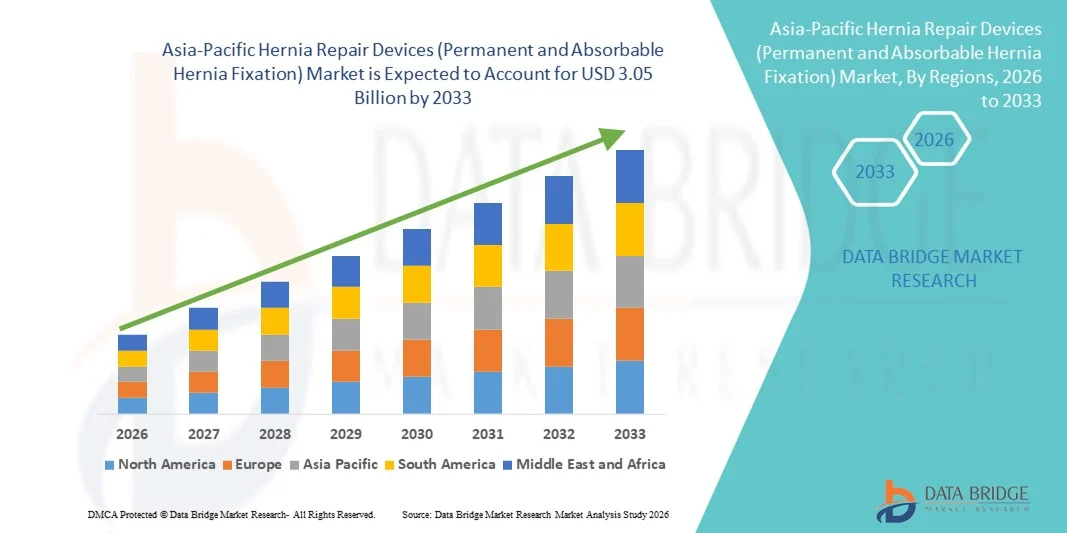
- Selon l'analyse de marché de Data Bridge, la taille du marché des appareils de réparation Hernia en Asie-Pacifique (permanente et absorbante Hernia fixation) a été évaluée à1,70 milliard de dollars en 2025et devrait atteindre3,05 milliards de dollars en 2033, à unTCAC de 7,60%pendant la période de prévision
- La croissance du marché est largement alimentée par l'augmentation de la prévalence des cas d'hernie dans le monde,Peu envahissantet les chirurgies laparoscopiques, et sensibilisation croissante à l'intervention chirurgicale précoce, conduisant à une demande accrue de dispositifs de réparation et de fixation de hernie avancés dans les hôpitaux et les centres chirurgicaux
- De plus, les progrès technologiques continus dans les dispositifs de fixation de l'hernie permanents et absorbants, y compris l'amélioration de la biocompatibilité, la réduction de la douleur postopératoire et l'amélioration des résultats chirurgicaux, établissent des dispositifs de réparation de l'hernie comme composants essentiels dans les interventions chirurgicales modernes. Ces facteurs convergents accélèrent l'adoption de solutions Hernia Repair Devices (Permanent and Absorbable Hernia Fixation), ce qui stimule considérablement la croissance du secteur
Taille du marché et prévisions
- Valeur marchande mondiale (2025):1,70 milliard de dollars en 2025
- Valeur marchande prévue (2033) :3,05 milliards de dollars en 2033
- Prévisions CAGR (2026-2033):7.60%
Dispositifs de réparation de Hernia en Asie-Pacifique (fixation permanente et absorbante de Hernia)
- Les dispositifs de réparation Hernia, y compris les systèmes de fixation permanents et absorbants, sont des composantes de plus en plus vitales des soins chirurgicaux modernes dans les hôpitaux et les centres de chirurgie ambulatoire, en raison de leur efficacité à réduire la récurrence de l'hernie, à soutenir des interventions peu invasives et à améliorer les résultats des patients.
- La demande croissante de dispositifs de réparation de l'hernie est principalement alimentée par la prévalence croissante de cas d'hernie à l'échelle mondiale, l'adoption croissante de chirurgies laparoscopiques et robotisées et une préférence croissante pour des solutions de fixation avancées et cliniquement éprouvées
- La Chine a dominé le marché des dispositifs de réparation de l'hernie (fixation permanente et absorbante de l'hernie) avec la plus grande part des revenus de 38,7 % en 2025, en raison de l'expansion rapide de l'infrastructure chirurgicale, de la forte prévalence des cas d'hernie, de l'adoption de techniques peu invasives et de la forte présence d'entreprises nationales et internationales de dispositifs médicaux.
- On s'attend à ce que l'Inde soit la région qui connaît la croissance la plus rapide du marché des dispositifs de réparation de l'hernie au cours de la période de prévision, avec un TCAC de 12,8 %, passant de 2026 à 2033, appuyé par l'augmentation des interventions chirurgicales, l'augmentation des investissements dans les soins de santé, une sensibilisation accrue à la réparation précoce de l'hernie et l'expansion des réseaux hospitaliers dans les villes de niveau 2 et de niveau 3
- Le segment de l'hernie inguinale a dominé la plus grande part de revenu du marché de 38,5 % en 2025, en raison de la forte prévalence mondiale des hernies inguinales et de l'efficacité établie de la réparation chirurgicale à l'aide de dispositifs de fixation permanents et absorbants
Portée du rapport et appareils de réparation Hernia (fixation permanente et absorbante Hernia) Segmentation du marché
|
Attributs |
Dispositifs de réparation Hernia (fixation permanente et absorbante Hernia) Principales perspectives du marché |
|
Segments couverts |
|
|
Pays couverts |
Asie-Pacifique
|
|
Principaux acteurs du marché |
|
|
Possibilités de marché |
|
|
Infos sur la valeur ajoutée |
En plus des renseignements sur les scénarios de marché comme la valeur marchande, le taux de croissance, la segmentation, la couverture géographique et les principaux intervenants, les rapports de marché établis par Data Bridge Market Research comprennent également une analyse approfondie des experts, l'épidémiologie des patients, l'analyse des pipelines, l'analyse des prix et le cadre réglementaire. |
Quelle est la tendance clé sur le marché des appareils de réparation Hernia d'Asie-Pacifique (fixation d'Hernia permanente et absorbante)
L'adoption croissante de techniques chirurgicales invasives
- Une tendance significative sur le marché des appareils de réparation de l'hernie de l'Asie-Pacifique est l'adoption croissante de techniques chirurgicales peu invasives et laparoscopiques, qui favorisent l'utilisation de dispositifs de fixation de l'hernie permanente et absorbante. Ces techniques réduisent le temps de récupération du patient, minimisent les complications post-chirurgicales et améliorent les résultats chirurgicaux globaux
- Par exemple, les hôpitaux japonais et sud-coréens appliquent de plus en plus la laparoscopiquehernie inguinaleréparation à l'aide de mailles absorbantes, permettant une évacuation plus rapide des patients et un séjour hospitalier réduit
- Les chirurgiens adoptent également des procédures de réparation de l'hernie assistée par robot, qui améliorent la précision et permettent un meilleur placement des mailles, améliorant les résultats des patients
- Les progrès dans les matériaux chirurgicaux, comme les mailles légères et composites, améliorent la performance de l'appareil, réduisent l'inflammation et améliorent le confort du patient
- La préférence croissante du chirurgien pour les implants maillés avec une biocompatibilité accrue et un risque d'adhésion réduit façonne les stratégies de développement des appareils
- L'augmentation des preuves cliniques appuyant l'innocuité et l'efficacité à long terme des dispositifs de fixation permanents et absorbants renforce la confiance du médecin et l'acceptation du patient
- Les acteurs du marché se concentrent également sur le développement de variantes d'appareils adaptées aux hernies complexes, y compris les hernies récurrentes et ventrales, reflétant la tendance vers des solutions chirurgicales personnalisées
Dispositifs de réparation de Hernia en Asie-Pacifique (fixation permanente et absorbante de Hernia) Dynamique du marché
Chauffeur
Élargissement du volume chirurgical et des infrastructures de soins de santé
- Le marché des appareils de réparation Hernia en Asie et dans le Pacifique est principalement alimenté par le nombre croissant d'opérations hernie et l'expansion des infrastructures de soins de santé dans les économies émergentes.
- Par exemple, en 2025, la Chine a représenté la plus grande part des procédures de réparation de l'hernie, grâce à l'augmentation des capacités hospitalières, à l'amélioration de l'accès aux soins chirurgicaux et à une sensibilisation accrue aux interventions précoces.
- L'Inde devrait être le marché qui connaît la croissance la plus rapide, avec l'adoption rapide d'appareils chirurgicaux modernes alimentés par destourisme médicalet les initiatives gouvernementales visant à moderniser les infrastructures hospitalières
- La prévalence croissante de l'hernie, en particulier dans les populations vieillissantes et chez les patients souffrant d'obésité ou de tension professionnelle, crée une demande soutenue de dispositifs de fixation avancés
- Les investissements dans les salles d'opération modernes, associés à des programmes de formation pour les chirurgiens, soutiennent l'adoption de produits de réparation de hernie permanents et absorbants
- Les progrès technologiques tels que les supports de fixation bio-absorbables et les mailles autofixantes rendent les opérations plus sûres et plus efficaces, encourageant les hôpitaux à investir dans ces dispositifs
- Les hôpitaux publics et privés collaborent de plus en plus avec les fabricants d'appareils pour des programmes pilotes et des études cliniques, favorisant ainsi l'adoption et accélérant la croissance du marché.
Restriction/Défi
Coûts élevés de l'instrument et risque de complications postopératoires
- Le coût relativement élevé des dispositifs avancés de réparation de l'hernie peut limiter l'adoption dans les régions sensibles aux prix, en particulier dans les zones rurales et semi-urbaines.
- Par exemple, les maillages composites et biologiques de qualité supérieure demeurent inaccessibles pour les petites cliniques en Inde, limitant leur utilisation aux segments de patients à revenu élevé.
- Les préoccupations concernant les complications postopératoires, y compris l'infection, la migration des mailles, la douleur chronique et la récurrence, continuent de remettre en question la croissance du marché.
- Les obstacles réglementaires et les processus d'approbation rigoureux pour les nouveaux types d'appareils peuvent retarder l'entrée sur le marché et limiter la disponibilité dans certains pays.
- Une sensibilisation limitée des patients et de certains prestataires de soins de santé aux avantages des maillages absorbants et permanents peut ralentir les taux d'adoption dans les régions en développement.
- Le manque de chirurgiens qualifiés formés à des procédures peu invasives et assistées par robot peut entraver l'adoption généralisée, en particulier dans les hôpitaux ruraux.
- Pour soutenir la croissance du marché, il est essentiel de s'attaquer aux problèmes de coûts par le biais de lignes de produits abordables, d'élargir les programmes de formation des chirurgiens et de mener des campagnes de sensibilisation aux avantages des appareils.
Dispositifs de réparation de Hernia en Asie-Pacifique (fixation permanente et absorbante de Hernia)
Le marché est segmenté en fonction du type, de l'utilisateur final et du canal de distribution.
- Par type
Sur la base du type, le marché des appareils de réparation Hernia est segmenté en hernie inguinale, hernie fémorale, hernie ombilicale, hernie hiatale (hiatus), hernie incisionnelle, hernie épigastrique, hernie spigelienne et hernie diaphragmatique. Le segment de l'hernie inguinale a dominé la plus grande part du marché de 38,5 % en 2025, en raison de la forte prévalence des hernies inguinales dans le monde et de l'efficacité établie de la réparation chirurgicale à l'aide de dispositifs de fixation permanents et absorbants. La sensibilisation accrue aux techniques de réparation de l'hernie minimalement invasive, conjuguée à une plus grande adoption sur les marchés développés et émergents, alimente la croissance. Les hôpitaux et les cliniques spécialisées préfèrent de plus en plus les appareils de réparation de hernie inguinale en raison de complications postopératoires réduites et de temps de récupération plus court. Le segment bénéficie également de données cliniques exhaustives appuyant l'efficacité à long terme. Les chirurgiens favorisent les appareils compatibles avec les procédures laparoscopiques et ouvertes, ce qui augmente la demande. La hausse de la population gériatrique et les taux d'obésité contribuent à augmenter l'incidence et les taux de traitement subséquents. Les polices d'assurance et de remboursement dans les régions développées facilitent l'adoption des procédures. L'intégration avec les systèmes de fixation avancés améliore la précision chirurgicale et les résultats des patients. Les innovations technologiques, y compris l'amélioration de la conception des mailles et des matériaux biocompatibles, renforcent la position du segment sur le marché. De plus, la prise de conscience croissante des patients quant à une récupération plus rapide et à une récurrence réduite entraîne une demande soutenue. De solides réseaux de distribution dans les hôpitaux et les cliniques assurent l'accessibilité, tandis que les économies émergentes sont témoins d'un recours accru aux procédures, ce qui maintient leur domination tout au long de la période de prévision.
On s'attend à ce que le segment de l'hernie fémorale soit témoin du TCAC le plus rapide de 12,1 % entre 2026 et 2033, sous l'impulsion d'une prise de conscience accrue et d'un diagnostic précoce chez les femmes, plus sujettes aux hernies fémorales. Une préférence croissante pour les chirurgies peu invasives favorise la croissance des segments. Le développement de la formation et de l'expertise des chirurgiens dans les techniques de réparation laparoscopique accélère l'adoption. L'augmentation des investissements dans les dispositifs de réparation de hernie avancés améliore les résultats du traitement. Les campagnes de sensibilisation et les programmes éducatifs sur les complications de l'hernie contribuent à une intervention précoce. La croissance dans les centres chirurgicaux ambulatoires offrant une hernie fémorale rentable répare l'expansion des carburants. Les progrès technologiques dans les matériaux de fixation absorbants réduisent l'inconfort postopératoire et la récurrence, ce qui augmente la préférence des médecins. Le segment bénéficie de directives chirurgicales améliorées et de protocoles normalisés qui améliorent les taux de réussite clinique. L'urbanisation accrue et l'accessibilité des soins de santé dans les économies émergentes renforcent encore l'adoption. Les politiques de remboursement de soutien dans les régions développées entraînent des volumes de procédures plus élevés. La satisfaction accrue des patients en raison d'une récupération plus rapide et d'une cicatrice minimale renforce l'attrait du segment. La combinaison d'innovation technologique, de sensibilisation croissante et de résultats cliniques favorables place les dispositifs de réparation de hernie fémorale pour le TCAC le plus élevé pendant la période de prévision.
- Par utilisateur final
Sur la base de l'utilisateur final, le marché des appareils de réparation Hernia est segmenté en hôpitaux, cliniques spécialisées, centres ambulatoires et autres. Le segment des hôpitaux a dominé la part de marché la plus importante de 45,3% en 2025, attribuable au volume élevé d'interventions chirurgicales effectuées en milieu hospitalier. Les hôpitaux disposent d'infrastructures avancées, d'équipes chirurgicales formées et d'un accès à des dispositifs de réparation d'hernie de pointe, ce qui facilite l'adoption généralisée. Le segment bénéficie de politiques de remboursement favorables, d'une couverture d'assurance et de processus d'approvisionnement établis. L'augmentation de la préférence des patients pour des interventions minimalement invasives menées dans les hôpitaux soutient encore davantage la domination. Les hôpitaux participent souvent à des études cliniques et à des essais d'instruments, ce qui accroît l'exposition aux nouvelles technologies. L'intégration de dispositifs de fixation permanents et absorbants dans les chirurgies laparoscopiques et ouvertes renforce l'utilisation du segment. Les hôpitaux, tant sur les marchés développés que sur les marchés émergents, conservent un pouvoir d'achat fort et une efficacité de la chaîne d'approvisionnement. La présence d'équipes chirurgicales multidisciplinaires assure une grande précision procédurale et la sécurité du patient. La croissance des populations gériatriques et obèses entraîne une augmentation de l'incidence des hernies, ce qui maintient la prédominance hospitalière. De plus, les hôpitaux offrent des soins postopératoires complets et une surveillance, ce qui renforce la préférence des patients. Les progrès technologiques dans les dispositifs de maillage et de fixation améliorent les résultats chirurgicaux, favorisant ainsi l'adoption des hôpitaux.
Le segment des centres ambulatoires devrait être témoin du TCAC le plus rapide de 11,8% entre 2026 et 2033, alimenté par la préférence croissante pour les procédures de réparation de l'hernie externe. Les centres ambulatoires offrent des soins chirurgicaux rentables et efficaces, réduisant ainsi le fardeau hospitalier. Le déplacement vers des chirurgies laparoscopiques peu invasives soutient l'expansion du segment. Une prise de conscience accrue du patient quant à des périodes de récupération plus courtes et un retour plus rapide aux activités quotidiennes accélère l'adoption. Les investissements croissants dans l'infrastructure chirurgicale ambulatoire permettent d'augmenter le volume des procédures. Les innovations technologiques dans les dispositifs de fixation portables et faciles à utiliser améliorent l'adoption. Des polices d'assurance et de remboursement favorables dans plusieurs régions encouragent les procédures ambulatoires. L'expansion des centres chirurgicaux spécialisés dans les zones urbaines et semi-urbaines augmente l'accessibilité. Les collaborations avec les hôpitaux pour les soins pré et postopératoires renforcent les offres de services. La hausse de la demande de solutions chirurgicales du même jour stimule la croissance du segment. L'intégration des systèmes numériques de planification et de gestion des patients améliore l'efficacité opérationnelle. L'attention accrue portée aux modèles de soins axés sur le patient place les centres ambulatoires comme un segment d'utilisateur final en croissance rapide tout au long de la période de prévision.
- Par canal de distribution
Sur la base du canal de distribution, le marché des appareils de réparation Hernia est segmenté en appels d'offres directs et ventes au détail. Le segment des appels d'offres directs a dominé la plus grande part du marché en 2025, soit 52,4 %, grâce à l'approvisionnement en gros des hôpitaux, des cliniques spécialisées et des établissements de santé publics. Les appels d'offres directs assurent un approvisionnement cohérent, des prix favorables et l'accès à des dispositifs de réparation Hernia premium et innovants. Les contrats à long terme avec les fabricants facilitent l'adoption de produits de fixation permanents et absorbants avancés. Les hôpitaux et les grands fournisseurs de soins de santé préfèrent les appels d'offres directs pour maintenir les niveaux d'inventaire et soutenir des volumes chirurgicaux élevés. Le segment bénéficie des relations établies avec les fournisseurs, des processus d'appel d'offres et de l'assurance de la conformité réglementaire. La sensibilisation accrue des chirurgiens et des équipes d'approvisionnement à la chirurgie minimalement invasive renforce l'adoption directe des appels d'offres. L'achat en vrac réduit les coûts opérationnels et assure la disponibilité des derniers appareils. Les réseaux avancés de distribution et de logistique permettent une livraison rapide. Les services de formation et de soutien fournis dans le cadre d'appels d'offres directs améliorent l'utilisation des appareils. Le segment continue de dominer en raison de l'efficacité, de la fiabilité et des avantages en termes de coûts.
Le segment des ventes au détail devrait connaître le TCAC le plus rapide de 10,5% entre 2026 et 2033, soutenu par la demande croissante des cliniques plus petites, des centres de consultation externe et des cabinets chirurgicaux privés. Les ventes au détail augmentent l'accessibilité pour les chirurgiens qui cherchent à se procurer immédiatement des appareils de réparation de hernie. Une prise de conscience accrue des technologies de fixation avancées chez les fournisseurs de soins de santé accélère l'adoption. La croissance des soins à domicile et des procédures ambulatoires appuie davantage le segment du commerce de détail. L'expansion des distributeurs médicaux et des marchés en ligne B2B améliore la commodité et la portée. Des options de prix flexibles et des emballages plus petits répondent à des besoins variés de l'utilisateur final. Les circuits de vente au détail permettent de réapprovisionner rapidement les consommables et les appareils à usage unique. Des activités promotionnelles et des démonstrations de produits dans les cliniques favorisent l'adoption. Les chirurgiens comptent de plus en plus sur l'accès au détail aux innovations de nouveaux appareils d'essai. Le segment bénéficie de la facilité de commande, des délais d'exécution plus courts et du soutien à la clientèle réactif. Une meilleure visibilité des options de produits dans les réseaux de détail renforce la pénétration du marché. La présence croissante de détaillants spécialisés en chirurgie sur les marchés émergents devrait soutenir une croissance vigoureuse tout au long de la période de prévision.
Asia-Pacific Hernia Repair Devices (Permanent and Absorbable Hernia Fixation) Analyse régionale du marché
- Le marché des dispositifs de réparation de l'hernie de l'Asie-Pacifique est sur le point de croître au rythme le plus rapide du TCAC pendant la période de prévision de 2026 à 2033, en raison de l'urbanisation rapide, de l'augmentation des revenus disponibles et des progrès technologiques dans des pays comme la Chine, le Japon et l'Inde.
- La région est témoin d'une adoption croissante d'interventions chirurgicales avancées, y compris des techniques laparoscopiques et peu invasives, qui favorisent l'utilisation de dispositifs de fixation d'hernie permanents et absorbants
- De plus, l'expansion de l'infrastructure hospitalière, la sensibilisation accrue des patients aux premières réparations de l'hernie et l'augmentation des investissements dans les soins de santé alimentent collectivement la croissance du marché. Au fur et à mesure que l'APAC apparaît comme un centre de fabrication des composants et systèmes des dispositifs de réparation Hernia, l'amélioration de l'accessibilité et de l'accessibilité permet à une base de patients plus large de bénéficier de ces solutions chirurgicales avancées
Dispositifs de réparation Hernia de la Chine (permanente et absorbable fixation Hernia)
Le marché chinois des dispositifs de réparation de l'hernie représentait la plus grande part des revenus en Asie-Pacifique en 2025, grâce à l'expansion rapide des infrastructures chirurgicales, à la forte prévalence des cas d'hernie et à l'adoption généralisée de techniques peu invasives. Les entreprises nationales et internationales d'appareils médicaux investissent activement dans la recherche, le développement et la production localisée, rendant les appareils de fixation hernie de haute qualité plus accessibles. La classe moyenne croissante, la sensibilisation à la santé et les soins préventifs et chirurgicaux précoces encouragent l'utilisation de mailles permanentes et absorbantes. De plus, l'aide gouvernementale à la modernisation des soins de santé et à l'expansion du réseau hospitalier permet une plus grande pénétration dans les régions urbaines et semi-urbaines.
Inde Appareils de réparation Hernia (permanent et absorbable Hernia fixation) Aperçu du marché
On s'attend à ce que le marché des dispositifs de réparation de l'hernie de l'Inde soit le marché qui connaît la croissance la plus rapide dans la région de l'Asie-Pacifique au cours de la période de prévision, avec un TCAC de 12,8 %, passant de 2026 à 2033. Cette croissance est due à l'augmentation des interventions chirurgicales, à l'augmentation des investissements dans les soins de santé et à la sensibilisation accrue des patients à l'intervention précoce pour la réparation de l'hernie. L'expansion des réseaux hospitaliers dans les villes de niveau 2 et de niveau 3 rend les dispositifs avancés de réparation de l'hernie plus accessibles. En outre, le secteur croissant du tourisme médical et l'adoption de techniques chirurgicales modernes, comme les procédures laparoscopiques et robotisées, propulsent davantage la demande du marché. Les initiatives gouvernementales visant à renforcer l'infrastructure des soins de santé et à promouvoir des soins chirurgicaux abordables soutiennent également une croissance soutenue.
Quelles sont les meilleures entreprises du marché des appareils de réparation Hernia d'Asie-Pacifique
L'industrie Hernia Repair Devices (Permanent and Absorbable Hernia Fixation) est principalement dirigée par des entreprises bien établies, notamment :
- Medtronic (États-Unis)
- B. Braun S.E. (Allemagne)
- BD (États-Unis)
- Smith et Nephew (Royaume-Uni)
- Médical Trojan (États-Unis)
- Hugel, Inc. (Corée du Sud)
- CONMED Corporation (États-Unis)
- Adhesys Medical (États-Unis)
- Integra LifeSciences (États-Unis)
- LifeHealthcare (Australie)
- Alliqua Biomedical (États-Unis)
- Avanos Medical, Inc. (États-Unis)
- Cousine Biotech (France)
- PMT Corporation (États-Unis)
- Société Steris (États-Unis)
- Cardinal Health (États-Unis)
- Hollister Incorporated (États-Unis)
- Mölnlycke Health Care AB (Suède)
Derniers développements en Asie-Pacifique Hernia Repair Devices (Permanent and Absorbable Hernia fixation)
- En avril 2025, BD (Becton, Dickinson and Company) a reçu l'autorisation de la FDA 510k) et a lancé commercialement le Phasix ST ombilical Hernia Patch, le premier patch d'hernie entièrement bioabsorbable conçu spécifiquement pour les réparations de l'hernie ombilical. Le dispositif transdermique utilise un matériau de poly‐4‐hydroxybutyrate (P4HB) biologiquement dérivé d'une barrière hydrogel, ce qui permet aux chirurgiens d'utiliser des techniques d'implantation familières tout en offrant des solutions de rechange absorbantes au maillage permanent. Ce lancement représente une innovation importante dans les dispositifs de réparation de l'hernie en élargissant les options bioabsorbables pour les patients et les cliniciens
- En avril 2024, TELA Bio, Inc. a annoncé le lancement commercial aux États-Unis de la matrice de tissu renforcé OviTex IHR pour la réparation d'hernie inguinale. Ce maillage biologique est renforcé pour une utilisation dans les procédures laparoscopiques et robotisées et combine des couches de rumen ovin avec une suture de polymère minimale pour réduire l'empreinte permanente des matériaux synthétiques tout en fournissant des efforts de réparation
- En mars 2025, Medtronic a introduit le ProShiftTM Fixation Device, un instrument portatif de pointe conçu pour la fixation rapide et sûre des mailles hernie lors de chirurgies hernies peu invasives, avec des options d'embouts absorbants et non absorbants pour améliorer l'efficacité et la fiabilité des procédures.
- En février 2025, W. L. Gore & Associates, Inc. a lancé le GORE Performance Mesh, qui offre une conception des pores optimisée et une meilleure intégration des tissus, représentant un produit raffiné visant à améliorer la résistance à la réparation à long terme et à réduire les complications postopératoires.
SKU-
Accédez en ligne au rapport sur le premier cloud mondial de veille économique

- Tableau de bord d'analyse de données interactif
- Tableau de bord d'analyse d'entreprise pour les opportunités à fort potentiel de croissance
- Accès d'analyste de recherche pour la personnalisation et les requêtes
- Analyse de la concurrence avec tableau de bord interactif
- Dernières actualités, mises à jour et analyse des tendances
- Exploitez la puissance de l'analyse comparative pour un suivi complet de la concurrence
Méthodologie de recherche
La collecte de données et l'analyse de l'année de base sont effectuées à l'aide de modules de collecte de données avec des échantillons de grande taille. L'étape consiste à obtenir des informations sur le marché ou des données connexes via diverses sources et stratégies. Elle comprend l'examen et la planification à l'avance de toutes les données acquises dans le passé. Elle englobe également l'examen des incohérences d'informations observées dans différentes sources d'informations. Les données de marché sont analysées et estimées à l'aide de modèles statistiques et cohérents de marché. De plus, l'analyse des parts de marché et l'analyse des tendances clés sont les principaux facteurs de succès du rapport de marché. Pour en savoir plus, veuillez demander un appel d'analyste ou déposer votre demande.
La méthodologie de recherche clé utilisée par l'équipe de recherche DBMR est la triangulation des données qui implique l'exploration de données, l'analyse de l'impact des variables de données sur le marché et la validation primaire (expert du secteur). Les modèles de données incluent la grille de positionnement des fournisseurs, l'analyse de la chronologie du marché, l'aperçu et le guide du marché, la grille de positionnement des entreprises, l'analyse des brevets, l'analyse des prix, l'analyse des parts de marché des entreprises, les normes de mesure, l'analyse globale par rapport à l'analyse régionale et des parts des fournisseurs. Pour en savoir plus sur la méthodologie de recherche, envoyez une demande pour parler à nos experts du secteur.
Personnalisation disponible
Data Bridge Market Research est un leader de la recherche formative avancée. Nous sommes fiers de fournir à nos clients existants et nouveaux des données et des analyses qui correspondent à leurs objectifs. Le rapport peut être personnalisé pour inclure une analyse des tendances des prix des marques cibles, une compréhension du marché pour d'autres pays (demandez la liste des pays), des données sur les résultats des essais cliniques, une revue de la littérature, une analyse du marché des produits remis à neuf et de la base de produits. L'analyse du marché des concurrents cibles peut être analysée à partir d'une analyse basée sur la technologie jusqu'à des stratégies de portefeuille de marché. Nous pouvons ajouter autant de concurrents que vous le souhaitez, dans le format et le style de données que vous recherchez. Notre équipe d'analystes peut également vous fournir des données sous forme de fichiers Excel bruts, de tableaux croisés dynamiques (Fact book) ou peut vous aider à créer des présentations à partir des ensembles de données disponibles dans le rapport.











