


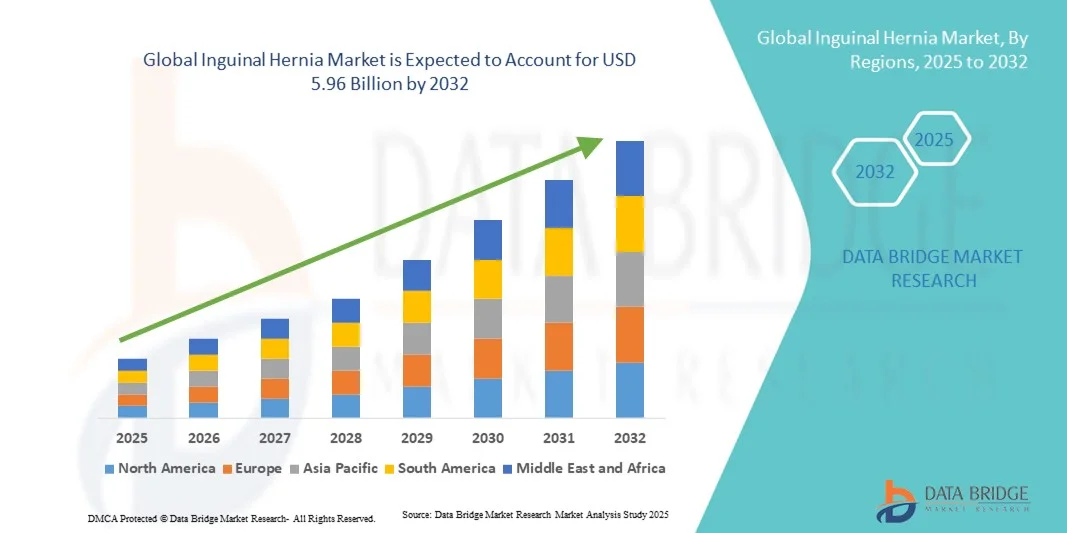
Inguinal Hernia Market Size
- The global inguinal hernia market size was valued at USD 4.80 billion in 2024 and is expected to reach USD 5.96 billion by 2032, at a CAGR of 2.75% during the forecast period
- The market growth is largely driven by the increasing prevalence of hernia cases worldwide, rising awareness about minimally invasive surgical procedures, and continuous advancements in mesh materials and surgical techniques that enhance treatment efficacy and patient recovery
- Furthermore, growing adoption of laparoscopic and robotic-assisted hernia repair procedures, coupled with the availability of reimbursement for hernia surgeries in developed regions, is fostering market expansion. These converging factors are strengthening the adoption of advanced inguinal hernia repair solutions, thereby significantly propelling the industry’s growth
Inguinal Hernia Market Analysis
- The inguinal hernia market, encompassing diagnostic, surgical, and post-operative care solutions for direct and indirect hernia cases, is becoming an essential component of modern healthcare due to continuous advancements in imaging technologies, surgical techniques, and medical devices designed for effective hernia management
- The growing demand within the inguinal hernia market is primarily fueled by the increasing prevalence of hernia conditions, aging population, and growing preference for minimally invasive and robotic-assisted repair procedures that offer reduced complications and faster recovery times
- North America dominated the inguinal hernia market with the largest revenue share of 41.8% in 2024, driven by the high adoption of advanced surgical technologies, favorable reimbursement structures, and a strong presence of leading device manufacturers. The U.S. remains a key contributor due to the availability of skilled surgeons and early adoption of laparoscopic and robotic hernia repair systems
- Asia-Pacific is projected to be the fastest growing region in the inguinal hernia market during the forecast period, supported by the rising geriatric population, increasing awareness of hernia conditions, and expanding access to modern surgical facilities across developing economies
- The laparoscopy segment dominated the inguinal hernia market with a market share of 46.2% in 2024, attributed to its minimally invasive approach, reduced post-surgical pain, shorter hospital stays, and increasing preference among healthcare providers for advanced laparoscopic systems in hernia repair
Report Scope and Inguinal Hernia Market Segmentation
|
Attributes |
Inguinal Hernia Key Market Insights |
|
Segments Covered |
|
|
Countries Covered |
North America
Europe
Asia-Pacific
Middle East and Africa
South America
|
|
Key Market Players |
|
|
Market Opportunities |
|
|
Value Added Data Infosets |
In addition to the insights on market scenarios such as market value, growth rate, segmentation, geographical coverage, and major players, the market reports curated by the Data Bridge Market Research also include in-depth expert analysis, patient epidemiology, pipeline analysis, pricing analysis, and regulatory framework |
Inguinal Hernia Market Trends
Advancement of Minimally Invasive and Robotic-Assisted Surgical Techniques
- A significant and accelerating trend in the global inguinal hernia market is the rapid adoption of minimally invasive and robotic-assisted surgical procedures, which are transforming hernia repair through enhanced precision, reduced recovery time, and improved patient comfort
- For instance, Intuitive Surgical’s da Vinci robotic system allows surgeons to perform complex hernia repairs with enhanced visualization and control, minimizing tissue trauma and postoperative pain. Similarly, Medtronic’s Hugo™ robotic-assisted system is gaining traction for inguinal hernia repair applications
- Integration of advanced imaging and robotic technologies enables surgeons to achieve superior mesh placement accuracy and minimize recurrence risks. For instance, Stryker’s 3D imaging platforms assist in preoperative planning and intraoperative navigation for optimized repair outcomes. Furthermore, robotic assistance improves dexterity in confined anatomical areas, leading to greater procedural success and patient satisfaction
- The growing preference for laparoscopic and robotic-assisted techniques over open surgery is fostering demand for advanced mesh materials and instruments compatible with these methods, promoting faster recovery and lower complication rates
- This trend toward technology-driven, minimally invasive repair solutions is reshaping surgical standards in hernia treatment. Consequently, companies such as Becton, Dickinson and Company (BD) and Johnson & Johnson’s Ethicon are investing in robotic-compatible mesh systems and next-generation fixation devices to enhance procedural outcomes
- The demand for minimally invasive and robotic-assisted inguinal hernia repair systems is expanding rapidly across hospitals and ambulatory surgical centers, as healthcare providers prioritize precision, shorter hospital stays, and improved long-term patient outcomes
Inguinal Hernia Market Dynamics
Driver
Rising Prevalence of Hernia Cases and Growing Adoption of Advanced Surgical Techniques
- The increasing global burden of hernia conditions, combined with the shift toward advanced surgical approaches such as laparoscopy and robotic-assisted repair, is a major driver of the inguinal hernia market’s growth
- For instance, in March 2024, Intuitive Surgical reported a surge in robotic hernia repair procedures performed using the da Vinci system, highlighting the growing reliance on technology to achieve safer, more efficient outcomes
- As the geriatric population expands and hernia recurrence remains a concern, the need for durable mesh implants, enhanced fixation devices, and precision surgical tools is escalating, reinforcing market demand
- Furthermore, the increasing availability of specialized hernia repair centers and surgeon training programs in advanced laparoscopic techniques is boosting adoption in both developed and emerging regions
- The advantages of minimally invasive surgery including reduced postoperative pain, shorter recovery periods, and lower infection risks are propelling the uptake of laparoscopic and robotic-assisted repairs. In addition, strong R&D investments by medical device companies in innovative mesh materials further stimulate market expansion
- The rise in healthcare infrastructure modernization and improved access to surgical care in developing economies continues to strengthen global demand for inguinal hernia repair solutions
Restraint/Challenge
Postoperative Complications and Regulatory Compliance Hurdles
- Persistent postoperative complications such as chronic pain, infection, and mesh-related issues pose significant challenges to the widespread adoption of inguinal hernia repair procedures
- For instance, reports of mesh erosion and chronic groin pain following repair surgeries have led to regulatory scrutiny and product recalls, affecting consumer and clinician confidence
- Addressing these complications through the development of lightweight, bioabsorbable, and biocompatible meshes is essential for improving patient safety and outcomes. For instance, companies such as W. L. Gore & Associates emphasize next-generation biologic meshes with enhanced tissue integration to minimize postoperative issues
- Moreover, stringent regulatory requirements for medical devices, particularly in the U.S. and Europe, extend approval timelines and increase compliance costs for manufacturers seeking market entry
- The cost burden associated with advanced laparoscopic or robotic procedures and the lack of reimbursement in certain regions can deter patient access to modern treatment options. In addition, concerns over long-term mesh performance continue to influence surgeon preferences and patient decisions
- Overcoming these challenges through continuous innovation in biomaterials, stronger clinical evidence, and streamlined regulatory processes will be vital for ensuring sustainable market growth
Inguinal Hernia Market Scope
The market is segmented on the basis of type, diagnosis, treatment, and end-use.
- By Type
On the basis of type, the global inguinal hernia market is segmented into direct and indirect. The Direct inguinal hernia segment dominated the market with the largest revenue share of 58.6% in 2024, primarily due to the high incidence among the aging male population and individuals engaged in physically demanding activities that increase abdominal pressure. This segment benefits from the increasing availability of advanced mesh products designed to strengthen weakened abdominal walls and reduce recurrence rates. In addition, growing awareness regarding early diagnosis and the effectiveness of minimally invasive repair options are reinforcing market dominance. Hospitals worldwide are reporting higher procedural volumes for direct hernia repair as surgeons adopt laparoscopic and robotic techniques to enhance surgical precision. The introduction of reimbursement schemes and government-backed hernia awareness programs further supports the segment’s leadership.
The Indirect inguinal hernia segment is expected to witness the fastest growth rate of 6.9% from 2025 to 2032, driven by the rising prevalence of congenital hernias, particularly in pediatric and younger adult populations. Advancements in neonatal and pediatric surgical techniques are enabling safer and faster correction of indirect hernias with minimal postoperative complications. For instance, the use of high-definition laparoscopic systems allows precise visualization of the hernia sac, improving surgical success rates. Moreover, increased diagnostic screening in infants and access to specialized surgical facilities are bolstering growth across both developed and emerging markets.
- By Diagnosis
On the basis of diagnosis, the global inguinal hernia market is segmented into physical examination, CT Scan, abdominal ultrasound, magnetic resonance imaging (MRI), and others. The Physical Examination segment dominated the market with the largest revenue share of 44.3% in 2024, owing to its role as the first-line diagnostic approach for suspected hernia cases. Physical examinations remain widely used due to their affordability, rapid assessment capability, and minimal equipment requirements. Physicians rely on visual inspection and palpation to detect inguinal bulges, particularly in outpatient and primary care settings. Furthermore, the segment continues to dominate in low- and middle-income regions where imaging resources are limited. The growing use of portable diagnostic tools during examinations is also enhancing diagnostic accuracy and patient confidence in early-stage detection.
The CT Scan segment is anticipated to grow at the fastest CAGR of 7.8% from 2025 to 2032, driven by its superior accuracy in differentiating between direct and indirect hernias and detecting complex or recurrent cases. The rising use of high-resolution CT imaging helps surgeons plan more precise interventions. For instance, multi-slice CT scanners allow detailed visualization of abdominal wall defects, improving preoperative assessment. Increasing availability of advanced imaging infrastructure in hospitals and growing clinician preference for CT over conventional methods are key growth factors.
- By Treatment
On the basis of treatment, the global inguinal hernia market is segmented into open hernia repair, laparoscopy, and others. The Laparoscopy segment dominated the market with a revenue share of 46.2% in 2024, due to its advantages such as reduced postoperative pain, minimal scarring, and faster patient recovery compared to open repair. The increasing adoption of minimally invasive and robotic-assisted laparoscopic systems is driving segment leadership. Technological advancements such as high-definition 3D visualization and energy-efficient surgical instruments are enhancing procedural outcomes. Moreover, the growing number of surgeons trained in laparoscopic repair and favorable insurance reimbursement for minimally invasive surgeries are boosting adoption. Healthcare facilities are investing in laparoscopic equipment to cater to the rising preference for less invasive procedures.
The Open Hernia Repair segment is projected to witness the fastest growth rate of 6.5% from 2025 to 2032, as it remains the preferred approach in large, complex, or emergency hernia cases. Despite the shift toward laparoscopy, open repair continues to be widely practiced in regions with limited access to robotic or laparoscopic technologies. Continuous innovation in mesh design, fixation methods, and postoperative pain management is supporting demand for open surgery. In addition, the lower procedural cost and shorter learning curve make open repair favorable for healthcare systems in developing economies.
- By End-Use
On the basis of end-use, the global inguinal hernia market is segmented into hospitals, ambulatory surgical centres, research & academic institutes, and others. The Hospitals segment dominated the market with the largest revenue share of 62.4% in 2024, driven by the availability of advanced surgical infrastructure, skilled medical personnel, and the ability to handle both elective and emergency hernia repairs. Hospitals continue to be the primary sites for laparoscopic and robotic-assisted hernia repair procedures, supported by favorable reimbursement systems and patient trust in comprehensive care. In addition, hospitals benefit from greater adoption of advanced imaging and intraoperative navigation systems. Government initiatives to expand surgical capacity in emerging economies are also contributing to this segment’s dominance. The integration of multidisciplinary teams and postoperative care programs further enhances outcomes and patient satisfaction.
The Ambulatory Surgical Centres (ASCs) segment is expected to record the fastest growth rate of 8.1% from 2025 to 2032, driven by the rising trend toward outpatient surgeries and same-day discharge procedures. ASCs provide cost-effective and time-efficient hernia repairs, appealing to patients and insurers likely as. For instance, the adoption of advanced anesthesia techniques and minimally invasive laparoscopic systems enables safe, rapid recovery within outpatient settings. Increasing collaborations between surgeons and private healthcare providers are also promoting the expansion of ASCs globally. Moreover, growing awareness among patients about reduced hospitalization costs and convenience is propelling segment growth.
Inguinal Hernia Market Regional Analysis
- North America dominated the inguinal hernia market with the largest revenue share of 41.8% in 2024, driven by the high adoption of advanced surgical technologies, favorable reimbursement structures, and a strong presence of leading device manufacturers
- Patients in the region increasingly prefer laparoscopic and robotic hernia repair procedures due to their faster recovery times, reduced postoperative complications, and enhanced cosmetic outcomes
- This widespread adoption is further supported by favorable reimbursement policies, high healthcare spending, and the strong presence of leading medical device manufacturers, establishing North America as a key hub for innovation and treatment excellence in inguinal hernia care
U.S. Inguinal Hernia Market Insight
The U.S. inguinal hernia market captured the largest revenue share of 82% in 2024 within North America, driven by the high incidence of hernia cases, early adoption of robotic-assisted and laparoscopic procedures, and the availability of advanced surgical infrastructure. The growing geriatric population and rising awareness about minimally invasive repair options are key factors fueling market demand. In addition, supportive reimbursement policies, the presence of leading medical device manufacturers, and ongoing clinical advancements in mesh technology further contribute to the strong market growth across the U.S.
Europe Inguinal Hernia Market Insight
The Europe inguinal hernia market is projected to expand at a significant CAGR throughout the forecast period, primarily driven by an increasing prevalence of abdominal wall disorders and continuous improvements in surgical techniques. The growing adoption of laparoscopic procedures, coupled with government initiatives to modernize healthcare systems, is promoting market expansion. European countries are also witnessing a rise in elective surgeries for hernia repair, supported by high-quality healthcare access and the presence of specialized treatment centers.
U.K. Inguinal Hernia Market Insight
The U.K. inguinal hernia market is anticipated to grow at a noteworthy CAGR during the forecast period, driven by an aging population, increased awareness about hernia complications, and the availability of advanced surgical procedures. The shift towards minimally invasive hernia repair techniques and the presence of skilled surgeons are boosting treatment adoption rates. Furthermore, the National Health Service (NHS) support for elective hernia repair procedures continues to encourage patient accessibility and enhance overall market performance.
Germany Inguinal Hernia Market Insight
The Germany inguinal hernia market is expected to expand at a steady CAGR during the forecast period, fueled by the country’s strong medical technology base and focus on precision-driven, patient-centric care. Germany’s healthcare infrastructure supports the adoption of innovative mesh products and robotic-assisted repair systems. The growing emphasis on faster recovery times, lower recurrence rates, and improved surgical outcomes is driving the preference for advanced laparoscopic and hybrid repair techniques across hospitals and specialty clinics.
Asia-Pacific Inguinal Hernia Market Insight
The Asia-Pacific inguinal hernia market is poised to grow at the fastest CAGR of around 25% during the forecast period of 2025 to 2032, attributed to the region’s expanding patient pool, rising healthcare expenditure, and increasing access to modern surgical technologies. Countries such as China, India, and Japan are witnessing growing awareness about hernia management and the availability of cost-effective mesh implants. Moreover, government healthcare initiatives and the rapid development of hospital infrastructure are fostering the growth of hernia repair procedures in the region.
Japan Inguinal Hernia Market Insight
The Japan inguinal hernia market is gaining momentum due to the country’s aging population, increased prevalence of hernia disorders, and emphasis on advanced surgical care. Japanese hospitals are rapidly adopting laparoscopic and robotic-assisted hernia repair technologies, supported by a strong network of medical device companies and training institutions. Furthermore, the high standard of healthcare and patient preference for minimally invasive treatments are driving continuous market expansion in Japan.
India Inguinal Hernia Market Insight
The India inguinal hernia market accounted for the largest market revenue share in Asia Pacific in 2024, driven by the growing number of hernia cases, expanding healthcare access, and an increasing number of general and laparoscopic surgeons. The government’s focus on strengthening secondary and tertiary healthcare facilities, along with the availability of affordable hernia meshes and surgical options, supports market growth. Moreover, the rising middle-class population and growing awareness regarding early hernia diagnosis are further fueling the adoption of modern repair techniques in India.
Inguinal Hernia Market Share
The Inguinal Hernia industry is primarily led by well-established companies, including:
- Johnson & Johnson Services, Inc. (U.S.)
- Medtronic (Ireland)
- W. L. Gore & Associates, Inc. (U.S.)
- B. Braun SE (Germany)
- BD (U.S.)
- Cook (U.S.)
- Baxter (U.S.)
- Integra LifeSciences Corporation (U.S.)
- AbbVie Inc. (U.S.)
- Meril Life Sciences Pvt. Ltd. (India)
- CONMED Corporation (U.S.)
- BioCer Entwicklungs-GmbH (Germany)
- PRIMEQUAL S.A. (France)
- Aspide Medical S.A.S. (France)
- Dipromed S.r.l. (Italy)
- Deep Blue Medical Advances, Inc (China)
- Betatech Medical (China)
- Sinolinks Medical Innovation, Inc. (China)
- HerniaMesh S.r.l. (Italy)
- Atrium Medical Technologies (U.S.)
What are the Recent Developments in Global Inguinal Hernia Market?
- In September 2025, Medtronic plc announced positive results from its clinical study of the Hugo™ Robotic-Assisted Surgery System in inguinal and ventral hernia repair, achieving a 100% surgical success rate for inguinal cases and zero surgical-site events in that cohort. The results validate the safety and effectiveness of robotic-assisted hernia repair and strengthen Medtronic’s position in the growing minimally invasive surgery segment
- In June 2025, TELA Bio launched its OviTex Inguinal Reinforced Tissue Matrix commercially in Europe, targeting robotic and laparoscopic inguinal hernia repair. The product combines biologic material with polymer reinforcement to deliver both strength and biocompatibility, providing an alternative to traditional synthetic meshes. This expansion strengthens TELA Bio’s global footprint and aligns with Europe’s increasing demand for biologic, resorbable, and patient-centric hernia repair materials designed to minimize complications and chronic pain
- In November 2024, Distalmotion AG announced that the first U.S. patients had been treated for inguinal hernia repair using the Dexter Robotic Surgery System, shortly after its FDA De Novo authorization. This milestone marked the introduction of Dexter’s robotic platform into the high-volume hernia repair space, supporting precise, minimally invasive procedures in outpatient settings
- In March 2024, TELA Bio, Inc. announced the U.S. commercial launch of the LIQUIFIX Precision Open Hernia Mesh Fixation device, designed specifically for open repair of groin (inguinal and femoral) hernias. This launch introduced the only FDA-approved liquid adhesive system for internal hernia mesh fixation, providing surgeons with a controlled, precise, and non-mechanical alternative to traditional tacks or sutures
- In June 2023, the U.S. Food and Drug Administration (FDA) granted approval for LiquiFix FIX8 and LiquiFix Precision Hernia Mesh Fixation Devices (P220024) developed by Advanced Medical Solutions Limited. These products can be used in both laparoscopic and open repair of inguinal and femoral hernias, introducing a new fixation technology that utilizes a proprietary pre-polymer adhesive

- Interactive Data Analysis Dashboard
- Company Analysis Dashboard for high growth potential opportunities
- Research Analyst Access for customization & queries
- Competitor Analysis with Interactive dashboard
- Latest News, Updates & Trend analysis
- Harness the Power of Benchmark Analysis for Comprehensive Competitor Tracking
Data collection and base year analysis are done using data collection modules with large sample sizes. The stage includes obtaining market information or related data through various sources and strategies. It includes examining and planning all the data acquired from the past in advance. It likewise envelops the examination of information inconsistencies seen across different information sources. The market data is analysed and estimated using market statistical and coherent models. Also, market share analysis and key trend analysis are the major success factors in the market report. To know more, please request an analyst call or drop down your inquiry.
The key research methodology used by DBMR research team is data triangulation which involves data mining, analysis of the impact of data variables on the market and primary (industry expert) validation. Data models include Vendor Positioning Grid, Market Time Line Analysis, Market Overview and Guide, Company Positioning Grid, Patent Analysis, Pricing Analysis, Company Market Share Analysis, Standards of Measurement, Global versus Regional and Vendor Share Analysis. To know more about the research methodology, drop in an inquiry to speak to our industry experts.
Data Bridge Market Research is a leader in advanced formative research. We take pride in servicing our existing and new customers with data and analysis that match and suits their goal. The report can be customized to include price trend analysis of target brands understanding the market for additional countries (ask for the list of countries), clinical trial results data, literature review, refurbished market and product base analysis. Market analysis of target competitors can be analyzed from technology-based analysis to market portfolio strategies. We can add as many competitors that you require data about in the format and data style you are looking for. Our team of analysts can also provide you data in crude raw excel files pivot tables (Fact book) or can assist you in creating presentations from the data sets available in the report.












