


Global Bean To Bar Chocolate Market
Taille du marché en milliards USD
TCAC :
% 
 USD
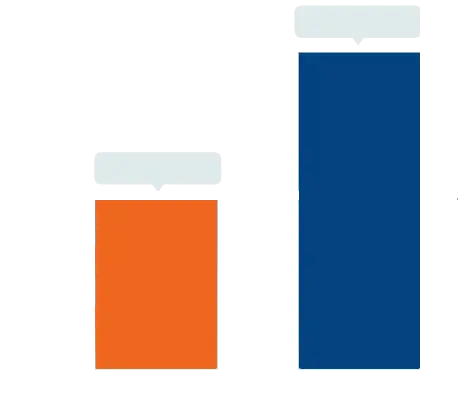
14.60 Billion
USD
34.15 Billion
2024
2032
USD
14.60 Billion
USD
34.15 Billion
2024
2032
 Période de prévision Période de prévision |
2025 –2032 |
 Taille du marché (année de référence) Taille du marché (année de référence) |
USD 14.60 Billion |
 Taille du marché (année de prévision) Taille du marché (année de prévision) |
USD 34.15 Billion |
 TCAC TCAC |
% |
| Principaux acteurs du marché |
|
Global Bean-To-Bar Chocolate Market Segmentation, By Type (Dark Chocolate, Milk Chocolate, White Chocolate, Chocolate Bean, and Others), Application (Supermarkets, Convenience Stores, Independent Retailers, Online Sales, and Others) - Industry Trends and Forecast to 2032
Bean-To-Bar Chocolate Market Size
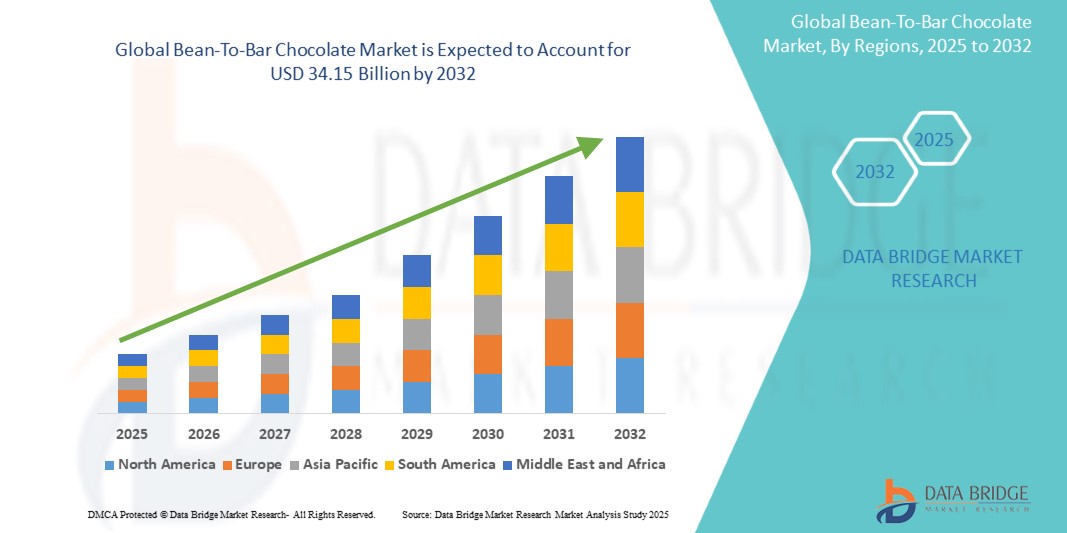
- The global bean-to-bar chocolate market was valued at USD 14.60 billion in 2024 and is expected to reach USD 34.15 billion by 2032
- During the forecast period of 2025 to 2032 the market is likely to grow at a CAGR of 11.20%, primarily driven by increasing consumer demand for premium, organic, and ethically sourced chocolates
- This growth is driven by rising awareness about sustainable cocoa farming practices and growing preferences for artisanal and craft chocolates over mass-produced alternatives
Bean-To-Bar Chocolate Market Analysis
- The bean-to-bar chocolate market has gained significant popularity due to increasing consumer demand for premium, ethically sourced chocolates, rising awareness of sustainable cocoa farming, and the growing preference for artisanal and craft chocolates over mass-produced alternatives. Its rich flavor profiles and unique production methods play a crucial role in attracting chocolate enthusiasts and health-conscious consumers
- The market is primarily driven by expanding applications in organic and fair-trade certifications, increasing investments in direct trade partnerships, and advancements in bean processing techniques. In addition, growing research validating the health benefits of dark chocolate is further accelerating market expansion
- Europe dominates the Bean-To-Bar Chocolate market due to its long-standing chocolate-making tradition, strong consumer preference for high-quality handcrafted chocolates, and rising demand for sustainable cocoa sourcing
- For instance, in Switzerland and Belgium, the demand for Bean-To-Bar Chocolate is increasing due to growing awareness of ethical cocoa sourcing and transparent supply chains, contributing to sustained market expansion
- Globally, Bean-To-Bar Chocolate remains a key player in the premium chocolate segment, with innovations such as single-origin chocolates, low-sugar formulations, and unique flavor infusions driving industry transformation and supporting the shift toward high-quality, artisanal confections
Report Scope and Bean-To-Bar Chocolate Market Segmentation
|
Attributes |
Bean-To-Bar Chocolate Key Market Insights |
|
Segments Covered |
|
|
Countries Covered |
North America
Europe
Asia-Pacific
Middle East and Africa
South America
|
|
Key Market Players |
|
|
Market Opportunities |
|
|
Value Added Data Infosets |
In addition to the insights on market scenarios such as market value, growth rate, segmentation, geographical coverage, and major players, the market reports curated by the Data Bridge Market Research also include in-depth expert analysis, pricing analysis, brand share analysis, consumer survey, demography analysis, supply chain analysis, value chain analysis, raw material/consumables overview, vendor selection criteria, PESTLE Analysis, Porter Analysis, and regulatory framework |
Bean-To-Bar Chocolate Market Trends
“Rising Demand for Premium and Ethically Sourced Chocolates”
- The increasing consumer preference for high-quality, artisanal chocolates is driving demand for Bean-To-Bar Chocolate, known for its ethical sourcing and unique flavor profiles
- Chocolate manufacturers are focusing on direct trade partnerships, organic certifications, and transparent supply chains to cater to ethically conscious consumers
- The rising focus on sustainability, fair-trade cocoa, and small-batch production is accelerating the adoption of Bean-To-Bar Chocolate across global markets
For instance,
- In June 2024, Lindt & Sprüngli introduced a single-origin dark chocolate collection, emphasizing traceable cocoa sourcing and bean fermentation techniques
- In February 2024, Raaka Chocolate launched a limited-edition stone-ground cacao bar, reflecting the growing demand for unroasted, minimally processed chocolates
- In September 2023, Dandelion Chocolate expanded its direct trade cocoa network, ensuring fair pricing and sustainable farming practices for its handcrafted bars
- As the demand for authentic, craft chocolates continues to grow, the incorporation of sustainable sourcing, transparent labeling, and innovative flavor infusions will expand, meeting consumer expectations for premium chocolate experiences
Bean-To-Bar Chocolate Market Dynamics
Driver
“Expansion of Direct Trade and Farm-to-Bar Initiatives”
- Chocolate makers are increasingly sourcing cocoa beans directly from farmers, ensuring higher profit margins for growers and better-quality control for producers
- Shoppers prefer farm-to-bar chocolates, valuing direct trade relationships that ensure transparency and fair compensation for farmers
- Companies are adopting blockchain technology and other traceability measures to verify ethical sourcing and reduce supply chain inefficiencies
For instance,
- In 2023, Dandelion Chocolate expanded its direct trade program, strengthening partnerships with cocoa farmers in Belize and the Philippines
- In 2022, Beyond Good built a chocolate factory in Madagascar, working directly with local farmers to cut out intermediaries and improve wages
- As direct trade and farm-to-bar models gain traction, brands that integrate transparency and sustainability into their supply chains will experience higher consumer trust and brand loyalty
Opportunity
“Expanding Market for Vegan and Plant-Based Bean-to-Bar Chocolate”
- Consumers, especially those with lactose intolerance or following vegan diets, seek high-quality dairy-free chocolates
- Brands are innovating with oat milk, almond milk, and coconut milk to create creamy textures without dairy
- Vegan chocolates align with the growing demand for sustainability, as they reduce carbon footprint compared to dairy-based options
For instance,
- In 2023, Lindt expanded its vegan Excellence line, using oat milk to maintain a creamy texture
- In 2022, Hu Kitchen introduced vegan, bean-to-bar chocolates made with organic cacao and coconut sugar, targeting health-conscious consumers
- The vegan bean-to-bar chocolate segment is expected to grow significantly, driven by health-conscious consumers and the rise of plant-based diets. Brands investing in dairy alternatives and ethical positioning will capture a loyal customer base
Restraint/Challenge
“Supply Chain Disruptions and Limited Access to High-Quality Cocoa Beans”
- The increasing global demand for Bean-To-Bar Chocolate has intensified challenges in securing premium cocoa beans, leading to supply chain disruptions and fluctuating production costs
- Climate change, deforestation, and inconsistent harvesting cycles affect the yield and quality of cocoa beans, impacting market stability and pricing
- Heavy reliance on West Africa and Latin America for cocoa bean sourcing creates logistical constraints, price volatility, and ethical concerns related to child labor and fair trade practices
For instance,
- In March 2024, the Ivory Coast government introduced stricter sustainability regulations, affecting cocoa exports and raising production costs for Bean-To-Bar Chocolate manufacturers
- In October 2023, severe droughts in Ghana led to a 15% drop in cocoa yields, causing raw material shortages for premium chocolate brands
- In June 2022, rising shipping costs and port delays in Latin America disrupted supply chains, increasing transportation expenses for chocolate makers
- To address these challenges, companies must diversify sourcing regions, invest in climate-resilient cocoa farming, and strengthen ethical supply chain partnerships to ensure long-term sustainability in the Bean-To-Bar Chocolate market
Bean-To-Bar Chocolate Market Scope
The market is segmented on the basis of type and application.
|
Segmentation |
Sub-Segmentation |
|
By Type |
|
|
By Application |
|
Bean-To-Bar Chocolate Market Regional Analysis
“Europe is the Dominant Region in the Bean-To-Bar Chocolate Market”
- Europe leads the global Bean-To-Bar Chocolate market, driven by increasing consumer demand for premium artisanal chocolates, rising awareness of ethical sourcing, and expanding applications in luxury confectionery
- France, Belgium, and Switzerland dominate the region due to their strong chocolate-making traditions, a well-established craft chocolate industry, and increasing investments in bean-to-bar production
- Supportive regulatory frameworks, advancements in cocoa processing technology, and growing awareness about sustainable farming practices have further strengthened market growth
- In addition, the presence of major artisanal chocolate brands, expanding direct-to-consumer sales, and increasing consumer spending on high-quality chocolates contribute to the region’s market dominance
“Asia-Pacific is projected to register the Highest Growth Rate”
- Asia-Pacific is expected to witness the highest growth rate in the Bean-To-Bar Chocolate market, driven by increasing demand for premium artisanal chocolates, growing consumer preference for ethically sourced cocoa, and rising awareness of sustainable chocolate production
- India and China are emerging as key markets due to strong government support for cocoa farming initiatives, increasing investments in craft chocolate brands, and expanding exports of single-origin chocolate products
- India leads the region in Bean-To-Bar Chocolate production, with significant investments in organic cocoa farming and the rising adoption of direct trade practices to ensure high-quality yields
- China is witnessing strong market growth due to increasing research in fermentation techniques, rising demand for luxury chocolates, and growing consumer trust in premium handcrafted confections
- Expanding e-commerce platforms, strategic collaborations between chocolate makers and cocoa farmers, and rising global demand for authentic bean-to-bar products further contribute to Asia-Pacific’s market expansion
Bean-To-Bar Chocolate Market Share
The market competitive landscape provides details by competitor. Details included are company overview, company financials, revenue generated, market potential, investment in research and development, new market initiatives, global presence, production sites and facilities, production capacities, company strengths and weaknesses, product launch, product width and breadth, application dominance. The above data points provided are only related to the companies' focus related to market.
The Major Market Leaders Operating in the Market Are:
- THE HERSHEY COMPANY (U.S.)
- Nestlé (Switzerland)
- Mondelez International (U.S.)
- Chocoladefabriken Lindt & Sprüngli AG (Switzerland)
- Lotte India (India)
- Blommer Chocolate Company (U.S.)
- Ferrero (Italy)
- GODIVA (Belgium)
- TCHO (U.S.)
- Endangered Species Chocolate (U.S.)
- Taza Chocolate (U.S.)
- Stivii Corp (U.S.)
- Alter Eco Foods (U.S.)
- NuGo Nutrition (U.S.)
- Dr. Oetker (Germany)
- The J.M. Smucker Company (U.S.)
- Nutkao Srl (Italy)
- Kickstarter, PBC (U.S.)
Latest Developments in Global Bean-To-Bar Chocolate Market
- In October 2024, Döhler, a German food manufacturing specialist, invested in Nukoko's bean-to-bar cocoa-free chocolate, aiming to scale up production ahead of its planned market launch in 2025
- In July 2022, Blue Gourmet, an India-based company, announced plans to launch a new bean-to-bar chocolate in September. With operations in Kerala, the company benefits from a geographical advantage, ensuring quality control from the cocoa-growing stage
- In April 2022, Whole Truth Foods introduced dark bean-to-bar chocolate sweetened with dates, made using locally sourced cocoa and Non-GMO dates
- In April 2022, The Whole Truth Foods (TWT) launched India’s first dark chocolate sweetened ONLY with dates, establishing its in-house bean-to-bar chocolate factory in Mumbai
- In July 2021, Latitude Craft Chocolate, a certified B Corporation producing chocolate in Uganda, partnered with U.S. distributor Bar & Cocoa to expand its market presence
SKU-
Accédez en ligne au rapport sur le premier cloud mondial de veille économique

- Tableau de bord d'analyse de données interactif
- Tableau de bord d'analyse d'entreprise pour les opportunités à fort potentiel de croissance
- Accès d'analyste de recherche pour la personnalisation et les requêtes
- Analyse de la concurrence avec tableau de bord interactif
- Dernières actualités, mises à jour et analyse des tendances
- Exploitez la puissance de l'analyse comparative pour un suivi complet de la concurrence
Table des matières
1 INTRODUCTION
1.1 OBJECTIVES OF THE STUDY
1.2 MARKET DEFINITION
1.3 OVERVIEW OF GLOBAL BEAN-TO-BAR CHOCOLATE MARKET
1.4 CURRENCY AND PRICING
1.5 LIMITATION
1.6 MARKETS COVERED
2 MARKET SEGMENTATION
2.1 KEY TAKEAWAYS
2.2 ARRIVING AT THE GLOBAL BEAN-TO-BAR CHOCOLATE MARKET SIZE
2.2.1 VENDOR POSITIONING GRID
2.2.2 TECHNOLOGY LIFE LINE CURVE
2.2.3 MARKET GUIDE
2.2.4 COMPANY POSITIONING GRID
2.2.5 COMAPANY MARKET SHARE ANALYSIS
2.2.6 MULTIVARIATE MODELLING
2.2.7 DEMAND AND SUPPLY-SIDE VARIABLES
2.2.8 TOP TO BOTTOM ANALYSIS
2.2.9 STANDARDS OF MEASUREMENT
2.2.10 VENDOR SHARE ANALYSIS
2.2.11 DATA POINTS FROM KEY PRIMARY INTERVIEWS
2.2.12 DATA POINTS FROM KEY SECONDARY DATABASES
2.3 GLOBAL BEAN-TO-BAR CHOCOLATE MARKET : RESEARCH SNAPSHOT
2.4 ASSUMPTIONS
3 MARKET OVERVIEW
3.1 DRIVERS
3.2 RESTRAINTS
3.3 OPPORTUNITIES
3.4 CHALLENGES
4 EXECUTIVE SUMMARY
5 PREMIUM INSIGHTS
5.1 VALUE CHAIN ANALYSIS
5.2 SUPPLY CHAIN ANALYSIS
5.3 NEW PRODUCT LAUNCH STRATEGY
5.3.1 NUMBER OF NEW PRODUCT LAUNCH
5.3.1.1. LINE EXTENSION
5.3.1.2. NEW PACKAGING
5.3.1.3. RE-LAUNCHED
5.3.1.4. NEW FORMULATION
5.3.2 DIFFERENTIAL PRODUCT OFFERING
5.3.3 MEETING CONSUMER REQUIREMENTS
5.3.4 PACKAGE DESIGNING
5.3.5 PRICING ANALYSIS
5.3.6 PRODUCT POSITIONING
5.4 LABELING AND CLAIMS
5.5 FACTORS INFLUENCING THE PURCHASE
5.6 INDUSTRY TRENDS AND FUTURE PERSPECTIVE
6 REGULATORY FRAMEWORK AND GUIDELINES
7 GLOBAL BEAN-TO-BAR CHOCOLATE MARKET BY TYPE
7.1 OVERVIEW
7.2 DARK CHOCOLATE
7.3 MILK CHOCOLATE
7.4 WHITE CHOCOLATE
7.5 OTHERS
8 GLOBAL BEAN-TO-BAR CHOCOLATE MARKET BY CATEGORY
8.1 OVERVIEW
8.2 ORGANIC
8.3 CONVENTIONAL
9 GLOBAL BEAN-TO-BAR CHOCOLATE MARKET BY FORTIFICATION
9.1 OVERVIEW
9.2 REGULAR
9.3 FORTIFIED
10 GLOBAL BEAN-TO-BAR CHOCOLATE MARKET, BY NATURE
10.1 OVERVIEW
10.2 GMO
10.3 NON-GMO
11 GLOBAL BEAN-TO-BAR CHOCOLATE MARKET, BY PACKAGING SIZE
11.1 OVERVIEW
11.2 250 ML
11.3 500ML
11.4 750 ML
11.5 1000 ML
11.6 OTHERS
12 GLOBAL BEAN-TO-BAR CHOCOLATE MARKET, BY DISTRIBUTION CHANNEL
12.1 OVERVIEW
12.2 STORE BASED RETAILERS
12.2.1 SUPERMARKETS/HYPERMARKETS
12.2.2 GROCERY STORES
12.2.3 CONVENIENCE STORES
12.2.4 SPECIALITY STORES
12.2.5 OTHERS
12.3 NON-STORE RETAILERS
12.3.1 VENDING MACHINE
12.3.2 ONLINE STORES
13 GLOBAL BEAN-TO-BAR CHOCOLATE MARKET, COMPANY LANDSCAPE
13.1 COMPANY SHARE ANALYSIS: GLOBAL
13.2 COMPANY SHARE ANALYSIS: NORTH AMERICA
13.3 COMPANY SHARE ANALYSIS: EUROPE
13.4 COMPANY SHARE ANALYSIS: ASIA-PACIFIC
13.5 MERGERS & ACQUISITIONS
13.6 NEW PRODUCT DEVELOPMENT & APPROVALS
13.7 EXPANSIONS & PARTNERSHIP
13.8 REGULATORY CHANGES
14 SWOT AND DBMR ANALYSIS, GLOBAL BEAN-TO-BAR CHOCOLATE MARKET
15 GLOBAL BEAN-TO-BAR CHOCOLATE MARKET, BY GEOGRAPHY
15.1 OVERVIEW (ALL SEGMENTATION PROVIDED ABOVE IS REPRESENTED IN THIS CHAPTER BY COUNTRY)
15.2 OVERVIEW (ALL SEGMENTATION PROVIDED ABOVE ISREPRESENTEDD IN THIS CHAPTER BY COUNTRY)
15.3 NORTH AMERICA
15.3.1 U.S.
15.3.2 CANADA
15.3.3 MEXICO
15.4 EUROPE
15.4.1 GERMANY
15.4.2 U.K.
15.4.3 ITALY
15.4.4 FRANCE
15.4.5 SPAIN
15.4.6 SWITZERLAND
15.4.7 NETHERLANDS
15.4.8 BELGIUM
15.4.9 RUSSIA
15.4.10 DENMARK
15.4.11 SWEDEN
15.4.12 POLAND
15.4.13 TURKEY
15.4.14 REST OF EUROPE
15.5 ASIA-PACIFIC
15.5.1 JAPAN
15.5.2 CHINA
15.5.3 SOUTH KOREA
15.5.4 INDIA
15.5.5 AUSTRALIA
15.5.6 SINGAPORE
15.5.7 THAILAND
15.5.8 INDONESIA
15.5.9 MALAYSIA
15.5.10 PHILIPPINES
15.5.11 NEW ZEALAND
15.5.12 VIETNAM
15.5.13 REST OF ASIA-PACIFIC
15.6 SOUTH AMERICA
15.6.1 BRAZIL
15.6.2 ARGENTINA
15.6.3 REST OF SOUTH AMERICA
15.7 MIDDLE EAST AND AFRICA
15.7.1 SOUTH AFRICA
15.7.2 UAE
15.7.3 SAUDI ARABIA
15.7.4 OMAN
15.7.5 QATAR
15.7.6 KUWAIT
15.7.7 REST OF MIDDLE EAST AND AFRICA
16 GLOBAL BEAN-TO-BAR CHOCOLATE MARKET, SWOT & DBMR ANALYSIS
17 GLOBAL BEAN-TO-BAR CHOCOLATE MARKET, COMPANY PROFILE
17.1 THE HERSHEY COMPANY
17.1.1 COMPANY OVERVIEW
17.1.2 REVENUE ANALYSIS
17.1.3 GEOGRAPHICAL PRESENCE
17.1.4 PRODUCT PORTFOLIO
17.1.5 RECENT DEVELOPMENTS
17.2 NESTLÉ GROUP
17.2.1 COMPANY OVERVIEW
17.2.2 REVENUE ANALYSIS
17.2.3 GEOGRAPHICAL PRESENCE
17.2.4 PRODUCT PORTFOLIO
17.2.5 RECENT DEVELOPMENTS
17.3 MONDELĒZ INTERNATIONAL.
17.3.1 COMPANY OVERVIEW
17.3.2 REVENUE ANALYSIS
17.3.3 GEOGRAPHICAL PRESENCE
17.3.4 PRODUCT PORTFOLIO
17.3.5 RECENT DEVELOPMENTS
17.4 CHOCOLADEFABRIKEN LINDT & SPRÜNGLI AG
17.4.1 COMPANY OVERVIEW
17.4.2 REVENUE ANALYSIS
17.4.3 GEOGRAPHICAL PRESENCE
17.4.4 PRODUCT PORTFOLIO
17.4.5 RECENT DEVELOPMENTS
17.5 LOTTE INDIA.
17.5.1 COMPANY OVERVIEW
17.5.2 REVENUE ANALYSIS
17.5.3 GEOGRAPHICAL PRESENCE
17.5.4 PRODUCT PORTFOLIO
17.5.5 RECENT DEVELOPMENTS
17.6 BLOMMER CHOCOLATE COMPANY
17.6.1 COMPANY OVERVIEW
17.6.2 REVENUE ANALYSIS
17.6.3 GEOGRAPHICAL PRESENCE
17.6.4 PRODUCT PORTFOLIO
17.6.5 RECENT DEVELOPMENTS
17.7 FERRERO
17.7.1 COMPANY OVERVIEW
17.7.2 REVENUE ANALYSIS
17.7.3 GEOGRAPHICAL PRESENCE
17.7.4 PRODUCT PORTFOLIO
17.7.5 RECENT DEVELOPMENTS
17.8 GODIVA
17.8.1 COMPANY OVERVIEW
17.8.2 REVENUE ANALYSIS
17.8.3 GEOGRAPHICAL PRESENCE
17.8.4 PRODUCT PORTFOLIO
17.8.5 RECENT DEVELOPMENTS
17.9 TCHO VENTURES, INC.
17.9.1 COMPANY OVERVIEW
17.9.2 REVENUE ANALYSIS
17.9.3 GEOGRAPHICAL PRESENCE
17.9.4 PRODUCT PORTFOLIO
17.9.5 RECENT DEVELOPMENTS
17.1 ENDANGERED SPECIES CHOCOLATE, LLC.
17.10.1 COMPANY OVERVIEW
17.10.2 REVENUE ANALYSIS
17.10.3 GEOGRAPHICAL PRESENCE
17.10.4 PRODUCT PORTFOLIO
17.10.5 RECENT DEVELOPMENTS
17.11 LINDTUSA
17.11.1 COMPANY OVERVIEW
17.11.2 REVENUE ANALYSIS
17.11.3 GEOGRAPHICAL PRESENCE
17.11.4 PRODUCT PORTFOLIO
17.11.5 RECENT DEVELOPMENTS
17.12 TAZA CHOCOLATE.
17.12.1 COMPANY OVERVIEW
17.12.2 REVENUE ANALYSIS
17.12.3 GEOGRAPHICAL PRESENCE
17.12.4 PRODUCT PORTFOLIO
17.12.5 RECENT DEVELOPMENTS
17.13 STIVII CORP
17.13.1 COMPANY OVERVIEW
17.13.2 REVENUE ANALYSIS
17.13.3 GEOGRAPHICAL PRESENCE
17.13.4 PRODUCT PORTFOLIO
17.13.5 RECENT DEVELOPMENTS
17.14 ALTER ECO
17.14.1 COMPANY OVERVIEW
17.14.2 REVENUE ANALYSIS
17.14.3 GEOGRAPHICAL PRESENCE
17.14.4 PRODUCT PORTFOLIO
17.14.5 RECENT DEVELOPMENTS
17.15 NUGO NUTRITION
17.15.1 COMPANY OVERVIEW
17.15.2 REVENUE ANALYSIS
17.15.3 GEOGRAPHICAL PRESENCE
17.15.4 PRODUCT PORTFOLIO
17.15.5 RECENT DEVELOPMENTS
17.16 DR. OETKER INDIA PVT LTD
17.16.1 COMPANY OVERVIEW
17.16.2 REVENUE ANALYSIS
17.16.3 GEOGRAPHICAL PRESENCE
17.16.4 PRODUCT PORTFOLIO
17.16.5 RECENT DEVELOPMENTS
17.17 THE J.M. SMUCKER COMPANY
17.17.1 COMPANY OVERVIEW
17.17.2 REVENUE ANALYSIS
17.17.3 GEOGRAPHICAL PRESENCE
17.17.4 PRODUCT PORTFOLIO
17.17.5 RECENT DEVELOPMENTS
17.18 NUTKAO S.R.L.
17.18.1 COMPANY OVERVIEW
17.18.2 REVENUE ANALYSIS
17.18.3 GEOGRAPHICAL PRESENCE
17.18.4 PRODUCT PORTFOLIO
17.18.5 RECENT DEVELOPMENTS
17.19 KICKSTARTER
17.19.1 COMPANY OVERVIEW
17.19.2 REVENUE ANALYSIS
17.19.3 GEOGRAPHICAL PRESENCE
17.19.4 PRODUCT PORTFOLIO
17.19.5 RECENT DEVELOPMENTS
17.2 PACARI
17.20.1 COMPANY OVERVIEW
17.20.2 REVENUE ANALYSIS
17.20.3 GEOGRAPHICAL PRESENCE
17.20.4 PRODUCT PORTFOLIO
17.20.5 RECENT DEVELOPMENTS
*NOTE: THE COMPANIES PROFILED IS NOT EXHAUSTIVE LIST AND IS AS PER OUR PREVIOUS CLIENT REQUIREMENT. WE PROFILE MORE THAN 100 COMPANIES IN OUR STUDY AND HENCE THE LIST OF COMPANIES CAN BE MODIFIED OR REPLACED ON REQUEST
18 RELATED REPORTS
19 CONCLUSION
20 QUESTIONNAIRE
21 ABOUT DATA BRIDGE MARKET RESEARCH

Méthodologie de recherche
La collecte de données et l'analyse de l'année de base sont effectuées à l'aide de modules de collecte de données avec des échantillons de grande taille. L'étape consiste à obtenir des informations sur le marché ou des données connexes via diverses sources et stratégies. Elle comprend l'examen et la planification à l'avance de toutes les données acquises dans le passé. Elle englobe également l'examen des incohérences d'informations observées dans différentes sources d'informations. Les données de marché sont analysées et estimées à l'aide de modèles statistiques et cohérents de marché. De plus, l'analyse des parts de marché et l'analyse des tendances clés sont les principaux facteurs de succès du rapport de marché. Pour en savoir plus, veuillez demander un appel d'analyste ou déposer votre demande.
La méthodologie de recherche clé utilisée par l'équipe de recherche DBMR est la triangulation des données qui implique l'exploration de données, l'analyse de l'impact des variables de données sur le marché et la validation primaire (expert du secteur). Les modèles de données incluent la grille de positionnement des fournisseurs, l'analyse de la chronologie du marché, l'aperçu et le guide du marché, la grille de positionnement des entreprises, l'analyse des brevets, l'analyse des prix, l'analyse des parts de marché des entreprises, les normes de mesure, l'analyse globale par rapport à l'analyse régionale et des parts des fournisseurs. Pour en savoir plus sur la méthodologie de recherche, envoyez une demande pour parler à nos experts du secteur.
Personnalisation disponible
Data Bridge Market Research est un leader de la recherche formative avancée. Nous sommes fiers de fournir à nos clients existants et nouveaux des données et des analyses qui correspondent à leurs objectifs. Le rapport peut être personnalisé pour inclure une analyse des tendances des prix des marques cibles, une compréhension du marché pour d'autres pays (demandez la liste des pays), des données sur les résultats des essais cliniques, une revue de la littérature, une analyse du marché des produits remis à neuf et de la base de produits. L'analyse du marché des concurrents cibles peut être analysée à partir d'une analyse basée sur la technologie jusqu'à des stratégies de portefeuille de marché. Nous pouvons ajouter autant de concurrents que vous le souhaitez, dans le format et le style de données que vous recherchez. Notre équipe d'analystes peut également vous fournir des données sous forme de fichiers Excel bruts, de tableaux croisés dynamiques (Fact book) ou peut vous aider à créer des présentations à partir des ensembles de données disponibles dans le rapport.












