


Segmentation du marché mondial des produits chimiques biorenouvelables, par type (acide lactique, acide succinique, acétone, glycérol, etc.), application (emballage, aliments et boissons, soins personnels et cosmétiques, industrie chimique, etc.) - Tendances et prévisions de l'industrie jusqu'en 2033
Quelle est la taille et l'aperçu du marché des produits chimiques biorenouvelables
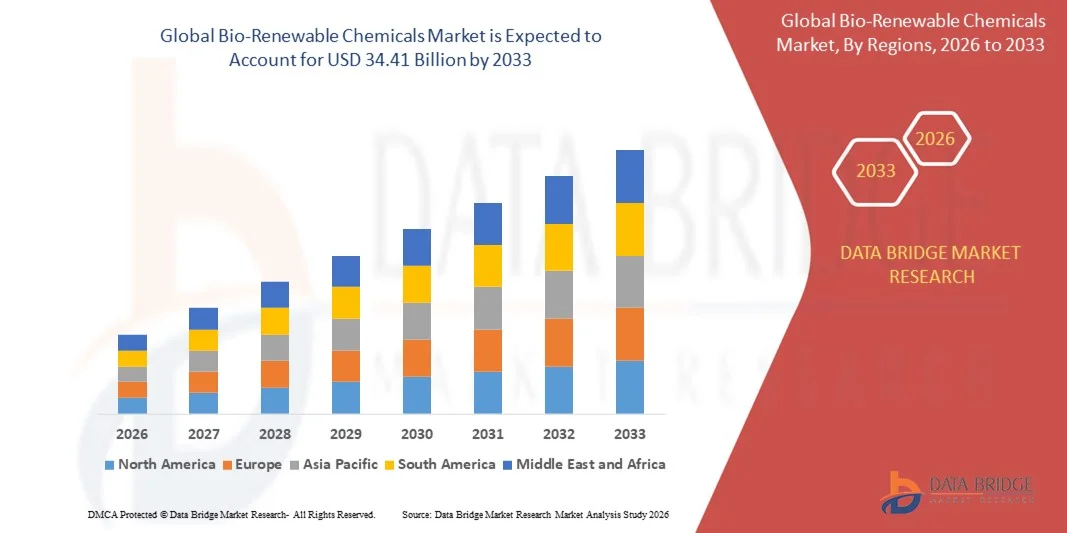
- La taille du marché mondial des produits chimiques biorenouvelables a été évaluée à15,64 milliards de dollars en 2025et devrait atteindre34,41 milliards de dollars en 2033, à unTCAC de 10,36 %pendant la période de prévision
- La croissance du marché est largement alimentée par le passage croissant à des solutions chimiques durables et respectueuses de l'environnement, appuyé par une prise de conscience croissante de la réduction du carbone et la nécessité de remplacer les produits chimiques dérivés du pétrole par des chaînes de valeur industrielles.
- De plus, la demande croissante de matériaux biologiques provenant de l'emballage, de l'alimentation, des soins personnels et des applications industrielles, associée à l'appui réglementaire à la chimie verte et aux pratiques de l'économie circulaire, accélère l'adoption. Ces facteurs convergents renforcent sensiblement la dynamique de croissance du marché des produits chimiques biorenouvelables
Taille du marché et prévisions
- Valeur marchande mondiale (2025):15,64 milliards de dollars
- Valeur marchande prévue (2033) :34,41 milliards de dollars
- Prévisions CAGR (2026-2033):10.36%
Quels sont les principaux débouchés du marché des produits chimiques biorenouvelables
- Les produits chimiques biorenouvelables, dérivés de la biomasse et des matières premières renouvelables, deviennent des composantes essentielles de la fabrication de produits chimiques modernes en raison de leur moindre impact sur l'environnement, de leur biodégradabilité et de leur dépendance réduite à l'égard des ressources fossiles.
- L'adoption croissante de produits chimiques biorenouvelables est principalement motivée par des réglementations environnementales strictes, des engagements accrus en matière de durabilité des entreprises et une préférence croissante des utilisateurs finaux pour des produits écologiques dans les secteurs des consommateurs et de l'industrie.
- L'Asie-Pacifique a dominé le marché des produits chimiques biorenouvelables avec une part de 64,82 %en 2025, en raison de l'industrialisation rapide, de l'expansion des capacités de fabrication de produits biologiques et de l'adoption croissante de produits chimiques durables dans les secteurs de l'emballage, de l'alimentation et des biens de consommation
- L'Amérique du Nord devrait être la région qui connaîtra la croissance la plus rapide sur le marché des produits chimiques biorenouvelables au cours de la période de prévision, en raison de l'augmentation des engagements pris par les entreprises en matière de durabilité, de l'augmentation de la demande de matières plastiques biologiques et des progrès de la biotechnologie industrielle.
- Le segment des acides lactiques a dominé le marché avec une part de marché de 35,5 % en 2025, en raison de son utilisation intensive dans les plastiques biodégradables, la préservation des aliments et les préparations pharmaceutiques. Sa forte demande est soutenue par l'adoption croissante de l'acide polylactique dans les emballages durables et la préférence croissante pour les ingrédients bio-basés dans les industries d'utilisation finale.Acide lactiqueIl bénéficie également de technologies de production bien établies et d'une large acceptation réglementaire, favorisant la commercialisation à grande échelle. Le segment continue de gagner en traction en raison de sa polyvalence et de son alignement avec les objectifs mondiaux de durabilité
Portée du rapport et segmentation du marché des produits chimiques biorenouvelables
|
Attributs |
Produits chimiques biorenouvelables Principales perspectives du marché |
|
Segments couverts |
|
|
Pays couverts |
Amérique du Nord
Europe
Asie-Pacifique
Moyen-Orient et Afrique
Amérique du Sud
|
|
Principaux acteurs du marché |
|
|
Possibilités de marché |
|
|
Infos sur la valeur ajoutée |
En plus des renseignements sur les scénarios du marché tels que la valeur marchande, le taux de croissance, la segmentation, la couverture géographique et les principaux intervenants, les rapports de marché établis par Data Bridge Market Research comprennent aussi l'analyse des exportations d'importations, l'aperçu des capacités de production, l'analyse de la consommation de production, l'analyse des tendances des prix, le scénario du changement climatique, l'analyse de la chaîne d'approvisionnement, l'analyse de la chaîne de valeur, l'aperçu des matières premières et des consommables, les critères de sélection des fournisseurs, l'analyse PESTLE, l'analyse Porter et le cadre réglementaire. |
Quelle est la tendance clé sur le marché des produits chimiques biorenouvelables
L'adoption croissante de produits chimiques de remplacement biofondés et durables
- Une tendance importante sur le marché des produits chimiques biorenouvelables est l'adoption accélérée de solutions de remplacement biofondées aux produits pétrochimiques classiques, motivées par des préoccupations environnementales croissantes et par la poussée mondiale vers la durabilité. Les industries de l'emballage, des biens de consommation et de la fabrication industrielle intègrent de plus en plus les produits chimiques renouvelables pour réduire l'empreinte carbone et améliorer la performance du cycle de vie
- Par exemple, NatureWorks LLC a élargi l'utilisation de son biopolymère Ingeo dérivé de matières premières renouvelables pour des emballages et des produits de consommation durables. Ce changement soutient les engagements de marque envers la neutralité carbone et renforce le rôle des produits chimiques biorenouvelables dans les applications commerciales à grande échelle
- Le secteur de l'emballage intègre de plus en plus de produits chimiques biorenouvelables pour satisfaire aux exigences réglementaires visant à réduire les déchets plastiques et à promouvoir les matériaux compostables. Cette transition renforce la demande de polymères et d'intermédiaires biologiques dans les secteurs de l'alimentation et de l'emballage des consommateurs
- Les principaux fabricants de produits chimiques alignent leurs portefeuilles de produits sur des stratégies de production de carbone renouvelable pour soutenir les objectifs de durabilité à long terme. Les entreprises investissent dans des filières de production à base de bioaffinage et de fermentation pour remplacer les intrants dérivés des fossiles
- La tendance est également évidente dans les formulations de soins personnels et de soins à domicile, où les marques hiérarchisent les ingrédients biodégradables et végétaux pour répondre aux attentes en matière d'étiquetage propre. Cela améliore la viabilité commerciale des tensioactifs biorenouvelables et des produits chimiques spécialisés
- Dans l'ensemble, l'intégration croissante des produits de remplacement biomédicaux dans plusieurs industries renforce la transition vers des chaînes de valeur chimiques plus écologiques et place les produits chimiques biorenouvelables comme facteurs essentiels de la transformation industrielle durable
Dynamique du marché des produits chimiques biorenouvelables
Chauffeur
Réglementation environnementale stricte et objectifs de réduction du carbone
- Une réglementation environnementale stricte visant à réduire les émissions de gaz à effet de serre et à limiter la dépendance aux combustibles fossiles est un moteur important du marché des produits chimiques biorenouvelables. Les gouvernements et les organismes de réglementation appliquent des politiques qui encouragent l ' adoption de matières renouvelables et de pratiques de production de produits chimiques durables
- Par exemple, le Green Deal de l'Union européenne et la réglementation de l'économie circulaire poussent les fabricants à intégrer des produits chimiques bio-basés dans les applications des emballages, de l'automobile et des biens de consommation. Ces politiques influencent directement les décisions en matière d'approvisionnement et accélèrent la demande du marché.
- Les objectifs de durabilité des entreprises renforcent également ce moteur, car les grandes organisations s'engagent à réduire les émissions de la portée 3 par le biais d'un approvisionnement renouvelable. Les entreprises se tournent de plus en plus vers des produits chimiques biorenouvelables pour se conformer aux normes de déclaration et de conformité environnementales
- L'industrie chimique réagit en augmentant les investissements dans les technologies à faible intensité de carbone et l'utilisation des matières premières renouvelables. Cette pression réglementaire modifie les stratégies de production et encourage l'adoption à long terme de solutions de remplacement à base biologique
- À mesure que les cadres réglementaires continueront de se resserrer à l'échelle mondiale, la dépendance à l'égard des produits chimiques renouvelables devrait croître régulièrement. Cette dynamique politique soutenue favorise considérablement l'expansion du marché et la croissance à long terme de l'industrie.
Restriction/Défi
Coûts de production élevés et économies d'échelle limitées
- Le marché des produits chimiques biorenouvelables est confronté à des défis liés aux coûts de production élevés associés au traitement de la biomasse, aux technologies de fermentation et à la purification en aval. Par rapport aux itinéraires pétrochimiques, la production biologique implique souvent une plus grande complexité opérationnelle et des investissements en capital.
- Par exemple, Amyris a dû faire face à des pressions sur les coûts liées à la production de molécules renouvelables à partir de la fermentation, en soulignant les défis financiers liés à l'efficacité commerciale. Ces contraintes de coûts peuvent limiter la compétitivité des prix par rapport aux produits chimiques classiques
- Des économies d'échelle limitées dans certains segments de produits chimiques biorenouvelables limitent davantage l'optimisation des coûts, en particulier pour les produits émergents dont le volume de production est plus faible. Cela affecte la rentabilité et ralentit la pénétration du marché
- La disponibilité des stocks intermédiaires et la volatilité des prix contribuent également à l'incertitude des coûts, en particulier pour les entreprises tributaires des matières premières agricoles. La gestion de la cohérence de la chaîne d'approvisionnement reste un défi opérationnel crucial
- Malgré les progrès technologiques en cours, la réalisation d'une production à grande échelle et rentable demeure une contrainte essentielle. Ces défis font pression sur les fabricants pour qu'ils innovent, optimisent les procédés et s'assurent des stratégies à long terme en matière de matières premières pour soutenir la croissance du marché.
Comment le marché des produits chimiques biorenouvelables est-il segmenté
Le marché est segmenté en fonction du type et de l'application.
- Par type
Sur la base du type, le marché des produits chimiques biorenouvelables est segmenté en acide lactique, acide succinique, acétone, glycérol, etc. Le segment de l'acide lactique a dominé le marché avec la plus grande part de chiffre d'affaires de 35,5% en 2025,plastiques biodégradables, préservation des aliments et formulations pharmaceutiques. Sa forte demande est soutenue par l'adoption croissante de l'acide polylactique dans les emballages durables et la préférence croissante pour les ingrédients bio-basés dans les industries d'utilisation finale. L'acide lactique bénéficie également de technologies de production bien établies et d'une large acceptation réglementaire, favorisant la commercialisation à grande échelle. Le segment continue de gagner en traction en raison de sa polyvalence et de son alignement avec les objectifs mondiaux de durabilité.
On s'attend à ce que le segment de l'acide succinique enregistre le taux de croissance le plus rapide entre 2026 et 2033, alimenté par l'utilisation croissante de polymères, de résines et de solvants à base biologique. Son rôle en tant que plate-forme chimique pour la production de matériaux biodégradables et de produits chimiques spécialisés suscite l'intérêt industriel. Les investissements croissants dans l'infrastructure de bioraffinerie et les progrès dans les technologies de fermentation favorisent la croissance rapide de ce segment dans plusieurs applications.
- Par demande
Sur la base de l'application, le marché des produits chimiques biorenouvelables est segmenté en emballages, aliments et boissons, soins personnels et cosmétiques, industrie chimique, etc. Le segment des emballages a dominé le marché en 2025, soutenu par une forte demande de matériaux durables, compostables et bio-basés comme solutions de rechange aux plastiques conventionnels. La pression réglementaire exercée sur les plastiques à usage unique et l'augmentation des engagements de marque envers les emballages écologiques sont des facteurs clés qui renforcent la domination du segment. Les produits chimiques biorenouvelables sont largement utilisés dans les films, les revêtements et les emballages rigides afin de réduire l'impact environnemental. Le segment bénéficie d'une consommation élevée et d'une innovation continue des produits.
Le secteur des soins personnels et des cosmétiques devrait enregistrer la croissance la plus rapide au cours de la période de prévision, en raison de l'augmentation de la préférence des consommateurs pour les formulations à base de plantes et d'étiquettes propres. Les produits chimiques biorenouvelables sont de plus en plus utilisés chez les surfactants, les émollients et les conservateurs en raison de leur faible toxicité et de leur biodégradabilité. L'expansion des marchés cosmétiques haut de gamme et des réglementations plus strictes sur les ingrédients synthétiques accélèrent l'adoption dans ce segment d'application.
Quelle région détient la plus grande part du marché des produits chimiques biorenouvelables
- L'Asie-Pacifique a dominé le marché des produits chimiques biorenouvelables, avec la plus grande part des revenus de 64,82 % en 2025, sous l'effet d'une industrialisation rapide, de l'expansion des capacités de fabrication de produits biologiques et de l'adoption croissante de produits chimiques durables dans les secteurs des emballages, des denrées alimentaires et des biens de consommation.
- La région bénéficie d'une disponibilité abondante de matières premières agricoles, de capacités de production rentables et d'investissements croissants dans les bioraffineries, favorisant la commercialisation à grande échelle de produits chimiques biorenouvelables
- Les politiques gouvernementales favorables à la promotion de la chimie verte, à la croissance de la fabrication de produits chimiques axés sur l ' exportation et à la sensibilisation à l ' environnement dans les pays en développement accélèrent la croissance des marchés régionaux
Aperçu du marché chinois des produits chimiques biorenouvelables
La Chine détenait la plus grande part du marché des produits chimiques biorenouvelables en Asie et dans le Pacifique en 2025, grâce à sa solide base de fabrication de produits chimiques et à d'importants investissements dans les matériaux biologiques et la biotechnologie industrielle. Le pays met l'accent sur la réduction de la dépendance à l'égard des produits pétrochimiques, combinée à la production à grande échelle de plastiques biodégradables et d'intermédiaires biodégradables, est à l'origine de la demande. L'expansion des applications dans les emballages, les textiles et les produits chimiques industriels renforce encore la position de la Chine sur le marché.
Aperçu du marché indien des produits chimiques biorenouvelables
L'Inde connaît la croissance la plus rapide dans la région de l'Asie et du Pacifique, en raison de l'importance croissante accordée à la durabilité, de l'augmentation de la demande de produits chimiques biologiques dans les secteurs de l'alimentation, des soins personnels et de l'agriculture, et de l'accroissement de la capacité de fabrication nationale. Les initiatives gouvernementales appuyant le développement de la bioéconomie et l'utilisation des matières premières renouvelables stimulent la production. La croissance est également soutenue par une forte production agricole et des investissements accrus dans les technologies de fermentation et de biotraitement.
Perspectives du marché européen des produits chimiques biorenouvelables
Le marché européen des produits chimiques biorenouvelables est en pleine expansion, soutenu par des réglementations environnementales rigoureuses, une forte importance accordée aux pratiques de l'économie circulaire et une forte adoption de matériaux durables dans toutes les industries. La demande est motivée par les fabricants d'emballages, d'automobiles et de biens de consommation qui cherchent à réduire l'empreinte carbone. Les capacités avancées de R-D et l'appui réglementaire à l'innovation biologique continuent de renforcer la croissance régionale.
Allemagne Aperçu du marché des produits chimiques biorenouvelables
Allemagne Le marché des produits chimiques biorenouvelables est déterminé par son leadership dans la fabrication durable de produits chimiques, un écosystème industriel solide de R-D et l'adoption rapide des principes de chimie verte. Le pays met l'accent sur les matériaux bio-basés à haute performance et l'intégration des produits chimiques renouvelables dans les chaînes de valeur industrielles soutient la demande constante. La collaboration entre les entreprises chimiques, les instituts de recherche et les décideurs favorise l'innovation continue.
Aperçu du marché britannique des produits chimiques biorenouvelables
Le marché britannique est soutenu par des investissements croissants dans le développement de la bioéconomie, une demande croissante de produits de consommation durables et une solide collaboration entre les universités et l'industrie. L'accent mis sur la réduction des déchets plastiques et la promotion de solutions de remplacement bio-basées dans l'emballage et les soins personnels conduit à l'adoption. Les objectifs de durabilité soutenus par l'État et le financement de l'innovation soutiennent davantage l'expansion du marché.
Aperçu du marché des produits chimiques biorenouvelables en Amérique du Nord
On prévoit que l'Amérique du Nord augmentera au rythme le plus rapide du TCAC de 2026 à 2033, en raison de l'augmentation des engagements des entreprises en matière de durabilité, de l'augmentation de la demande de matières plastiques à base biologique et des progrès de la biotechnologie industrielle. La forte préférence des consommateurs pour des produits écologiques et l'utilisation accrue de produits chimiques renouvelables dans les applications d'emballage et d'automobile sont des facteurs de croissance clés. L'augmentation des investissements dans l'infrastructure de bioraffinerie appuie davantage l'expansion régionale.
Aperçu du marché américain des produits chimiques biorenouvelables
Les États-Unis ont représenté la plus grande part du marché nord-américain en 2025, avec l'appui d'une industrie chimique bien établie, de solides capacités de R-D et d'importants investissements dans l'innovation biologique. Le pays met l'accent sur la réduction des émissions de gaz à effet de serre et l'amélioration de la viabilité de la chaîne d'approvisionnement accélère l'adoption de produits chimiques biorenouvelables. La présence des principaux acteurs de l'industrie et des technologies de production avancées renforce la position de leader des États-Unis dans la région.
Quelles sont les principales entreprises du marché des produits chimiques biorenouvelables
L'industrie des produits chimiques biorenouvelables est principalement dirigée par des entreprises bien établies, notamment :
- Clariant AG (Suisse)
- Gevo, Inc. (États-Unis)
- Unilever PLC (Royaume-Uni)
- NatureWorks LLC(États-Unis)
- Solvay(Belgique)
- Amyris, Inc. (États-Unis)
- BASE SE(Allemagne)
- Braskem S.A.(Brésil)
- Vizag Chemical (Inde)
- Corbion N.V.(PaysBas)
- DuPont de Nemours, Inc. (États-Unis)
- Cargill, Incorporated (États-Unis)
- ZeaChem, Inc. (États-Unis)
- Elevance Health (États-Unis)
- Novozymes A/S (Danemark)
Quelles sont les dernières évolutions du marché des produits chimiques biorenouvelables
- En janvier 2026, BioBond a introduit BioAdhere SUP250, un adhésif industriel certifié USDA BioPreferred de haute performance, renforçant l'adoption de produits chimiques biorenouvelables dans les applications de collage industriel. Ce lancement met en lumière la tendance croissante à remplacer les adhésifs à base pétrochimique conventionnelle par des solutions de remplacement durables et durables dans les cas d'utilisation de liants métalliques et de verre, favorisant une plus grande acceptation industrielle des matériaux à base bio.
- En décembre 2025, Renaissance BioScience s'est associée à Biome Bioplastiques au Royaume-Uni dans le cadre d'une initiative de 1,5 million de dollars canadiens sur deux ans visant à mettre à l'échelle les bioplastiques renouvelables et à accélérer la commercialisation des polymères à base de bioplastiques. La collaboration reflète l'augmentation des investissements transfrontaliers visant à accroître les capacités de production et à promouvoir l'innovation dans les plastiques durables pour les emballages et les applications pour les consommateurs
- En octobre 2025, Braskem a présenté une nouvelle génération de solutions bio-basées et de produits circulaires au K 2025 à Düsseldorf, renforçant son leadership dans la production industrielle de biopolymère. En découvrant les nouveaux produits lancés et les partenariats entre l'emballage, les soins de santé, l'hygiène et les biens de consommation, l'entreprise a renforcé son élan vers l'adoption à grande échelle de produits chimiques biorenouvelables dans l'industrie mondiale des plastiques
- En juin 2025, HH Chemical a annoncé le lancement de BIODEX®, la première marque de matériaux bio-intégrés au monde, permettant des solutions de matériaux durables de bout en bout. Ce développement favorise la croissance du marché en rationalisant les chaînes d'approvisionnement pour les produits chimiques biorenouvelables et en améliorant l'accessibilité des produits biologiques intégrés dans plusieurs secteurs industriels.
- En février 2022, Clariant a lancé une gamme de surfactants 100 % bio, soutenant la transition vers le carbone renouvelable dans les produits chimiques spécialisés. Cette initiative a joué un rôle clé dans l'adoption rapide de produits chimiques biorenouvelables dans les soins personnels, les soins à domicile et les formulations industrielles, en établissant les bases d'une expansion à long terme du marché.
SKU-
Accédez en ligne au rapport sur le premier cloud mondial de veille économique

- Tableau de bord d'analyse de données interactif
- Tableau de bord d'analyse d'entreprise pour les opportunités à fort potentiel de croissance
- Accès d'analyste de recherche pour la personnalisation et les requêtes
- Analyse de la concurrence avec tableau de bord interactif
- Dernières actualités, mises à jour et analyse des tendances
- Exploitez la puissance de l'analyse comparative pour un suivi complet de la concurrence
Méthodologie de recherche
La collecte de données et l'analyse de l'année de base sont effectuées à l'aide de modules de collecte de données avec des échantillons de grande taille. L'étape consiste à obtenir des informations sur le marché ou des données connexes via diverses sources et stratégies. Elle comprend l'examen et la planification à l'avance de toutes les données acquises dans le passé. Elle englobe également l'examen des incohérences d'informations observées dans différentes sources d'informations. Les données de marché sont analysées et estimées à l'aide de modèles statistiques et cohérents de marché. De plus, l'analyse des parts de marché et l'analyse des tendances clés sont les principaux facteurs de succès du rapport de marché. Pour en savoir plus, veuillez demander un appel d'analyste ou déposer votre demande.
La méthodologie de recherche clé utilisée par l'équipe de recherche DBMR est la triangulation des données qui implique l'exploration de données, l'analyse de l'impact des variables de données sur le marché et la validation primaire (expert du secteur). Les modèles de données incluent la grille de positionnement des fournisseurs, l'analyse de la chronologie du marché, l'aperçu et le guide du marché, la grille de positionnement des entreprises, l'analyse des brevets, l'analyse des prix, l'analyse des parts de marché des entreprises, les normes de mesure, l'analyse globale par rapport à l'analyse régionale et des parts des fournisseurs. Pour en savoir plus sur la méthodologie de recherche, envoyez une demande pour parler à nos experts du secteur.
Personnalisation disponible
Data Bridge Market Research est un leader de la recherche formative avancée. Nous sommes fiers de fournir à nos clients existants et nouveaux des données et des analyses qui correspondent à leurs objectifs. Le rapport peut être personnalisé pour inclure une analyse des tendances des prix des marques cibles, une compréhension du marché pour d'autres pays (demandez la liste des pays), des données sur les résultats des essais cliniques, une revue de la littérature, une analyse du marché des produits remis à neuf et de la base de produits. L'analyse du marché des concurrents cibles peut être analysée à partir d'une analyse basée sur la technologie jusqu'à des stratégies de portefeuille de marché. Nous pouvons ajouter autant de concurrents que vous le souhaitez, dans le format et le style de données que vous recherchez. Notre équipe d'analystes peut également vous fournir des données sous forme de fichiers Excel bruts, de tableaux croisés dynamiques (Fact book) ou peut vous aider à créer des présentations à partir des ensembles de données disponibles dans le rapport.











