


What is the Bio-Renewable Chemicals Market Size and Overview?
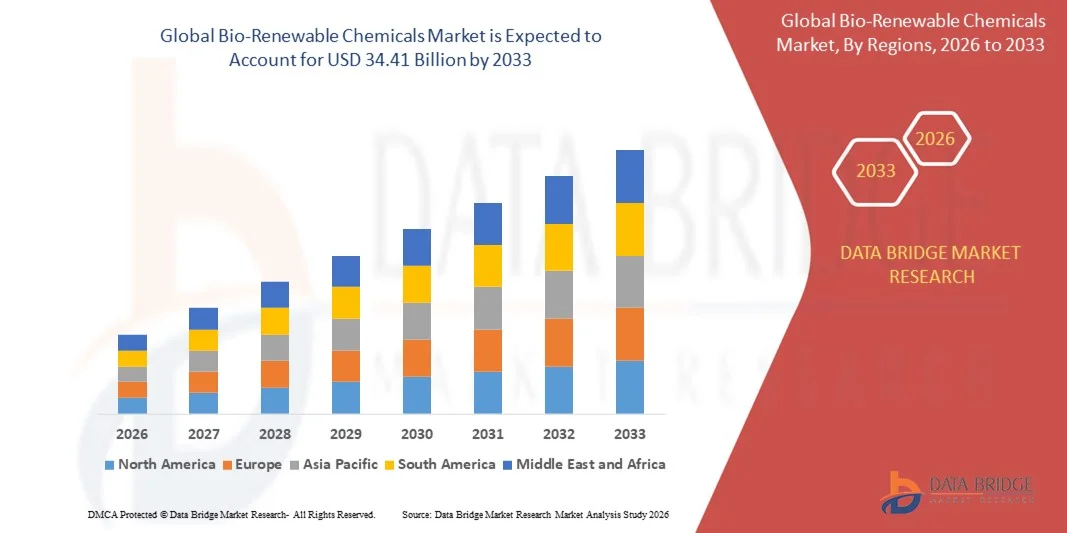
- The global bio-renewable chemicals market size was valued at USD 15.64 billion in 2025 and is expected to reach USD 34.41 billion by 2033, at a CAGR of 10.36% during the forecast period
- The market growth is largely fueled by the increasing shift toward sustainable and environmentally friendly chemical solutions, supported by growing awareness of carbon reduction and the need to replace petroleum-based chemicals across industrial value chains
- Furthermore, rising demand for bio-based materials from packaging, food, personal care, and industrial applications, combined with regulatory support for green chemistry and circular economy practices, is accelerating adoption. These converging factors are significantly strengthening the growth momentum of the bio-renewable chemicals market
Market Size & Forecast
- Global Market Value (2025): USD 15.64 billion
- Expected Market Value (2033): USD 34.41 billion
- Forecast CAGR (2026–2033): 10.36%
What are the Major Takeaways of Bio-Renewable Chemicals Market?
- Bio-renewable chemicals, derived from biomass and renewable feedstocks, are becoming essential components in modern chemical manufacturing due to their lower environmental impact, biodegradability, and reduced dependence on fossil resources
- The expanding adoption of bio-renewable chemicals is primarily driven by stringent environmental regulations, increasing corporate sustainability commitments, and growing end-user preference for eco-friendly products across consumer and industrial sectors
- Asia-Pacific dominated the bio-renewable chemicals market with a share of 64.82% in 2025, due to rapid industrialization, expanding bio-based manufacturing capacity, and increasing adoption of sustainable chemicals across packaging, food, and consumer goods sectors
- North America is expected to be the fastest growing region in the bio-renewable chemicals market during the forecast period due to increasing corporate sustainability commitments, rising demand for bio-based plastics, and advancements in industrial biotechnology
- Lactic acid segment dominated the market with a market share of 35.5% in 2025, due to its extensive use in biodegradable plastics, food preservation, and pharmaceutical formulations. Its strong demand is supported by rising adoption of polylactic acid in sustainable packaging and growing preference for bio-based ingredients across end-use industries. Lactic acid also benefits from well-established production technologies and wide regulatory acceptance, supporting large-scale commercialization. The segment continues to gain traction due to its versatility and alignment with global sustainability goals
Report Scope and Bio-Renewable Chemicals Market Segmentation
|
Attributes |
Bio-Renewable Chemicals Key Market Insights |
|
Segments Covered |
|
|
Countries Covered |
North America
Europe
Asia-Pacific
Middle East and Africa
South America
|
|
Key Market Players |
|
|
Market Opportunities |
|
|
Value Added Data Infosets |
In addition to the insights on market scenarios such as market value, growth rate, segmentation, geographical coverage, and major players, the market reports curated by the Data Bridge Market Research also include import export analysis, production capacity overview, production consumption analysis, price trend analysis, climate change scenario, supply chain analysis, value chain analysis, raw material/consumables overview, vendor selection criteria, PESTLE Analysis, Porter Analysis, and regulatory framework. |
What is the Key Trend in the Bio-Renewable Chemicals Market?
Rising Adoption of Bio-Based and Sustainable Chemical Alternatives
- A prominent trend in the bio-renewable chemicals market is the accelerating adoption of bio-based alternatives to conventional petrochemical products, driven by growing environmental concerns and the global push toward sustainability. Industries across packaging, consumer goods, and industrial manufacturing are increasingly integrating renewable chemicals to reduce carbon footprints and improve lifecycle performance
- For instance, NatureWorks LLC has expanded the use of its Ingeo biopolymer derived from renewable feedstocks for sustainable packaging and consumer products. This shift supports brand commitments to carbon neutrality and reinforces the role of bio-renewable chemicals in large-scale commercial applications
- The packaging sector is increasingly incorporating bio-renewable chemicals to meet regulatory requirements aimed at reducing plastic waste and promoting compostable materials. This transition is strengthening demand for bio-based polymers and intermediates across food and consumer packaging segments
- Major chemical manufacturers are aligning product portfolios with renewable carbon strategies to support long-term sustainability goals. Companies are investing in bio-refining and fermentation-based production routes to replace fossil-derived inputs
- The trend is also evident in personal care and home care formulations, where brands are prioritizing biodegradable and plant-based ingredients to meet clean-label expectations. This is enhancing the commercial viability of bio-renewable surfactants and specialty chemicals
- Overall, the rising integration of bio-based alternatives across multiple industries is reinforcing the transition toward greener chemical value chains and positioning bio-renewable chemicals as critical enablers of sustainable industrial transformation
Bio-Renewable Chemicals Market Dynamics
Driver
Stringent Environmental Regulations and Carbon Reduction Targets
- Stringent environmental regulations aimed at reducing greenhouse gas emissions and limiting fossil fuel dependency are a major driver for the bio-renewable chemicals market. Governments and regulatory bodies are implementing policies that encourage the adoption of renewable materials and sustainable chemical production practices
- For instance, the European Union’s Green Deal and circular economy regulations are pushing manufacturers to incorporate bio-based chemicals in packaging, automotive, and consumer goods applications. These policies are directly influencing procurement decisions and accelerating market demand
- Corporate sustainability targets are also reinforcing this driver, as large organizations commit to lowering Scope 3 emissions through renewable sourcing. Companies are increasingly turning to bio-renewable chemicals to comply with environmental reporting and compliance standards
- The chemical industry is responding by expanding investments in low-carbon technologies and renewable feedstock utilization. This regulatory pressure is reshaping production strategies and encouraging long-term adoption of bio-based alternatives
- As regulatory frameworks continue to tighten globally, the reliance on renewable chemicals is expected to grow steadily. This sustained policy-driven momentum is significantly supporting market expansion and long-term industry growth
Restraint/Challenge
High Production Costs and Limited Economies of Scale
- The bio-renewable chemicals market faces challenges related to high production costs associated with biomass processing, fermentation technologies, and downstream purification. Compared to petrochemical routes, bio-based production often involves higher operational complexity and capital investment
- For instance, Amyris has faced cost pressures linked to scaling fermentation-based production of renewable molecules, highlighting the financial challenges of achieving commercial efficiency. These cost constraints can limit price competitiveness against conventional chemical alternatives
- Limited economies of scale in certain bio-renewable chemical segments further restrict cost optimization, especially for emerging products with smaller production volumes. This affects profitability and slows broader market penetration
- Feedstock availability and price volatility also contribute to cost uncertainty, particularly for companies reliant on agricultural raw materials. Managing supply chain consistency remains a critical operational challenge
- Despite ongoing technological advancements, achieving large-scale, cost-efficient production continues to be a key restraint. These challenges place pressure on manufacturers to innovate, optimize processes, and secure long-term feedstock strategies to sustain market growth
How is the Bio-Renewable Chemicals Market Segmented?
The market is segmented on the basis of type and application.
- By Type
On the basis of type, the bio-renewable chemicals market is segmented into lactic acid, succinic acid, acetone, glycerol, and others. The lactic acid segment dominated the market with the largest revenue share of 35.5% in 2025, driven by its extensive use in biodegradable plastics, food preservation, and pharmaceutical formulations. Its strong demand is supported by rising adoption of polylactic acid in sustainable packaging and growing preference for bio-based ingredients across end-use industries. Lactic acid also benefits from well-established production technologies and wide regulatory acceptance, supporting large-scale commercialization. The segment continues to gain traction due to its versatility and alignment with global sustainability goals.
The succinic acid segment is expected to witness the fastest growth rate from 2026 to 2033, fueled by increasing use in bio-based polymers, resins, and solvents. Its role as a platform chemical for producing biodegradable materials and specialty chemicals is driving industrial interest. Growing investments in bio-refinery infrastructure and advancements in fermentation technologies are further supporting rapid growth of this segment across multiple applications.
- By Application
On the basis of application, the bio-renewable chemicals market is segmented into packaging, food and beverages, personal care and cosmetics, chemical industry, and others. The packaging segment dominated the market in 2025, supported by strong demand for sustainable, compostable, and bio-based materials as alternatives to conventional plastics. Regulatory pressure on single-use plastics and increasing brand commitments toward eco-friendly packaging are key factors reinforcing segment dominance. Bio-renewable chemicals are widely used in films, coatings, and rigid packaging formats to reduce environmental impact. The segment benefits from high-volume consumption and continuous product innovation.
The personal care and cosmetics segment is projected to register the fastest growth during the forecast period, driven by rising consumer preference for natural, plant-based, and clean-label formulations. Bio-renewable chemicals are increasingly used in surfactants, emollients, and preservatives due to their low toxicity and biodegradability. Expanding premium cosmetic markets and stricter regulations on synthetic ingredients are further accelerating adoption in this application segment.
Which Region Holds the Largest Share of the Bio-Renewable Chemicals Market?
- Asia-Pacific dominated the bio-renewable chemicals market with the largest revenue share of 64.82% in 2025, driven by rapid industrialization, expanding bio-based manufacturing capacity, and increasing adoption of sustainable chemicals across packaging, food, and consumer goods sectors
- The region benefits from abundant availability of agricultural feedstock, cost-effective production capabilities, and rising investments in bio-refineries, supporting large-scale commercialization of bio-renewable chemicals
- Supportive government policies promoting green chemistry, growing export-oriented chemical manufacturing, and rising environmental awareness across developing economies are accelerating regional market growth
China Bio-Renewable Chemicals Market Insight
China held the largest share in the Asia-Pacific bio-renewable chemicals market in 2025, supported by its strong chemical manufacturing base and significant investments in bio-based materials and industrial biotechnology. The country’s focus on reducing dependence on petrochemicals, combined with large-scale production of biodegradable plastics and bio-based intermediates, is driving demand. Expanding applications in packaging, textiles, and industrial chemicals further strengthen China’s market position.
India Bio-Renewable Chemicals Market Insight
India is witnessing the fastest growth in the Asia-Pacific region, driven by increasing emphasis on sustainability, rising demand for bio-based chemicals in food, personal care, and agriculture, and expanding domestic manufacturing capacity. Government initiatives supporting bio-economy development and renewable feedstock utilization are boosting production. Growth is further supported by strong agricultural output and increasing investments in fermentation and bio-processing technologies.
Europe Bio-Renewable Chemicals Market Insight
The Europe bio-renewable chemicals market is expanding steadily, supported by stringent environmental regulations, strong emphasis on circular economy practices, and high adoption of sustainable materials across industries. Demand is driven by packaging, automotive, and consumer goods manufacturers seeking to reduce carbon footprints. Advanced R&D capabilities and regulatory support for bio-based innovation continue to strengthen regional growth.
Germany Bio-Renewable Chemicals Market Insight
Germany’s bio-renewable chemicals market is driven by its leadership in sustainable chemical manufacturing, strong industrial R&D ecosystem, and early adoption of green chemistry principles. The country’s focus on high-performance bio-based materials and integration of renewable chemicals into industrial value chains supports steady demand. Collaboration between chemical companies, research institutions, and policymakers fosters continuous innovation.
U.K. Bio-Renewable Chemicals Market Insight
The U.K. market is supported by growing investments in bio-economy development, increasing demand for sustainable consumer products, and strong academic–industry collaboration. Focus on reducing plastic waste and promoting bio-based alternatives in packaging and personal care is driving adoption. Government-backed sustainability targets and innovation funding further support market expansion.
North America Bio-Renewable Chemicals Market Insight
North America is projected to grow at the fastest CAGR from 2026 to 2033, driven by increasing corporate sustainability commitments, rising demand for bio-based plastics, and advancements in industrial biotechnology. Strong consumer preference for eco-friendly products and expanding use of renewable chemicals in packaging and automotive applications are key growth drivers. Increased investments in bio-refinery infrastructure are further supporting regional expansion.
U.S. Bio-Renewable Chemicals Market Insight
The U.S. accounted for the largest share in the North America market in 2025, supported by a well-established chemical industry, strong R&D capabilities, and significant investments in bio-based innovation. The country’s focus on reducing greenhouse gas emissions and enhancing supply chain sustainability is accelerating adoption of bio-renewable chemicals. Presence of major industry players and advanced production technologies reinforces the U.S.’s leading position in the region.
Which are the Top Companies in Bio-Renewable Chemicals Market?
The bio-renewable chemicals industry is primarily led by well-established companies, including:
- Clariant AG (Switzerland)
- Gevo, Inc. (U.S.)
- Unilever PLC (U.K.)
- NatureWorks LLC (U.S.)
- Solvay (Belgium)
- Amyris, Inc. (U.S.)
- BASF SE (Germany)
- Braskem S.A. (Brazil)
- Vizag Chemical (India)
- Corbion N.V. (Netherlands)
- DuPont de Nemours, Inc. (U.S.)
- Cargill, Incorporated (U.S.)
- ZeaChem, Inc. (U.S.)
- Elevance Health (U.S.)
- Novozymes A/S (Denmark)
What are Latest Developments in Bio-Renewable Chemicals Market?
- In January 2026, BioBond introduced BioAdhere SUP250, a high-performance, USDA BioPreferred certified industrial adhesive, strengthening the adoption of bio-renewable chemicals in industrial bonding applications. This launch highlights the growing shift toward replacing conventional petrochemical-based adhesives with durable, sustainable alternatives across metal and glass bonding use cases, supporting wider industrial acceptance of bio-based materials
- In December 2025, Renaissance BioScience partnered with U.K.-based Biome Bioplastics under a two-year CAD$1.5 million initiative to scale renewable bioplastics, accelerating commercialization of bio-based polymers. The collaboration reflects increasing cross-border investments aimed at expanding production capacity and advancing innovation in sustainable plastics for packaging and consumer applications
- In October 2025, Braskem showcased a new generation of bio-based and circular product solutions at K 2025 in Düsseldorf, reinforcing its leadership in industrial-scale biopolymer production. By unveiling new product launches and partnerships across packaging, healthcare, hygiene, and consumer goods, the company strengthened momentum toward large-scale adoption of bio-renewable chemicals in the global plastics industry
- In June 2025, HH Chemical announced the launch of BIODEX®, the world’s first fully integrated bio-based materials brand, enabling end-to-end sustainable material solutions. This development supports market growth by streamlining supply chains for bio-renewable chemicals and improving accessibility of integrated bio-based products across multiple industrial sectors
- In February 2022, Clariant launched a 100% bio-based surfactants range, supporting the transition toward renewable carbon in specialty chemicals. This move played a key role in driving early adoption of bio-renewable chemicals in personal care, home care, and industrial formulations, setting a foundation for long-term market expansion

- Interactive Data Analysis Dashboard
- Company Analysis Dashboard for high growth potential opportunities
- Research Analyst Access for customization & queries
- Competitor Analysis with Interactive dashboard
- Latest News, Updates & Trend analysis
- Harness the Power of Benchmark Analysis for Comprehensive Competitor Tracking
Global Bio Renewable Chemicals Market, Supply Chain Analysis and Ecosystem Framework
To support market growth and help clients navigate the impact of geopolitical shifts, DBMR has integrated in-depth supply chain analysis into its Global Bio Renewable Chemicals Market research reports. This addition empowers clients to respond effectively to global changes affecting their industries. The supply chain analysis section includes detailed insights such as Global Bio Renewable Chemicals Market consumption and production by country, price trend analysis, the impact of tariffs and geopolitical developments, and import and export trends by country and HSN code. It also highlights major suppliers with data on production capacity and company profiles, as well as key importers and exporters. In addition to research, DBMR offers specialized supply chain consulting services backed by over a decade of experience, providing solutions like supplier discovery, supplier risk assessment, price trend analysis, impact evaluation of inflation and trade route changes, and comprehensive market trend analysis.
Data collection and base year analysis are done using data collection modules with large sample sizes. The stage includes obtaining market information or related data through various sources and strategies. It includes examining and planning all the data acquired from the past in advance. It likewise envelops the examination of information inconsistencies seen across different information sources. The market data is analysed and estimated using market statistical and coherent models. Also, market share analysis and key trend analysis are the major success factors in the market report. To know more, please request an analyst call or drop down your inquiry.
The key research methodology used by DBMR research team is data triangulation which involves data mining, analysis of the impact of data variables on the market and primary (industry expert) validation. Data models include Vendor Positioning Grid, Market Time Line Analysis, Market Overview and Guide, Company Positioning Grid, Patent Analysis, Pricing Analysis, Company Market Share Analysis, Standards of Measurement, Global versus Regional and Vendor Share Analysis. To know more about the research methodology, drop in an inquiry to speak to our industry experts.
Data Bridge Market Research is a leader in advanced formative research. We take pride in servicing our existing and new customers with data and analysis that match and suits their goal. The report can be customized to include price trend analysis of target brands understanding the market for additional countries (ask for the list of countries), clinical trial results data, literature review, refurbished market and product base analysis. Market analysis of target competitors can be analyzed from technology-based analysis to market portfolio strategies. We can add as many competitors that you require data about in the format and data style you are looking for. Our team of analysts can also provide you data in crude raw excel files pivot tables (Fact book) or can assist you in creating presentations from the data sets available in the report.













