


Segmentation du marché mondial des équipements d'électrodialyse, par type (électrodialyse continue et électrodialyse par lots), application (dessalement de l'eau de mer, agroalimentaire et pharmaceutique , laboratoire, environnements de recyclage et autres), canal de vente (direct et indirect) - Tendances et prévisions du secteur jusqu'en 2032
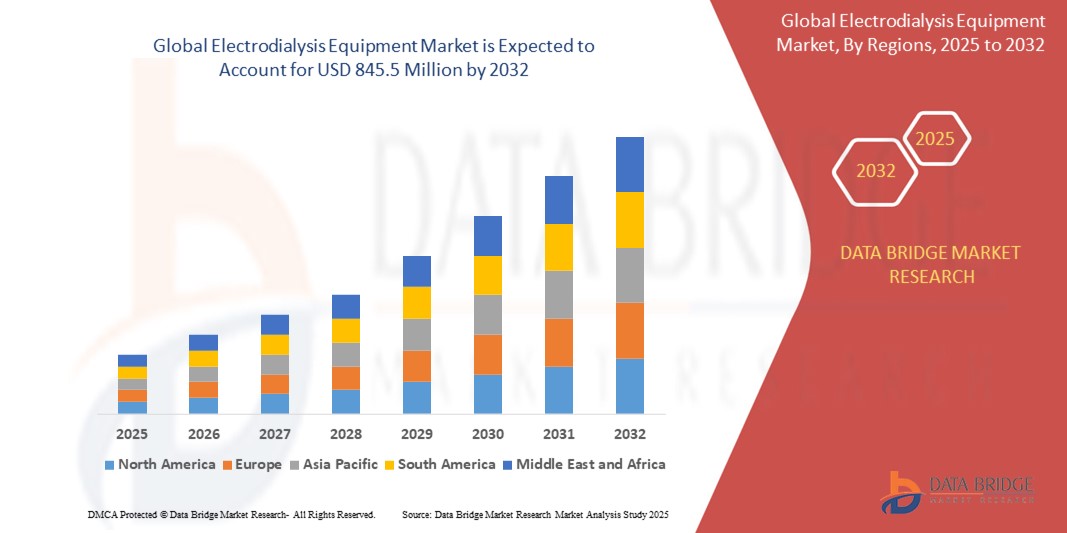
Taille du marché des équipements d'électrodialyse
- La taille du marché mondial des équipements d'électrodialyse était évaluée à 567,92 millions USD en 2024 et devrait atteindre 845,50 millions USD d'ici 2032 , à un TCAC de 5,10 % au cours de la période de prévision.
- L'expansion du marché est largement motivée par le besoin croissant de solutions avancées de traitement de l'eau dans les secteurs industriel, municipal et agricole. La raréfaction croissante de l'eau douce, conjuguée à des réglementations environnementales strictes, incite les industries à adopter des technologies de dessalement efficaces, comme l'électrodialyse.
- De plus, les innovations technologiques en cours, telles que les membranes écoénergétiques, l'optimisation des performances par l'IA et les systèmes de surveillance IoT, améliorent la fiabilité et l'efficacité opérationnelle des systèmes. Ces avancées accélèrent l'adoption mondiale des équipements d'électrodialyse et alimentent une croissance constante du marché.
Analyse du marché des équipements d'électrodialyse
- L'équipement d'électrodialyse, conçu pour l'élimination sélective des ions des solutions aqueuses, devient une solution essentielle dans les applications de dessalement de l'eau saumâtre, de traitement des eaux usées industrielles et de récupération des ressources.
- Le marché est propulsé par la demande croissante d'industries telles que la production d'électricité, l'agroalimentaire, les produits pharmaceutiques et les produits chimiques , qui nécessitent une eau de haute pureté et des solutions de traitement respectueuses de l'environnement.
- La capacité des systèmes d'électrodialyse à offrir une faible utilisation de produits chimiques, une efficacité énergétique élevée et une évolutivité modulaire les rend de plus en plus attractifs par rapport aux technologies traditionnelles telles que l'osmose inverse, en particulier dans les régions confrontées à un stress hydrique ou à des conditions de salinité élevée.
- L'Asie-Pacifique domine le marché des équipements d'électrodialyse avec la plus grande part de revenus de 41,8 % en 2024, tirée par une industrialisation rapide, une population croissante et une demande croissante de technologies de purification de l'eau dans les économies émergentes telles que la Chine, l'Inde et les pays d'Asie du Sud-Est.
- Le marché nord-américain des équipements d'électrodialyse devrait enregistrer le TCAC le plus rapide de 8,3 % entre 2025 et 2032, soutenu par les progrès des technologies de traitement de l'eau, les réglementations environnementales strictes et la demande croissante de systèmes à rejet de liquide nul dans toutes les industries.
- The continuous electrodialysis segment dominated the market with the largest revenue share of 64.7% in 2024, due to its superior efficiency, scalability, and ability to support high-throughput industrial processes
Report Scope and Electrodialysis Equipment Market Segmentation
|
Attributes |
Electrodialysis Equipment Key Market Insights |
|
Segments Covered |
|
|
Countries Covered |
North America
Europe
Asia-Pacific
Middle East and Africa
South America
|
|
Key Market Players |
|
|
Market Opportunities |
|
|
Value Added Data Infosets |
In addition to the insights on market scenarios such as market value, growth rate, segmentation, geographical coverage, and major players, the market reports curated by the Data Bridge Market Research also include in-depth expert analysis, pricing analysis, brand share analysis, consumer survey, demography analysis, supply chain analysis, value chain analysis, raw material/consumables overview, vendor selection criteria, PESTLE Analysis, Porter Analysis, and regulatory framework. |
Electrodialysis Equipment Market Trends
“AI-Powered Optimization and IoT Integration Driving Efficiency”
- A major trend shaping the electrodialysis equipment market is the integration of artificial intelligence (AI) and Internet of Things (IoT) technologies to optimize desalination and water purification processes. These technologies are enabling smarter monitoring, predictive maintenance, and enhanced operational efficiency across industrial, municipal, and agricultural applications
- For instance, GE Water & Process Technologies and Veolia have introduced AI-driven platforms that can track real-time system performance, water quality metrics, and membrane wear, allowing for automated adjustments to ensure optimal efficiency and reduce energy consumption
- AI-enhanced electrodialysis systems can identify fouling risks, optimize ion exchange processes, and schedule membrane cleaning based on predictive analytics. This reduces downtime and extends equipment lifespan, leading to lower operating costs
- The use of IoT-enabled sensors in electrodialysis units enables remote monitoring and control, empowering operators to make real-time decisions, detect anomalies early, and automate data logging for compliance and performance analysis
- Companies such as Suez are leveraging digital twins and AI analytics to create virtual models of electrodialysis plants, enabling scenario simulations and energy optimization strategies before real-world deployment
- The combination of smart monitoring tools, data-driven decision-making, and automated optimization is redefining operational standards in the electrodialysis equipment market, appealing especially to industries looking to lower their environmental footprint and enhance cost-efficiency
Electrodialysis Equipment Market Dynamics
Driver
“Rising Demand for Efficient and Sustainable Water Treatment Solutions”
- The increasing global scarcity of freshwater, growing industrialization, and environmental regulations on wastewater treatment are driving demand for energy-efficient and scalable water purification technologies such as electrodialysis equipment
- For instance, in March 2024, Saltworks Technologies deployed modular electrodialysis systems for brine concentration in oil & gas operations, offering a sustainable alternative to thermal treatment processes
- Industries such as food & beverage, pharmaceuticals, and chemicals are turning to electrodialysis for selective ion removal, low chemical usage, and high recovery rates, making it a preferred method for process water treatment
- Municipal water authorities and desalination plants are increasingly adopting electrodialysis reversal (EDR) systems due to their low energy consumption and adaptability to varying feedwater conditions, especially in areas with brackish or high-salinity water sources
- The push for net-zero water usage and green manufacturing has placed electrodialysis at the center of many companies’ water management strategies, particularly in regions with water stress such as Asia-Pacific and the Middle East
Restraint/Challenge
“High Capital Costs and Technical Complexity”
- Despite its efficiency, electrodialysis technology is associated with high upfront costs, including the price of membranes, electrodes, and specialized control systems. This capital intensity can be a barrier to adoption, especially for small- to mid-sized enterprises and utilities in developing regions
- For instance, while large-scale plants in the U.S. and Japan are investing in next-generation electrodialysis systems, budget constraints in sub-Saharan Africa and Southeast Asia are slowing market penetration
- Another challenge is the technical complexity of maintaining and operating electrodialysis units, which require skilled personnel for system calibration, membrane replacement, and performance monitoring. Inadequate training or lack of automation can lead to reduced efficiency or system failures
- In addition, the limited public awareness and longer return on investment (ROI) compared to conventional systems may deter stakeholders unfamiliar with the technology’s long-term benefits
- Overcoming these barriers will require cost innovation, local manufacturing support, training initiatives, and government incentives or subsidies to encourage sustainable water infrastructure upgrades in cost-sensitive markets
Electrodialysis Equipment Market Scope
The market is segmented on the basis of type, application, and sales channel.
• By Type
On the basis of type, the electrodialysis equipment market is segmented into continuous electrodialysis and batch electrodialysis. The continuous electrodialysis segment dominated the market with the largest revenue share of 64.7% in 2024, owing to its superior efficiency, scalability, and ability to support high-throughput industrial processes. This type is widely used in applications requiring uninterrupted desalination or ion separation, such as wastewater treatment and industrial effluent processing.
The batch electrodialysis segment is anticipated to witness the fastest CAGR from 2025 to 2032, due to its flexibility and cost-efficiency for small-scale operations. It is particularly favored in laboratory and research environments where process control and customization are critical.
• By Application
On the basis of application, the electrodialysis equipment market is segmented into seawater desalination, foods and pharmaceutical, laboratory, recycling environments, and others. The seawater desalination segment held the largest revenue share of 38.9% in 2024, driven by rising global freshwater scarcity and increasing investment in desalination infrastructure, especially in coastal and arid regions.
The foods and pharmaceutical segment is expected to register the fastest CAGR from 2025 to 2032, fueled by stringent purity standards and increasing demand for ion-removal processes in food and drug production. Electrodialysis enables precise separation and purification, making it ideal for sensitive manufacturing environments.
• By Sales Channel
On the basis of sales channel, the electrodialysis equipment market is segmented into direct channel and indirect channel. The direct channel segment dominated with the largest market revenue share of 57.5% in 2024, as major end-users prefer direct procurement from manufacturers for custom installations, technical support, and cost benefits on bulk purchases.
The indirect channel is projected to witness the fastest CAGR from 2025 to 2032, driven by the growth of e-commerce platforms, distributors, and third-party vendors. Indirect channels enhance market accessibility for smaller enterprises and labs by offering flexible purchasing and delivery options.
Electrodialysis Equipment Market Regional Analysis
- Asia-Pacific dominates the electrodialysis equipment market with the largest revenue share of 41.8% in 2024, driven by rapid industrialization, growing population, and rising demand for water purification technologies across emerging economies such as China, India, and Southeast Asian countries
- The region benefits from increasing government investments in water treatment infrastructure and environmental sustainability, especially in industries such as power, chemicals, and food processing
- The expanding manufacturing base, technological advancements, and the cost-effective availability of electrodialysis components further boost adoption across industrial, pharmaceutical, and municipal applications, making Asia-Pacific a global hub for electrodialysis deployment
China Electrodialysis Equipment Market Insight
The China electrodialysis equipment market accounted for the largest revenue share within Asia-Pacific in 2024, fueled by the country’s growing industrial sector, heightened environmental regulations, and national initiatives promoting water reuse and desalination. China's robust investment in green technologies and wastewater treatment facilities continues to drive the uptake of electrodialysis equipment in both municipal and industrial sectors. Furthermore, the presence of domestic manufacturers enhances market affordability and innovation, reinforcing China’s dominance in the regional market.
India Electrodialysis Equipment Market Insight
The India electrodialysis equipment market is projected to grow at the fastest CAGR in Asia-Pacific during the forecast period, driven by increasing freshwater scarcity, urban population growth, and a rising emphasis on decentralized water treatment. The Make in India initiative and industrial development in Tier-II and Tier-III cities are creating new opportunities for electrodialysis solutions. In addition, heightened awareness about water purification and government-supported infrastructure projects are further accelerating market growth.
Japan Electrodialysis Equipment Market Insight
The Japan electrodialysis equipment market is gaining steady momentum due to a strong focus on environmental sustainability, innovation in water treatment technologies, and the country’s high standard for water purity. With growing demand from the pharmaceutical and food industries, Japan is leveraging electrodialysis to ensure high-quality water standards. The country’s aging infrastructure and push toward modernization in water management also promote adoption.
North America Electrodialysis Equipment Market Insight
The North America electrodialysis equipment market is expected to register the fastest CAGR of 8.3% from 2025 to 2032, supported by advancements in water treatment technologies, stringent environmental regulations, and increasing demand for zero-liquid discharge systems across industries. The region’s focus on industrial wastewater reuse, coupled with significant investment in upgrading municipal water treatment facilities, is propelling the use of electrodialysis systems. Moreover, increasing awareness of sustainable water management among U.S. and Canadian enterprises is expected to drive continued growth in the forecast period.
U.S. Electrodialysis Equipment Market Insight
The U.S. electrodialysis equipment market leads the North American region, driven by the demand for reliable water purification systems across power plants, oil refineries, and food & beverage industries. The presence of key manufacturers, regulatory mandates, and a strong R&D ecosystem are enhancing product innovation and commercialization. In addition, increasing adoption of membrane separation technologies as a sustainable alternative to traditional methods is boosting market prospects.
Europe Electrodialysis Equipment Market Insight
The Europe electrodialysis equipment market is expected to grow steadily over the forecast period, propelled by environmental regulations such as the EU Water Framework Directive and growing demand for water recycling solutions. Industrial sectors across Germany, France, and the U.K. are incorporating advanced water treatment systems to comply with sustainability goals. The shift toward green manufacturing and circular water economy practices is further accelerating demand in the region.
Germany Electrodialysis Equipment Market Insight
The Germany electrodialysis equipment market is among the leading in Europe, backed by the country’s strong engineering capabilities, emphasis on environmental stewardship, and rising demand in chemical and pharmaceutical industries. Investments in industrial modernization and eco-friendly technologies, including electrodialysis, are fostering adoption at scale.
Electrodialysis Equipment Market Share
The Electrodialysis Equipment industry is primarily led by well-established companies, including:
- Eurodia (France)
- PCCell GmbH (Germany)
- Evoqua Water Technologies LLC (U.S.)
- General Electric Company (U.S.)
- C-Tech Innovation (U.K.)
- AGC Engineering CO., LTD. (Japan)
- ASTOM Corporation (Japan)
- MEGA group companies (Czechia)
- SnowPure, LLC (U.S.)
- Saltworks Technologies Inc. (Canada)
- Electrosynthesis Company, Inc. (U.S.)
- Separation Technologists (U.S.)
- WGM Systems Import and Export Ltda. (Brazil)
- BWT Holding GmbH (Germany)
- The Innovation Enterprise Ltd. (U.K.)
- Shandong Tianwei Membrane Technology Co. Ltd. (China)
Latest Developments in Global Electrodialysis Equipment Market
- In April 2022, Alstom Corporation entered a partnership with SACE to promote exports and strengthen procurement opportunities for Italian small and medium-sized enterprises. This collaboration is expected to enhance the international competitiveness of Italy’s industrial sector
- In February 2022, AGC Engineering boosted its investments in the development of next-generation power semiconductor materials technology. This move aims to strengthen the company's position in the advanced electronics and energy market
- In February 2022, Saltworks Technologies launched a new ceramic ultrafiltration solution specifically designed for industrial desalination and manufacturing applications. This innovation enhances filtration performance and durability under harsh industrial conditions
- In January 2022, SUEZ Water Technologies and Solutions completed the acquisition of Sentinel Monitoring Systems, expanding its capabilities in real-time water quality monitoring. This strategic acquisition supports SUEZ’s commitment to intelligent and sustainable water management
- In April 2021, Saltworks Technologies introduced its advanced ion-exchange membranes through the FlexEDR system in collaboration with Chile’s VIGAflow. The system, which resists solvents and targets selective ion separations such as chloride removal, simplifies industrial water reuse by eliminating the need for complex pretreatment steps
- In January 2021, MEGA International, a long-standing leader in enterprise architecture software, announced strategic partnerships with SOAINT in Spain, NEXID in Italy, and CREApro in Central Europe. These alliances aim to accelerate digital transformation for European enterprises through localized support and expanded distribution networks
SKU-
Accédez en ligne au rapport sur le premier cloud mondial de veille économique

- Tableau de bord d'analyse de données interactif
- Tableau de bord d'analyse d'entreprise pour les opportunités à fort potentiel de croissance
- Accès d'analyste de recherche pour la personnalisation et les requêtes
- Analyse de la concurrence avec tableau de bord interactif
- Dernières actualités, mises à jour et analyse des tendances
- Exploitez la puissance de l'analyse comparative pour un suivi complet de la concurrence
Méthodologie de recherche
La collecte de données et l'analyse de l'année de base sont effectuées à l'aide de modules de collecte de données avec des échantillons de grande taille. L'étape consiste à obtenir des informations sur le marché ou des données connexes via diverses sources et stratégies. Elle comprend l'examen et la planification à l'avance de toutes les données acquises dans le passé. Elle englobe également l'examen des incohérences d'informations observées dans différentes sources d'informations. Les données de marché sont analysées et estimées à l'aide de modèles statistiques et cohérents de marché. De plus, l'analyse des parts de marché et l'analyse des tendances clés sont les principaux facteurs de succès du rapport de marché. Pour en savoir plus, veuillez demander un appel d'analyste ou déposer votre demande.
La méthodologie de recherche clé utilisée par l'équipe de recherche DBMR est la triangulation des données qui implique l'exploration de données, l'analyse de l'impact des variables de données sur le marché et la validation primaire (expert du secteur). Les modèles de données incluent la grille de positionnement des fournisseurs, l'analyse de la chronologie du marché, l'aperçu et le guide du marché, la grille de positionnement des entreprises, l'analyse des brevets, l'analyse des prix, l'analyse des parts de marché des entreprises, les normes de mesure, l'analyse globale par rapport à l'analyse régionale et des parts des fournisseurs. Pour en savoir plus sur la méthodologie de recherche, envoyez une demande pour parler à nos experts du secteur.
Personnalisation disponible
Data Bridge Market Research est un leader de la recherche formative avancée. Nous sommes fiers de fournir à nos clients existants et nouveaux des données et des analyses qui correspondent à leurs objectifs. Le rapport peut être personnalisé pour inclure une analyse des tendances des prix des marques cibles, une compréhension du marché pour d'autres pays (demandez la liste des pays), des données sur les résultats des essais cliniques, une revue de la littérature, une analyse du marché des produits remis à neuf et de la base de produits. L'analyse du marché des concurrents cibles peut être analysée à partir d'une analyse basée sur la technologie jusqu'à des stratégies de portefeuille de marché. Nous pouvons ajouter autant de concurrents que vous le souhaitez, dans le format et le style de données que vous recherchez. Notre équipe d'analystes peut également vous fournir des données sous forme de fichiers Excel bruts, de tableaux croisés dynamiques (Fact book) ou peut vous aider à créer des présentations à partir des ensembles de données disponibles dans le rapport.











