


Predictive Analytics Market Size
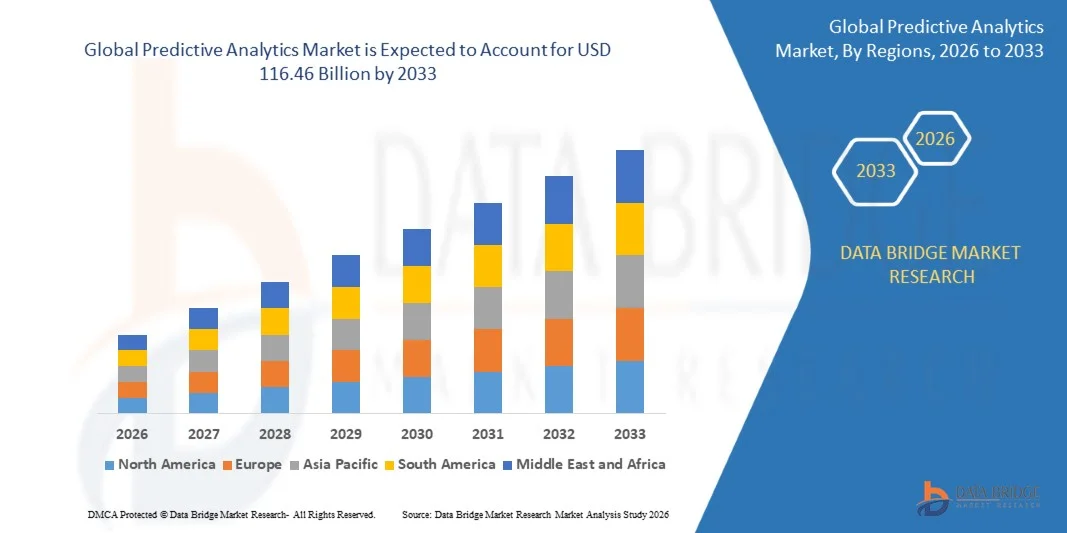
- The global predictive analytics market size was valued at USD 21.49 billion in 2025 and is expected to reach USD 116.46 billion by 2033, at a CAGR of 23.52% during the forecast period
- The market growth is largely fueled by the increasing adoption of data-driven decision-making and technological advancements in AI and machine learning, enabling organizations to leverage predictive insights for operational efficiency, risk management, and strategic planning
- Furthermore, rising demand from enterprises across BFSI, healthcare, retail, and manufacturing for accurate forecasting, trend analysis, and performance optimization is establishing predictive analytics as a critical tool for competitive advantage. These converging factors are accelerating the deployment of predictive analytics solutions, thereby significantly boosting market growth
Predictive Analytics Market Analysis
- Predictive analytics, offering data-driven forecasting and actionable insights through advanced algorithms and statistical models, is becoming an essential component of enterprise analytics strategies across multiple sectors. Its ability to anticipate trends, optimize processes, and improve customer engagement is driving widespread adoption
- The escalating demand for predictive analytics is primarily fueled by digital transformation initiatives, growing volumes of structured and unstructured data, and the increasing reliance of organizations on AI-powered analytics tools for informed decision-making. In addition, the availability of cloud-based and scalable analytics platforms is further enhancing accessibility and adoption across enterprises of all sizes
- North America dominated the predictive analytics market with a share of 33.9% in 2025, due to high adoption of advanced analytics solutions across BFSI, IT, and healthcare sectors
- Asia-Pacific is expected to be the fastest growing region in the predictive analytics market during the forecast period due to increasing digital transformation, rapid urbanization, and rising adoption of cloud-based solutions in countries such as China, Japan, and India
- Solutions segment dominated the market with a market share of 81.1% in 2025, due to the increasing adoption of advanced analytics platforms for decision-making and performance optimization. Organizations leverage predictive analytics solutions to forecast trends, improve operational efficiency, and enhance customer experiences. The demand for solutions is further supported by the integration of machine learning and AI capabilities, enabling more accurate and actionable insights
Report Scope and Predictive Analytics Market Segmentation
|
Attributes |
Predictive Analytics Key Market Insights |
|
Segments Covered |
|
|
Countries Covered |
North America
Europe
Asia-Pacific
Middle East and Africa
South America
|
|
Key Market Players |
|
|
Market Opportunities |
|
|
Value Added Data Infosets |
In addition to the market insights such as market value, growth rate, market segments, geographical coverage, market players, and market scenario, the market report curated by the Data Bridge Market Research team includes in-depth expert analysis, import/export analysis, pricing analysis, production consumption analysis, and pestle analysis. |
Predictive Analytics Market Trends
“Growing Adoption of AI-Driven Predictive Analytics Solutions”
- A significant trend in the predictive analytics market is the increasing deployment of AI-driven predictive analytics platforms across enterprises, driven by the rising need for data-driven decision-making, operational efficiency, and strategic foresight. These solutions enable organizations to analyze large volumes of structured and unstructured data and generate actionable insights that support forecasting, resource optimization, and risk mitigation
- For instance, Microsoft’s Azure Machine Learning and Google Cloud’s Vertex AI provide AI-powered predictive analytics solutions that allow businesses to develop, train, and deploy machine learning models at scale. Such platforms enhance predictive capabilities and accelerate enterprise adoption of data-driven strategies across sectors including finance, healthcare, and retail
- The adoption of predictive analytics in financial services is rapidly increasing as institutions leverage platforms such as FICO’s Analytics Workbench to forecast customer behavior, optimize lending decisions, and mitigate fraud risk. This trend is positioning predictive analytics as a critical component for organizations seeking competitive advantage through intelligent forecasting
- Healthcare organizations are increasingly integrating predictive analytics to enhance patient outcomes, improve operational efficiency, and streamline resource allocation. Tools such as Oracle Analytics Intelligence for Life Sciences enable providers and researchers to unify disparate datasets and derive actionable insights, supporting data-driven decisions in complex clinical and operational environments
- Enterprises in retail and e-commerce are deploying predictive analytics solutions to optimize inventory management, personalize marketing campaigns, and anticipate consumer demand patterns. Platforms such as SAS Viya allow businesses to build predictive models that inform strategy and enhance revenue generation
- The rising adoption of cloud-based predictive analytics solutions is driving market growth, as platforms provided by Amazon Web Services (AWS) and Salesforce enable scalable, cost-effective, and accessible analytics for enterprises of all sizes. This is reinforcing the role of predictive analytics as an essential technology in digital transformation initiatives
Predictive Analytics Market Dynamics
Driver
“Increasing Demand for Data-Driven Decision Making Across Enterprises”
- The growing reliance on data to inform business strategy is driving demand for predictive analytics solutions that can deliver actionable insights and anticipate future trends. Enterprises across BFSI, healthcare, retail, and manufacturing are increasingly leveraging predictive analytics to optimize operations, improve customer experiences, and enhance decision-making accuracy
- For instance, Accenture has integrated predictive analytics into its Cloud First consulting services, enabling clients to utilize AI, machine learning, and data analytics for improved forecasting, operational efficiency, and innovation. Such applications allow organizations to respond proactively to market trends and maintain competitive advantage
- The proliferation of big data and IoT devices is creating immense volumes of information, which predictive analytics platforms transform into meaningful insights. Companies such as Dataiku and Alteryx provide comprehensive analytics environments that enable organizations to harness data at scale for predictive modeling and performance optimization
- Enterprises are increasingly investing in predictive analytics to minimize risk and anticipate potential challenges. In banking, for instance, predictive tools offered by SAS and FICO help forecast credit defaults and fraud incidents, ensuring proactive risk mitigation and regulatory compliance
- The demand for AI-augmented analytics, combined with cloud-based deployment models, is enabling enterprises to deploy predictive solutions more efficiently, reducing dependency on in-house IT infrastructure and enhancing scalability. These factors collectively are reinforcing predictive analytics as a core enabler of data-driven business transformation
Restraint/Challenge
“Complexity of Integrating Predictive Analytics with Legacy Systems”
- The predictive analytics market faces challenges due to the complexity of integrating advanced analytics solutions with existing legacy IT systems and enterprise applications. Many organizations rely on older infrastructure that may lack compatibility with modern AI-powered platforms, making deployment and data integration difficult
- For instance, large enterprises attempting to implement predictive analytics platforms from SAP or Oracle often encounter issues connecting these solutions with legacy ERP or CRM systems, requiring substantial customization and IT investment. This increases deployment time and overall project costs, potentially slowing adoption
- Ensuring data quality, consistency, and accessibility across multiple legacy and modern systems remains a critical challenge, as predictive analytics models require clean, structured, and real-time data to generate accurate insights. Integration efforts may also involve migrating on-premises data to cloud platforms, which adds technical complexity and security considerations
- The lack of standardized integration protocols across software vendors and platforms further complicates seamless deployment, forcing enterprises to engage specialized IT teams or consulting services to bridge gaps. This challenge can limit predictive analytics adoption, particularly in organizations with extensive legacy infrastructure
- Scaling predictive analytics across multiple business units while maintaining compatibility with legacy systems remains a restraint, emphasizing the need for solutions that simplify integration, reduce technical barriers, and deliver measurable value across the enterprise
Predictive Analytics Market Scope
The market is segmented on the basis of component, deployment model, organization size, and end-user.
• By Component
On the basis of component, the predictive analytics market is segmented into solutions and services. The solutions segment dominated the market with the largest revenue share of 81.1% in 2025, driven by the increasing adoption of advanced analytics platforms for decision-making and performance optimization. Organizations leverage predictive analytics solutions to forecast trends, improve operational efficiency, and enhance customer experiences. The demand for solutions is further supported by the integration of machine learning and AI capabilities, enabling more accurate and actionable insights. Vendors offering comprehensive platforms with real-time analytics and visualization tools have contributed to the strong market presence of the solutions segment. Scalability and compatibility with existing IT infrastructure also reinforce the preference for solutions over standalone services.
The services segment is expected to witness the fastest growth from 2026 to 2033, fueled by the rising need for consulting, deployment, and maintenance support for predictive analytics implementations. For instance, companies such as IBM provide professional services that help organizations deploy predictive models and optimize their analytics strategies. Services including data integration, model customization, and post-deployment support are increasingly critical for businesses with limited in-house expertise. Cloud-based service offerings enhance accessibility and reduce upfront costs, driving adoption among enterprises seeking flexible analytics solutions. In addition, managed services ensure continuous updates and scalability, making them a preferred choice for dynamic business environments.
• By Deployment Model
On the basis of deployment model, the predictive analytics market is segmented into on-premises and cloud. The on-premises segment dominated the market in 2025, primarily due to the strong demand from highly regulated industries requiring strict data security and control. Enterprises in sectors such as BFSI and government prefer on-premises deployment for sensitive data handling, compliance adherence, and full control over analytics workflows. The segment benefits from existing IT infrastructure investments and offers customization capabilities to align with organizational policies and security standards. High integration with internal databases and legacy systems further strengthens the adoption of on-premises solutions. Organizations with large-scale operations often prefer on-premises deployment to maintain consistent performance and minimize latency issues.
The cloud segment is projected to witness the fastest growth from 2026 to 2033, driven by its scalability, flexibility, and cost-effectiveness for organizations of all sizes. For instance, Microsoft Azure’s predictive analytics cloud services allow enterprises to deploy models without heavy upfront infrastructure investment. Cloud deployment enables real-time insights, remote access, and easy integration with third-party applications, accelerating decision-making processes. The growing trend of hybrid cloud environments and SaaS adoption further fuels the segment’s expansion. In addition, cloud-based predictive analytics supports rapid updates and advanced AI functionalities, making it appealing for businesses seeking agility and innovation.
• By Organization Size
On the basis of organization size, the predictive analytics market is segmented into small and medium-sized enterprises (SMEs) and large enterprises. Large enterprises dominated the market in 2025, holding the largest revenue share due to their extensive data ecosystems and higher adoption of advanced analytics technologies. These organizations leverage predictive analytics to optimize operations, reduce costs, improve customer retention, and gain competitive advantage across multiple business units. Large enterprises also have the resources to invest in robust infrastructure, skilled personnel, and custom analytics solutions. The ability to handle massive datasets and integrate analytics into strategic decision-making further strengthens their dominance. High-profile deployments in sectors such as finance, telecommunications, and manufacturing underscore the prominence of large enterprises in the market.
The SME segment is expected to witness the fastest growth from 2026 to 2033, driven by the increasing availability of affordable and user-friendly predictive analytics solutions. For instance, companies such as SAS offer scalable analytics tools tailored for SMEs to enable data-driven decisions without complex IT infrastructure. SMEs are increasingly adopting cloud-based analytics and subscription-based services to overcome budget and expertise limitations. Predictive analytics helps SMEs improve operational efficiency, enhance marketing strategies, and forecast demand trends effectively. In addition, the rising awareness of the benefits of AI-driven insights is fueling faster adoption among small and medium businesses globally.
• By End User
On the basis of end user, the predictive analytics market is segmented into BFSI, telecommunications and IT, retail and e-commerce, healthcare and life sciences, manufacturing, government and defense, energy and utilities, transportation and logistics, and others. The BFSI segment dominated the market in 2025, driven by the critical need for risk management, fraud detection, customer analytics, and regulatory compliance. Banks, insurance providers, and investment firms utilize predictive analytics to anticipate market trends, optimize portfolios, and enhance customer engagement. The sector also benefits from the integration of AI and machine learning into predictive models, providing faster and more accurate insights. BFSI organizations often have structured and high-volume data sets, making predictive analytics highly effective for strategic decision-making. Partnerships with leading analytics providers further reinforce the dominance of this end-user segment.
The retail and e-commerce segment is projected to witness the fastest growth from 2026 to 2033, fueled by the increasing need for personalized customer experiences, demand forecasting, and inventory optimization. For instance, Amazon leverages predictive analytics to recommend products, optimize pricing, and streamline logistics, driving sales and customer satisfaction. Predictive models help retailers analyze consumer behavior, identify trends, and make informed marketing decisions. The rapid growth of online shopping and digital payment adoption further accelerates the demand for predictive analytics in this sector. In addition, predictive analytics enables real-time decision-making for promotions, supply chain management, and customer retention strategies, making it highly valuable for retail and e-commerce enterprises.
Predictive Analytics Market Regional Analysis
- North America dominated the predictive analytics market with the largest revenue share of 33.9% in 2025, driven by high adoption of advanced analytics solutions across BFSI, IT, and healthcare sectors
- Organizations in the region are increasingly leveraging predictive analytics to optimize operations, enhance customer engagement, and improve decision-making capabilities. The market growth is further supported by the presence of leading analytics software providers, robust IT infrastructure, and high awareness of data-driven strategies
- U.S. enterprises are particularly investing in AI and machine learning-powered predictive solutions to gain a competitive edge. The widespread integration of cloud-based analytics platforms and real-time data processing solutions further establishes predictive analytics as a strategic priority
U.S. Predictive Analytics Market Insight
The U.S. predictive analytics market captured the largest revenue share in North America in 2025, fueled by increasing digital transformation initiatives and growing reliance on data-driven decision-making. Enterprises are adopting predictive analytics to forecast trends, mitigate risks, and enhance operational efficiency. For instance, IBM and SAS provide advanced predictive analytics platforms that help U.S. companies optimize supply chains, detect fraud, and improve customer personalization. The expanding use of cloud-based solutions and AI integration further drives adoption across BFSI, healthcare, and retail sectors. In addition, the strong focus on smart technologies and automation amplifies the demand for predictive analytics solutions in both commercial and government applications.
Europe Predictive Analytics Market Insight
The Europe predictive analytics market is projected to expand at a substantial CAGR throughout the forecast period, driven by increasing digitalization, regulatory compliance requirements, and the growing emphasis on data-driven decision-making. Organizations across BFSI, manufacturing, and retail sectors are adopting predictive analytics to enhance efficiency, forecast demand, and reduce operational risks. The presence of mature IT infrastructure, strong technological expertise, and a focus on innovation further support market growth. For instance, SAP provides predictive analytics solutions that enable European enterprises to improve operational insights and business strategy planning. The increasing deployment of cloud-based analytics platforms and AI-enabled tools across enterprises is contributing to significant market expansion.
U.K. Predictive Analytics Market Insight
The U.K. predictive analytics market is anticipated to grow at a noteworthy CAGR during the forecast period, driven by widespread adoption of digital transformation strategies and advanced analytics in organizations. Companies are investing in predictive solutions to optimize marketing campaigns, improve customer retention, and enhance operational efficiency. Concerns regarding risk management and data-driven compliance are further motivating enterprises to implement predictive analytics tools. For instance, Deloitte offers analytics consulting services that help U.K. firms leverage predictive insights for strategic decision-making. The growing adoption of cloud-based and AI-integrated predictive platforms is expected to sustain market growth across sectors.
Germany Predictive Analytics Market Insight
The Germany predictive analytics market is expected to expand at a considerable CAGR during the forecast period, fueled by the country’s advanced manufacturing sector, strong IT infrastructure, and growing digitalization in enterprises. Organizations are increasingly deploying predictive analytics to optimize production, improve customer engagement, and support innovation initiatives. Germany’s emphasis on precision, operational efficiency, and compliance with data privacy regulations strengthens market adoption. For instance, SAP and T-Systems provide predictive analytics solutions that enable German companies to enhance business intelligence and forecasting capabilities. The integration of predictive analytics with AI and IoT systems in industrial and commercial sectors further propels growth.
Asia-Pacific Predictive Analytics Market Insight
The Asia-Pacific predictive analytics market is poised to grow at the fastest CAGR during the forecast period of 2026 to 2033, driven by increasing digital transformation, rapid urbanization, and rising adoption of cloud-based solutions in countries such as China, Japan, and India. Organizations across BFSI, retail, and manufacturing sectors are leveraging predictive analytics to improve decision-making, forecast trends, and optimize operations. Government initiatives promoting data-driven governance and smart cities further accelerate adoption. For instance, Microsoft and Oracle provide predictive analytics platforms widely adopted across APAC enterprises. The growing technology ecosystem and increasing availability of affordable solutions contribute to strong market expansion.
Japan Predictive Analytics Market Insight
The Japan predictive analytics market is gaining momentum due to high technological adoption, digital transformation initiatives, and the increasing need for operational efficiency across enterprises. Organizations are deploying predictive solutions to forecast demand, enhance customer experience, and optimize logistics and supply chains. For instance, NEC and Fujitsu offer predictive analytics solutions that integrate AI and machine learning for smarter decision-making. The focus on automation, smart manufacturing, and data-driven business strategies further propels market growth in both corporate and government sectors. Moreover, Japan’s aging workforce is encouraging companies to adopt predictive analytics to maintain productivity and efficiency.
China Predictive Analytics Market Insight
The China predictive analytics market accounted for the largest revenue share in Asia-Pacific in 2025, attributed to the country’s expanding digital economy, rapid urbanization, and high adoption of analytics solutions across BFSI, retail, and manufacturing sectors. Organizations are increasingly utilizing predictive analytics to optimize operations, enhance customer engagement, and support smart city initiatives. For instance, Alibaba Cloud and Huawei provide predictive analytics platforms widely used across enterprises in China. The government’s focus on digitalization, combined with strong technology infrastructure and growing cloud adoption, further drives market growth. Availability of cost-effective solutions and strong domestic vendors are contributing factors for the robust expansion of predictive analytics in China.
Predictive Analytics Market Share
The predictive analytics industry is primarily led by well-established companies, including:
- Microsoft (U.S.)
- Oracle (U.S.)
- SAP SE (Germany)
- SAS Institute Inc. (U.S.)
- Google (U.S.)
- Salesforce (U.S.)
- Amazon Web Services, Inc. (U.S.)
- Hewlett Packard Enterprise Development LP (U.S.)
- Teradata (U.S.)
- Alteryx, Inc. (U.S.)
- FICO (U.S.)
- Altair Engineering, Inc. (U.S.)
- Domo, Inc. (U.S.)
- Cloudera, Inc. (U.S.)
- Board International (Switzerland)
- TIBCO Software Inc. (U.S.)
- Hitachi Vantara LLC (Japan)
- Happiest Minds (India)
- Dataiku (France)
- QlikTech International AB (Sweden)
Latest Developments in Global Predictive Analytics Market
- In December 2025, Accenture expanded its capabilities by integrating Nextira’s AI, machine learning, and data analytics expertise into its Cloud First engineering suite — This acquisition strengthens Accenture’s ability to deliver enhanced predictive analytics and cloud-native solutions across industries, enabling clients to achieve more accurate forecasting and data-driven outcomes. By embedding Nextira’s predictive analytics strengths, Accenture can offer deeper insight generation and faster analytics deployment at scale, which accelerates adoption of predictive tools across digital transformation initiatives
- In March 2025, 9fin completed the acquisition of Bond Radar, enhancing its debt markets analytics platform with 20 years of historical primary issuance data. This acquisition improves predictive modeling capabilities for financial institutions by combining extensive historical datasets with machine learning-driven analysis, enabling more accurate predictions of bond market trends and investment opportunities. The integration significantly strengthens 9fin’s analytics offerings and exemplifies how data enrichment strategies amplify predictive analytics value in financial services
- In 2025, ZestyAI expanded its predictive analytics solutions in insurance risk assessment by launching advanced AI models and securing regulatory approvals for new use cases such as non-weather water damage claims. By broadening its portfolio beyond wildfire modeling to include storm and water risk predictive tools, ZestyAI has enhanced risk forecasting precision for insurers, supporting better underwriting decisions and regulatory compliance. This expansion illustrates the growing influence of predictive analytics in specialized industry applications, particularly in risk-sensitive sectors such as insurance
- In October 2024, Oracle launched Oracle Analytics Intelligence for Life Sciences, an AI-powered cloud analytics platform designed to unify disparate data sets into a cohesive workspace. This innovation improves the efficiency of insight generation for clinical research and healthcare analytics, enabling life sciences organizations to accelerate data-driven decisions. By integrating predictive analytics directly with life sciences workflows, Oracle’s platform enhances cross-domain data interpretation and supports more dynamic research outcomes, reinforcing the role of predictive analytics in complex data environments
- In June 2023, Accenture acquired Nextira, an AWS Premier Partner specializing in predictive analytics and cloud innovation, bolstering its cloud-based analytics service portfolio. The acquisition equipped Accenture with advanced analytics and immersive experience capabilities, enabling clients to leverage predictive insights more effectively and scale analytic solutions across operations. This strategic move has driven broader adoption of cloud-centric predictive analytics solutions and expanded service offerings for data strategy and AI implementations across sectors

- Interactive Data Analysis Dashboard
- Company Analysis Dashboard for high growth potential opportunities
- Research Analyst Access for customization & queries
- Competitor Analysis with Interactive dashboard
- Latest News, Updates & Trend analysis
- Harness the Power of Benchmark Analysis for Comprehensive Competitor Tracking
Data collection and base year analysis are done using data collection modules with large sample sizes. The stage includes obtaining market information or related data through various sources and strategies. It includes examining and planning all the data acquired from the past in advance. It likewise envelops the examination of information inconsistencies seen across different information sources. The market data is analysed and estimated using market statistical and coherent models. Also, market share analysis and key trend analysis are the major success factors in the market report. To know more, please request an analyst call or drop down your inquiry.
The key research methodology used by DBMR research team is data triangulation which involves data mining, analysis of the impact of data variables on the market and primary (industry expert) validation. Data models include Vendor Positioning Grid, Market Time Line Analysis, Market Overview and Guide, Company Positioning Grid, Patent Analysis, Pricing Analysis, Company Market Share Analysis, Standards of Measurement, Global versus Regional and Vendor Share Analysis. To know more about the research methodology, drop in an inquiry to speak to our industry experts.
Data Bridge Market Research is a leader in advanced formative research. We take pride in servicing our existing and new customers with data and analysis that match and suits their goal. The report can be customized to include price trend analysis of target brands understanding the market for additional countries (ask for the list of countries), clinical trial results data, literature review, refurbished market and product base analysis. Market analysis of target competitors can be analyzed from technology-based analysis to market portfolio strategies. We can add as many competitors that you require data about in the format and data style you are looking for. Our team of analysts can also provide you data in crude raw excel files pivot tables (Fact book) or can assist you in creating presentations from the data sets available in the report.













