


Global High Temperature Plastics Market, By Type (Polysulfones, Polyimides, Polyphenylene Sulfide, Fluoropolymers, Others), Application (Electrical & Electronic, Transportation, Industrial, Medical, and Others), Country (U.S., Canada, Mexico, Brazil, Argentina, Rest of South America, Germany, France, Italy, U.K., Belgium, Spain, Russia, Turkey, Netherlands, Switzerland, Rest of Europe, Japan, China, India, South Korea, Australia, Singapore, Malaysia, Thailand, Indonesia, Philippines, Rest of Asia-Pacific, U.A.E, Saudi Arabia, Egypt, South Africa, Israel, Rest of the Middle East and Africa) Industry Trends and Forecast to 2029
Quelle est la taille du marché des plastiques à haute température et le taux de croissance
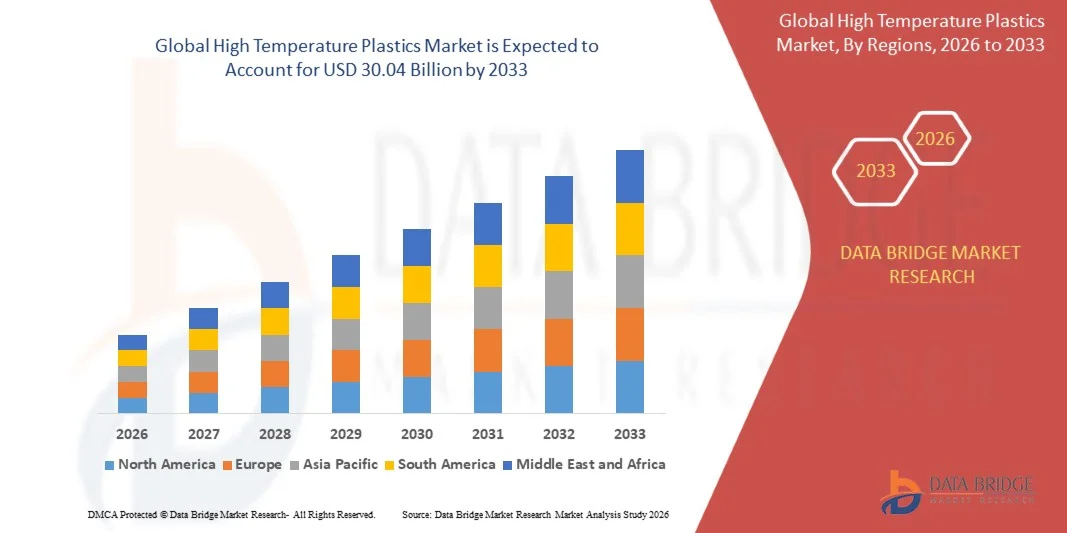
- Selon Data Bridge études de marché Analyse La taille du marché mondial des plastiques à haute température a été évaluée à19,50 milliards de dollars en 2025et devrait atteindre30,04 milliards de dollars en 2033, à unTCAC de 5,55%pendant la période de prévision
- La croissance du marché est largement alimentée par la demande croissante deléger, haute performanceetrésistant à la chaleurmatériaux dans les secteurs de l'automobile, de l'aérospatiale, de l'électronique et de l'industrie, favorisant l'adoption de plastiques à haute température dans les applications critiques
- De plus, l'accent croissant mis sur l'efficacité énergétique, la miniaturisation des composants électroniques et les exigences rigoureuses en matière de résistance thermique et chimique poussent les fabricants à remplacer les métaux et les plastiques conventionnels par des polymères à haute température avancés. Ces facteurs convergents accélèrent l'adoption de plastiques à haute performance, ce qui stimule considérablement la croissance de l'industrie.
Taille du marché et prévisions
- Valeur marchande mondiale (2025):19,50 milliards de dollars
- Valeur marchande prévue (2033) :30,04 milliards de dollars
- Prévisions CAGR (2026-2033):5.55%
Analyse du marché des plastiques à haute température
- Les plastiques à haute température sont des polymères d'ingénierie capables de résister aux températures élevées tout en maintenant la résistance mécanique, la résistance chimique et la stabilité dimensionnelle. Ils sont utilisés dans des composants tels que des pièces pour l'automobile, des connecteurs électriques, des assemblages aérospatiaux et des machines industrielles
- La demande croissante de ces plastiques est principalement alimentée par l'industrialisation rapide, l'électrification des véhicules, l'avancement de l'électronique et l'adoption croissante de matériaux légers et durables pour améliorer les performances et l'efficacité dans les applications critiques
- L'Asie-Pacifique a dominé le marché des plastiques à haute température avec une part de 47,2%en 2025, en raison de l'expansion de la fabrication automobile, électronique et aérospatiale, de l'adoption croissante de matériaux légers et de haute performance, et d'une forte présence de pôles de production de polymères
- L'Amérique du Nord devrait être la région qui connaît la croissance la plus rapide du marché des plastiques à haute température au cours de la période de prévision en raison de la forte demande de polymères à haute performance dans les secteurs de l'automobile, de l'électronique, de l'aérospatiale et de la médecine.
- Le segment électrique et électronique a dominé le marché avec une part de marché de 41,7 % en 2025, en raison du besoin croissant de composants pouvant supporter des températures élevées et des contraintes mécaniques. Les plastiques à haute température sont largement utilisés dans l'isolation, les connecteurs, la fabrication de semi-conducteurs et les circuits flexibles. Leur fiabilité sous cycle thermique continu et leur exposition aux produits chimiques en font un choix privilégié pour l'électronique critique
Étendue du rapport et segmentation du marché des plastiques à haute température
|
Attributs |
Plastiques haute température Principales perspectives du marché |
|
Segments couverts |
|
|
Pays couverts |
Amérique du Nord
Europe
Asie-Pacifique
Moyen-Orient et Afrique
Amérique du Sud
|
|
Principaux acteurs du marché |
|
|
Possibilités de marché |
|
|
Infos sur la valeur ajoutée |
|
Quelle est la tendance clé du marché des plastiques à haute température
Augmentation de l'adoption de matériaux résistants à la chaleur
- Une tendance significative sur le marché des plastiques à haute température est l'adoption croissante de polymères capables de résister aux conditions thermiques extrêmes, entraînée par la demande croissante dans les applications automobiles, aérospatiales et électroniques. Ces matériaux sont de plus en plus utilisés pour les composants exposés à une chaleur élevée, à des environnements chimiques ou à des contraintes mécaniques, assurant ainsi une plus longue durée de vie et une plus grande fiabilité opérationnelle.
- Par exemple, Solvay fournit des résines de polyéthérékétone (PEEK) et de sulfure de polyphénylène (PPS) à haute performance qui sont utilisées dans les systèmes de combustible aérospatial et les composants de l'automobile en sous-état. Ces matériaux permettent aux ingénieurs de concevoir des pièces plus légères et plus durables qui conservent leur résistance à des températures élevées
- La demande de plastiques résistants à la chaleur dans l'électronique augmente, car les composants nécessitent des matériaux qui empêchent la déformation et maintiennent la stabilité dimensionnelle sous la chaleur. Cette tendance est de positionner les plastiques à haute température comme des catalyseurs critiques pour les solutions avancées d'emballage électronique et de gestion thermique
- Des industries comme les dispositifs médicaux et les machines industrielles intègrent ces plastiques pour des composants exposés à la chaleur de haute précision, où des propriétés telles que la résistance chimique et la stabilité dimensionnelle sont essentielles. Cela stimule l'innovation dans les formulations de polymères adaptées aux applications spécialisées
- Le marché assiste à un virage vers des plastiques de génie qui combinent résistance thermique, ignifuge et résistance mécanique. Ceci permet une application plus large dans les secteurs des transports, de l'énergie et de l'industrie où les plastiques conventionnels échouent dans des conditions extrêmes
- Les plastiques à haute température sont de plus en plus considérés comme essentiels pour une fabrication durable, car leur durabilité et leur résistance réduisent la fréquence d'entretien et prolongent la durée de vie du produit. Cela renforce leur importance stratégique dans les industries en quête d'efficacité et de fiabilité dans les environnements à forte contrainte
Dynamique du marché des plastiques à haute température
Chauffeur
L'augmentation de la demande des applications automobiles et aérospatiales
- La demande de plastiques à haute température est déterminée par les secteurs de l'automobile et de l'aérospatiale, où les composants sont exposés à des températures extrêmes, des frottements et des contraintes mécaniques. Ces applications nécessitent des matériaux qui maintiennent l'intégrité en cas d'exposition à la chaleur à long terme tout en réduisant le poids global du système
- Par exemple, Victrex fournit des solutions basées sur PEEK largement utilisées dans les composants aérospatiaux et les systèmes de carburant automobile pour réduire le poids sans compromettre les performances. Leurs polymères permettent aux fabricants de respecter des normes plus strictes en matière d'efficacité énergétique et d'émissions
- La poussée pour les véhicules légers et économes en énergie accélère encore l'utilisation de ces polymères dans les pièces du moteur, les connecteurs électriques et les applications de niveau inférieur. Les plastiques à haute température aident à atteindre les objectifs de performance tout en soutenant les objectifs de durabilité
- Les fabricants aérospatials adoptent de plus en plus ces plastiques dans les composants intérieurs, les supports structuraux et les systèmes de manutention des fluides en raison de leur rapport résistance-poids et de leur stabilité thermique. Cette tendance souligne le rôle des polymères dans le respect des normes de sécurité et de performance exigeantes
- Des secteurs industriels tels que l'électronique et le stockage d'énergie intègrent également des plastiques résistants à la chaleur pour l'isolation, les circuits et les composants de batterie, permettant des performances fiables dans des environnements à haute température. Cette large absorption industrielle renforce le potentiel global de croissance du marché
Restriction/Défi
Coûts de production élevés limitant l'adoption généralisée
- Le marché des plastiques à haute température est confronté à des défis en raison des coûts élevés associés aux matières premières, au traitement et à l'équipement spécialisé. Ces facteurs limitent l'adoption dans les applications sensibles aux coûts et créent une pression sur les fabricants pour équilibrer les performances et l'économie
- Par exemple, des entreprises comme SABIC investissent dans des technologies d'extrusion et de moulage de pointe pour produire des composantes PEEK et SPA, ce qui entraîne des dépenses en capital et des coûts opérationnels importants. Cette complexité peut limiter l'échelle des marchés où la tolérance budgétaire est moindre
- Le traitement de ces matériaux nécessite souvent un contrôle précis de la température et des outils spécialisés, ce qui accroît les difficultés de production et la consommation d'énergie. Ces exigences élèvent les coûts unitaires et limitent la compétitivité des plastiques à haute température par rapport aux plastiques classiques de génie
- La disponibilité limitée de grades de polymères à haute performance et la dépendance à l'égard de technologies exclusives limitent encore davantage l'utilisation généralisée. Les fabricants doivent gérer les contraintes de la chaîne d'approvisionnement et maintenir des normes de qualité cohérentes, ce qui ajoute aux défis opérationnels
- Le marché continue de subir des pressions dues aux fluctuations des prix des matières premières, en particulier pour les polymères dérivés de produits chimiques spécialisés. Ces dynamiques de coûts influent sur les stratégies de tarification et peuvent ralentir l'adoption dans les secteurs qui privilégient l'abordabilité
Étendue du marché des plastiques à haute température
Le marché est segmenté en fonction du type et de l'application.
• Par type
Sur la base du type, le marché des plastiques à haute température est segmenté en polysulfons, polyimides, sulfure de polyphénylène, fluoropolymères, etc. Le segment des polyimides a dominé la plus grande part du marché en 2025, en raison de leur stabilité thermique exceptionnelle, de leur résistance mécanique et de leur résistance chimique. Les polyimides sont largement préférés dans les applications aérospatiales, électroniques et automobiles où les hautes performances sous des températures extrêmes sont critiques. Leur polyvalence dans la formation de films, de revêtements et de composants moulés favorise l'adoption dans des applications d'ingénierie complexes. La capacité des polyimides à résister à une exposition continue à des températures supérieures à 250 °C et leur compatibilité avec les composites avancés renforcent encore leur leadership sur le marché. Les fabricants favorisent également les polyimides pour l'isolation des fils à haute température et l'électronique flexible en raison de leur fiabilité et de leur longue durée de vie.
Le segment du sulfure de polyphénylène (SPP) devrait connaître le taux de croissance le plus rapide entre 2026 et 2033, alimenté par la demande croissante dans les secteurs de l'automobile et de l'industrie. Par exemple, Solvay a développé des solutions basées sur le PPS pour les composants automobiles de qualité inférieure en raison de leur excellente stabilité dimensionnelle et de leur résistance chimique. PPS offre une facilité de traitement, des performances légères et une excellente isolation électrique, ce qui le rend adapté aux applications industrielles à forte demande. Sa faible absorption d'humidité et sa résistance aux produits chimiques agressifs améliorent la fiabilité dans les environnements opérationnels difficiles. En outre, l'adoption croissante de l'impression 3D et des composants électroniques accélère encore la croissance de ce segment.
• Par demande
Sur la base de l'application, le marché des plastiques à haute température est segmenté en électricité et électronique, transport, industriel, médical, etc. Le segment de l'électricité et de l'électronique a dominé la plus grande part du marché de 41,7 % en 2025, en raison du besoin croissant de composants pouvant supporter des températures élevées et des contraintes mécaniques. Les plastiques à haute température sont largement utilisés dans l'isolation, les connecteurs, la fabrication de semi-conducteurs et les circuits flexibles. Leur fiabilité sous cycle thermique continu et leur exposition aux produits chimiques en font un choix privilégié pour l'électronique critique. L'intégration croissante de l'IoT et des appareils portables exige également des matériaux polymère avancés pour une stabilité et des performances à long terme. De plus, les fabricants comptent de plus en plus sur les plastiques à haute température pour réduire le poids des composants tout en maintenant la sécurité et l'efficacité.
Le secteur des transports devrait connaître le taux de croissance le plus rapide de 2026 à 2033, sous l'impulsion des industries de l'automobile et de l'aérospatiale. Par exemple, SABIC a mis au point des composites plastiques de haute performance pour les composants du moteur et les applications sous-jacentes pour remplacer les pièces métalliques. Ces plastiques offrent une stabilité thermique supérieure, une résistance à la corrosion et une résistance mécanique dans des conditions de fonctionnement extrêmes. L'adoption croissante de véhicules électriques, qui nécessitent des composants à haute température pour les batteries et l'électronique de puissance, stimule également la croissance. De plus, des règlements rigoureux sur les émissions incitent les OEM à se tourner vers des polymères qui réduisent le poids du véhicule tout en maintenant des normes de performance et de sécurité.
Analyse régionale du marché des plastiques à haute température
- L'Asie-Pacifique a dominé le marché des plastiques à haute température avec la plus grande part des revenus de 47,2 % en 2025, en raison de l'expansion de l'automobile, de l'électronique et de la fabrication aérospatiale, de l'adoption croissante de matériaux légers et à haute performance et de la forte présence de pôles de production de polymères
- Le paysage manufacturier rentable de la région, l'augmentation des investissements dans la production de polymères spécialisés et l'augmentation des exportations de plastiques de haute performance accélèrent l'expansion du marché
- La disponibilité de main-d'oeuvre qualifiée, les politiques gouvernementales de soutien et l'industrialisation rapide dans les économies en développement contribuent à accroître la consommation de plastiques à haute température dans les applications électriques, les transports et industrielles
Chine Plastiques haute température Aperçu du marché
La Chine détenait la plus grande part du marché des plastiques à haute température en Asie et dans le Pacifique en 2025, en raison de son statut de leader mondial dans la fabrication automobile, électronique et aérospatiale. La forte base industrielle du pays, les incitations gouvernementales pour les matériaux de pointe et les grandes capacités d'exportation des polymères à haute performance sont des moteurs de croissance majeurs. La demande est également renforcée par des investissements continus dans la R-D pour des composants légers et résistants à la chaleur et par l'adoption croissante de produits électroniques haut de gamme et d'équipements industriels.
Inde Plastiques haute température Aperçu du marché
L'Inde connaît la croissance la plus rapide dans la région Asie-Pacifique, alimentée par l'expansion rapide des secteurs de l'automobile et de l'électronique, l'automatisation industrielle croissante et les investissements croissants dans l'infrastructure des polymères. Les initiatives visant à appuyer la fabrication locale de plastiques de haute performance et le passage à l'autonomie dans les matériaux de pointe renforcent la demande. De plus, les exportations croissantes de composants polymère et l'adoption croissante d'applications médicales et industrielles contribuent à une forte expansion du marché.
Perspectives du marché des plastiques à haute température en Europe
Le marché européen des plastiques à haute température est en pleine expansion, soutenu par des normes réglementaires strictes, une forte demande de polymères thermiquement stables et résistants aux produits chimiques et des investissements dans la production durable de matériaux. La région met fortement l'accent sur la qualité, la conformité environnementale et les formulations de polymères de pointe, en particulier dans l'automobile, l'aérospatiale et l'électronique. L'utilisation accrue de plastiques à haute température dans les équipements industriels et d'ingénierie de haute performance favorise la croissance du marché.
Allemagne Plastiques haute température Aperçu du marché
Allemagne Le marché des plastiques à haute température est animé par son leadership dans la fabrication automobile et aérospatiale, un fort patrimoine de l'industrie chimique et des polymères et un modèle de production axé sur l'exportation. Le pays dispose de réseaux de R-D et de partenariats bien établis entre les établissements universitaires et les fabricants de polymères, ce qui favorise l'innovation continue. La demande est particulièrement forte pour les composants électroniques, les pièces d'automobile légères et les machines industrielles.
Royaume-Uni Haute température Plastiques Aperçu du marché
Le marché britannique est soutenu par un secteur automobile et aérospatial mature, l'accent étant mis de plus en plus sur le développement de matériaux de pointe et l'adoption de polymères résistants à la chaleur dans les applications industrielles et électroniques. L'augmentation des investissements dans la R-D, les collaborations entre les universités et l'industrie et le développement de plastiques durables à haut rendement stimulent la croissance. Le Royaume-Uni continue de jouer un rôle important dans les applications de polymères spécialisés et la fabrication avancée.
Aperçu du marché des plastiques à haute température en Amérique du Nord
On prévoit que l'Amérique du Nord augmentera au TCAC le plus rapidement, de 2026 à 2033, en raison de la forte demande de polymères de haute performance dans les secteurs de l'automobile, de l'électronique, de l'aérospatiale et de la médecine. L'accent mis sur les matériaux légers, les progrès de l'ingénierie des plastiques et la dépendance croissante à l'égard des polymères résistants à la chaleur stimulent la demande. En outre, la résorption croissante de la production de polymères et la collaboration entre les fabricants et les utilisateurs finals favorisent l'expansion du marché.
Aperçu du marché américain des plastiques à haute température
Les États-Unis ont représenté la plus grande part du marché nord-américain en 2025, grâce à leur vaste industrie automobile, électronique et aérospatiale, à une solide infrastructure de R-D et à des investissements importants dans la production de polymères à haute performance. L'accent mis sur l'innovation, la conformité réglementaire et la durabilité encourage l'utilisation de plastiques à haute température avancés dans les applications critiques. La présence d'acteurs clés et d'un réseau de distribution mature renforce encore la position de premier plan des États-Unis dans la région.
Quelles sont les meilleures entreprises du marché des plastiques à haute température
L'industrie des plastiques à haute température est principalement dirigée par des entreprises bien établies, notamment :
- Dow Inc. (États-Unis)
- BASF SE (Allemagne)
- Daicel Corporation (Japon)
- Eastman Chemical Company (États-Unis)
- Société Celanese (États-Unis)
- Ensinger GmbH (Allemagne)
- Bayer AG (Allemagne)
- RTP Company (États-Unis)
- Quadrant Group Limited (Royaume-Uni)
- DSM (Pays-Bas)
- La Compagnie Cary (États-Unis)
- Hardie Polymers (Royaume-Uni)
- Nicolet Plastics (États-Unis)
- SABIC (Arabie saoudite)
- Solvay S.A. (Belgique)
- Victrex plc. (Royaume-Uni)
- Arkema S.A. (France)
Les derniers développements du marché mondial des plastiques à haute température
- En août 2025, Victrex introduit le polymère VICTREX LMPAEK de nouvelle génération, offrant une fenêtre de traitement plus large et un point de fusion plus bas tout en conservant des performances thermiques exceptionnelles. Ce progrès permet aux fabricants d'applications industrielles aérospatiales, marines et de haute précision de produire plus efficacement des composants complexes. La combinaison de la résistance à la chaleur et de la flexibilité de conception devrait élargir l'adoption de plastiques à haute température dans les secteurs où des pièces légères, durables et thermiquement stables sont essentielles, ce qui accroît la demande globale du marché et ouvre de nouvelles possibilités d'application
- En octobre 2025, Solvay a élargi ses capacités de composition de la centrale Ryton® PPS à Augusta, aux États-Unis, augmentant ainsi sa capacité de production pour répondre à la demande croissante. Cette expansion renforce la fourniture de matériaux de haute performance pour l'automobile, l'électronique électrique et les applications d'équipements industriels. Le mouvement devrait réduire les délais, améliorer la fiabilité de la chaîne d'approvisionnement et favoriser l'adoption croissante de plastiques à haute température dans les composants qui nécessitent une résistance chimique, une stabilité dimensionnelle et une endurance thermique, ce qui stimulera la trajectoire de croissance du marché.
- En juillet 2025, BASF a lancé des composés Ultramid® T6000 PA66/6T, conçus pour améliorer la fluidité, la stabilité dimensionnelle et le retard de flamme pour les connecteurs de véhicules électriques et l'électronique compacte. Ce produit permet aux fabricants de produire des composants plus petits, plus fiables et thermiquement stables, répondant ainsi aux défis de l'électronique à haute densité et des applications de mobilité électronique. L'introduction de ces solutions avancées en polyamide renforce la position des plastiques à haute température dans les secteurs émergents et est susceptible de favoriser une adoption accrue sur les marchés de l'automobile et de la fabrication électronique
- En juin 2025, BASF a dévoilé sa feuille de route d'innovation pour des solutions polymères hautes performances et durables, mettant en avant de nouveaux matériaux avec une gestion thermique améliorée et des performances mécaniques pour les applications industrielles et e-mobilité. L'initiative met l'accent sur l'utilisation de plastiques avancés à haute température pour répondre aux exigences strictes en matière de performance, de réduction du poids et de durabilité. En favorisant les polymères qui combinent durabilité, résistance à la chaleur et considérations environnementales, ce développement devrait accélérer la croissance du marché et encourager une adoption plus large dans plusieurs applications à haute performance
- En septembre 2025, Stargate Hydrogen a mis en œuvre le polysulfone Ultrason® (PSU) dans des montures d'électrolyse légères, remplaçant les métaux traditionnels tout en maintenant une haute résistance thermique et chimique. Cette application démontre la polyvalence des plastiques à haute température dans l'énergie propre et les technologies industrielles émergentes. L'adoption de PSU dans ces environnements exigeants met en évidence le potentiel des plastiques à haute température pour pénétrer de nouveaux marchés au-delà des applications automobiles et électroniques classiques, ce qui stimule l'innovation et l'expansion générale du marché.
SKU-
Accédez en ligne au rapport sur le premier cloud mondial de veille économique

- Tableau de bord d'analyse de données interactif
- Tableau de bord d'analyse d'entreprise pour les opportunités à fort potentiel de croissance
- Accès d'analyste de recherche pour la personnalisation et les requêtes
- Analyse de la concurrence avec tableau de bord interactif
- Dernières actualités, mises à jour et analyse des tendances
- Exploitez la puissance de l'analyse comparative pour un suivi complet de la concurrence
Méthodologie de recherche
La collecte de données et l'analyse de l'année de base sont effectuées à l'aide de modules de collecte de données avec des échantillons de grande taille. L'étape consiste à obtenir des informations sur le marché ou des données connexes via diverses sources et stratégies. Elle comprend l'examen et la planification à l'avance de toutes les données acquises dans le passé. Elle englobe également l'examen des incohérences d'informations observées dans différentes sources d'informations. Les données de marché sont analysées et estimées à l'aide de modèles statistiques et cohérents de marché. De plus, l'analyse des parts de marché et l'analyse des tendances clés sont les principaux facteurs de succès du rapport de marché. Pour en savoir plus, veuillez demander un appel d'analyste ou déposer votre demande.
La méthodologie de recherche clé utilisée par l'équipe de recherche DBMR est la triangulation des données qui implique l'exploration de données, l'analyse de l'impact des variables de données sur le marché et la validation primaire (expert du secteur). Les modèles de données incluent la grille de positionnement des fournisseurs, l'analyse de la chronologie du marché, l'aperçu et le guide du marché, la grille de positionnement des entreprises, l'analyse des brevets, l'analyse des prix, l'analyse des parts de marché des entreprises, les normes de mesure, l'analyse globale par rapport à l'analyse régionale et des parts des fournisseurs. Pour en savoir plus sur la méthodologie de recherche, envoyez une demande pour parler à nos experts du secteur.
Personnalisation disponible
Data Bridge Market Research est un leader de la recherche formative avancée. Nous sommes fiers de fournir à nos clients existants et nouveaux des données et des analyses qui correspondent à leurs objectifs. Le rapport peut être personnalisé pour inclure une analyse des tendances des prix des marques cibles, une compréhension du marché pour d'autres pays (demandez la liste des pays), des données sur les résultats des essais cliniques, une revue de la littérature, une analyse du marché des produits remis à neuf et de la base de produits. L'analyse du marché des concurrents cibles peut être analysée à partir d'une analyse basée sur la technologie jusqu'à des stratégies de portefeuille de marché. Nous pouvons ajouter autant de concurrents que vous le souhaitez, dans le format et le style de données que vous recherchez. Notre équipe d'analystes peut également vous fournir des données sous forme de fichiers Excel bruts, de tableaux croisés dynamiques (Fact book) ou peut vous aider à créer des présentations à partir des ensembles de données disponibles dans le rapport.











