


What is the Lightweight Materials Market Size and Overview?
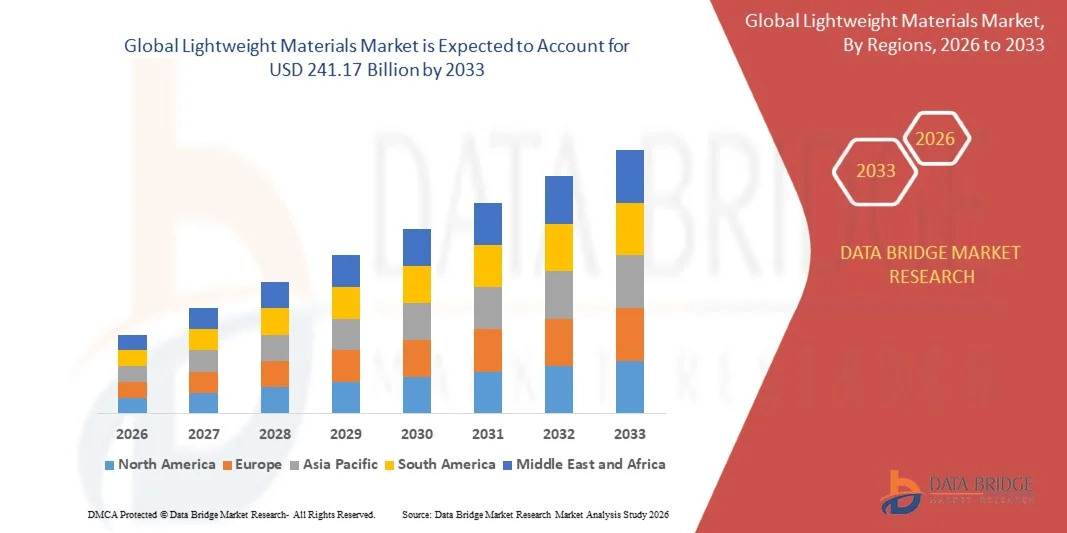
As per Data Bridge Market Research Analysis the Lightweight Materials Market was valued at USD 214.51 billion in 2025 and is projected to reach USD 241.17 billion by 2033, growing at a CAGR of 8.80% from 2026 to 2033. This growth is fueled by escalating regulatory pressure for fuel efficiency and emission reduction across the automotive and aerospace sectors, alongside a strong push for sustainability in manufacturing .
The surge in electric vehicle (EV) adoption further accelerates demand, as lightweight materials are critical for offsetting heavy battery weight to enhance range and efficiency . Technological advancements in material science, such as supercritical fluid foaming and additive manufacturing, are enabling the production of stronger, lighter, and more cost-effective solutions .
Market Size & Forecast
- Global Market Value (2025): USD 52 Billion
- Expected Market Value (2033): USD 17 Billion
- Forecast CAGR (2026–2033): 8.80%
- Leading Region in 2025: Asia Pacific
- Fastest Growing Region: Asia-Pacific
Key Market Trends & Insights
- Asia-Pacific dominated the Lightweight Materials Market in 2025, capturing the largest regional share of 45%. This leadership is driven by booming automotive and aerospace industries in China, India, and Japan, along with rapid urbanization and industrialization. China is projected to be a key growth engine, with a CAGR of 8.8% .
- North America is another significant market, led by the U.S. (valued at approximately USD 61.3 billion in 2025), supported by an established aerospace ecosystem and stringent fuel economy standards .
- Europe is also a major contributor, driven by aggressive decarbonization policies (like the EU's CBAM), a strong automotive industry, and innovation in the energy sector .
- The metals segment is currently the market leader by type, particularly aluminum, due to its widespread use in the automotive industry for compliance with emission regulations .
- The composites segment is the fastest-growing material type, experiencing rapid adoption in aerospace, sports, and automotive applications due to an exceptional strength-to-weight ratio . Carbon-fiber-reinforced polymers (CFRP) are gaining significant traction.
- The automotive sector is the largest end-user, accounting for over 89% of total market volume, driven by the need for lightweighting to meet fuel economy and emission standards
Report Scope and Lightweight Materials Market Segmentation
|
Attributes |
Lightweight Materials Key Market Insights |
|
Segments Covered |
|
|
Countries Covered |
North America
Europe
Asia-Pacific
Middle East and Africa
South America
|
|
Key Market Players |
|
|
Market Opportunities |
|
|
Value Added Data Infosets |
|
What is the Key Trend in the Lightweight Materials Market?
Trend: Growth of Composites in High-Performance Sectors
The demand for composites, especially carbon-fiber-reinforced polymers (CFRP) and glass-fiber-reinforced polymers (GFRP), is surging across aerospace, automotive, and wind energy . Their superior strength-to-weight ratio makes them essential for next-generation aircraft (like Boeing 787 and Airbus A350, which are ~50% composites), high-performance EVs, and longer wind turbine blades . Innovations in thermoplastic composites are reducing cycle times, making them viable for high-volume automotive applications . SGL Carbon's development of a recycled carbon fiber process retaining 80-85% of virgin strength is a notable trend, reducing costs and enhancing sustainability .
Lightweight Materials Market Dynamics
Key Market Driver: Stricter Global CO₂ and Fuel-Economy Regulations
Stringent regulations like the EU's CO₂ emission standards, China's dual-credit scheme, and the U.S. EPA's 2024 directive are compelling automakers to significantly reduce vehicle weight . Fines for excess CO₂ (e.g., €95 per g/km in the EU) incentivize the use of aluminum, high-strength steel, and composites to offset battery mass . China's action plan mandating magnesium components in NEVs is a key driver in the region . These regulations are forcing OEMs to integrate lightweight solutions as essential compliance measures.
Key Restraint/Challenge: High Production Costs and Scalability
A significant challenge is the high cost associated with advanced lightweight materials like carbon fiber, which requires 80-110 MWh per ton for precursor oxidation and carbonization, and titanium, produced via the energy-intensive Kroll process . Primary aluminum smelting also faces high electricity costs . These costs, combined with limited commercial-scale infrastructure, restrict adoption . However, technological advancements like inert-anode aluminum and more efficient additive manufacturing are expected to lower costs over time .
Key Market Opportunity: Electrification, Hydrogen, and Renewable Energy
The rapid growth of electric vehicles (EVs) presents a major opportunity, as lightweight materials are crucial for improving battery efficiency and range . The developing hydrogen economy, with its need for lightweight high-pressure storage tanks, creates substantial demand for CFRP . Additionally, the renewable energy sector, particularly offshore wind, requires large-scale use of composites for lighter, more efficient blades, driving demand across these high-growth applications .
Lightweight Materials Market Scope
The lightweight materials market is segmented on the basis of type, application, distribution channel, and region.
- By Type
On the basis of type, the market is segmented into metal alloys, composites, and polymers. The Metal Alloys segment led the market in 2025, driven by extensive use in automotive and aerospace for structural components . Aluminum is dominant, with a CAGR of 7.3%, while high-strength steel is also projected to grow at 7.1% . The Composites segment is expected to be the fastest-growing due to the superior strength-to-weight ratio of materials like CFRP and GFRP . High-performance polymers like PEEK and PEI are gaining traction for battery housings and electric motor insulators .
- By Application
On the basis of application, the market is segmented into automotive, aerospace, wind energy, marine, construction, electronics, and consumer goods. The Automotive sector held the largest share (38.88% in 2025), driven by emission regulations and the need to offset EV battery weight . The Energy sector (wind and hydrogen) is forecast to grow at a rapid CAGR of 9.81%, driven by demand for long, lightweight wind turbine blades and hydrogen storage tanks . The Aerospace sector is a major adopter, driven by fuel efficiency goals and innovations in reusable launch vehicles .
- By End-User Industry
By end-user, the market is segmented into automotive, aerospace & defense, construction, energy, and others. The Automotive segment dominated in 2025, but its growth is stabilizing as aluminum penetration plateaus . The Energy sector is poised for the highest CAGR, driven by offshore wind and hydrogen mobility, as these applications require significant amounts of composites . The Aerospace & Defense sector consistently demands high-performance lightweight materials to improve fuel economy and payload .
Lightweight Materials Market Regional Analysis
Asia-Pacific was the largest region, capturing 41.12% of the market share in 2025 . Its dominance is driven by China's magnesium mandate, Japan's hydrogen subsidy initiatives, and South Korea's joint ventures for carbon fiber production . China is the world's fastest-growing national market, projected at a CAGR of 8.8% . North America, led by the U.S., is a mature market experiencing steady growth . Europe, led by Germany, is a strong market with a focus on innovation and low-carbon steel production for EVs .
U.S. Lightweight Materials Market Insight
The U.S. market is valued at approximately $61.3 billion in 2025 and is projected to see significant growth, driven by substantial federal research funding (DoE, DoD), a strong aerospace and defense industry, and fuel economy regulations . The demand is particularly fueled by aerospace leaders and the automotive industry's focus on EV battery enclosures .
China Lightweight Materials Market Insight
China is one of the fastest-growing markets, driven by rapid urbanization, massive automotive production, and aggressive government mandates for NEVs . The country's 2025 action plan mandates magnesium wheels and motor housings, and its updated dual-credit scheme promotes NEVs . This is positioning China as a global hub for lightweight material production and innovation .
Which are the Top Companies in Lightweight Materials Market?
The lightweight materials industry is primarily led by well-established companies, including:
- Alcoa Corporation (U.S.)
- ArcelorMittal S.A. (Luxembourg)
- Novelis Inc. (U.S.)
- Toray Industries, Inc. (Japan)
- SGL Carbon SE (Germany)
- Hexcel Corporation (U.S.)
- Owens Corning (U.S.)
- Saudi Basic Industries Corporation (SABIC) (Saudi Arabia)
- PPG Industries, Inc. (U.S.)
- Covestro AG (Germany)
- Thyssenkrupp AG (Germany)
- Teijin Limited (Japan)
- Solvay S.A. (Belgium)
- DuPont de Nemours Inc. (U.S.)
- Exxon Mobil Corporation (U.S.)
- China Hongqiao Group Limited (China)
Latest Developments in Lightweight Materials Market
- In February 2025, SGL Carbon received the German Sustainability Award for a recycled carbon fiber process that retains 80-85% of its original strength, scaling capacity to 2,000 tons by 2027 to meet growing demand .
- In January 2025, Gestamp inaugurated a USD 45 million hot-stamping facility in Tennessee, manufacturing 1,500 MPa battery enclosures that reduce weight by 25% compared to mild steel .
- In April 2024, Covestro AG introduced Desmopan FLY, a TPU material using supercritical fluid injection foaming technology for lightweight, recyclable applications in footwear and sports equipment .

- Interactive Data Analysis Dashboard
- Company Analysis Dashboard for high growth potential opportunities
- Research Analyst Access for customization & queries
- Competitor Analysis with Interactive dashboard
- Latest News, Updates & Trend analysis
- Harness the Power of Benchmark Analysis for Comprehensive Competitor Tracking
Global Lightweight Materials Market, Supply Chain Analysis and Ecosystem Framework
To support market growth and help clients navigate the impact of geopolitical shifts, DBMR has integrated in-depth supply chain analysis into its Global Lightweight Materials Market research reports. This addition empowers clients to respond effectively to global changes affecting their industries. The supply chain analysis section includes detailed insights such as Global Lightweight Materials Market consumption and production by country, price trend analysis, the impact of tariffs and geopolitical developments, and import and export trends by country and HSN code. It also highlights major suppliers with data on production capacity and company profiles, as well as key importers and exporters. In addition to research, DBMR offers specialized supply chain consulting services backed by over a decade of experience, providing solutions like supplier discovery, supplier risk assessment, price trend analysis, impact evaluation of inflation and trade route changes, and comprehensive market trend analysis.
Data collection and base year analysis are done using data collection modules with large sample sizes. The stage includes obtaining market information or related data through various sources and strategies. It includes examining and planning all the data acquired from the past in advance. It likewise envelops the examination of information inconsistencies seen across different information sources. The market data is analysed and estimated using market statistical and coherent models. Also, market share analysis and key trend analysis are the major success factors in the market report. To know more, please request an analyst call or drop down your inquiry.
The key research methodology used by DBMR research team is data triangulation which involves data mining, analysis of the impact of data variables on the market and primary (industry expert) validation. Data models include Vendor Positioning Grid, Market Time Line Analysis, Market Overview and Guide, Company Positioning Grid, Patent Analysis, Pricing Analysis, Company Market Share Analysis, Standards of Measurement, Global versus Regional and Vendor Share Analysis. To know more about the research methodology, drop in an inquiry to speak to our industry experts.
Data Bridge Market Research is a leader in advanced formative research. We take pride in servicing our existing and new customers with data and analysis that match and suits their goal. The report can be customized to include price trend analysis of target brands understanding the market for additional countries (ask for the list of countries), clinical trial results data, literature review, refurbished market and product base analysis. Market analysis of target competitors can be analyzed from technology-based analysis to market portfolio strategies. We can add as many competitors that you require data about in the format and data style you are looking for. Our team of analysts can also provide you data in crude raw excel files pivot tables (Fact book) or can assist you in creating presentations from the data sets available in the report.













