


Global Isoprene Market, By Grade (Polymer Grade, Chemical Grade), Application (Styrene Isoprene Styrene, Isobutylene Isoprene, Polyisoprene, Others), End-Use Industry (Automotive, Personal Care, Construction, Medical, Others) – Industry Trends and Forecast to 2032
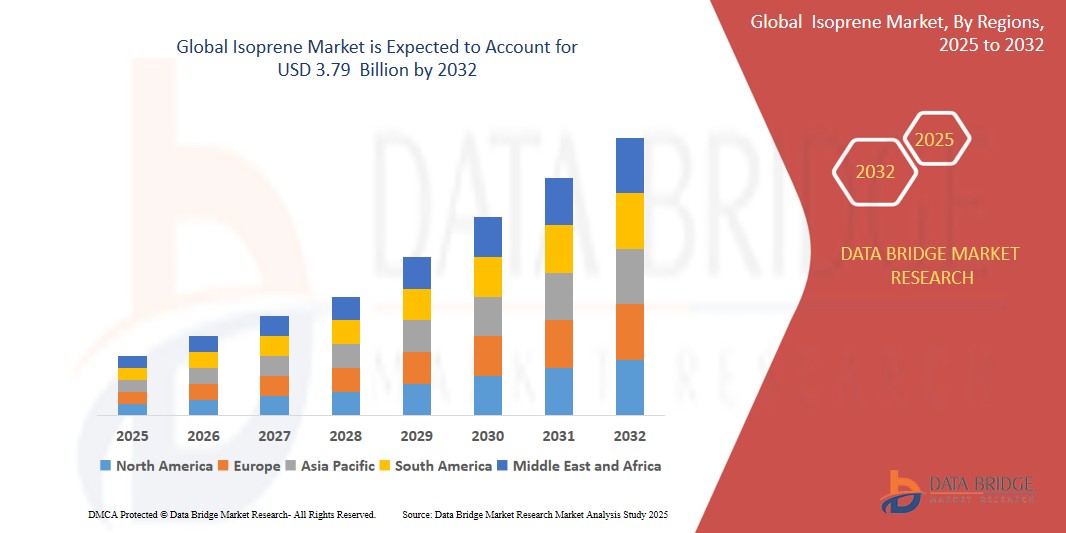
Isoprene Market Size
- The global Isoprene Market was valued atUSD 2.15 billion in 2024 and is expected to reachUSD 3.79 billion by 2032
- During the forecast period of 2025 to 2032 the market is likely to grow at aCAGR of 7.35%, primarily driven by the growing consumer awareness regarding health and wellness
- This growth is driven by factors such as busy lifestyles and a growing aging population are fuelling demand for products that enhance health and prevent disease
Isoprene Market Analysis
- Isoprene is a colorless volatile liquid hydrocarbon that serves as a crucial building block in the production of synthetic rubber and other polymers. It is primarily used to manufacture polyisoprene—a synthetic analog of natural rubber—offering excellent elasticity, tensile strength, and durability. Isoprene is typically derived as a by-product of petroleum-based cracking processes or synthesized from formaldehyde and isobutylene. The resulting polymer-grade and chemical-grade isoprene are extensively used across sectors such as automotive, healthcare, personal care, and construction for applications like tires, medical gloves, adhesives, and sealants.
- The isoprene market is experiencing notable growth driven by increasing demand for high-performance synthetic rubber in the automotive and medical sectors. Rising vehicle production and greater emphasis on fuel efficiency are accelerating the need for durable rubber-based components such as tires, engine mounts, and hoses. Simultaneously, the medical industry is witnessing higher adoption of polyisoprene-based gloves and equipment, particularly in the wake of hygiene and safety awareness. Moreover, investments in bio-based isoprene production technologies are creating sustainable growth opportunities, aligning with industry trends toward renewable and cost-efficient alternatives.
- North America is expected to dominate the isoprene market due to the region’s expansive automotive manufacturing base, rising healthcare expenditure, and large-scale production capacity in China, India, and Southeast Asia. In contrast, Europe is projected to witness the highest CAGR during the forecast period, fueled by stringent environmental regulations, increasing R&D in sustainable rubber alternatives, and the adoption of isoprene in advanced manufacturing sectors.
- By Grade, Polymer Grade isoprene is the largest segment by revenue, primarily owing to its extensive usage in synthetic rubber production—especially for tires, latex products, and medical applications where high elasticity and purity are crucial. Meanwhile, Chemical Grade isoprene is expected to grow at a higher CAGR during the forecast period, driven by its increasing application in adhesives, resins, and specialty chemicals across personal care and industrial sectors.
Report Scope andIsoprene Market Segmentation
|
Attributes |
Isoprene KeyMarket Insights |
|
Segments Covered |
|
|
Countries Covered |
North America
Europe
Asia-Pacific (APAC)
South America
Middle East and Africa (MEA)
|
|
Key Market Players |
|
|
Market Opportunities |
|
|
Value Added Data Infosets |
In addition to the insights on market scenarios such as market value, growth rate, segmentation, geographical coverage, and major players, the market reports curated by the Data Bridge Market Research also include in-depth expert analysis, pricing analysis, brand share analysis, consumer survey, demography analysis, supply chain analysis, value chain analysis, raw material/consumables overview, vendor selection criteria, PESTLE Analysis, Porter Analysis, and regulatory framework |
Isoprene Market Trends
“Shift Toward Bio-Based Isoprene and Sustainable Production”
• A significant trend in the isoprene market is the rising interest in bio-based isoprene production, driven by increasing environmental concerns and the need to reduce dependency on fossil fuels. Bio-based isoprene, derived from renewable sources like biomass or agricultural feedstocks, is gaining traction as a more sustainable alternative to petroleum-derived isoprene.
• With growing global emphasis on carbon footprint reduction and circular economy principles, industries are actively seeking greener raw materials. Bio-isoprene provides similar performance characteristics to conventional isoprene, making it a suitable drop-in replacement for applications such as synthetic rubber, adhesives, and medical products.
• The automotive and medical sectors, in particular, are aligning their supply chains with sustainability objectives, boosting demand for eco-friendly raw materials like bio-based isoprene.
- For instance, companies like Goodyear and Michelin have partnered with biotechnology firms to commercialize bio-isoprene production at scale, aiming to secure long-term sustainable supply sources for rubber production.
• Leading manufacturers are investing in R&D to commercialize cost-effective and scalable bio-isoprene processes. These efforts are expected to not only address supply chain vulnerabilities but also enhance brand positioning in environmentally conscious markets.
Isoprene Market Dynamics
Driver
“Rising Demand from Automotive and Medical Sectors”
• The increasing demand for synthetic rubber in the automotive and medical industries is a primary driver of the isoprene market. Synthetic rubber made from polyisoprene offers excellent durability, elasticity, and resistance properties, making it ideal for applications such as tires, engine mounts, seals, and medical gloves.
• In the automotive sector, the focus on performance, safety, and fuel efficiency is elevating the use of isoprene-based materials in tire and component manufacturing. Meanwhile, the healthcare industry’s growing emphasis on hygiene and infection control—especially post-COVID—has spurred demand for medical-grade gloves and equipment made from isoprene-based elastomers.
• The robust growth of these end-use industries, especially in Asia-Pacific and Latin America, is reinforcing the demand for isoprene as a critical raw material.
Opportunity
“Emerging Applications in Adhesives, Resins, and Personal Care Products”
• A notable opportunity in the isoprene market lies in its expanding applications beyond traditional rubber use—particularly in adhesives, tackifiers, and resins used in the packaging, construction, and personal care sectors.
• Isoprene-based chemicals are increasingly used in pressure-sensitive adhesives, hot-melt adhesives, and formulations for products such as sanitary pads, diapers, and cosmetics, thanks to their flexibility, tackiness, and compatibility with other compounds.
• As consumer demand for high-performance and skin-friendly materials in personal care continues to rise, manufacturers are exploring isoprene-derived ingredients for their favorable chemical properties and low irritation potential. This diversification of applications is expected to contribute significantly to future market expansion.
Restraint/Challenge
“Volatility in Raw Material Supply and Price Fluctuations”
• One of the key challenges in the isoprene market is the dependency on crude oil derivatives and the volatility associated with petrochemical feedstock prices. Since a large portion of isoprene is produced as a by-product of naphtha cracking, any fluctuations in oil markets directly impact availability and pricing.
• This unpredictability makes it difficult for manufacturers to ensure consistent supply and manage cost structures, especially when competing with other rubber or chemical substitutes. Additionally, feedstock supply chain disruptions—caused by geopolitical tensions or refinery outages—can impact global production capacity.
• To mitigate this, companies are exploring alternative feedstocks and investing in bio-based isoprene technologies. However, high R&D and infrastructure costs associated with these alternatives remain a barrier to rapid scalability.
Isoprene Market Scope
The market is segmented on the basis grade, application and end-use industry.
|
Segmentation |
Sub-Segmentation |
|
By Grade |
|
|
By Application |
|
|
By End-User Industry |
|
Isoprene MarketRegional Analysis
“North America to Dominate the Isoprene Market by Revenue”
- North America is expected to lead the isoprene market in terms of revenue, supported by the region’s strong presence of key end-use industries such as automotive, healthcare, and industrial manufacturing. The United States, in particular, plays a dominant role due to its large-scale production of synthetic rubber and high adoption of medical and personal care products derived from isoprene.
- The region's well-established automotive industry continues to demand large volumes of polyisoprene for tire and component manufacturing. Additionally, stringent health and safety regulations have accelerated the use of synthetic latex gloves and medical elastomers, further boosting isoprene consumption.
- North America also benefits from advanced refining and petrochemical infrastructure, ensuring stable isoprene supply, coupled with significant investments in R&D focused on bio-based alternatives.
“Europe to Register the Highest CAGR in the Isoprene Market”
- Europe is anticipated to witness the fastest growth in the isoprene market, fueled by the region's strong push toward sustainability, circular economy practices, and the adoption of green raw materials. Regulatory support from the European Union and initiatives to reduce carbon emissions are encouraging the use of bio-based isoprene across diverse industries.
- The European automotive sector, with its focus on electric vehicles and lightweight components, is generating new demand for high-performance elastomers and adhesives based on isoprene. Furthermore, the healthcare and hygiene segments in countries like Germany, France, and the Netherlands are expanding, enhancing the use of isoprene-derived latex products.
- Continued investment in eco-innovation and the presence of key global players focusing on bio-isoprene development are positioning Europe as a rapidly growing regional market with strong future potential.
Isoprene Market Share
The market competitive landscape provides details by competitor. Details included are company overview, company financials, revenue generated, market potential, investment in research and development, new market initiatives, global presence, production sites and facilities, production capacities, company strengths and weaknesses, product launch, product width and breadth, application dominance. The above data points provided are only related to the companies' focus related to market.
The Major Market Leaders Operating in the Market Are:
- Royal Dutch Shell Plc (Netherlands)
- Kuraray Co., Ltd (Japan)
- Exxon Mobil Corporation (U.S.)
- LyondellBasell Industries Holding B.V (Netherlands)
- Shandong Yuhuang Chemical Co., Ltd (China)
- Braskem (Brazil)
- The Goodyear Tire and Rubber Company (U.S.)
- SIBUR (Russia)
- FINETECH INDUSTRIES LIMITED (India)
- ZEON Corporation (Japan)
- Ningbo Jinhai Chenguang Chemical Corporation (China)
- Haihang Industry Co., Ltd (China)
- FORTREC PTE LTD (Singapore)
- Chevron Phillips Chemical Company (U.S.)
- Bridgestone Corporation (Japan)
- Michelin (France)
- Continental AG (Germany)
- Sumitomo Rubber Industries Ltd (Japan)
- Sinopec (China)
- Dow (U.S.)
Latest Developments in Global Isoprene Market
- In March, 2025, Kuraray Co., Ltd. unveiled a new plant in Thailand to expand its isoprene business, addressing rising global demand for advanced materials like hydrogenated styrenic block copolymers.
- In November, 2024, DL Chemical completed the $2.5 billion acquisition of Kraton Corp., boosting its market position and global reach in the isoprene sector.
- In August, 2023, Bridgestone Corporation launched a joint research initiative to develop chemical recycling technologies for used tires, with a focus on high-yield isoprene production to support sustainability.
SKU-
Accédez en ligne au rapport sur le premier cloud mondial de veille économique

- Tableau de bord d'analyse de données interactif
- Tableau de bord d'analyse d'entreprise pour les opportunités à fort potentiel de croissance
- Accès d'analyste de recherche pour la personnalisation et les requêtes
- Analyse de la concurrence avec tableau de bord interactif
- Dernières actualités, mises à jour et analyse des tendances
- Exploitez la puissance de l'analyse comparative pour un suivi complet de la concurrence
Méthodologie de recherche
La collecte de données et l'analyse de l'année de base sont effectuées à l'aide de modules de collecte de données avec des échantillons de grande taille. L'étape consiste à obtenir des informations sur le marché ou des données connexes via diverses sources et stratégies. Elle comprend l'examen et la planification à l'avance de toutes les données acquises dans le passé. Elle englobe également l'examen des incohérences d'informations observées dans différentes sources d'informations. Les données de marché sont analysées et estimées à l'aide de modèles statistiques et cohérents de marché. De plus, l'analyse des parts de marché et l'analyse des tendances clés sont les principaux facteurs de succès du rapport de marché. Pour en savoir plus, veuillez demander un appel d'analyste ou déposer votre demande.
La méthodologie de recherche clé utilisée par l'équipe de recherche DBMR est la triangulation des données qui implique l'exploration de données, l'analyse de l'impact des variables de données sur le marché et la validation primaire (expert du secteur). Les modèles de données incluent la grille de positionnement des fournisseurs, l'analyse de la chronologie du marché, l'aperçu et le guide du marché, la grille de positionnement des entreprises, l'analyse des brevets, l'analyse des prix, l'analyse des parts de marché des entreprises, les normes de mesure, l'analyse globale par rapport à l'analyse régionale et des parts des fournisseurs. Pour en savoir plus sur la méthodologie de recherche, envoyez une demande pour parler à nos experts du secteur.
Personnalisation disponible
Data Bridge Market Research est un leader de la recherche formative avancée. Nous sommes fiers de fournir à nos clients existants et nouveaux des données et des analyses qui correspondent à leurs objectifs. Le rapport peut être personnalisé pour inclure une analyse des tendances des prix des marques cibles, une compréhension du marché pour d'autres pays (demandez la liste des pays), des données sur les résultats des essais cliniques, une revue de la littérature, une analyse du marché des produits remis à neuf et de la base de produits. L'analyse du marché des concurrents cibles peut être analysée à partir d'une analyse basée sur la technologie jusqu'à des stratégies de portefeuille de marché. Nous pouvons ajouter autant de concurrents que vous le souhaitez, dans le format et le style de données que vous recherchez. Notre équipe d'analystes peut également vous fournir des données sous forme de fichiers Excel bruts, de tableaux croisés dynamiques (Fact book) ou peut vous aider à créer des présentations à partir des ensembles de données disponibles dans le rapport.











