



Segmentation du marché mondial de l'automatisation des laboratoires et de la chaîne d'approvisionnement en réactifs intelligents, par type de produit (systèmes automatisés de manipulation de liquides, instruments de préparation et d'analyse d'échantillons), par application (génomique et protéomique, découverte et développement de médicaments) - Tendances du secteur et prévisions jusqu'en 2033
Qu'est-ce que l'automatisation de laboratoire et la chaîne d'approvisionnement intelligente réactif Taille du marché et taux de croissance
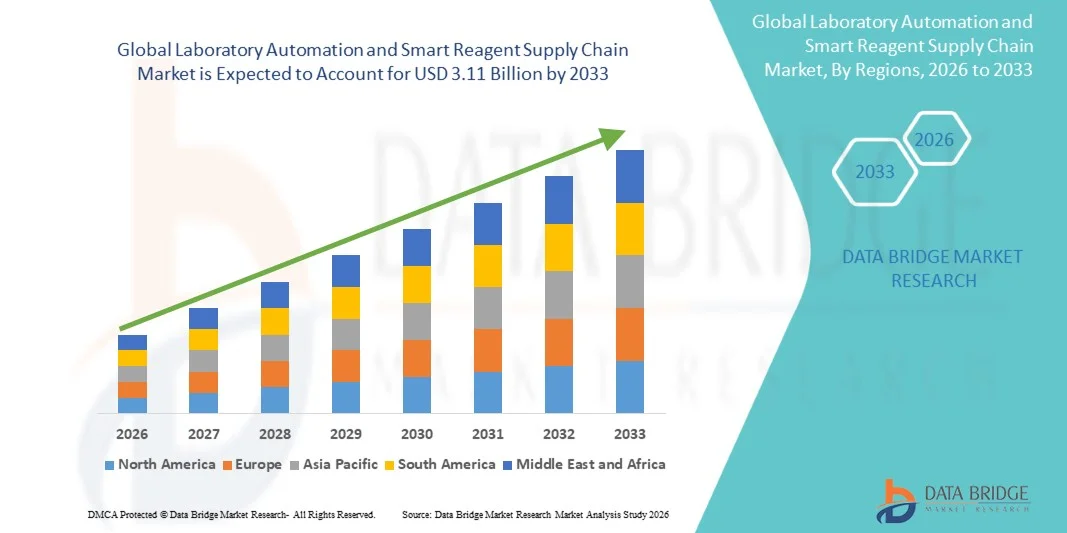
- Selon Data Bridge études de marché Analyse La taille du marché de l'automatisation des laboratoires et de la chaîne d'approvisionnement de réactifs intelligents a été évaluée à1,42 milliard de dollars en 2025et devrait atteindre3,11 milliards de dollars en 2033, à unTCAC de 10,30 %pendant la période de prévision
- La croissance du marché est largement alimentée par la demande croissante de procédés de laboratoire à haut débit, précis et efficaces, ainsi que par les progrès des technologies d'automatisation et des systèmes intelligents de gestion des réactifs qui simplifient les flux de travail, réduisent les erreurs humaines et optimisent l'utilisation des ressources.
- De plus, l'adoption croissante de solutions de laboratoire automatisées dans les organismes pharmaceutiques, de biotechnologie et de recherche, ainsi que l'accent croissant mis sur l'efficacité des coûts et la reproductibilité dans les expériences, font de l'automatisation des laboratoires et des systèmes intelligents de chaîne d'approvisionnement en réactifs des outils essentiels pour les laboratoires modernes. Ces facteurs convergents accélèrent l'adoption de solutions d'automatisation de laboratoire et de chaîne d'approvisionnement de réactif intelligent, ce qui stimule considérablement la croissance globale du marché
Taille du marché et prévisions
- Valeur marchande mondiale (2025): 1,42 milliard de dollars
- Valeur marchande prévue (2033): 3,11 milliards de dollars
- Prévisions CAGR (2026-2033): 10.30%
Automatisation de laboratoire et analyse du marché de la chaîne d'approvisionnement intelligente
- L'automatisation des laboratoires et les systèmes intelligents de chaîne d'approvisionnement en réactifs, y compris la manipulation automatisée des liquides, le traitement des échantillons et les plateformes intelligentes de gestion des réactifs, sont de plus en plus essentiels dans les laboratoires modernes en raison de leur capacité à améliorer la précision, la reproductibilité et l'efficacité opérationnelle dans les domaines de la recherche, des applications cliniques et industrielles.
- L'augmentation de la demande d'automatisation de laboratoire et de solutions intelligentes de la chaîne d'approvisionnement en réactifs est principalement due au besoin croissant d'expérimentation à haut débit, à la réduction des erreurs manuelles et à l'optimisation des coûts dans le secteur pharmaceutique.biotechnologie, et des laboratoires de recherche universitaires. L'intégration avec l'IA, l'IoT et la gestion des stocks cloud accélère encore l'adoption
- L'Amérique du Nord a dominé le marché de l'automatisation des laboratoires et de la chaîne d'approvisionnement en réactifs intelligents avec la plus grande part de revenus d'environ 37,5 % en 2025, appuyée par une infrastructure de laboratoire avancée, des investissements élevés en R-D et la forte présence d'acteurs clés du marché. Les États-Unis représentaient la majorité des recettes régionales en raison de l'adoption généralisée dans les établissements pharmaceutiques, de biotechnologie et universitaires.
- L'Asie-Pacifique devrait être la région qui connaît la croissance la plus rapide du marché de l'automatisation des laboratoires et du réactif intelligent de la chaîne d'approvisionnement au cours de la période de prévision, avec un TCAC d'environ 8,2 %, en raison de l'augmentation des investissements en R-D, de l'expansion des industries de la biotechnologie et des produits pharmaceutiques et de l'adoption croissante de solutions automatisées de laboratoire en Chine, en Inde et au Japon.
- L'application génomique et protéomique a dominé le marché en 2025, représentant 48,7% des revenus
Rapport Portée et automatisation en laboratoire et segmentation du marché de la chaîne d'approvisionnement intelligente
|
Attributs |
Automatisation de laboratoire & Chaîne d'approvisionnement intelligente et réactif Principales perspectives du marché |
|
Segments couverts |
|
|
Pays couverts |
Amérique du Nord
Europe
Asie-Pacifique
Moyen-Orient et Afrique
Amérique du Sud
|
|
Principaux acteurs du marché |
|
|
Possibilités de marché |
|
|
Infos sur la valeur ajoutée |
En plus des renseignements sur les scénarios de marché comme la valeur marchande, le taux de croissance, la segmentation, la couverture géographique et les principaux intervenants, les rapports de marché établis par Data Bridge Market Research comprennent également une analyse approfondie des experts, l'épidémiologie des patients, l'analyse des pipelines, l'analyse des prix et le cadre réglementaire. |
Quelle est la tendance clé sur le marché de l'automatisation de laboratoire et de la chaîne d'approvisionnement intelligente
(en milliers de dollars)Progrès dans l'automatisation des laboratoires et la gestion des réactifs(en milliers de dollars)
- Une tendance significative et accélérée sur le marché mondial de l'automatisation des laboratoires et du réactif intelligent Supply Chain est l'adoption croissante de systèmes automatisés pour le traitement des échantillons, le traitement des réactifs et la gestion des flux de travail. Ces technologies améliorent l'efficacité des laboratoires, réduisent les erreurs humaines et optimisent l'utilisation des réactifs dans les laboratoires de recherche, les laboratoires cliniques et les laboratoires industriels.
- Par exemple, en 2024, Tecan a lancé son poste de travail Fluent Laboratory Automation Workstation avec des modules de gestion intégrée du réactif, permettant un dépistage à haut débit et une meilleure précision dans la recherche en sciences de la vie.
- L'intégration de la robotique, de la manipulation automatisée des liquides et des systèmes de suivi numérique améliore l'efficacité des processus et permet aux laboratoires de traiter des volumes d'échantillons plus importants avec une intervention manuelle minimale
- La demande croissante de précision et de reproductibilité dans la recherche pharmaceutique, le diagnostic et les essais cliniques conduit à l'adoption de systèmes de laboratoire automatisés
- La tendance vers des chaînes d'approvisionnement en réactifs connectées et une gestion intelligente des stocks est à réduire le gaspillage, à assurer une reconstitution en temps opportun et à améliorer l'efficacité opérationnelle
Automatisation de laboratoire et dynamique du marché de la chaîne d'approvisionnement intelligente
Chauffeur
Demande de croissance pour l'efficacité et les opérations de laboratoire à haut rendement
- L'augmentation de la demande pour des résultats de laboratoire plus rapides et plus fiables et une productivité accrue dans les laboratoires de recherche et de diagnostic est un moteur majeur du marché de l'automatisation des laboratoires et de la chaîne d'approvisionnement intelligente
- Par exemple, en 2023, Roche a élargi ses plateformes d'automatisation de laboratoire dans les laboratoires cliniques européens afin de rationaliser le traitement des échantillons et d'accélérer les tests diagnostiques pendant la haute saison grippale.
- Les laboratoires accordent de plus en plus de priorité à l'automatisation afin de réduire les erreurs manuelles, de réduire la consommation de réactif et de normaliser les processus à plusieurs endroits.
- La nécessité de flux de travail efficaces dans les tests à grand volume, la médecine personnalisée et la R-D pharmaceutique stimule encore davantage la croissance du marché
- La conformité réglementaire, la traçabilité des données et les flux de travail prêts à l'audit encouragent également l'adoption de systèmes automatisés dans les laboratoires cliniques et industriels
Restriction/Défi
(en milliers de dollars)Coûts d'investissement et d'entretien initiaux élevés(en milliers de dollars)
- Malgré les avantages, le coût élevé de la mise en place de systèmes automatisés de laboratoire et les dépenses d'entretien connexes demeurent des défis majeurs, en particulier pour les petits et moyens laboratoires.
- Par exemple, plusieurs instituts de recherche d ' Asie et du Pacifique ont signalé des retards dans l ' adoption de l ' automatisation en raison de contraintes budgétaires et d ' un financement limité des systèmes avancés de gestion des réactifs
- Les problèmes de compatibilité entre les instruments de laboratoire existants et les nouvelles plates-formes d'automatisation peuvent également entraver la mise en œuvre
- Il est essentiel de former le personnel à l'exploitation et à la maintenance de systèmes automatisés complexes, mais cela peut prendre du temps et coûter cher
- Surmonter ces défis grâce à des solutions rentables, des plates-formes d'automatisation modulaire et des modèles de déploiement évolutifs sera crucial pour une croissance soutenue du marché de l'automatisation de laboratoire et de la chaîne d'approvisionnement intelligente
Automatisation de laboratoire et chaîne d'approvisionnement intelligente
Le marché est segmenté en fonction du type de produit et de l'application.
• Par type de produit
Sur la base du type de produit, le marché de l'automatisation de laboratoire et de la chaîne d'approvisionnement intelligente est segmenté en systèmes automatisés de manipulation des liquides et instruments de préparation et d'analyse des échantillons. Le segment des systèmes automatisés de manipulation des liquides a dominé le marché en 2025 avec une part de 46,5 % des revenus, grâce à l'adoption croissante de solutions d'automatisation de laboratoire à haut débit en génomique, en protéomique et en recherche pharmaceutique. Ces systèmes minimisent les erreurs humaines, améliorent la reproductibilité et permettent une manipulation précise des microvolumes de réactifs, ce qui est crucial pour les flux de travail modernes à haut débit. La tendance croissante à la miniaturisation des essais, combinée à l'augmentation des dépenses de R-D dans les biopharmacies et les sciences de la vie, alimente leur forte adoption. Les principaux utilisateurs finaux, y compris les grandes entreprises pharmaceutiques et les laboratoires de recherche universitaires, valorisent ces systèmes pour une efficacité accrue, une consommation réduite de réactifs et la capacité de s'intégrer de façon transparente avec d'autres instruments de laboratoire. La demande croissante d'automatisation dans la préparation des échantillons et la normalisation des essais renforce encore la domination du marché. L'intégration de la surveillance de l'IA et de l'IoT améliore la transparence des processus, l'efficacité opérationnelle et le respect des normes réglementaires. Des régions géographiques comme l'Amérique du Nord et l'Europe sont à la pointe de l'adoption en raison d'une forte pénétration technologique, d'infrastructures robustes et d'investissements importants dans la R-D en laboratoire. Le segment bénéficie également d'un solide soutien des fournisseurs, notamment en matière de formation, de maintenance et de services, ce qui le rend très attrayant pour les laboratoires établis et émergents.
Le segment des instruments de préparation et d'analyse des échantillons devrait connaître le TCAC le plus rapide (22,3 %) entre 2026 et 2033, en raison de leur rôle essentiel dans la découverte de médicaments, le diagnostic moléculaire et la recherche en protéomique. L'augmentation de la demande est alimentée par le besoin croissant d'analyses d'échantillons rapides, fiables et de haute précision, ce qui accélère les délais de recherche et améliore la reproductibilité. Ces instruments sont de plus en plus intégrés à des flux de travail automatisés afin de rationaliser les processus de préparation et d'analyse des échantillons, en minimisant les interventions manuelles. Les marchés émergents de l'Asie-Pacifique, en particulier la Chine, l'Inde et le Japon, investissent massivement dans les infrastructures de laboratoire, contribuant ainsi à la croissance. L'expansion de la génomique et de la recherche en médecine personnalisée conduit à l'adoption. Les fabricants innovent continuellement pour offrir des instruments multifonctionnels qui soutiennent diverses applications et tests à haut débit, ce qui les rend attrayants pour les laboratoires universitaires et industriels. La conformité à la réglementation, associée aux progrès réalisés dans le domaine de la microfluidique et des logiciels d'analyse, accroît encore le potentiel du marché. La rentabilité, la réduction du temps de traitement des échantillons et l'intégration avec les plateformes d'analyse de données basées sur le cloud stimulent également la croissance rapide du segment.
• Par demande
Sur la base de l'application, le marché est segmenté en génomique et protéomique et découverte et développement de médicaments. L'application Génomique & Protéomique a dominé le marché en 2025, représentant 48,7% des revenus. La dominance est attribuée à la croissance exponentielle des technologies de séquençage, à l'analyse des protéines et aux initiatives médicales personnalisées. Les laboratoires qui gèrent des projets génomiques et protéomiques à grande échelle comptent de plus en plus sur des systèmes automatisés de traitement des liquides et des chaînes d'approvisionnement en réactifs intelligents pour la précision et l'évolutivité. La nécessité d'obtenir des résultats reproductibles à haut rendement, combinés à une réduction des erreurs de manipulation manuelle, est essentielle pour les établissements de recherche, les entreprises de biotechnologie et les entreprises pharmaceutiques. De plus, l'expansion de la recherche en protéomique pour la découverte de biomarqueurs et l'analyse des voies de la maladie stimule la demande d'automatisation dans la préparation des échantillons, le stockage et le suivi des réactifs. L'Amérique du Nord et l'Europe sont des marchés clés en raison d'infrastructures de recherche bien établies, d'écosystèmes de laboratoire avancés et d'un financement important pour la recherche sur l'omique. L'intégration aux systèmes de gestion de l'information de laboratoire (SIGI) assure une efficacité opérationnelle et une conformité accrues. Le segment continue d'investir dans l'analyse de l'IA et les systèmes compatibles avec l'IoT renforcent son leadership sur le marché.
Le segment Découverte et développement des médicaments devrait enregistrer le TCAC le plus rapide (21,8 %) de 2026 à 2033, en raison du besoin croissant d'accélérer les processus de recherche préclinique et clinique. L'automatisation de la manipulation des échantillons et de la gestion des réactifs réduit les délais, les coûts opérationnels et les erreurs dans le dépistage à haut débit et les essais composés. Les entreprises pharmaceutiques et de biotechnologie adoptent de plus en plus de chaînes d'approvisionnement en réactifs intelligents pour optimiser les stocks, maintenir la stabilité des réactifs et assurer la traçabilité. L'émergence de plateformes de découverte de médicaments assistées par l'IA et de systèmes robotiques intégrés améliore le débit et l'intégrité des données. L'expansion rapide de la R-D pharmaceutique en Asie-Pacifique et en Amérique latine stimule la croissance du marché. De plus, la demande croissante de produits biologiques, de vaccins et de produits thérapeutiques personnalisés stimule les investissements dans l'infrastructure de laboratoire automatisée. La combinaison d'économies de coûts, d'un redressement plus rapide et d'une reproductibilité fiable place ce segment comme l'application qui augmente le plus rapidement sur le marché de l'automatisation des laboratoires et de la chaîne d'approvisionnement en réactifs intelligents.
Automatisation des laboratoires et analyse régionale du marché de la chaîne d'approvisionnement intelligente
- L'Amérique du Nord a dominé le marché de l'automatisation des laboratoires et de la chaîne d'approvisionnement en réactifs intelligents avec la plus grande part de revenus d'environ 37,5 % en 2025.
- Soutenus par des infrastructures de laboratoire avancées, des investissements élevés en R-D et la forte présence d'acteurs clés du marché
- La région met l'accent sur l'amélioration de l'efficacité des laboratoires, la réduction des erreurs et l'accélération des résultats de la recherche.
US Laboratory Automation & Smart Reagent Supply Chain Insight Marché
Le marché américain de l'automatisation des laboratoires et de la chaîne d'approvisionnement en réactifs intelligents a attiré la majorité des revenus de l'Amérique du Nord en 2025, grâce à l'adoption généralisée de solutions de laboratoire automatisées dans les établissements de recherche pharmaceutique, de biotechnologie et universitaire. Des investissements importants dans la R-D, la présence de fournisseurs de solutions d'automatisation de laboratoire de premier plan et des initiatives visant à améliorer l'efficacité et la conformité des laboratoires aux normes réglementaires sont des facteurs clés qui alimentent l'expansion du marché. L'intégration de chaînes d'approvisionnement en réactifs intelligents avec des systèmes de laboratoire robotiques et compatibles avec l'IA améliore encore l'optimisation des flux de travail et accélère l'adoption dans le pays.
Europe Laboratory Automation & Smart Reagent Supply Chain Aperçu du marché
Le marché européen de l'automatisation des laboratoires et de la chaîne d'approvisionnement en réactifs intelligents devrait connaître une croissance substantielle au cours de la période de prévision, grâce à des normes de qualité rigoureuses, à une demande croissante de dépistage à haut débit et à l'adoption croissante de l'automatisation dans les laboratoires pharmaceutiques et universitaires. L'Allemagne, la France et le Royaume-Uni sont des contributeurs clés, appuyés par de solides initiatives gouvernementales visant à moderniser l'infrastructure des laboratoires et à accroître l'efficacité de la R-D.
U.K. Automatisation de laboratoire et Smart Réagent Supply Chain Aperçu du marché
Le marché de l'automatisation des laboratoires et de la chaîne d'approvisionnement en réactifs intelligents devrait croître régulièrement au cours de la période de prévision, alimenté par l'adoption croissante de flux de travail automatisés en laboratoire, l'expansion des secteurs de la biotechnologie et des produits pharmaceutiques et l'augmentation des investissements dans la recherche et le développement. La présence de solides réseaux de recherche universitaire et de santé accélère encore la demande de solutions intelligentes pour la chaîne d'approvisionnement en réactifs.
Allemagne Automatisation de laboratoire & Smart Réagent Supply Chain Aperçu du marché
Le marché allemand devrait s'étendre à un important TCAC durant la période de prévision, sous l'impulsion d'une forte base industrielle, d'une recherche croissante en biotechnologie et en pharmaceutique, et de l'adoption de solutions d'automatisation de laboratoire de pointe. L'Allemagne met l'accent sur la précision, l'efficacité et le respect de cadres réglementaires stricts.
Asia-Pacific Laboratory Automation & Smart Regent Supply Chain Aperçu du marché
L'automatisation des laboratoires et la chaîne d'approvisionnement en réactifs intelligents en Asie-Pacifique devraient être la région qui connaît la croissance la plus rapide sur le marché de l'automatisation des laboratoires et de la chaîne d'approvisionnement en réactifs intelligents. La croissance est attribuable à l'augmentation des investissements en R-D, à l'expansion rapide des industries pharmaceutiques et de biotechnologie et à l'adoption de solutions de laboratoire automatisées dans des pays comme la Chine, l'Inde et le Japon. L'augmentation du soutien gouvernemental, la multiplication des initiatives de recherche universitaire et l'externalisation accrue des services de laboratoire alimentent l'expansion du marché.
Japan Laboratory Automation & Smart Reagent Supply Chain Aperçu du marché
Le marché japonais de l'automatisation des laboratoires et de la chaîne d'approvisionnement en réactifs intelligents prend de l'ampleur en raison de l'importance accordée à l'innovation technologique, de l'adoption généralisée de l'automatisation des laboratoires et des investissements importants dans la recherche pharmaceutique et biotechnologique. L'intégration de chaînes d'approvisionnement intelligentes en réactifs avec des équipements de laboratoire automatisés améliore l'efficacité du workflow, réduisant les erreurs manuelles et les délais d'exécution.
China Laboratory Automation & Smart Reagent Supply Chain Aperçu du marché
L'automatisation des laboratoires et la chaîne d'approvisionnement en réactifs intelligents en Chine ont représenté la plus grande part des revenus du marché en Asie-Pacifique en 2025, attribuable à la croissance rapide de la R-D pharmaceutique et biotechnologique, à l'augmentation de l'infrastructure des laboratoires et aux initiatives gouvernementales visant à soutenir l'innovation et l'automatisation. Le pays met l'accent sur le dépistage à haut débit et les solutions de laboratoire rentables, ce qui favorise l'adoption de systèmes intelligents de chaîne d'approvisionnement en réactifs, avec des fabricants nationaux solides qui soutiennent l'expansion du marché.
Automatisation de laboratoire & Smart Réagent Supply Chain Part du marché
L'industrie de l'automatisation de laboratoire et de la chaîne d'approvisionnement intelligente est principalement dirigée par des entreprises bien établies, notamment :
- Tecan Group Ltd. (Suisse)
- Société Hamilton (États-Unis)
- Beckman Coulter, Inc. (États-Unis)
- Agilent Technologies, Inc. (États-Unis)
- Thermo Fisher Scientific, Inc. (États-Unis)
- PerkinElmer, Inc. (États-Unis)
- Illumina, Inc. (États-Unis)
- Eppendorf AG (Allemagne)
- Sartorius AG (Allemagne)
- Bio-Rad Laboratories, Inc. (États-Unis)
- Corning Incorporated (États-Unis)
- Danaher Corporation (États-Unis)
- Mettler-Toledo International Inc. (Suisse)
- Hitachi High-Tech Corporation (Japon)
Derniers développements sur le marché mondial de l'automatisation des laboratoires et de la chaîne d'approvisionnement intelligente
- En mai 2023, Opentrons, une entreprise américaine d'automatisation de laboratoire, a lancé sa plateforme robotisée Flex pour développer des solutions d'automatisation de laboratoire avancées pour les chercheurs du monde entier, fournissant aux chercheurs un système robotique flexible capable de réaliser une large gamme d'expériences, y compris la préparation d'échantillons et la manipulation des réactifs. Le robot Flex a été développé pour être programmable et compatible avec les workflows de laboratoire existants, permettant une amélioration du débit, une intervention manuelle réduite et une reproductibilité accrue, reflétant le changement de l'industrie vers des systèmes d'automatisation plus accessibles et modulaires
- En décembre 2023, Hudson Robotics, Inc. a acquis Tomtec Inc., un fournisseur de solutions d'automatisation de laboratoire, dans le cadre d'une démarche stratégique visant à renforcer son portefeuille d'automatisation et à élargir ses offres de traitement de réactifs à haut débit et de systèmes automatisés de traitement des liquides. Cette acquisition a réuni des technologies complémentaires pour soutenir les flux de travail automatisés de bout en bout et améliorer l'efficacité de la chaîne d'approvisionnement en réactifs pour les clients des secteurs de la biotechnologie, des produits pharmaceutiques et de la recherche universitaire
- En juillet 2024, Inpeco a dévoilé le système total d'automatisation de laboratoire FlexLab X à l'ADLM 2024 à Chicago, une plate-forme d'automatisation modulaire conçue pour intégrer des analyseurs de plusieurs fournisseurs via une interface unifiée, rationaliser considérablement les opérations de laboratoire et améliorer la manipulation des réactifs, le suivi des échantillons et l'intégration des données à travers les flux automatisés. Le système FlexLab X a été introduit pour répondre au besoin croissant de solutions d'automatisation évolutives et flexibles dans les laboratoires de recherche cliniques et à haut débit
- En mai 2024, Abbott a introduit la solution d'automatisation des systèmes GLP Track dans plusieurs laboratoires de diagnostic en Inde, une plateforme conçue pour soutenir les workflows de laboratoire à volume élevé en automatisant le traitement des échantillons et en réduisant jusqu'à 80 % des étapes manuelles. Ce déploiement a aidé les laboratoires à augmenter leurs performances, à réduire leurs erreurs et à optimiser l'utilisation et le suivi des réactifs, en répondant à la demande croissante de tests diagnostiques dans l'un des marchés asiatiques qui connaissent la croissance la plus rapide.
- En janvier 2025, Agilent Technologies a présenté de nouvelles solutions automatisées de flux de travail à SLAS2025 à San Diego, mettant en avant des outils d'automatisation améliorés pour la préparation d'échantillons, l'auto-dilution, la livraison d'échantillons et les processus de lavage couvrant des applications en génomique, protéomique et biomolécule. Ce lancement à grande visibilité a démontré comment les technologies d'automatisation sont cruciales pour améliorer l'efficacité des laboratoires, le débit et la gestion de la chaîne d'approvisionnement en réactifs dans les milieux de recherche et cliniques.
SKU-
Accédez en ligne au rapport sur le premier cloud mondial de veille économique

- Tableau de bord d'analyse de données interactif
- Tableau de bord d'analyse d'entreprise pour les opportunités à fort potentiel de croissance
- Accès d'analyste de recherche pour la personnalisation et les requêtes
- Analyse de la concurrence avec tableau de bord interactif
- Dernières actualités, mises à jour et analyse des tendances
- Exploitez la puissance de l'analyse comparative pour un suivi complet de la concurrence
Méthodologie de recherche
La collecte de données et l'analyse de l'année de base sont effectuées à l'aide de modules de collecte de données avec des échantillons de grande taille. L'étape consiste à obtenir des informations sur le marché ou des données connexes via diverses sources et stratégies. Elle comprend l'examen et la planification à l'avance de toutes les données acquises dans le passé. Elle englobe également l'examen des incohérences d'informations observées dans différentes sources d'informations. Les données de marché sont analysées et estimées à l'aide de modèles statistiques et cohérents de marché. De plus, l'analyse des parts de marché et l'analyse des tendances clés sont les principaux facteurs de succès du rapport de marché. Pour en savoir plus, veuillez demander un appel d'analyste ou déposer votre demande.
La méthodologie de recherche clé utilisée par l'équipe de recherche DBMR est la triangulation des données qui implique l'exploration de données, l'analyse de l'impact des variables de données sur le marché et la validation primaire (expert du secteur). Les modèles de données incluent la grille de positionnement des fournisseurs, l'analyse de la chronologie du marché, l'aperçu et le guide du marché, la grille de positionnement des entreprises, l'analyse des brevets, l'analyse des prix, l'analyse des parts de marché des entreprises, les normes de mesure, l'analyse globale par rapport à l'analyse régionale et des parts des fournisseurs. Pour en savoir plus sur la méthodologie de recherche, envoyez une demande pour parler à nos experts du secteur.
Personnalisation disponible
Data Bridge Market Research est un leader de la recherche formative avancée. Nous sommes fiers de fournir à nos clients existants et nouveaux des données et des analyses qui correspondent à leurs objectifs. Le rapport peut être personnalisé pour inclure une analyse des tendances des prix des marques cibles, une compréhension du marché pour d'autres pays (demandez la liste des pays), des données sur les résultats des essais cliniques, une revue de la littérature, une analyse du marché des produits remis à neuf et de la base de produits. L'analyse du marché des concurrents cibles peut être analysée à partir d'une analyse basée sur la technologie jusqu'à des stratégies de portefeuille de marché. Nous pouvons ajouter autant de concurrents que vous le souhaitez, dans le format et le style de données que vous recherchez. Notre équipe d'analystes peut également vous fournir des données sous forme de fichiers Excel bruts, de tableaux croisés dynamiques (Fact book) ou peut vous aider à créer des présentations à partir des ensembles de données disponibles dans le rapport.











