


Global Low Noise Amplifier Market Segmentation, By Frequency (6 Hz to 60 Hz, Greater than 60hertz, DC to 6GZ), Material (Gallium Arsenide, Silicon Germanium, Silicon and Indium Phosphide), Application (Cellular Infrastructure, Broadband, GPS , ISM Band and WLAN), Vertical (Telecom and Datacom, Consumer Electronics, Military & Space, Medical, Automotive, Industrial) - Industry Trends and Forecast to 2032
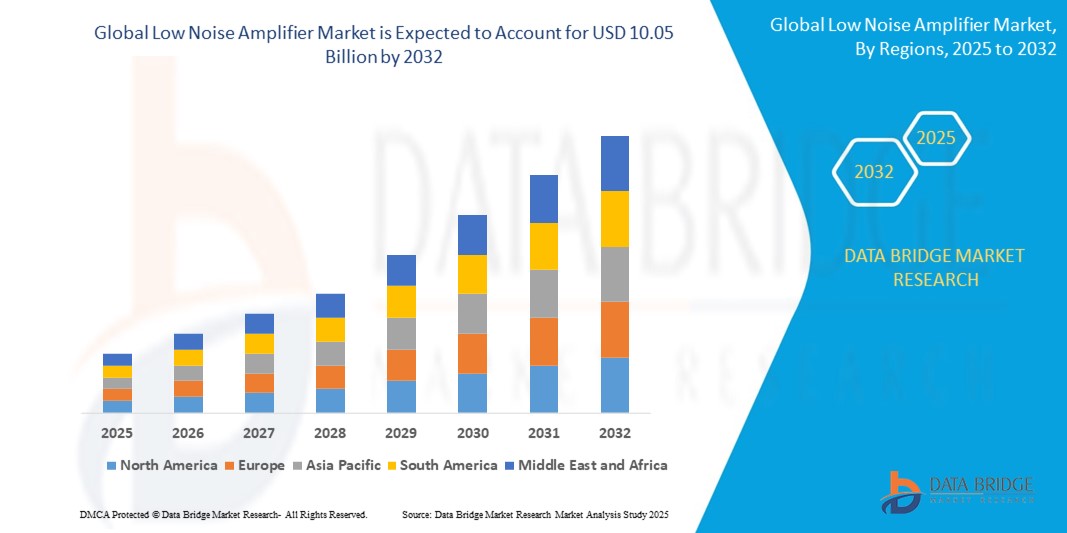
Low Noise Amplifier Market Size
- The global Low Noise Amplifier Market size was valued at USD 3.20 billion in 2024 and is expected to reach USD 10.05 billion by 2032, at a CAGR of 13.6% during the forecast period
- This growth is driven by factors such as the Expansion of 5G Networks, Proliferation of IoT Devices, and Developments in Semiconductor Materials
Low Noise Amplifier Market Analysis
- The low noise amplifier is an electronic amplifying device that increases weak and low-power sound wave signals received through an antenna. It increases the power of both the signal and the noise present at its input without significantly degrading its signal-to-noise ratio.
- It is highly used in end-use industries such as medical, and automotive, military and defense.
- Asia-Pacific region dominates the low noise amplifier market due to rising adoption of consumer electronics devices like wearable devices, smartphones, tablets and laptops during the forecast period.
- The North America region is projected to undergo substantial during the forecast period due to the shift toward higher-speed mobile technology and a higher growing range of mobile services consumed within the region.
- 6 Hz to 60 Hz segment is expected to dominate the market with a market share of 48.67% due to its widespread use in low-frequency applications such as seismic data acquisition, medical instrumentation, and audio systems, where low noise and high signal fidelity are critical for performance and accuracy.
Report Scope and Low Noise Amplifier Market Segmentation
|
Attributes |
Low Noise Amplifier Key Market Insights |
|
Segments Covered |
|
|
Countries Covered |
North America
Europe
Asia-Pacific
Middle East and Africa
Amérique du Sud
|
|
Principaux acteurs du marché |
|
|
Opportunités de marché |
|
|
Ensembles d'informations de données à valeur ajoutée |
Outre les informations sur les scénarios de marché tels que la valeur marchande, le taux de croissance, la segmentation, la couverture géographique et les principaux acteurs, les rapports de marché organisés par Data Bridge Market Research comprennent également une analyse des importations et des exportations, un aperçu de la capacité de production, une analyse de la consommation de production, une analyse des tendances des prix, un scénario de changement climatique, une analyse de la chaîne d'approvisionnement, une analyse de la chaîne de valeur, un aperçu des matières premières/consommables, des critères de sélection des fournisseurs, une analyse PESTLE, une analyse Porter et un cadre réglementaire. |
Tendances du marché des amplificateurs à faible bruit
« Demande croissante en communications haute fréquence et applications spatiales »
- Une tendance significative qui façonne le marché des LNA est le déploiement croissant des LNA dans les systèmes de communication haute fréquence et haute précision, tels que les réseaux 5G, les communications par satellite et les systèmes aérospatiaux.
- Ces applications nécessitent une clarté du signal sur de longues distances et dans des environnements avec des interférences importantes, ce qui rend les performances à faible bruit essentielles.
- Les LNA sont désormais conçus avec de nouveaux matériaux semi-conducteurs comme le nitrure de gallium (GaN) et le silicium germanium (SiGe), qui offrent une meilleure stabilité thermique et un gain plus élevé.
- Par exemple, dans les missions spatiales et les stations terrestres de satellites, les LNA sont utilisés pour amplifier les signaux faibles reçus des satellites en orbite ou des sondes spatiales lointaines, garantissant l'intégrité du signal même dans des environnements à très faible bruit.
- Ces avancées technologiques améliorent non seulement les performances du système, mais ouvrent également de nouvelles portes pour les applications LNA dans les industries avancées du sans fil et de l’aérospatiale.
Dynamique du marché des amplificateurs à faible bruit
Conducteur
« Développement de l'infrastructure 5G mondiale »
- Le déploiement généralisé de l’infrastructure 5G est un moteur majeur de la croissance du marché LNA.
- La technologie 5G fonctionne sur des fréquences plus élevées et nécessite une amplification sensible et à faible bruit pour maintenir la force et la clarté du signal.
- Les LNA jouent un rôle essentiel dans la réduction du bruit et l’amplification des signaux faibles dans les stations de base, les petites cellules et les appareils des utilisateurs.
Par exemple,
- Alors que les opérateurs de télécommunications augmentent la couverture du réseau 5G dans les zones urbaines et suburbaines, ils installent des LNA dans les récepteurs pour gérer la transmission de données à haut débit et les performances de connectivité.
- Cette évolution technologique rapide augmente la demande en volume de LNA sur les marchés développés et émergents.
Opportunité
« Adoption croissante de la 5G et au-delà »
- With 5G networks expanding globally and early research into 6G already underway, there's a strong opportunity for LNAs to play a critical role in enabling high-speed, low-latency communication.
- These amplifiers are vital for processing weak signals at millimeter-wave frequencies, which are common in 5G infrastructure.
For instance,
- Telecom operators rolling out 5G base stations need LNAs to boost signal quality in densely populated urban areas. Consumer devices like smartphones and tablets rely on LNAs for consistent connectivity in high-speed mobile networks.
Restraint/Challenge
“High Development and Component Costs”
- Despite their critical role in modern electronics, LNAs come with high development and production costs due to advanced fabrication processes and materials.
- This becomes a significant barrier, especially for small-scale manufacturers or industries in budget-sensitive regions.
- Additionally, maintaining quality and minimizing noise while optimizing for power and size adds to the design complexity and cost burden.
For instance,
- In countries where R&D investment is limited, telecommunication or aerospace programs may struggle to adopt the latest LNA technologies due to high unit prices and licensing costs.
- These cost factors can restrict market penetration and slow the adoption of LNAs in emerging technologies and developing economies.
Low Noise Amplifier Market Scope
The market is segmented on the basis frequency, material, application and vertical.
|
Segmentation |
Sub-Segmentation |
|
By Frequency |
|
|
Material |
|
|
Application |
|
|
Vertical |
|
In 2025, the 6 Hz to 60 Hz is projected to dominate the market with a largest share in segment
In 2025, the 6 Hz to 60 Hz frequency range is expected to dominate the market, holding the largest share of 48.67%. This frequency range is critical in various applications, particularly in industrial and consumer electronics. It serves a broad range of low-to-medium frequency applications, including audio systems, communication devices, and certain medical equipment. The demand for these devices continues to rise as the need for low-noise performance becomes more vital. Industries are increasingly relying on these frequencies for applications requiring stable and clear signal processing. Additionally, the affordability and versatility of equipment in this range make it a preferred choice in many sectors. This segment’s significant share reflects its well-established role across multiple industries, making it the dominant force in the market.
The Greater than 60hertz is expected to account for the largest share during the forecast period in market
The frequency range greater than 60 Hz is projected to account for 44.78% of the market share during the forecast period, showcasing its significant growth potential. This segment covers a range of high-frequency applications, including telecommunications, satellite communications, and high-end audio systems. As demand for advanced technologies increases, this frequency range plays a crucial role in applications that require greater signal clarity and stability over long distances. The adoption of 5G networks and other high-speed data transmission technologies relies heavily on frequencies above 60 Hz to maintain signal integrity and efficiency. High-performance electronics and wireless systems, such as radars, sensors, and medical imaging, also require these higher frequencies for improved functionality. The expansion of space exploration and satellite communication systems further drives the demand for high-frequency LNAs.
Low Noise Amplifier Market Regional Analysis
“Asia-Pacific Holds the Largest Share in the Low Noise Amplifier Market”
- Asia-Pacific holds the largest share in the Low Noise Amplifier (LNA) market, driven by several factors. The region is home to some of the world’s leading electronics manufacturers, including China, Japan, South Korea, and Taiwan, which are major consumers of LNAs in various applications.
- The rapid growth of 5G infrastructure and the ongoing expansion of telecommunication networks in countries like China and India are fueling the demand for LNAs, which are crucial for maintaining signal quality in high-frequency communication systems.
- Additionally, the booming electronics industry, particularly in consumer electronics like smartphones and IoT devices, relies heavily on LNAs for clear and noise-free signal transmission.
- The automotive sector in Asia-Pacific is also a key contributor, as advanced driver-assistance systems (ADAS) and autonomous vehicles require LNAs to process signals from radar and other sensors.
“North America is Projected to Register the Highest CAGR in the Low Noise Amplifier Market”
- North America is projected to register the highest Compound Annual Growth Rate (CAGR) in the Low Noise Amplifier (LNA) market, driven by several key factors. The region is experiencing significant advancements in 5G deployment, with the U.S. at the forefront of this transformation. LNAs are essential for ensuring the clarity and reliability of signals in high-speed 5G networks, contributing to their growing demand in North America.
- Additionally, the increasing adoption of autonomous vehicles and advanced driver-assistance systems (ADAS) in the U.S. and Canada is creating a surge in demand for LNAs in automotive radar systems. The aerospace and defense industries, which are major contributors to the North American economy, also heavily rely on LNAs for satellite communications, secure transmissions, and space exploration applications.
- With the growing emphasis on connected devices, the Internet of Things (IoT), and smart cities, the need for high-performance LNAs to manage large amounts of data and signals continues to rise. North American companies are also leading in technological innovation, further driving the demand for low-noise amplification solutions in new applications like healthcare, industrial automation, and consumer electronics.
Low Noise Amplifier Market Share
The market competitive landscape provides details by competitor. Details included are company overview, company financials, revenue generated, market potential, investment in research and development, new market initiatives, global presence, production sites and facilities, production capacities, company strengths and weaknesses, product launch, product width and breadth, application dominance. The above data points provided are only related to the companies' focus related to market.
The Major Market Leaders Operating in the Market Are:
- NXP Semiconductors,
- Analog Devices, Inc.,
- Infineon Technologies AG,
- L3Harris Narda-MITEQ,
- Qorvo, Inc.,
- Skyworks Solutions, Inc.,
- Semiconductor Components Industries, LLC.,
- Panasonic Corporation,
- Sage Millimeter, Inc.,
- Texas Instruments Incorporated,
- Teledyne Defense Electronics,
- Custom MMIC Design Services, Inc.,
- Macom,
- Technical Solutions Holdings, Inc.,
- Qotana Technologies Co., Ltd.,
- Norsat International Inc.,
- B&Z Technologies,
- PSEMI Corporation,
- Broadcom
Latest Developments in Global Low Noise Amplifier Market
- In March 2024 Teledyne e2v HiRel introduced the TDLNA2050SEP, a rad-tolerant S-band LNA developed on a 90 nm enhancement-mode pHEMT process. It offers a gain of 17.5 dB from 2 GHz to 5 GHz, a noise figure of less than 0.4 dB, and an output power of 19.5 dBm. This device is ideal for space and radar applications requiring low noise and minimal power consumption.
- In March 2025 MACOM unveiled its new Opto-Amp product line at SATELLITE 2025, aimed at enhancing optical connectivity between satellites and ground stations. The line features output power ranges from 10–50W, offering leading power efficiency and compact size to meet the growing demand for satellite communications.
- In July 2024 Teledyne e2v HiRel released two enhanced plastic VHF to S-band LNAs: the TDLNA2050EP and TDLNA0430EP. Developed on a 250 nm pHEMT process, these LNAs provide exceptional performance with low noise figures and minimal power consumption, suitable for military and industrial applications.
- In June 2024 Teledyne e2v HiRel announced the TDLNA0840SEP, a UHF to S-band LNA developed on a 150 nm pHEMT process. This device offers ultra-low power consumption and low noise figure, making it ideal for new space applications requiring high reliability.
- En septembre 2023, Teledyne e2v HiRel a présenté le TDLNA002093SEP, un amplificateur à faible bruit (LNA) tolérant aux radiations en bandes L et S, développé sur une technologie pHEMT InGaAs de 0,15 μm. Il offre un gain de 21 dB de 1 GHz à 6 GHz avec un facteur de bruit inférieur à 0,37 dB, adapté aux applications spatiales et radar.
SKU-
Accédez en ligne au rapport sur le premier cloud mondial de veille économique

- Tableau de bord d'analyse de données interactif
- Tableau de bord d'analyse d'entreprise pour les opportunités à fort potentiel de croissance
- Accès d'analyste de recherche pour la personnalisation et les requêtes
- Analyse de la concurrence avec tableau de bord interactif
- Dernières actualités, mises à jour et analyse des tendances
- Exploitez la puissance de l'analyse comparative pour un suivi complet de la concurrence
Méthodologie de recherche
La collecte de données et l'analyse de l'année de base sont effectuées à l'aide de modules de collecte de données avec des échantillons de grande taille. L'étape consiste à obtenir des informations sur le marché ou des données connexes via diverses sources et stratégies. Elle comprend l'examen et la planification à l'avance de toutes les données acquises dans le passé. Elle englobe également l'examen des incohérences d'informations observées dans différentes sources d'informations. Les données de marché sont analysées et estimées à l'aide de modèles statistiques et cohérents de marché. De plus, l'analyse des parts de marché et l'analyse des tendances clés sont les principaux facteurs de succès du rapport de marché. Pour en savoir plus, veuillez demander un appel d'analyste ou déposer votre demande.
La méthodologie de recherche clé utilisée par l'équipe de recherche DBMR est la triangulation des données qui implique l'exploration de données, l'analyse de l'impact des variables de données sur le marché et la validation primaire (expert du secteur). Les modèles de données incluent la grille de positionnement des fournisseurs, l'analyse de la chronologie du marché, l'aperçu et le guide du marché, la grille de positionnement des entreprises, l'analyse des brevets, l'analyse des prix, l'analyse des parts de marché des entreprises, les normes de mesure, l'analyse globale par rapport à l'analyse régionale et des parts des fournisseurs. Pour en savoir plus sur la méthodologie de recherche, envoyez une demande pour parler à nos experts du secteur.
Personnalisation disponible
Data Bridge Market Research est un leader de la recherche formative avancée. Nous sommes fiers de fournir à nos clients existants et nouveaux des données et des analyses qui correspondent à leurs objectifs. Le rapport peut être personnalisé pour inclure une analyse des tendances des prix des marques cibles, une compréhension du marché pour d'autres pays (demandez la liste des pays), des données sur les résultats des essais cliniques, une revue de la littérature, une analyse du marché des produits remis à neuf et de la base de produits. L'analyse du marché des concurrents cibles peut être analysée à partir d'une analyse basée sur la technologie jusqu'à des stratégies de portefeuille de marché. Nous pouvons ajouter autant de concurrents que vous le souhaitez, dans le format et le style de données que vous recherchez. Notre équipe d'analystes peut également vous fournir des données sous forme de fichiers Excel bruts, de tableaux croisés dynamiques (Fact book) ou peut vous aider à créer des présentations à partir des ensembles de données disponibles dans le rapport.











