



Global Neuroprosthetics Market Segmentation, By Type (Output Neural Prosthetics and Input Neural Prosthetics), Technique (Deep Brain Stimulation, Vagus Nerve Stimulation, Spinal Cord Stimulation, and Sacral Nerve Stimulation), Application (Motor Neuron Disorders, Physiological Disorders, and Cognitive Disorders), End User (Hospitals and Clinics) - Industry Trends and Forecast to 2032
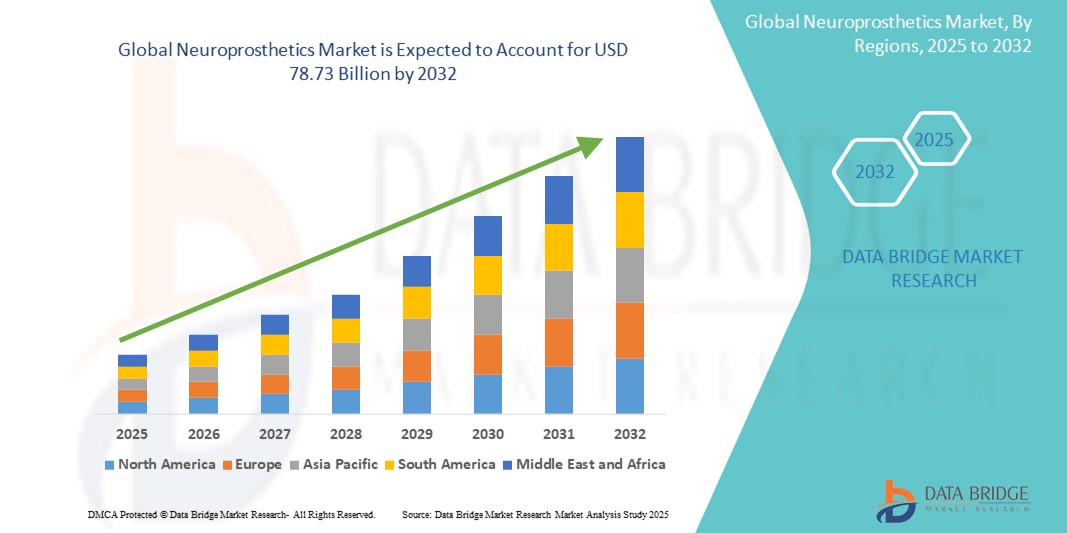
Neuroprosthetics Market Size
- The global neuroprosthetics market size was valued atUSD 27.41 billion in 2024and is expected to reachUSD 78.73 billion by 2032, at aCAGR of 14.10%during the forecast period
- This growth is driven by factors such as rising neurological disorder cases, technological advancements, an aging population, increased R&D investment, and supportive regulatory and reimbursement policies
Neuroprosthetics Market Analysis
- Neuroprosthetics are advanced medical devices designed to restore or replace neural function in individuals with neurological disorders or injuries. They play a vital role in improving motor control, sensory feedback, and cognitive function, and are used across settings such as hospitals, rehabilitation centers, and research institutions
- The neuroprosthetics market is witnessing steady growth driven by the increasing prevalence of neurological conditions, advancements in brain-computer interface and neural stimulation technologies, rising demand for minimally invasive treatments, and growing support through healthcare funding and R&D initiatives
- North America is expected to dominate the neuroprosthetics marketwith largest market share of 43%, due to a robust healthcare infrastructure, significant government and private funding, and a high level of research and development activity
- Asia-Pacific is expected to be the fastest growing region in the neuroprosthetics market during the forecast period due to increased healthcare investments, rising patient awareness, and efforts to reduce manufacturing costs of neuroprosthetic devices
- Motor neuron disorders segment is expected to dominate the market with alargest market shareof 60% due to high prevalence of conditions such asamyotrophic lateral sclerosis (ALS)and spinal muscular atrophy (SMA), coupled with increasing demand for advanced assistive technologies that restore motor function and improve quality of life in affected patients
Report Scope and Neuroprosthetics Market Segmentation
|
Attributes |
Neuroprosthetics Key Market Insights |
|
Segments Covered |
|
|
Countries Covered |
North America
Europe
Asia-Pacific
Middle East and Africa
South America
|
|
Key Market Players |
|
|
Market Opportunities |
|
|
Value Added Data Infosets |
In addition to the insights on market scenarios such as market value, growth rate, segmentation, geographical coverage, and major players, the market reports curated by the Data Bridge Market Research also include depth expert analysis, patient epidemiology, pipeline analysis, pricing analysis, and regulatory framework. |
Neuroprosthetics Market Trends
“Rising Adoption of Brain-Computer Interface (BCI) Technology”
- One prominent trend in the global neuroprosthetics market is the rising adoption ofbrain-computer interface (BCI)technology
- This trend is driven by the growing need for advanced solutions that enable direct brain-to-device communication, especially for patients with severe motor impairments and neurological conditions
- For instance, companies such as Neuralink and Blackrock Neurotech are actively developing BCI-integrated neuroprosthetics to enhance precision, responsiveness, and user control
- The demand for BCI-enabled systems is increasing across hospitals and research institutions due to their potential to restore motor function and improve patient outcomes
- As the focus on personalized and high-performance neurorehabilitation grows, this trend is expected to drive major innovation and investment in the neuroprosthetics market
Neuroprosthetics Market Dynamics
Driver
“Rising Prevalence of Neurological Disorders”
- The rising prevalence of neurological disorders is a key driver of growth in the neuroprosthetics market, as conditions such as Parkinson’s disease,epilepsy, and ALS increasingly require advanced neural interface solutions for effective management
- This demand is particularly evident in patients with motor neuron disorders, where neuroprosthetics help restore mobility and improve quality of life through targeted neural stimulation
- As neurological conditions become more common globally, especially among aging populations, there is a growing need for innovative, high-precision neuroprosthetic devices across hospitals, rehabilitation centers, and home care settings
- Manufacturers are actively developing next-generation neuroprosthetics that enhance neural signal processing, improve patient adaptability, and support minimally invasive application
- The focus on early intervention, functional recovery, and long-term neurological care is driving adoption in both developed and emerging healthcare markets
For instance,
- Medtronic and Boston Scientific continue to expand their neurostimulation product lines to address a wider range of neurological disorders
- Companies such as Cochlear and Nevro are investing in R&D to meet rising global demand for condition-specific neuroprosthetic solutions
- As the burden of neurological diseases grows, this driver is expected to significantly influence innovation, adoption, and market expansion in the neuroprosthetics sector
Opportunity
“Advancements in Neural Interface Technology”
- Advancements in neural interface technology present a significant opportunity for the neuroprosthetics market, driven by increasing demand for more precise, responsive, and biocompatible neural interaction systems
- Healthcare providers and research institutions are seeking cutting-edge neuroprosthetic solutions that enable seamless brain-device communication, enhance user control, and support real-time data processing
- This opportunity aligns with rapid progress in areas such as flexible electrodes, wireless interfaces, and AI integration, which are expanding the scope and effectiveness of neuroprosthetic applications
For instance,
- Companies such as Synchron and NeuroPace are developing minimally invasive neural interfaces designed to improve signal accuracy and patient comfort
- Blackrock Neurotech is focusing on next-generation BCI technologies aimed at restoring full mobility and communication capabilities for paralyzed individuals
- As innovation in neural interface technology accelerates, the neuroprosthetics market is well-positioned to capitalize on this momentum by delivering transformative solutions that address complex neurological needs
Restraint/Challenge
“Limited Long-term Durability and Reliability”
- Limited long-term durability and reliability present a significant challenge for the neuroprosthetics market, as devices must withstand prolonged use in the human body while maintaining optimal performance
- The need for consistent functionality over extended periods, combined with challenges in ensuring biocompatibility and minimizing device degradation, complicates product development and raises concerns over patient safety and device failure
- This challenge is especially prominent in emerging markets, where healthcare infrastructure may not support the long-term monitoring and maintenance of neuroprosthetic devices, potentially leading to higher costs and reduced accessibility
For instance,
- Companies such as Medtronic and Abbott are focusing on improving device longevity through enhanced materials and better sealing techniques, but smaller players may struggle to meet these standards
- The complexity of ensuring long-term reliability may slow innovation in the sector and hinder the broader adoption of advanced neuroprosthetic solutions, particularly in regions with limited healthcare resources and technical expertise
Neuroprosthetics Market Scope
The market is segmented on the basis of type, technique, application, and end user.
|
Segmentation |
Sub-Segmentation |
|
By Type |
|
|
By Technique |
|
|
By Application |
|
|
By End User
|
|
In 2025, the motor neuron disorders is projected to dominate the market with a largest share in application segment
The motor neuron disorders segment is expected to dominate the neuroprosthetics market with the largest share of 60% in 2025 due to high prevalence of conditions such as amyotrophic lateral sclerosis (ALS) and spinal muscular atrophy (SMA), coupled with increasing demand for advanced assistive technologies that restore motor function and improve quality of life in affected patients.
The spinal cord stimulation is expected to account for the largest share during the forecast period in technique segment
In 2025, the spinal cord stimulation segment is expected to dominate the market with the largest market share of 49.7% due to its proven efficacy in managing chronic pain conditions, rising adoption of minimally invasive procedures, and growing preference for neuromodulation therapies as alternatives to opioids.
Neuroprosthetics Market Regional Analysis
“North America Holds the Largest Share in the Neuroprosthetics Market”
- North America dominates the neuroprostheticsmarket with a share of 43%, driven by a robust healthcare infrastructure, significant government and private funding, and a high level of research and development activity
- U.S.holds a significant share in North America region due to its advanced healthcare system, high adoption of cutting-edge neuroprosthetic technologies, and strong investment in neurological disorder treatments and medical research
- The region's leadership is further bolstered by the presence of major players such as Medtronic, Boston Scientific, and Cochlear, who continue to push the boundaries of neuroprosthetic innovation, alongside favorable regulatory policies from agencies such as the FDA
- As the demand for advanced neuroprosthetics for conditions such as ALS, Parkinson’s disease, and spinal cord injuries grows, North America is poised to maintain its market dominance through 2032, fueled by continuous investment and the adoption of breakthrough neurotechnologies
“Asia-Pacific is Projected to Register the Highest CAGR in the Neuroprosthetics Market”
- Asia-Pacificis expected to witness the highest growth rate in the neuroprostheticsmarket, driven by increased healthcare investments, rising patient awareness, and efforts to reduce manufacturing costs of neuroprosthetic devices
- China holds a significant share due to its large population, expanding healthcare infrastructure, and government initiatives to improve access to advanced medical technologies
- The region’s rapid growth is supported by a surge in neuroprosthetic demand due to rising incidences of neurological disorders and an increasing preference for cost-effective, yet advanced, neuroprosthetic solutions across hospitals and clinics
- With improvements in healthcare accessibility and technology adoption, Asia-Pacific is anticipated to become a major driver of growth in the global neuroprosthetics market, particularly in countries such as China, India, and Japan, through 2032
Neuroprosthetics Market Share
The market competitive landscape provides details by competitor. Details included are company overview, company financials, revenue generated, market potential, investment in research and development, new market initiatives, global presence, production sites and facilities, production capacities, company strengths and weaknesses, product launch, product width and breadth, application dominance. The above data points provided are only related to the companies' focus related to market.
The Major Market Leaders Operating in the Market Are:
- Boston Scientific Corporation(U.S.)
- Zimmer Biomet (U.S.)
- Cochlear Ltd.(Australia)
- Medtronic(U.S.)
- NDI Medical, LLC (U.S.)
- NeuroPace, Inc. (U.S.)
- NEVRO CORP (U.S.)
- Abbott(U.S.)
- Sonova (Switzerland)
- CorTec GmbH (Germany)
- Neuro Device Group S.A. (Poland)
- LivaNova PLC (U.K.)
- MED-EL Medical Electronics (Austria)
Latest Developments in Global Neuroprosthetics Market
- In December 2022, Saskatchewan's Ministry of Health and the Saskatchewan Health Authority launched an expanded Cochlear Implant Program, offering subsidized replacements for external sound processors. Individuals contribute USD 840 per implant, with the Ministry covering the remainder (USD 8,000 to USD 12,000). This initiative aims to enhance accessibility to auditory devices for those in need across the province
- In October 2022, Axoft, a neurotechnology firm, introduced a brain-machine interface (BMI) targeting neurological disorders. This FDA breakthrough device involves neural implants, with an initial USD 8 million in funding for FDA studies and prototype scaling. The innovation seeks to advance treatment efficacy and patient outcomes through advanced neurotechnology solutions
- In July 2021, Researchers at US San Francisco developed a groundbreaking "speech neuroprosthesis." This device enables individuals with severe paralysis to communicate in sentences by translating brain signals directly into spoken words displayed as text on a screen. The innovation represents a significant advancement in assistive technology, enhancing communication and quality of life for paralyzed individuals
- In April 2021, Houston Methodist and Rice University launched a collaborative center for Translational Neural Prosthetics. This partnership focuses on neuroprosthetics research aimed at restoring brain function post-disease or injury. The initiative integrates clinical expertise from Houston Methodist with research capabilities from Rice University, aiming to accelerate innovations in neural prosthetics for neurological rehabilitation
SKU-
Accédez en ligne au rapport sur le premier cloud mondial de veille économique

- Tableau de bord d'analyse de données interactif
- Tableau de bord d'analyse d'entreprise pour les opportunités à fort potentiel de croissance
- Accès d'analyste de recherche pour la personnalisation et les requêtes
- Analyse de la concurrence avec tableau de bord interactif
- Dernières actualités, mises à jour et analyse des tendances
- Exploitez la puissance de l'analyse comparative pour un suivi complet de la concurrence
Méthodologie de recherche
La collecte de données et l'analyse de l'année de base sont effectuées à l'aide de modules de collecte de données avec des échantillons de grande taille. L'étape consiste à obtenir des informations sur le marché ou des données connexes via diverses sources et stratégies. Elle comprend l'examen et la planification à l'avance de toutes les données acquises dans le passé. Elle englobe également l'examen des incohérences d'informations observées dans différentes sources d'informations. Les données de marché sont analysées et estimées à l'aide de modèles statistiques et cohérents de marché. De plus, l'analyse des parts de marché et l'analyse des tendances clés sont les principaux facteurs de succès du rapport de marché. Pour en savoir plus, veuillez demander un appel d'analyste ou déposer votre demande.
La méthodologie de recherche clé utilisée par l'équipe de recherche DBMR est la triangulation des données qui implique l'exploration de données, l'analyse de l'impact des variables de données sur le marché et la validation primaire (expert du secteur). Les modèles de données incluent la grille de positionnement des fournisseurs, l'analyse de la chronologie du marché, l'aperçu et le guide du marché, la grille de positionnement des entreprises, l'analyse des brevets, l'analyse des prix, l'analyse des parts de marché des entreprises, les normes de mesure, l'analyse globale par rapport à l'analyse régionale et des parts des fournisseurs. Pour en savoir plus sur la méthodologie de recherche, envoyez une demande pour parler à nos experts du secteur.
Personnalisation disponible
Data Bridge Market Research est un leader de la recherche formative avancée. Nous sommes fiers de fournir à nos clients existants et nouveaux des données et des analyses qui correspondent à leurs objectifs. Le rapport peut être personnalisé pour inclure une analyse des tendances des prix des marques cibles, une compréhension du marché pour d'autres pays (demandez la liste des pays), des données sur les résultats des essais cliniques, une revue de la littérature, une analyse du marché des produits remis à neuf et de la base de produits. L'analyse du marché des concurrents cibles peut être analysée à partir d'une analyse basée sur la technologie jusqu'à des stratégies de portefeuille de marché. Nous pouvons ajouter autant de concurrents que vous le souhaitez, dans le format et le style de données que vous recherchez. Notre équipe d'analystes peut également vous fournir des données sous forme de fichiers Excel bruts, de tableaux croisés dynamiques (Fact book) ou peut vous aider à créer des présentations à partir des ensembles de données disponibles dans le rapport.











