



Global Peripheral Neuritis Treatment Market Segmentation, By Drug Class (Anti-Depressants, Tricyclic, Selective Serotonin/Norepinephrine Reuptake Inhibitors, Serotonin Reuptake Inhibitors, Anticonvulsants, Local Anesthesia, Analgesics, NSAID, Opioid, Steroids, and Others), Application (Diabetic Peripheral Neuropathy, Chemotherapy-Induced Peripheral Neuropathy, Idiopathic Peripheral Neuropathy, and Others), Distribution Channel (Hospital Pharmacies, Retail Pharmacies, Drug Stores, and Online Pharmacies)- Industry Trends and Forecast to 2033
Quelle est la taille et l'aperçu du marché du traitement de la neurite périphérique
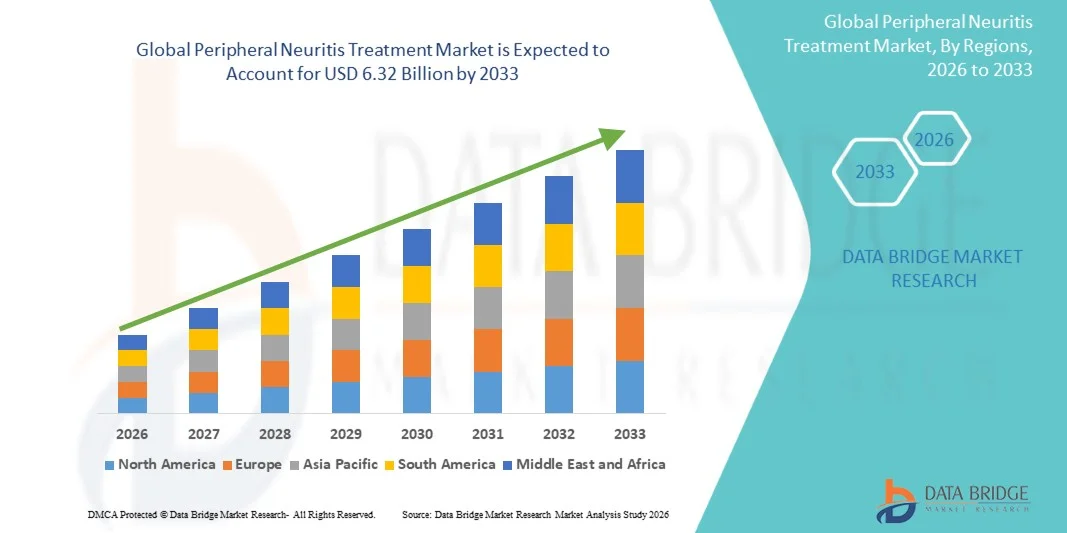
- Selon l'analyse de marché de Data Bridge La taille du marché mondial du traitement des névrites périphériques a été évaluée à4,80 milliards de dollars en 2025et devrait atteindre6,32 milliards de dollars en 2033, à unTCAC de 3,50 %pendant la période de prévision
- La croissance du marché est en grande partie attribuable à la prévalence croissante des neuropathies périphériques, à la sensibilisation accrue aux troubles liés aux nerfs et aux progrès dans les options de traitement pharmacologique et non pharmacologique, y compris les nouveaux analgésiques et les thérapies neuroprotectives
- En outre, la demande croissante de patients pour desthérapies ciblées injectablespour l'inflammation des nerfs et les dommages est de positionner les traitements avancés de névrite périphérique comme le choix préféré parmi les cliniciens et les patients. Ces facteurs combinés propulsent l'adoption de solutions de traitement innovantes, alimentant ainsi de manière significative l'expansion du marché
Taille du marché et prévisions
- Valeur marchande mondiale (2025): USD4,80 milliards
- Valeur marchande prévue (2033): USD6,32 milliards
- Prévisions CAGR (2026-2033):3.50%
Quels sont les principaux débouchés du marché du traitement de la neurite périphérique
- Traitements de la névrite périphérique, y compris les thérapies pharmacologiquesanticonvulsivants, antidépresseurs, analgésiques,et anesthésiques locaux, sont de plus en plus critiques pour la gestion de l'inflammation nerveuse et de la douleur neuropathique dans les cas aigus et chroniques, en raison de leur efficacité à améliorer la qualité de vie des patients et les résultats fonctionnels
- La demande croissante de traitements de la neurite périphérique est principalement due à la prévalence croissante de la neuropathie diabétique, des neuropathies induites par la chimiothérapie et des neuropathies périphériques idiopathiques, associées à une prise de conscience croissante des patients et des fournisseurs de soins de santé quant au diagnostic et à l'intervention précoces.
- L'Amérique du Nord a dominé le marché du traitement des névrites périphériques avec la plus grande part de revenus de 38,7 % en 2025, appuyée par des infrastructures de soins de santé avancées, l'adoption de classes de médicaments innovatrices, des activités de R-D robustes et un financement important du gouvernement et du secteur privé, les États-Unis ayant observé une croissance importante des prescriptions d'anticonvulsivants et d'inhibiteurs sélectifs de la recapture de la sérotonine et de la norépinéphrine pour la gestion des symptômes.
- L'Asie-Pacifique devrait être la région qui connaîtra la croissance la plus rapide du marché du traitement de la neurite périphérique au cours de la période de prévision en raison de l'incidence croissante de la neuropathie périphérique diabétique, de l'augmentation des dépenses de soins de santé et de l'amélioration de l'accès aux traitements spécialisés dans les économies émergentes.
- Le segment des anticonvulsivants a dominé le marché du traitement de la névrite périphérique avec une part de marché de 45,6 % en 2025, en raison de leur efficacité dans le contrôle de la douleur neuropathique et de la préférence généralisée des médecins dans plusieurs applications de névrite périphérique
Étendue du rapport et segmentation du marché du traitement de la neurite périphérique
Attributs |
Traitement de la neurite périphérique Principales perspectives du marché |
|
Segments couverts |
|
|
Pays couverts |
Amérique du Nord
Europe
Asie-Pacifique
Moyen-Orient et Afrique
Amérique du Sud
|
|
Principaux acteurs du marché |
|
|
Possibilités de marché |
|
|
Infos sur la valeur ajoutée |
En plus des renseignements sur les scénarios du marché comme la valeur du marché, le taux de croissance, la segmentation, la couverture géographique et les principaux intervenants, les rapports de marché établis par Data Bridge Market Research comprennent également une analyse approfondie des experts, l'épidémiologie des patients, l'analyse des pipelines, l'analyse des prix et le cadre réglementaire. |
Quelle est la tendance clé du marché du traitement de la neurite périphérique
Progrès dans les thérapies pharmacologiques ciblées
- Une tendance notable et accélérée sur le marché mondial du traitement de la névrite périphérique est le développement et l'adoption de traitements pharmacologiques ciblés, y compris des anticonvulsivants, des inhibiteurs sélectifs de la recapture de la sérotonine et de la norépinéphrine (SNRI) et des anesthésiques locaux, visant à traiter à la fois la douleur neuropathique et l'inflammation nerveuse sous-jacente.
- Par exemple, les nouvelles formulations SNRI sont conçues pour fournir un soulagement de la douleur plus durable avec moins d'effets secondaires, tandis que de nouveaux anticonvulsivants tels que les analogues de la prégabaline sont optimisés pour améliorer le contrôle de la douleur nerveuse dans les neuropathies diabétiques et induites par la chimiothérapie
- L'intégration de ces thérapies avancées à des plans de traitement spécifiques au patient permet une prise en charge plus précise et efficace des symptômes de la neurite périphérique, améliorant l'adhésion globale du patient et la qualité de vie
- L'innovation pharmacologique est de plus en plus complétée par des régimes combinés qui permettent de cibler simultanément les voies de la douleur et la régénération nerveuse, améliorant ainsi les résultats cliniques chez les patients souffrant de neuropathies périphériques chroniques
- Cette tendance vers des approches thérapeutiques plus personnalisées, ciblées et multimodales consiste à remodeler les protocoles de traitement, des sociétés pharmaceutiques comme Pfizer et Grünenthal développant de nouvelles formulations pour des indications spécifiques de neuropathie périphérique
- L'adoption de ces thérapies ciblées se développe rapidement sur les marchés développés et émergents, les cliniciens et les patients privilégiant l'efficacité, la tolérance et les stratégies de gestion spécifiques aux symptômes dans les soins de la neurite périphérique
- Par exemple, les plates-formes de santé numériques sont de plus en plus intégrées aux plans de traitement pour surveiller la réponse des patients, ce qui permet aux médecins d'ajuster les thérapies en temps réel pour obtenir de meilleurs résultats.
Dynamique du marché du traitement de la neurite périphérique
Chauffeur
La prévalence croissante de la neuropathie périphérique et de la sensibilisation croissante
- La prévalence croissante des maladies à l'origine de la névrite périphérique, comme le diabète, l'exposition à la chimiothérapie et les troubles auto-immuns, associée à une sensibilisation accrue des patients et des fournisseurs de soins de santé, est un facteur clé de la croissance du marché.
- Par exemple, en mars 2025, Pfizer a signalé une augmentation des ordonnances de duloxétine pour la neuropathie périphérique diabétique en Amérique du Nord, ce qui reflète une adoption clinique accrue et une sensibilisation accrue aux options de traitement fondées sur des preuves
- Comme un plus grand nombre de patients recherchent un diagnostic et une prise en charge rapides de la douleur neuropathique, la demande de traitements pharmacologiques efficaces, y compris des anticonvulsivants, des analgésiques et des anesthésiques locaux, continue de croître de façon significative.
- De plus, l'augmentation des investissements dans les infrastructures de soins de santé, les programmes d'éducation des patients et les stratégies d'intervention précoce rendent les traitements de la névrite périphérique plus accessibles et stimulent l'expansion du marché.
- La disponibilité de plusieurs classes de médicaments ayant prouvé leur efficacité dans la gestion de diverses applications de névrite périphérique encourage les cliniciens à adopter des plans de traitement personnalisés, renforçant la demande globale du marché
- Par exemple, les collaborations croissantes entre les compagnies pharmaceutiques et les hôpitaux pour promouvoir des programmes de dépistage précoce de la neuropathie diabétique et induite par la chimiothérapie stimulent les taux d'adoption de traitements
- L'intensification de la recherche sur les biomarqueurs nouveaux et les outils de diagnostic permet une identification plus précise de la névrite périphérique, facilitant des interventions de traitement ciblées et opportunes.
Restriction/Défi
Effets secondaires et obstacles à l'approbation réglementaire
- Les préoccupations concernant les effets indésirables associés à l'utilisation à long terme de médicaments contre la névrite périphérique, y compris les vertiges, les problèmes gastro-intestinaux et les risques de dépendance, posent des défis à l'adoption généralisée de certaines thérapies pharmacologiques.
- Par exemple, les rapports de dépendance liée aux opioïdes dans la gestion de la douleur neuropathique chronique ont conduit à des pratiques de prescription plus prudentes et à une surveillance plus stricte par les cliniciens.
- La navigation de voies réglementaires complexes pour l'approbation de nouveaux médicaments ou de thérapies combinées ajoute de nouveaux obstacles, en particulier dans les régions où les exigences en matière d'innocuité et d'efficacité clinique sont strictes
- En outre, des coûts élevés de traitement associés à des thérapies innovantes ou de marque peuvent limiter l'accès aux marchés sensibles aux prix, en particulier dans les économies émergentes ou parmi les populations non assurées
- S'attaquer à ces défis par des formulations de médicaments plus sûres, une surveillance accrue des patients, la conformité à la réglementation et l'éducation des patients à la gestion des effets secondaires seront essentielles à une croissance soutenue du marché.
- Par exemple, l'approbation tardive de thérapies innovantes sur les marchés clés peut ralentir l'adoption malgré les avantages cliniques démontrés, ce qui a une incidence sur l'expansion globale du marché.
- L'expiration des brevets et la concurrence générique dans certaines catégories de médicaments peuvent exercer une pression sur les prix et la rentabilité, limitant ainsi les incitations à l'innovation dans le traitement des névrites périphériques
Comment le marché du traitement de la neurite périphérique est-il segmenté
Le marché est segmenté en fonction de la classe de médicaments, de l'application et du canal de distribution
- Par catégorie de drogues
Sur la base de la classe de médicaments, le marché du traitement des névrites périphériques est segmenté en antidépresseurs, tricycliques, sélectifs, sérotonine/Norépinephrine inhibiteurs de recapture (SNRI), sérotonine inhibiteurs de recapture (SSRI), anticonvulsivants, anesthésie locale, analgésique, AINS, opioïde, stéroïdes, etc. Le segment des anticonvulsivants a dominé le marché avec la plus grande part des revenus de 45,6 % en 2025, en raison de leur efficacité avérée dans le contrôle de la douleur neuropathique associée aux neuropathies périphériques diabétiques, induites par la chimiothérapie et idiopathiques. Les médecins préfèrent les anticonvulsivants en raison de leur profil d'innocuité clinique bien établi, de leur vaste gamme thérapeutique et de leur aptitude à la prise en charge à long terme de la douleur nerveuse. Leur adoption extensive est également alimentée par l'augmentation des ordonnances de médicaments tels que la prégabaline et la gabapentine, appuyées par des politiques de remboursement sur les marchés développés. De plus, les anticonvulsivants sont souvent utilisés en association avec d'autres classes de médicaments, ce qui améliore le contrôle des symptômes et l'adhésion du patient. Les patients apprécient également la facilité de l'administration orale et le soulagement prévisible de la douleur, ce qui favorise la croissance du segment.
Le segment des SNRI devrait connaître le taux de croissance le plus rapide de 2026 à 2033, alimenté par l'adoption croissante de la modulation de la douleur ciblée dans la neuropathie diabétique et induite par la chimiothérapie. Ces médicaments, comme la duloxétine et la venlafaxine, offrent un double avantage d'atténuer la douleur neuropathique et de gérer la dépression comorbide ou l'anxiété généralement associée à la douleur chronique. L'augmentation des preuves cliniques appuyant leur efficacité et leur innocuité, ainsi que la sensibilisation accrue des fournisseurs de soins de santé et des patients, contribuent à une adoption rapide. Les entreprises pharmaceutiques mettent également au point de nouvelles formulations plus tolérantes, ce qui renforce l'adhésion des patients et accroît la pénétration du marché dans les économies développées et émergentes.
- Par demande
Sur la base de l'application, le marché du traitement de la neurite périphérique est segmenté en neuropathie périphérique diabétique (NDP), neuropathie périphérique induite par la chimiothérapie (NCIP), neuropathie périphérique idiopathique et autres. Le segment de la neuropathie périphérique diabétique (NPD) a dominé le marché avec la plus grande part en 2025, en raison de la prévalence mondiale croissante du diabète et de ses complications neuropathiques associées. Les patients atteints de DPN souffrent souvent de douleurs chroniques, d'engourdissements et d'une qualité de vie réduite, ce qui rend les interventions pharmacologiques efficaces critiques. L'augmentation des programmes de dépistage, des diagnostics précoces et des protocoles de gestion de routine stimule la demande de classes de médicaments comme les anticonvulsivants, les ISN et les anesthésiques topiques. En outre, l'aide au remboursement et l'inclusion des traitements NPD dans les lignes directrices nationales en matière de soins de santé dans les pays développés stimulent l'adoption. Les médecins comptent de plus en plus sur des thérapies fondées sur des données probantes pour soulager les symptômes, et la préférence des patients pour les médicaments oraux ou faciles à administrer renforce la domination du segment.
Le segment de la neuropathie périphérique induite par la chimiothérapie (NCIP) devrait être témoin du TCAC le plus rapide de 2026 à 2033, en raison du nombre croissant de survivants du cancer et de la sensibilisation croissante aux effets secondaires neuropathiques de la chimiothérapie. L'utilisation croissante de nouveaux régimes chimiothérapeutiques a amplifié l'incidence du CIPN, créant la demande d'options efficaces de gestion de la douleur, y compris les SISN, les anticonvulsivants et les anesthésiques locaux. Les fournisseurs de soins de santé se concentrent sur les interventions précoces et les thérapies combinées pour réduire les lésions nerveuses à long terme, ce qui favorise la croissance. De plus, les approches centrées sur le patient, y compris la surveillance des symptômes neuropathiques par les cliniques d'oncologie et les plateformes de santé numériques, facilitent l'adoption plus rapide dans les hôpitaux et les cliniques externes.
- Par canal de distribution
Sur la base du canal de distribution, le marché du traitement des névrites périphériques est segmenté en pharmacies hospitalières, pharmacies de détail, pharmacies pharmaceutiques et pharmacies en ligne. Le segment des Pharmacies hospitalières a dominé le marché avec la plus grande part des revenus en 2025, en raison de l'initiation fréquente du traitement dans des milieux cliniques où se produisent le diagnostic, la surveillance et la prescription de thérapies pharmacologiques spécialisées. Les hôpitaux offrent l'accès à un large éventail de classes de médicaments, y compris les anticonvulsivants, les ISN et les opioïdes, sous surveillance professionnelle, assurant un dosage optimal et la gestion des effets indésirables. La forte présence de professionnels de la santé formés, les programmes de surveillance des patients établis et la couverture de remboursement d'assurance favorisent l'utilisation des pharmacies hospitalières. De plus, les pharmacies hospitalières facilitent l'accès aux combinaisons thérapeutiques et aux formulations spécialisées, soutenant la gestion chronique des neuropathies périphériques.
Le segment Pharmacies en ligne devrait connaître le taux de croissance le plus rapide de 2026 à 2033, alimenté par l'augmentation de la pénétration d'Internet, la commodité de la livraison à domicile et la préférence croissante des patients pour les solutions de soins de santé numériques. Les plateformes en ligne permettent un accès facile aux médicaments sur ordonnance, en particulier pour les patients des régions éloignées ou ceux qui ont des limitations de mobilité en raison de la douleur neuropathique. La confiance croissante dans les services de pharmacopée électronique, conjuguée aux approbations réglementaires pour la vente en ligne de médicaments contrôlés sur les marchés clés, favorise l'adoption rapide. De plus, l'éducation des patients et les services numériques d'ordonnance intégrés à la télémédecine accélèrent le passage aux services de pharmacie en ligne.
Analyse régionale du marché du traitement de la neurite périphérique
- L'Amérique du Nord a dominé le marché du traitement de la neurite périphérique avec la plus grande part des revenus de 38,7 % en 2025, appuyée par des infrastructures de soins de santé de pointe, l'adoption de classes de médicaments innovatrices, des activités de R-D robustes et un financement public et privé substantiel.
- Les patients et les fournisseurs de soins de santé de la région apprécient fortement la disponibilité de multiples thérapies pharmacologiques, y compris les anticonvulsivants, les ISN et les anesthésiques locaux, qui offrent une gestion efficace des symptômes et une meilleure qualité de vie aux névrites périphériques.
- Cette adoption généralisée s'appuie en outre sur de solides activités de R-D, une couverture d'assurance, des initiatives gouvernementales de sensibilisation à la neuropathie et la présence de grandes sociétés pharmaceutiques, faisant de l'Amérique du Nord le premier marché de traitement de la neurite périphérique, tant en clinique qu'en consultation externe.
Aperçu du marché américain du traitement de la neurite périphérique
Le marché américain du traitement des névrites périphériques a enregistré la plus grande part de revenus de 82 % en 2025 en Amérique du Nord, en raison de la forte prévalence des neuropathies périphériques induites par le diabète et la chimiothérapie. Les patients privilégient de plus en plus la prise en charge efficace de la douleur neuropathique et de l'inflammation nerveuse par des traitements pharmacologiques avancés tels que les anticonvulsivants, les ISN et les anesthésiques locaux. L'adoption croissante de diagnostics précoces, de plans de traitement personnalisés et de plateformes numériques de surveillance de la santé favorise la croissance du marché. De plus, de solides infrastructures de soins de santé, un soutien au remboursement et la présence de grandes sociétés pharmaceutiques contribuent de façon significative à l'expansion du marché.
Europe Aperçu du marché du traitement de la neurite périphérique
Le marché européen du traitement des névrites périphériques devrait s'étendre à un TCAC important tout au long de la période de prévision, principalement en raison de la sensibilisation accrue aux troubles liés aux nerfs et de l'augmentation des dépenses de santé. L'adoption de traitements fondés sur des lignes directrices pour les neuropathies périphériques induites par le diabète, l'idiopathie et la chimiothérapie favorise la croissance du marché. Les patients européens recherchent de plus en plus des médicaments efficaces et bien tolérés, tels que les anticonvulsivants et les ISN. De plus, les initiatives gouvernementales de soutien, les programmes de dépistage précoce et l'intégration de thérapies spécialisées dans les hôpitaux et les cliniques externes stimulent la demande. Le marché connaît une croissance dans les établissements de santé résidentiels et institutionnels.
Aperçu du marché du traitement de la neurite périphérique au Royaume-Uni
On s'attend à ce que le marché du traitement des névrites périphériques du Royaume-Uni augmente à un TCAC remarquable au cours de la période de prévision, en raison d'une sensibilisation accrue à la gestion de la douleur neuropathique et de la nécessité d'une intervention précoce. Les cas croissants de neuropathie périphérique diabétique et de neuropathie induite par la chimiothérapie encouragent les patients et les cliniciens à adopter des traitements pharmacologiques efficaces. La forte infrastructure de soins de santé du Royaume-Uni, combinée à l'accessibilité des médicaments d'ordonnance par les hôpitaux et les pharmacies de détail, continue de stimuler la croissance du marché. Une préférence accrue des patients pour des classes de médicaments bien tolérées, de même que des programmes nationaux de sensibilisation à la neuropathie, favorisent l'adoption.
Allemagne Aperçu du marché du traitement de la neurite périphérique
Le marché allemand du traitement des névrites périphériques devrait se développer à un TCAC considérable au cours de la période de prévision, alimenté par la prévalence croissante des neuropathies périphériques et la demande d'options de traitement avancées. L'Allemagne dispose d'une infrastructure de soins de santé bien développée et met l'accent sur les thérapies innovantes pour promouvoir l'adoption de traitements pharmacologiques de première ligne et de combinaisons. L'intégration des protocoles fondés sur des données probantes, de la surveillance numérique des patients et des programmes de diagnostic précoce devient de plus en plus courante. Les patients en Allemagne sont particulièrement concentrés sur des options de traitement efficaces, sûres et durables, en adéquation avec les pratiques cliniques locales et les attentes des consommateurs.
Aperçu du marché du traitement de la neurite périphérique en Asie-Pacifique
Le marché du traitement des névrites périphériques en Asie et dans le Pacifique est sur le point de croître au rythme le plus rapide de 23 % au cours de la période de prévision de 2026 à 2033, en raison de l'augmentation de l'incidence des neuropathies périphériques induites par le diabète et la chimiothérapie, de la sensibilisation accrue aux soins de santé et de l'amélioration des infrastructures médicales dans des pays comme la Chine, le Japon et l'Inde. La région met de plus en plus l'accent sur le diagnostic précoce, associé à la disponibilité croissante de thérapies pharmacologiques efficaces, favorise l'adoption. En outre, les investissements émergents dans les soins de santé et les plateformes numériques de santé améliorent l'accessibilité des traitements. L'urbanisation rapide, l'augmentation des revenus disponibles et les initiatives gouvernementales de gestion des troubles nerveux propulsent davantage la croissance du marché.
Aperçu du marché japonais du traitement de la neurite périphérique
Le marché japonais du traitement des névrites périphériques prend de l'ampleur en raison du vieillissement de la population, de la forte prévalence de la neuropathie diabétique et de la demande de prise en charge efficace de la douleur. Le marché japonais met l'accent sur la qualité des soins, avec l'adoption croissante de thérapies ciblées telles que les anticonvulsivants, les SNRI et les anesthésiques locaux. L'intégration de la surveillance numérique et des solutions de télésanté pour les patients atteints de neuropathie chronique stimule la croissance. De plus, l'accent mis sur le diagnostic précoce, l'éducation des patients et les approches de thérapie combinée favorise l'adoption dans les établissements résidentiels et hospitaliers.
Aperçu du marché indien du traitement de la neurite périphérique
Le marché indien du traitement des névrites périphériques a représenté la plus grande part des revenus en Asie-Pacifique en 2025, attribuable à l'augmentation de la prévalence du diabète, aux neuropathies liées à la chimiothérapie et à l'expansion des infrastructures de soins de santé. L'Inde est témoin d'une prise de conscience croissante des troubles liés aux nerfs, ce qui pousse les patients à exiger des thérapies pharmacologiques efficaces. La disponibilité de médicaments abordables, la croissance des réseaux de pharmacies au détail et hospitalières et les initiatives gouvernementales en matière de santé sont des facteurs clés qui propulsent le marché. L'urbanisation croissante, l'augmentation de la population de la classe moyenne et l'élargissement de l'accès aux solutions de santé numériques stimulent l'adoption de traitements dans tout le pays.
Part du marché du traitement de la neurite périphérique
L'industrie du traitement de la neurite périphérique est principalement dirigée par des entreprises bien établies, notamment :
- Pfizer Inc.. (États-Unis)
- GSK plc(Royaume-Uni)
- Services Johnson & Johnson, Inc. (États-Unis)
- AstraZeneca (Royaume-Uni)
- Novartis AG (Suisse)
- Eli Lilly and Company, (États-Unis)
- Takeda Pharmaceuticals & Co. Ltd. (Japon)
- Viatris Inc. (États-Unis)
- Teva Pharmaceutical Industries Ltd. (Israël)
- Astellas Pharma Inc., (Japon)
- Sun Pharmaceutical Industries Ltd. (Inde)
- Apotex Inc., (Canada)
- Dr. Reddy-S Laboratories Ltd. (Inde)
- Cipla Inc., (Inde)
- Amneal Pharmaceuticals LLC (États-Unis)
- Lupin Ltd. (Inde)
- Daiichi Sankyo Co. Ltd. (Japon)
- Glenmark Pharmaceuticals Ltd., (Inde)
- Cadila Pharmaceuticals Ltd. (Inde)
- Mallinckrodt Pharmaceuticals plc (Royaume-Uni)
Quelles sont les évolutions récentes du marché mondial du traitement de la neurite périphérique
- En octobre 2025, Lexicon Pharmaceuticals a présenté des données cliniques supplémentaires sur le pilavapadin lors du 19e Sommet annuel sur la douleur thérapeutique, renforçant son potentiel en tant que nouvelle thérapie orale non opioïde pour la douleur neuropathique périphérique diabétique basée sur des analyses étendues de l'étude de phase 2b PROGRESS
- En mars 2025, le rythme de développement clinique du pilavapadin s'est poursuivi lorsque les données de phase 2b PROGRESS ont confirmé l'efficacité et la tolérance de la dose de 10 mg, ce qui a conduit à la sélection de cette dose pour les prochains essais de phase 3 ciblant les patients souffrant de douleur neuropathique périphérique diabétique
- En mars 2025, Dogwood Therapeutics a commencé à administrer le premier patient dans son essai de phase 2b HALT‐CINP évaluant Halneuron® pour le traitement de la neuropathie périphérique induite par la chimiothérapie (CIPN), ce qui marque la progression vers le premier traitement à base de mécanisme pour la douleur neuropathique liée à la chimio
- En mars 2025, Lexicon Pharmaceuticals a annoncé les résultats topline de son étude de phase 2b PROGRESS évaluant la pilavapadin (LX9211) chez les adultes présentant une douleur neuropathique périphérique diabétique modérée à sévère (DPNP), démontrant des réductions significatives de la douleur par rapport au placebo et positionnant l'inhibiteur expérimental AAK1 pour progresser vers le développement de la phase 3
- En décembre 2023, la Food and Drug Administration (FDA) des États-Unis a approuvé Wainua (eplontersen), développé par Ionis Pharmaceuticals et AstraZeneca, en tant que premier traitement auto-administré approuvé pour les patients adultes atteints de polyneuropathie amyloïde héréditaire (ATTRv‐PN), offrant une réduction soutenue de la neuropathie et une amélioration de la qualité de vie.
SKU-
Accédez en ligne au rapport sur le premier cloud mondial de veille économique

- Tableau de bord d'analyse de données interactif
- Tableau de bord d'analyse d'entreprise pour les opportunités à fort potentiel de croissance
- Accès d'analyste de recherche pour la personnalisation et les requêtes
- Analyse de la concurrence avec tableau de bord interactif
- Dernières actualités, mises à jour et analyse des tendances
- Exploitez la puissance de l'analyse comparative pour un suivi complet de la concurrence
Méthodologie de recherche
La collecte de données et l'analyse de l'année de base sont effectuées à l'aide de modules de collecte de données avec des échantillons de grande taille. L'étape consiste à obtenir des informations sur le marché ou des données connexes via diverses sources et stratégies. Elle comprend l'examen et la planification à l'avance de toutes les données acquises dans le passé. Elle englobe également l'examen des incohérences d'informations observées dans différentes sources d'informations. Les données de marché sont analysées et estimées à l'aide de modèles statistiques et cohérents de marché. De plus, l'analyse des parts de marché et l'analyse des tendances clés sont les principaux facteurs de succès du rapport de marché. Pour en savoir plus, veuillez demander un appel d'analyste ou déposer votre demande.
La méthodologie de recherche clé utilisée par l'équipe de recherche DBMR est la triangulation des données qui implique l'exploration de données, l'analyse de l'impact des variables de données sur le marché et la validation primaire (expert du secteur). Les modèles de données incluent la grille de positionnement des fournisseurs, l'analyse de la chronologie du marché, l'aperçu et le guide du marché, la grille de positionnement des entreprises, l'analyse des brevets, l'analyse des prix, l'analyse des parts de marché des entreprises, les normes de mesure, l'analyse globale par rapport à l'analyse régionale et des parts des fournisseurs. Pour en savoir plus sur la méthodologie de recherche, envoyez une demande pour parler à nos experts du secteur.
Personnalisation disponible
Data Bridge Market Research est un leader de la recherche formative avancée. Nous sommes fiers de fournir à nos clients existants et nouveaux des données et des analyses qui correspondent à leurs objectifs. Le rapport peut être personnalisé pour inclure une analyse des tendances des prix des marques cibles, une compréhension du marché pour d'autres pays (demandez la liste des pays), des données sur les résultats des essais cliniques, une revue de la littérature, une analyse du marché des produits remis à neuf et de la base de produits. L'analyse du marché des concurrents cibles peut être analysée à partir d'une analyse basée sur la technologie jusqu'à des stratégies de portefeuille de marché. Nous pouvons ajouter autant de concurrents que vous le souhaitez, dans le format et le style de données que vous recherchez. Notre équipe d'analystes peut également vous fournir des données sous forme de fichiers Excel bruts, de tableaux croisés dynamiques (Fact book) ou peut vous aider à créer des présentations à partir des ensembles de données disponibles dans le rapport.











