


Global Psoriasis Treatment Market Segmentation, By Drug Class (Corticosteroids, TNF Inhibitors, Interleukins, and Others), Type (Plaque Psoriasis, Psoriatic Arthritis, and Others), Route of Administration (Oral, Parenteral, and Topical), Application (Topical Therapeutic Drugs, Systemic Therapeutic Drugs, and Combinations), End User (Hospital Pharmacy, Clinics, Retail Pharmacies, and Online Sales)- Industry Trends and Forecast to 2033
Quelle est la taille du marché et le taux de croissance du traitement du psoriasis
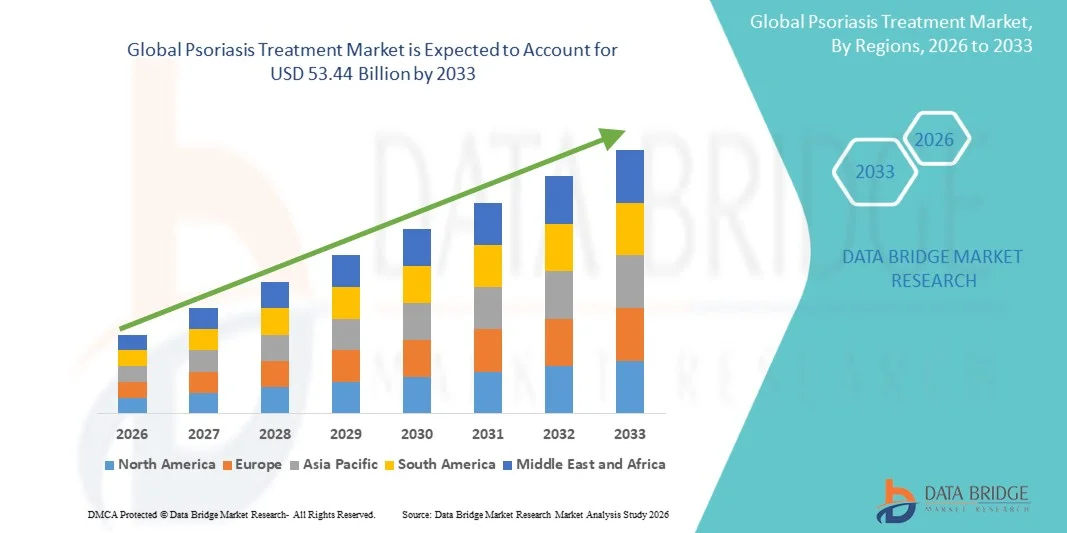
- Selon l'analyse de Data Bridge Market Research, la taille du marché mondial du traitement du psoriasis a été évaluée à29,20 milliards de dollars en 2025et devrait atteindre53,44 milliards de dollars en 2033, à unTCAC de 7,85 %pendant la période de prévision
- La croissance du marché est en grande partie alimentée par la prévalence croissante du psoriasis dans le monde, la sensibilisation accrue aux options de traitement et l'adoption rapide de produits biologiques et biologiques de pointe.thérapies cibléesqui offrent des profils d'efficacité et de sécurité améliorés
- De plus, l'augmentation des taux de diagnostic, l'augmentation des investissements en R-D et la demande des consommateurs pour des solutions de traitement personnalisées et efficaces établissent des options thérapeutiques novatrices comme stratégie de gestion préférée pour les patients. Ces facteurs convergents accélèrent l'adoption de solutions de traitement du psoriasis, ce qui stimule significativement la croissance de l'industrie
Taille du marché et prévisions
- Valeur marchande mondiale (2025):29,20 milliards de dollars
- Valeur marchande prévue (2033) :53,44 milliards de dollars
- Prévisions CAGR (2026-2033):7.85%
Quels sont les principaux débouchés du marché du traitement du psoriasis
- Traitement du psoriasiscorticoïdes, les inhibiteurs du TNF, les interleukins et d'autres classes de médicaments sont des composantes de plus en plus vitales des soins dermatologiques modernes en raison de leur efficacité dans la gestion des symptômes chroniques, l'amélioration de la qualité de vie des patients et la prévention de la progression de la maladie
- La demande croissante de traitements du psoriasis est principalement alimentée par la prévalence croissante du psoriasis en plaques et du rhumatisme psoriasique à l'échelle mondiale, la sensibilisation croissante aux thérapies disponibles et une préférence croissante pour des options de traitement systémique et combiné avancées qui offrent une meilleure efficacité et sécurité
- L'Amérique du Nord a dominé le marché du traitement par psoriasis avec la plus grande part des revenus de 38,5 % en 2025, caractérisée par des dépenses élevées en soins de santé, l'adoption précoce de thérapies biologiques parentérales et une forte présence de grandes sociétés pharmaceutiques, les États-Unis connaissant une croissance substantielle de l'absorption de traitement grâce à des innovations dans les agents ciblant l'interleukine.
- L'Asie-Pacifique devrait être la région qui connaîtra la croissance la plus rapide sur le marché du traitement du psoriasis au cours de la période de prévision en raison de l'augmentation de l'accès aux soins de santé, des revenus disponibles et de l'expansion de la distribution par les hôpitaux, les cliniques, les pharmacies de détail et les circuits de vente en ligne.
- Le segment parentéral a dominé le marché avec une part de marché de 46,7 % en 2025, en raison de l'adoption élevée de produits biologiques injectables qui assurent un meilleur contrôle des maladies et des résultats thérapeutiques à long terme par rapport aux thérapies orales et topiques traditionnelles.
Portée du rapport et segmentation du marché du traitement du psoriasis
|
Attributs |
Traitement du psoriasis Principales perspectives du marché |
|
Segments couverts |
|
|
Pays couverts |
Amérique du Nord
Europe
Asie-Pacifique
Moyen-Orient et Afrique
Amérique du Sud
|
|
Principaux acteurs du marché |
|
|
Possibilités de marché |
|
|
Infos sur la valeur ajoutée |
En plus des renseignements sur les scénarios du marché comme la valeur du marché, le taux de croissance, la segmentation, la couverture géographique et les principaux intervenants, les rapports de marché établis par Data Bridge Market Research comprennent également une analyse approfondie des experts, l'épidémiologie des patients, l'analyse des pipelines, l'analyse des prix et le cadre réglementaire. |
Quelle est la tendance clé sur le marché du traitement du psoriasis
Vers des produits biologiques et des thérapies ciblées
- Une tendance significative et accélérée sur le marché mondial du traitement du psoriasis est l'adoption croissante de produits biologiques et de thérapies ciblées, qui améliorent l'efficacité, réduisent les effets secondaires et contrôlent les maladies à long terme chez les patients atteints de psoriasis modéré à sévère.
- Par exemple, Cosentyx (secukinumab) a montré une grande efficacité dans le traitement du psoriasis en plaques et du rhumatisme psoriasique, obtenant une préférence médicale généralisée et l'acceptation du patient dans plusieurs régions
- Les thérapies ciblées permettent une modulation précise du système immunitaire, comme les inhibiteurs de l'interleukine réduisant l'inflammation tout en minimisant l'exposition systémique, offrant ainsi des options de traitement plus sûres
- L'intégration des produits biologiques à des plans de traitement personnalisés basés sur le profilage génétique et la gravité de la maladie permet aux dermatologues d'optimiser les résultats thérapeutiques et de minimiser les approches d'essai et d'erreur
- Cette tendance vers des thérapies plus avancées, précises et spécifiques au patient est fondamentalement en train de remodeler les attentes en matière de traitement, des entreprises comme AbbVie et Novartis lançant de nouveaux produits biologiques ciblant l'interleukine pour répondre aux besoins non satisfaits du patient
- La demande de thérapies efficaces, durables et plus sûres augmente rapidement dans les hôpitaux et les services ambulatoires, car les patients privilégient de plus en plus la qualité de vie et la prise en charge durable des maladies.
- L'intérêt croissant pour les thérapies mixtes, qui intègrent les produits biologiques aux médicaments topiques ou systémiques, offre aux dermatologues des options de traitement flexibles pour gérer les cas de psoriasis réfractaire ou complexe
Dynamique du marché du traitement du psoriasis
Chauffeur
Augmentation de la prévalence et sensibilisation au psoriasis
- La prévalence croissante du psoriasis dans le monde, associée à la sensibilisation croissante des patients et des médecins aux options de traitement avancées, est un facteur important pour accroître la demande sur le marché.
- Par exemple, en 2025, AbbVie a élargi sa distribution mondiale de Skyrizi (risankizumab) pour s'attaquer à la hausse des cas de psoriasis en plaques modérée à sévère, soulignant le rôle des produits biologiques dans la croissance du marché.
- Comme plus de patients sont diagnostiqués et cherchent un traitement, les thérapies systémiques et biologiques offrent un meilleur contrôle des maladies que les traitements topiques traditionnels, offrant une option convaincante pour les dermatologues et les patients
- De plus, l'accès accru aux services de santé, aux campagnes de sensibilisation et aux programmes de soutien aux patients rend les thérapies avancées plus largement acceptées et adoptées à l'échelle mondiale.
- La commodité des thérapies injectables auto-administrées, combinées à une amélioration de l'observance et de la surveillance de l'efficacité par les cliniques et la télémédecine, est essentielle à l'expansion du marché.
- Les initiatives gouvernementales et l'amélioration de la couverture de l'assurance-maladie dans les principaux marchés facilitent l'accès des patients à des thérapies biologiques coûteuses, ce qui favorise davantage les taux d'adoption.
- Les entreprises pharmaceutiques investissent de plus en plus dans la recherche et le développement en introduisant continuellement de nouvelles thérapies, en élargissant les portefeuilles de traitements et en créant des possibilités de croissance supplémentaires.
- Les collaborations entre les centres de dermatologie, les hôpitaux et les groupes de défense des patients accroissent la sensibilisation et le diagnostic précoce, ce qui stimule la demande de traitements efficaces
Restriction/Défi
Coûts de traitement élevés et accessibilité limitée
- Le coût élevé des produits biologiques et des thérapies systémiques avancées, associé aux limitations de la couverture d'assurance, pose un défi important à une plus grande pénétration du marché, en particulier dans les régions en développement.
- Par exemple, de nombreux patients dans les pays à faible revenu et à revenu intermédiaire sont incapables d'accéder aux inhibiteurs de l'interleukine en raison de coûts prohibitifs, limitant l'adoption du traitement malgré une efficacité élevée.
- Pour améliorer l'accessibilité et élargir la base de patients, il est essentiel de s'attaquer au problème de l'abordabilité par le biais de programmes d'aide aux patients, de lancements biosimilaires et d'initiatives gouvernementales en matière de soins de santé.
- En outre, les effets secondaires du traitement, tels que l'augmentation du risque d'infection par des traitements immunosuppresseurs, créent une hésitation du patient et nécessitent une surveillance attentive de la part des fournisseurs de soins de santé.
- Bien que les possibilités de traitement soient de plus en plus avancées, la combinaison d'obstacles aux coûts et de problèmes de sécurité peut entraver l'adoption généralisée et la croissance du marché.
- Surmonter ces défis en améliorant la couverture d'assurance, en développant des biosimilaires rentables et en sensibilisant les patients à la gestion de la sécurité sera vital pour une expansion durable du marché
- Une infrastructure limitée pour le stockage de la chaîne du froid et la livraison de produits biologiques dans certaines régions peut limiter la disponibilité, ce qui complique encore la pénétration du marché.
- Des approbations réglementaires rigoureuses et des variations dans les politiques de remboursement des médicaments d'un pays à l'autre peuvent retarder le lancement de nouvelles thérapies, ce qui affecte la croissance du marché.
Comment le marché du traitement du psoriasis est-il segmenté
Le marché est segmenté en fonction de la classe de médicaments, du type, de la voie d'administration, de l'application et de l'utilisateur final.
- Par catégorie de drogues
Sur la base de la classe de médicaments, le marché du traitement par psoriasis est segmenté en corticoïdes, inhibiteurs du TNF, interleukins et autres. Le segment des interleukins a dominé le marché avec la plus grande part de revenus de 45 % en 2025, sous l'effet de leur action ciblée contre des voies inflammatoires spécifiques, ce qui a entraîné une plus grande efficacité et moins d'effets secondaires systémiques. Les inhibiteurs de l'interleukine sont largement prescrits pour le psoriasis en plaques modéré à sévère et le rhumatisme psoriasique, offrant un contrôle durable de la maladie. Les médecins favorisent souvent les interleukins chez les patients qui ne répondent pas aux thérapies traditionnelles ou aux inhibiteurs du TNF. La croissance du segment est également soutenue par l'augmentation des approbations de nouveaux produits biologiques ciblant l'interleukine par les autorités de réglementation. L'observance du patient est améliorée en raison des schémas posologiques pratiques, comme les injections mensuelles ou bimensuelles. La combinaison de l'efficacité clinique, de la commodité du patient et d'une forte adoption par le médecin fait des interleukins la plus grande classe de médicaments générateurs de revenus sur le marché.
Le segment des inhibiteurs du TNF devrait connaître le taux de croissance le plus rapide de 12,8 % du TCAC de 2026 à 2033, alimenté par l'adoption croissante sur les marchés émergents et l'expansion de la couverture d'assurance. Les inhibiteurs du TNF sont efficaces pour le psoriasis et le rhumatisme psoriasique, augmentant ainsi leur utilité dans la gestion multisymptômes. La sensibilisation accrue des patients et des dermatologues aux avantages d'une intervention précoce stimule l'absorption des inhibiteurs du TNF. Les lancements de biosimilaires améliorent l'abordabilité et l'accès aux marchés. Le segment bénéficie de données cliniques établies appuyant l'innocuité et l'efficacité à long terme, encourageant les médecins et les patients à préférer les inhibiteurs du TNF. On s'attend à ce que les entreprises pharmaceutiques clés accroissent leurs investissements en R-D pour introduire des inhibiteurs du TNF de nouvelle génération, ce qui favorisera la croissance.
- Par type
Sur la base du type, le marché du traitement par psoriasis est segmenté en psoriasis en plaques,arthrite psoriasique, et autres. Le segment du psoriasis en plaques a dominé le marché avec une part de recettes de 58 % en 2025, car il représente la manifestation la plus fréquente de la maladie touchant la majorité des patients. Les traitements du psoriasis en plaques comprennent les thérapies topiques, les médicaments systémiques et les produits biologiques, ce qui en fait un facteur important dans les recettes globales du marché. Les dermatologues préfèrent des traitements ciblés pour le psoriasis en plaques modéré à sévère en raison d'une efficacité accrue et d'une meilleure adhérence des patients. Les campagnes de sensibilisation des patients et les programmes de diagnostic précoce ont également augmenté le taux de traitement du psoriasis en plaques. La nature chronique de la maladie nécessite un traitement à long terme, qui maintient la demande récurrente. Les entreprises pharmaceutiques innovent continuellement des formulations pour améliorer la commodité et les résultats, ce qui favorise davantage la domination du marché.
On s'attend à ce que le segment du rhumatisme psoriasique soit témoin du TCAC le plus rapide de 11,5% entre 2026 et 2033, en raison de l'augmentation des taux de diagnostic et de l'adoption croissante de thérapies systémiques et biologiques. Le rhumatisme psoriasique peut causer des lésions articulaires s'il n'est pas traité, ce qui entraîne une intervention médicale plus élevée. Les patients sont de plus en plus sensibilisés aux avantages d'un traitement précoce, en particulier sur les marchés développés. Les thérapies combinées ciblant à la fois les symptômes cutanés et articulaires gagnent en traction, ce qui stimule l'absorption du traitement. La croissance du marché s'appuie davantage sur l'accès accru aux cliniques de soins spécialisés et à la couverture d'assurance pour les produits biologiques. Les innovations pharmaceutiques axées sur les thérapies à double action pour la peau et les manifestations articulaires améliorent le potentiel de croissance du segment.
- Par voie d'administration
Sur la base de la voie d'administration, le marché est segmenté en orale, parentérale et topique. Le segment parentéral a dominé le marché avec une part de 46,7 % en 2025, en raison de l'adoption élevée de produits biologiques injectables et d'inhibiteurs de l'interleukine qui assurent un contrôle supérieur des maladies. Les thérapies parentérales sont souvent préférées pour les cas modérés à graves et pour les patients qui ne répondent pas aux traitements oraux ou topiques. Les injections offrent un dosage contrôlé et des intervalles plus longs entre les administrations, améliorant ainsi l'observance du patient. Les cliniques et les hôpitaux administrent largement des thérapies parentérales en raison des exigences de surveillance. Les produits biologiques administrés par voie parentérale sont étayés par des données cliniques démontrant leur efficacité et leur innocuité à long terme. La croissance est encore facilitée par la préférence du patient pour des doses moins fréquentes et une meilleure prise en charge des symptômes chroniques.
Le segment oral devrait être témoin du TCAC le plus rapide de 10,9% entre 2026 et 2033, alimenté par la commodité de l'administration de pilules et la disponibilité croissante de thérapies à petites molécules. Les traitements oraux sont plus faciles pour les patients à auto-administrer, améliorant ainsi l'adhésion. De nouvelles thérapies orales ciblant des voies inflammatoires spécifiques sont approuvées, ce qui augmente l'adoption clinique. Les patients atteints de psoriasis léger à modéré préfèrent les médicaments oraux en raison de leur commodité et de leur faible invasibilité par rapport aux injections. La sensibilisation accrue des dermatologues à l'efficacité du traitement oral entraîne des taux de prescription. Les marchés émergents adoptent de plus en plus des thérapies buccodentaires en raison de l'amélioration de l'accessibilité à la distribution et de l'accessibilité.
- Par demande
Sur la base de l'application, le marché est segmenté en médicaments thérapeutiques topiques, médicaments thérapeutiques systémiques et combinaisons. Le segment des médicaments thérapeutiques systémiques a dominé le marché avec une part des revenus de 52 % en 2025, en raison de la forte prévalence de cas de psoriasis modéré à sévère nécessitant une intervention systémique. Les médicaments systémiques, y compris les produits biologiques et les thérapies buccales, offrent une gestion complète de la maladie et améliorent les résultats à long terme. Les médecins préfèrent les thérapies systémiques pour les patients présentant des lésions étendues ou une atteinte articulaire. L'utilisation récurrente et la surveillance continue contribuent à la production durable de revenus. Les programmes d'assurance et de sensibilisation des patients ont accéléré l'adoption de la thérapie systémique. Les entreprises pharmaceutiques se concentrent sur les thérapies systémiques de prochaine génération avec des profils d'innocuité améliorés, renforçant le leadership du marché.
Le segment des polythérapies devrait connaître le TCAC le plus rapide de 13,2 % entre 2026 et 2033, alimenté par la nécessité de gérer des cas complexes en utilisant des approches multimécaniques. La thérapie combinée intègre des traitements topiques, systémiques et biologiques pour maximiser l'efficacité. Les patients atteints de psoriasis réfractaire ou sévère bénéficient d'une association adaptée. L'intensification de la recherche sur les effets synergiques des polythérapies renforce la confiance des médecins. Les fournisseurs de soins de santé adoptent de plus en plus des approches combinées pour réduire les taux de rechute et améliorer la qualité de vie des patients. La prévalence croissante des cas difficiles à traiter favorise l'adoption de la thérapie combinée à l'échelle mondiale.
- Par Utilisateur final
Sur la base de l'utilisateur final, le marché est segmenté en pharmacies hospitalières, cliniques, pharmacies de détail et ventes en ligne. Le segment des pharmacies hospitalières a dominé le marché avec une part de revenus de 41 % en 2025, sous la supervision professionnelle de l'administration de produits biologiques, de thérapies systémiques et de médicaments parentaux. Les hôpitaux offrent des programmes de surveillance du traitement, d'éducation des patients et d'observance, qui sont essentiels à la prise en charge chronique. Les centres de dermatologie spécialisés dans les hôpitaux donnent accès à des thérapies avancées et à un diagnostic précoce. Les pharmacies hospitalières bénéficient de prescriptions récurrentes et de contrats d'achats institutionnels, ce qui favorise la croissance des revenus. Les remboursements d'assurance et les partenariats hospitaliers améliorent l'accessibilité et l'accessibilité. Les hôpitaux demeurent le canal privilégié pour les cas modérés à graves, ce qui renforce la domination.
Le segment des ventes en ligne devrait connaître le TCAC le plus rapide de 15,5 % entre 2026 et 2033, alimenté par l'augmentation des services d'adoption, de commodité et de livraison à domicile. Les plateformes en ligne permettent aux patients d'accéder discrètement aux médicaments, y compris l'exécution des ordonnances pour les médicaments oraux et topiques. L'intégration de la télémédecine favorise la croissance de la pharmacie en ligne. Les ventes en ligne améliorent l'accès dans les régions éloignées ou mal desservies, ce qui améliore la conformité des patients. Les rabais sur le commerce électronique et les modèles d'abonnement attirent les patients sensibles aux coûts. L'éducation numérique et la pénétration des smartphones accélèrent l'expansion du marché par les canaux en ligne.
Quelle région détient la plus grande part du marché du traitement du psoriasis
- L'Amérique du Nord a dominé le marché du traitement du psoriasis avec la plus grande part des revenus de 38,5 % en 2025, caractérisée par des dépenses élevées en soins de santé, l'adoption précoce de thérapies biologiques parentérales et une forte présence de grandes sociétés pharmaceutiques.
- Les patients et les fournisseurs de soins de santé de la région privilégient des options de traitement efficaces et à long terme telles que les inhibiteurs de l'interleukine et les inhibiteurs du TNF, appuyées par des données cliniques solides et des lignes directrices établies pour le traitement
- Cette adoption généralisée est soutenue par une infrastructure de soins de santé bien développée, une grande sensibilisation aux options de gestion du psoriasis, une couverture d'assurance pour les thérapies coûteuses et l'accès aux cliniques de dermatologie spécialisées, l'établissement de produits biologiques et de thérapies systémiques comme solutions thérapeutiques privilégiées pour les cas modérés à graves dans les hôpitaux et les cliniques externes.
Aperçu du marché américain du traitement du psoriasis
Le marché américain du traitement du psoriasis a enregistré la plus grande part de revenus de 82 % en 2025 en Amérique du Nord, alimentée par la prévalence croissante du psoriasis modéré à sévère et l'adoption généralisée de produits biologiques et de thérapies ciblées. Les patients et les fournisseurs de soins de santé privilégient de plus en plus la prise en charge à long terme des maladies par les traitements de l'interleukine et des inhibiteurs du TNF. La préférence croissante pour le diagnostic précoce et des plans de traitement personnalisés, combinés avec une couverture d'assurance robuste et des cliniques de dermatologie spécialisées, propulse le marché. De plus, les programmes de sensibilisation des patients et les investissements en R-D de sociétés pharmaceutiques clés contribuent de façon significative à l'expansion du marché.
Europe Psoriasis Traitement Aperçu du marché
Le marché européen du traitement du psoriasis devrait s'étendre à un TCAC important tout au long de la période de prévision, principalement en raison d'une sensibilisation accrue aux options de traitement avancées et à des réglementations strictes en matière de soins de santé. L'urbanisation croissante et la demande de gestion efficace des maladies chroniques favorisent l'adoption de produits biologiques et de thérapies systémiques. Les patients et les médecins européens sont attirés par des thérapies personnalisées basées sur des lignes directrices qui offrent une plus grande efficacité et moins d'effets secondaires. La région connaît une croissance importante dans les hôpitaux, les cliniques et les pharmacies de détail, et les produits biologiques sont de plus en plus intégrés dans les traitements pour les patients nouveaux et établis.
Aperçu du marché britannique du traitement du psoriasis
Le marché du traitement du psoriasis au Royaume-Uni devrait croître à un TCAC remarquable au cours de la période de prévision, en raison de la sensibilisation accrue des patients, de l'adoption élevée de produits biologiques et d'une solide infrastructure de soins de santé. De plus, les initiatives de diagnostic précoce et les préoccupations concernant la progression de la maladie encouragent les patients et les fournisseurs de soins de santé à choisir des thérapies systémiques avancées. L'assurance robuste du Royaume-Uni, associée à un accès généralisé aux spécialistes en dermatologie et aux médicaments électroniques, devrait continuer à stimuler la croissance du marché. La préférence pour les thérapies mixtes pour gérer les cas réfractaires soutient davantage l'expansion du marché.
Allemagne Psoriasis Traitement Aperçu du marché
Le marché allemand du traitement du psoriasis devrait se développer à un TCAC considérable au cours de la période de prévision, alimenté par une sensibilisation accrue aux thérapies personnalisées et à de solides systèmes de soutien des soins de santé. L'Allemagne dispose d'infrastructures bien développées, met l'accent sur la recherche clinique et met l'accent sur les soins centrés sur le patient. L'intégration des services de télédermatologie et des cliniques spécialisées est également de plus en plus répandue, les patients affichant une forte préférence pour des thérapies avancées offrant un contrôle et une sécurité à long terme des maladies. Des programmes innovateurs d'accès au traitement favorisent l'adoption dans les hôpitaux et les services ambulatoires.
Aperçu du marché du traitement du psoriasis en Asie-Pacifique
Le marché du traitement du psoriasis en Asie-Pacifique est sur le point de croître au rythme le plus rapide du TCAC de 23 % au cours de la période de prévision de 2026 à 2033, en raison de l'augmentation de la prévalence, de la sensibilisation accrue aux soins de santé et de l'amélioration de l'accès aux thérapies de pointe dans des pays comme la Chine, le Japon et l'Inde. L'adoption croissante par la région de produits biologiques, d'initiatives gouvernementales en matière de soins de santé et l'expansion des infrastructures de soins de santé stimulent la croissance du marché. De plus, la disponibilité de biosimilaires économiques et de thérapies systémiques accroît l'accès au traitement pour une population de patients plus large. La sensibilisation accrue des patients et les centres de dermatologie spécialisés alimentent également l'adoption dans les hôpitaux et les cliniques.
Japon Psoriasis Traitement Aperçu du marché
Le marché japonais du traitement du psoriasis prend de l'ampleur en raison de la forte sensibilisation du pays aux produits biologiques, de la solidité de l'infrastructure de soins de santé et de la concentration sur la qualité de vie des patients. L'adoption de thérapies avancées est motivée par l'augmentation des cas de psoriasis modéré à sévère et l'intégration croissante de la télédermatologie et de la surveillance en clinique. La population vieillissante est susceptible d'accroître la demande d'options de traitement pratiques et efficaces. De plus, l'accent mis sur le diagnostic précoce, les soins préventifs et les thérapies personnalisées alimente l'expansion du marché dans les hôpitaux et les services ambulatoires.
Inde Psoriasis Traitement Aperçu du marché
Le marché indien du traitement du psoriasis a représenté la plus grande part des revenus du marché en Asie-Pacifique en 2025, attribuable à l'augmentation de la prévalence, à l'augmentation de l'accès aux soins de santé et à l'adoption croissante de produits biologiques et de thérapies systémiques. L'Inde dispose d'une importante base de patients pour le psoriasis, et les programmes de sensibilisation améliorent les taux de diagnostic précoce. La poussée vers des initiatives de santé numérique, des biosimilaires abordables et l'expansion des cliniques spécialisées de dermatologie sont des facteurs clés qui propulsent le marché. De plus, l'urbanisation croissante, l'augmentation des revenus disponibles et l'amélioration de la couverture d'assurance améliorent l'accessibilité au traitement et l'adoption dans les hôpitaux, les cliniques et les pharmacies de détail.
Quelles sont les meilleures entreprises du marché du traitement du psoriasis
L'industrie du traitement du psoriasis est principalement dirigée par des entreprises bien établies, notamment :
- AbbVieInc. (États-Unis)
- Amgen Inc. (États-Unis)
- Eli Lilly and Company (États-Unis)
- Pfizer Inc.. (États-Unis)
- Services Johnson & Johnson, Inc. (États-Unis)
- Novartis AG (Suisse)
- Takeda Pharmaceutical Company Limited (Japon)
- Biogen Inc. (États-Unis)
- Sanofi(France)
- Merck & Co., Inc., (États-Unis)
- Bristol‐Myers Squibb Company, (États-Unis)
- Celgene Corporation (États-Unis)
- Sun Pharmaceutical Industries Ltd., (Inde)
- Teva Pharmaceutical Industries Ltd. (Israël)
- Alvotech hf. (Islande)
- Protagonist Therapeutics, Inc., (États-Unis)
- Roivant Sciences Ltd., (États-Unis)
- Organon & Co., (États-Unis)
- Stiefel Laboratories, Inc. (États-Unis)
- Horizon thérapeutique plc (Irlande)
Quelles sont les évolutions récentes du marché mondial du traitement du psoriasis
- En décembre 2025, Takeda a révélé que son médicament oral expérimental conçu par l'IA zasocitinib a obtenu des résultats cutanés significativement plus clairs dans deux essais en fin d'étape pour le psoriasis en plaques, le plaçant comme un concurrent fort potentiel aux thérapies orales et injectables existantes en attendant des dépôts réglementaires
- En septembre 2025, la FDA américaine a approuvé le TREMFYA® (guselkumab) pour les patients pédiatriques âgés de six ans et plus atteints de psoriasis en plaques modéré à sévère et de rhumatisme psoriasique actif, devenant le premier inhibiteur de l'IL‐23 avec cette indication élargie et offrant de nouvelles options de traitement aux patients plus jeunes.
- En octobre 2023, la Food and Drug Administration des États-Unis a approuvé BIMZELX® (bimekizumab‐bkzx), le premier produit biologique spécifiquement conçu pour inhiber l'IL‐17A et l'IL‐17F, pour le traitement du psoriasis en plaques modéré à sévère, ce qui marque une avancée significative dans l'immunothérapie ciblée de la maladie.
- En octobre 2023, la FDA des États-Unis a approuvé la version biosimilaire d'Amgens de Johnson & Johnsons Stelara (ustekinumab), en élargissant l'accès à une option biologique à moindre coût pour le psoriasis en plaques et les conditions inflammatoires connexes, un mouvement qui devrait influencer le prix et l'accessibilité
- En septembre 2022, la FDA des États-Unis a approuvé SotyktuTM (deucravacitinib), le premier inhibiteur oral de TYK2 pour le psoriasis en plaques modéré à sévère, ce qui représente un changement important vers des solutions de traitement oral efficaces aux côtés de produits biologiques injectables.
SKU-
Accédez en ligne au rapport sur le premier cloud mondial de veille économique
- Tableau de bord d'analyse de données interactif
- Tableau de bord d'analyse d'entreprise pour les opportunités à fort potentiel de croissance
- Accès d'analyste de recherche pour la personnalisation et les requêtes
- Analyse de la concurrence avec tableau de bord interactif
- Dernières actualités, mises à jour et analyse des tendances
- Exploitez la puissance de l'analyse comparative pour un suivi complet de la concurrence
Méthodologie de recherche
La collecte de données et l'analyse de l'année de base sont effectuées à l'aide de modules de collecte de données avec des échantillons de grande taille. L'étape consiste à obtenir des informations sur le marché ou des données connexes via diverses sources et stratégies. Elle comprend l'examen et la planification à l'avance de toutes les données acquises dans le passé. Elle englobe également l'examen des incohérences d'informations observées dans différentes sources d'informations. Les données de marché sont analysées et estimées à l'aide de modèles statistiques et cohérents de marché. De plus, l'analyse des parts de marché et l'analyse des tendances clés sont les principaux facteurs de succès du rapport de marché. Pour en savoir plus, veuillez demander un appel d'analyste ou déposer votre demande.
La méthodologie de recherche clé utilisée par l'équipe de recherche DBMR est la triangulation des données qui implique l'exploration de données, l'analyse de l'impact des variables de données sur le marché et la validation primaire (expert du secteur). Les modèles de données incluent la grille de positionnement des fournisseurs, l'analyse de la chronologie du marché, l'aperçu et le guide du marché, la grille de positionnement des entreprises, l'analyse des brevets, l'analyse des prix, l'analyse des parts de marché des entreprises, les normes de mesure, l'analyse globale par rapport à l'analyse régionale et des parts des fournisseurs. Pour en savoir plus sur la méthodologie de recherche, envoyez une demande pour parler à nos experts du secteur.
Personnalisation disponible
Data Bridge Market Research est un leader de la recherche formative avancée. Nous sommes fiers de fournir à nos clients existants et nouveaux des données et des analyses qui correspondent à leurs objectifs. Le rapport peut être personnalisé pour inclure une analyse des tendances des prix des marques cibles, une compréhension du marché pour d'autres pays (demandez la liste des pays), des données sur les résultats des essais cliniques, une revue de la littérature, une analyse du marché des produits remis à neuf et de la base de produits. L'analyse du marché des concurrents cibles peut être analysée à partir d'une analyse basée sur la technologie jusqu'à des stratégies de portefeuille de marché. Nous pouvons ajouter autant de concurrents que vous le souhaitez, dans le format et le style de données que vous recherchez. Notre équipe d'analystes peut également vous fournir des données sous forme de fichiers Excel bruts, de tableaux croisés dynamiques (Fact book) ou peut vous aider à créer des présentations à partir des ensembles de données disponibles dans le rapport.











