Segmentation mondiale du marché des vaccins vétérinaires recombinants, selon le type de vaccin recombinant (vaccins sous-unitaires, vaccins génétiquement atténués, vaccin vectoriel et vaccin ADN), type d'animal (Chiens, chats et chevaux), voie d'administration (orale, injectable et thématique), canal de distribution (hôpitaux et cliniques vétérinaires) – tendances et prévisions de l'industrie jusqu'en 2032
Analyse du marché des vaccins vétérinaires recombinants
Le marché des vaccins vétérinaires recombinants connaît une croissance importante en raison de la prévalence croissante des maladies animales et de la demande croissante de mesures préventives efficaces tant pour le bétail que pour les animaux de compagnie. À mesure que les soins de santé vétérinaires évoluent, les vaccins recombinants offrent des avantages comme une sécurité accrue, une immunité ciblée et des risques réduits par rapport aux vaccins traditionnels. La prise de conscience croissante des zoonoses et le potentiel de propagation de ces maladies chez l'homme stimulent également la demande de solutions de vaccination robustes.
Les progrès technologiques de la technologie de l'ADN recombinant et des plates-formes de particules virales ont ouvert la voie au développement de vaccins hautement spécifiques et efficaces. Cela est particulièrement crucial dans des secteurs comme l'aquaculture et le bétail, où des maladies comme la fièvre aphteuse et la grippe aviaire peuvent causer des pertes économiques dévastatrices.
Le marché est encore renforcé par l'augmentation des investissements dans les soins vétérinaires, parallèlement à des réglementations plus strictes en matière de bien-être animal et de biosécurité. Les initiatives et le financement gouvernementaux stimulent également l'innovation, car ils encouragent la mise au point de nouveaux vaccins recombinants pour les maladies émergentes.
Toutefois, des défis subsistent, tels que les coûts de production élevés et la complexité de la fabrication à grande échelle. Le processus d'approbation réglementaire des vaccins recombinants est long, ce qui peut retarder l'entrée sur le marché. Malgré ces obstacles, les perspectives globales du marché demeurent positives, l'accent étant mis de plus en plus sur les solutions préventives de santé animale.
Taille du marché des vaccins vétérinaires recombinants
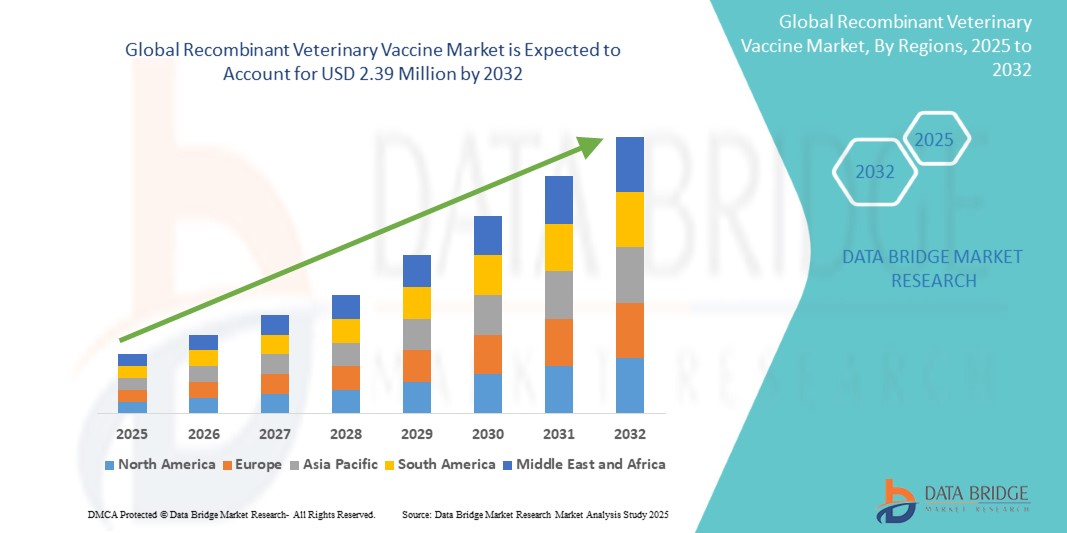
La taille du marché mondial des vaccins vétérinaires recombinants a été évaluée à 1,37 milliard de dollars en 2024 et devrait atteindre 2,39 milliards de dollars en 2032, avec un TCAC de 7,22 % au cours de la période de prévision allant de 2025 à 2032. En plus des renseignements sur les scénarios du marché tels que la valeur du marché, le taux de croissance, la segmentation, la couverture géographique et les principaux intervenants, les rapports de marché établis par Data Bridge Market Research comprennent également une analyse approfondie par des experts, une épidémiologie des patients, une analyse des pipelines, une analyse des prix et un cadre réglementaire.
Vaccin vétérinaire recombinantTendances du marché
Augmentation de l'adoption de systèmes de vaccination sans aiguille
Une tendance importante sur le marché des vaccins vétérinaires recombinants est l'adoption croissante de systèmes de vaccination sans aiguille. Ces systèmes offrent une méthode plus efficace, plus sûre et moins stressante d'administration de vaccins aux animaux, en particulier dans les exploitations d'élevage à grande échelle. Les méthodes d'administration sans aiguille, comme les jet-injecteurs ou les vaccins oraux, réduisent le risque de blessures par piqûre d'aiguille pour les travailleurs, ce qui constitue un grave problème de sécurité dans les soins vétérinaires. Ils réduisent également le besoin de manipulation, ce qui facilite et accélère la vaccination, en particulier dans les milieux agricoles à forte densité.
Cette tendance s'améliore particulièrement dans les industries avicole et porcine, où la vaccination rapide d'un grand nombre d'animaux est essentielle. De plus, les systèmes sans aiguille aident à assurer une distribution uniforme des vaccins, ce qui améliore l'efficacité et l'immunité globale des troupeaux. Par conséquent, cette technologie devrait stimuler la croissance du marché, car elle accroît la viabilité économique et l'accessibilité des vaccins vétérinaires recombinants.
Portée du rapport et vaccin vétérinaire recombinantSegmentation du marché
| Attributs | Vaccin vétérinaire recombinantCléPerspectives du marché |
| Segments couverts |
|
| Pays couverts | Allemagne, États-Unis, Canada et Mexique, France, Royaume-Uni, Italie, Russie, Espagne, Danemark, Suède, Norvège, Reste de l'Europe, Chine, Japon, Inde, Corée du Sud, Australie, Thaïlande, Reste de l'Asie-Pacifique (APAC), Arabie saoudite, États-Unis d'Amérique, Afrique du Sud, Nigéria, Égypte, Koweït, Reste du Moyen-Orient et Afrique, Brésil, Argentine et Reste de l'Amérique du Sud |
| Principaux acteurs du marché | Bayer AG (Allemagne), BioNTech SE (Allemagne), Boehringer Ingelheim International GmbH (Allemagne), Biogénesis Bagó S.A. (Argentine), Ceva (France), Elanco ou ses sociétés affiliées (États-Unis), FeedVax, Inc. (Argentine), HESTER BIOSCIENCES LIMITED (Inde), Heska Corporation (États-Unis), INOVIO Pharmaceuticals (États-Unis), Indian Immunilogicals Ltd. (Inde), LABORATORIO AVI-MEX, SA DE CV (Mexique), Merck & Co., Inc. (États-Unis), Phibro Animal Health Corporation (États-Unis), Virbac (France), VAKSINDO ANIMAL HEALTH PVT. LTD (Inde), Virbac (France), Vétoquinol (France), Vaccine Valley (Égypte) et Zoetis Services LLC (États-Unis) |
| Possibilités de marché |
|
| Infos sur la valeur ajoutée | En plus des renseignements sur les scénarios du marché tels que la valeur du marché, le taux de croissance, la segmentation, la couverture géographique et les principaux intervenants, les rapports de marché établis par Data Bridge Market Research comprennent également une analyse approfondie par des experts, une épidémiologie des patients, une analyse des pipelines, une analyse des prix et un cadre réglementaire. |
Vaccin vétérinaire recombinantMarchéDéfinition
Un vaccin vétérinaire recombinant est un type de vaccin développé à l'aide de la technologie de l'ADN recombinant, où des gènes d'un pathogène (comme des bactéries ou des virus) sont insérés dans un organisme hôte (comme des bactéries ou des levures) pour produire les protéines ou les antigènes du pathogène. Ces protéines ou antigènes sont ensuite utilisés pour stimuler une réponse immunitaire chez les animaux, aidant à les protéger contre des maladies spécifiques. Contrairement aux vaccins traditionnels, qui utilisent souvent des formes inactivées ou atténuées de l'agent pathogène, les vaccins recombinants offrent une approche plus sûre et ciblée en utilisant uniquement les composants essentiels nécessaires à l'immunité. Cette technologie permet le développement de vaccins avec des profils de sécurité améliorés, une efficacité accrue et moins d'effets secondaires pour les animaux, ce qui en fait une avancée importante en médecine vétérinaire.
Dynamique du marché des vaccins vétérinaires recombinants
Conducteurs
- Augmentation des maladies zoonotiques
L'incidence croissante des zoonoses, transmises des animaux aux humains, est un facteur important du marché des vaccins vétérinaires recombinants. Les maladies comme l'influenza aviaire, la rage et la tuberculose bovine posent des risques majeurs pour la santé publique, ce qui incite les gouvernements et les organismes de santé à se concentrer sur la lutte contre leur propagation par la vaccination. Les vaccins vétérinaires recombinants offrent une approche plus sûre et plus ciblée pour prévenir de telles maladies. Par exemple, le vaccin recombinant contre la rage a joué un rôle crucial dans le contrôle de la maladie chez les populations sauvages, réduisant ainsi le risque de transmission aux humains. La sensibilisation aux menaces zoonotiques augmentant, la demande de vaccins vétérinaires efficaces devrait augmenter, ce qui stimulera la croissance du marché. La nécessité de prendre des mesures préventives contre ces maladies renforce non seulement la santé animale, mais contribue aussi à atténuer le risque d'éclosions chez l'homme, renforçant ainsi l'importance d'investir dans le développement de vaccins vétérinaires recombinants.
- Progrès en biotechnologie
Les progrès de la biotechnologie, en particulier dans les technologies d'expression de l'ADN et des protéines recombinantes, ont conduit à la mise au point de vaccins vétérinaires plus efficaces et plus sûrs. La capacité de créer des vaccins à l'aide de composants pathogènes spécifiques plutôt que de pathogènes entiers améliore le profil de sécurité de ces vaccins. Par exemple, les vaccins recombinants comme celui contre la maladie de Marek chez la volaille, qui utilise un virus modifié pour stimuler une réponse immunitaire sans causer de maladie, ont démontré une efficacité accrue par rapport aux vaccins traditionnels. Au fur et à mesure que ces innovations biotechnologiques évoluent, elles permettent de créer des vaccins pour un plus large éventail de maladies animales, ce qui ouvre de plus grandes perspectives sur le marché. L'avancement continu de la technologie des vaccins est susceptible de stimuler la croissance du marché en offrant des solutions plus spécialisées pour la santé animale tout en améliorant la productivité dans les industries du bétail et de l'aquaculture.
Possibilités
- Développement de l'industrie aquacole
La croissance rapide duaquaculturel'industrie présente une opportunité importante pour le marché des vaccins vétérinaires recombinants. À mesure que la demande de produits de la mer augmente, la pisciculture est devenue une source importante de protéines. Toutefois, l'aquaculture est confrontée à de nombreux défis, notamment des épidémies de maladies telles que la vibriose et la furonculose, qui peuvent entraîner des pertes économiques importantes. Les vaccins recombinants adaptés aux espèces de poissons, comme les vaccins recombinants contre la vibriose chez le saumon, offrent une solution très efficace pour prévenir ces maladies. La mise au point et la commercialisation de ces vaccins devraient augmenter en réponse à l'expansion du secteur de l'aquaculture. À mesure que les pratiques piscicoles s'amplifient pour répondre aux besoins alimentaires mondiaux, l'adoption de vaccins recombinants sera cruciale pour améliorer la santé des poissons d'élevage, améliorer l'efficacité de la production et réduire l'utilisation des antibiotiques. Ce besoin croissant de prévention efficace des maladies en aquaculture stimule l'expansion du marché.
- Sensibilisation accrue à la santé animale dans les marchés émergents
À mesure que les niveaux de revenu augmentent et que les pratiques d'élevage se modernisent sur les marchés émergents comme l'Asie-Pacifique, l'Amérique latine et l'Afrique, on est de plus en plus conscient de l'importance des mesures de santé animale et de prévention. Ce changement crée de nouvelles possibilités pour les vaccins vétérinaires recombinants. Par exemple, la Chine et l'Inde adoptent de plus en plus de vaccins recombinants pour la volaille, qui aident à lutter contre des maladies telles que l'influenza aviaire et la maladie de Newcastle. Cette tendance est motivée par une classe moyenne croissante qui exige des produits animaux plus sûrs et de meilleure qualité. À mesure que les marchés émergents augmentent leur infrastructure de soins vétérinaires, il existe un potentiel important d'adoption de vaccins recombinants. Cette tendance devrait stimuler le marché en encourageant les fabricants de vaccins à mettre au point des solutions adaptées pour ces régions, en élargissant la portée du marché et en améliorant les résultats en matière de santé animale dans ces régions en développement rapide.
Restrictions et difficultés
- Haute production et développement Coûts
L'une des principales restrictions sur le marché des vaccins vétérinaires recombinants est le coût élevé de la production et du développement. La mise au point de vaccins recombinants nécessite des techniques biotechnologiques avancées, qui prennent du temps et coûtent cher. Le processus implique le génie génétique, des tests rigoureux et des approbations réglementaires, ce qui augmente le coût global. Par exemple, les vaccins recombinants contre des maladies comme la fièvre aphteuse chez le bétail nécessitent des investissements importants dans la recherche et la fabrication. Le coût élevé de la production peut limiter la disponibilité de ces vaccins sur les marchés sensibles aux prix ou sur les petits agriculteurs qui ne peuvent pas se les permettre. Cet obstacle financier pourrait ralentir l'adoption de vaccins recombinants, en particulier dans les régions en développement où les solutions de remplacement rentables sont plus attrayantes. Par conséquent, la croissance du marché pourrait être entravée par ces coûts élevés, qui limitent l'utilisation généralisée de ces vaccins dans certaines régions géographiques.
- Les obstacles réglementaires
Un défi important sur le marché des vaccins vétérinaires recombinants est le long et complexe processus d'approbation réglementaire. Les gouvernements et les organismes de réglementation exigent de vastes essais d'innocuité et d'efficacité avant d'approuver de nouveaux vaccins, en particulier ceux produits à l'aide de la technologie de l'ADN recombinant. Par exemple, les vaccins comme le vaccin recombinant contre la rage nécessitent des années de tests et de validation avant de pouvoir être mis sur le marché. Ce délai d'approbation prolongé peut retarder l'introduction de nouveaux vaccins, ce qui pose un défi aux fabricants visant à répondre à la demande croissante de solutions de santé animale. L'imprévisibilité des voies réglementaires peut entraîner des incertitudes sur le marché, affecter les investissements et ralentir la commercialisation des produits. Ce défi pourrait avoir une incidence négative sur la croissance du marché, car la capacité de déployer rapidement de nouveaux vaccins améliorés est essentielle pour répondre aux maladies émergentes et répondre aux demandes du marché.
Ce rapport de marché fournit des détails sur les nouveaux développements récents, la réglementation commerciale, l'analyse des importations et des exportations, l'analyse de la production, l'optimisation de la chaîne de valeur, la part de marché, l'impact des acteurs du marché national et local, l'analyse des possibilités en termes de nouvelles poches de revenus, les changements dans la réglementation du marché, l'analyse stratégique de la croissance du marché, la taille du marché, la catégorie de croissance du marché, les créneaux d'application et la position dominante, les approbations de produits, les lancements de produits, les expansions géographiques, les innovations technologiques sur le marché. Pour obtenir plus d'informations sur le marché, contactez Data Bridge Market Research pour un résumé d'analyste, notre équipe vous aidera à prendre une décision de marché éclairée pour atteindre la croissance du marché.
Étendue du marché des vaccins vétérinaires recombinants
Le marché est segmenté en fonction du type de vaccin recombinant, du type d'animal, de la voie d'administration et du canal de distribution. La croissance de ces segments vous aidera à analyser des segments de croissance médiocres dans les industries et à fournir aux utilisateurs une vue d'ensemble du marché et des perspectives de marché précieuses pour les aider à prendre des décisions stratégiques pour identifier les applications du marché central.
Type deVaccin recombinant
- Vaccins de sous-unité
- Vaccins génétiquement atténués
- Vaccin vectorisé
- Vecteurs bactériens
- Vecteurs viraux
- Vecteurs de levure
- Vaccin ADN
Type d'animal
- Chiens
- Chats
- Chevaux
Voie d' administration
- Voie orale
- Injectable
- Thèmes
Chaîne de distribution
- Hôpitaux vétérinaires
- Cliniques
Marché des vaccins vétérinaires recombinants Analyse régionale
Le marché est analysé et les données et les tendances relatives à la taille du marché sont fournies par le pays, le type de vaccin recombinant, le type d'animal, la voie d'administration et le canal de distribution mentionnés ci-dessus.
Les pays couverts par le rapport de marché sont l'Allemagne, les États-Unis, le Canada et le Mexique, la France, le Royaume-Uni, l'Italie, la Russie, l'Espagne, le Danemark, la Suède, la Norvège, le reste de l'Europe, la Chine, le Japon, l'Inde, la Corée du Sud, l'Australie, la Thaïlande, le reste de l'Asie-Pacifique (APAC), l'Arabie saoudite, les États-Unis, l'Afrique du Sud, le Nigéria, l'Égypte, le Koweït, le reste du Moyen-Orient et l'Afrique, le Brésil, l'Argentine et le reste de l'Amérique du Sud.
On s'attend à ce que l'Amérique du Nord domine le marché des vaccins vétérinaires recombinants en raison de son infrastructure de soins vétérinaires de pointe, de l'adoption de technologies novatrices et de cadres réglementaires solides. La présence d'acteurs majeurs, d'importants investissements dans la recherche et le développement et l'attention croissante accordée à la santé animale contribuent au leadership de la région. De plus, une sensibilisation accrue aux zoonoses et à la demande de soins de santé préventifs pour les animaux favorisent la croissance du marché en Amérique du Nord, ce qui stimule sa domination sur le marché mondial.
L'Asie-Pacifique devrait afficher le taux de croissance le plus élevé sur le marché des vaccins vétérinaires recombinants. Cela est dû à l'industrialisation rapide de l'élevage, à l'augmentation de la demande de protéines animales et à une sensibilisation accrue à la santé animale et à la prévention des maladies. Des pays comme la Chine et l'Inde investissent massivement dans les soins vétérinaires et adoptent des technologies de vaccination de pointe. En outre, la croissance de l'industrie aquacole dans la région renforce encore la demande de vaccins vétérinaires recombinants, favorisant ainsi une croissance rapide du marché.
La section de pays du rapport présente également les facteurs influençant le marché et les modifications de la réglementation sur le marché intérieur qui influent sur les tendances actuelles et futures du marché. Des points de données comme l'analyse de la chaîne de valeur en aval et en amont, les tendances techniques et l'analyse des cinq forces du porteur, des études de cas sont quelques-uns des indicateurs utilisés pour prévoir le scénario du marché pour chaque pays. En outre, la présence et la disponibilité des marques mondiales et les difficultés qu ' elles rencontrent en raison de la concurrence importante ou rare des marques locales et nationales, l ' impact des tarifs intérieurs et des itinéraires commerciaux sont pris en compte tout en fournissant une analyse prévisionnelle des données nationales.
Part du marché des vaccins vétérinaires recombinants
Le paysage concurrentiel du marché fournit des détails par concurrent. Les détails inclus sont l'aperçu de l'entreprise, les finances de l'entreprise, les revenus générés, le potentiel du marché, les investissements dans la recherche et le développement, les nouvelles initiatives du marché, la présence mondiale, les sites et installations de production, les capacités de production, les forces et faiblesses de l'entreprise, le lancement de produits, la largeur et l'étendue du produit, la domination de l'application. Les données ci-dessus fournies ne sont liées qu'à la concentration des entreprises sur le marché.
Vaccin vétérinaire recombinantLes leaders du marché opérant sur le marché sont :
- Bayer AG (Allemagne)
- BioNTech SE (Allemagne)
- Boehringer Ingelheim International GmbH (Allemagne)
- Biogénèse Bagó S.A. (Argentine)
- Ceva (France)
- Elanco ou ses filiales (États-Unis)
- FeedVax, Inc. (Argentine)
- BIOSCIENCES HESTER LIMITÉES (Inde)
- Heska Corporation (États-Unis)
- INOVIO Pharmaceuticals (États-Unis)
- Indian Immunologicals Ltd. (Inde)
- LABORATORIO AVI-MEX, SA DE CV (Mexique)
- Merck & Co., Inc. (États-Unis)
- Phibro Animal Health Corporation (États-Unis)
- Virbac (France)
- VAKSINDO ANIMAL HEALTH PVT. LTD (Inde)
- Virbac (France)
- Vétoquinol (France)
- Vallée du vaccin (Égypte)
- Zoetis Services LLC (États-Unis)
Les derniers développements du marché des vaccins vétérinaires recombinants
- En septembre 2024, Merck Animal Health a annoncé l'expansion de sa nouvelle plateforme de vaccins NOBIVAC NXT approuvée par l'USDA pour inclure une solution haut de gamme pour protéger les chats contre le virus de la leucémie féline (FeLV), l'une des plus répanduesmaladies infectieusesen félins. Le vaccin devrait être disponible dans les cliniques vétérinaires et les hôpitaux partout au pays cet automne. NOBIVAC NXT FeLV est le premier et le seul vaccin contre la leucémie féline développé à l'aide de Merck Animal Health.
- En juin 2024, Merck Animal Health a annoncé le lancement et la disponibilité du portefeuille NOBIVAC NXT Rabies au Canada, qui comprend NOBIVAC NXT Feline-3 Rabies et NOBIVAC NXT Canine-3 Rabies. Ce communiqué fait partie de l'engagement continu de la société envers la prévention de la rage. La gamme NOBIVAC NXT rage est la première gamme de vaccins qui utilise une technologie avancée de particules d'ARN pour protéger les chats et les chiens de la rage.
- En février 2024, l'École de médecine vétérinaire de l'Université de Pennsylvanie (Penn Vet) a dévoilé le lancement de son Initiative de recherche sur l'ARNm. Cette initiative vise à accélérer le développement de vaccins vétérinaires à base d'ARNm et de thérapies dirigées par l'hôte. Non seulement elle apportera une contribution importante à la recherche sur les ARNm, mais elle contribuera également à l'application de la plateforme d'ARNm pour créer des solutions de vaccins vétérinaires innovantes.
- En juillet 2023, Invetx a annoncé l'achèvement réussi du développement de sa technologie d'extension de demi-vie spécifique à l'espèce pour les chiens et les chats, ce qui a entraîné une plus longue durée d'activité pour les anticorps monoclonaux vétérinaires de l'entreprise. Cette technologie innovante permet à l'entreprise d'améliorer les options de traitement des anticorps pour les maladies chroniques et graves chez les animaux de compagnie. Invetx a obtenu quatre brevets américains pour sa technologie d'extension de demi-vie et possède d'autres brevets en attente aux États-Unis, en Europe et dans d'autres régions.
- En septembre 2021, Invetx a annoncé le lancement d'une étude clinique sur le terrain chez les chiens visant une maladie chronique non divulguée, en utilisant IVX-01, son anticorps monoclonal étendu (mAb) exclusif, nouveau, entièrement canin, haute affinité et demi-vie.
SKU-
Accédez en ligne au rapport sur le premier cloud mondial de veille économique
- Tableau de bord d'analyse de données interactif
- Tableau de bord d'analyse d'entreprise pour les opportunités à fort potentiel de croissance
- Accès d'analyste de recherche pour la personnalisation et les requêtes
- Analyse de la concurrence avec tableau de bord interactif
- Dernières actualités, mises à jour et analyse des tendances
- Exploitez la puissance de l'analyse comparative pour un suivi complet de la concurrence
Méthodologie de recherche
La collecte de données et l'analyse de l'année de base sont effectuées à l'aide de modules de collecte de données avec des échantillons de grande taille. L'étape consiste à obtenir des informations sur le marché ou des données connexes via diverses sources et stratégies. Elle comprend l'examen et la planification à l'avance de toutes les données acquises dans le passé. Elle englobe également l'examen des incohérences d'informations observées dans différentes sources d'informations. Les données de marché sont analysées et estimées à l'aide de modèles statistiques et cohérents de marché. De plus, l'analyse des parts de marché et l'analyse des tendances clés sont les principaux facteurs de succès du rapport de marché. Pour en savoir plus, veuillez demander un appel d'analyste ou déposer votre demande.
La méthodologie de recherche clé utilisée par l'équipe de recherche DBMR est la triangulation des données qui implique l'exploration de données, l'analyse de l'impact des variables de données sur le marché et la validation primaire (expert du secteur). Les modèles de données incluent la grille de positionnement des fournisseurs, l'analyse de la chronologie du marché, l'aperçu et le guide du marché, la grille de positionnement des entreprises, l'analyse des brevets, l'analyse des prix, l'analyse des parts de marché des entreprises, les normes de mesure, l'analyse globale par rapport à l'analyse régionale et des parts des fournisseurs. Pour en savoir plus sur la méthodologie de recherche, envoyez une demande pour parler à nos experts du secteur.
Personnalisation disponible
Data Bridge Market Research est un leader de la recherche formative avancée. Nous sommes fiers de fournir à nos clients existants et nouveaux des données et des analyses qui correspondent à leurs objectifs. Le rapport peut être personnalisé pour inclure une analyse des tendances des prix des marques cibles, une compréhension du marché pour d'autres pays (demandez la liste des pays), des données sur les résultats des essais cliniques, une revue de la littérature, une analyse du marché des produits remis à neuf et de la base de produits. L'analyse du marché des concurrents cibles peut être analysée à partir d'une analyse basée sur la technologie jusqu'à des stratégies de portefeuille de marché. Nous pouvons ajouter autant de concurrents que vous le souhaitez, dans le format et le style de données que vous recherchez. Notre équipe d'analystes peut également vous fournir des données sous forme de fichiers Excel bruts, de tableaux croisés dynamiques (Fact book) ou peut vous aider à créer des présentations à partir des ensembles de données disponibles dans le rapport.