


Global Refractories Market Segmentation, By Product Type (Clay and Non-Clay), Alkalinity (Acidic & Neutral Refractories and Carbon), Form Type (Bricks, Monolithic, and Others), Fusion Temperature (Normal Refractory (1580-1780°C), High Refractory (1780-2000°C), and Super Refractory (2000°C)), Technology (Isostatics Pressing, Slide Gates Mechanism, and Others), Application (Iron & Steel, Cement & Lime, Energy & Chemicals, Glass, Non-Ferrous Metal, and Others)- Industry Trends and Forecast to 2032
Quelle est la taille du marché et le taux de croissance des réfractaires
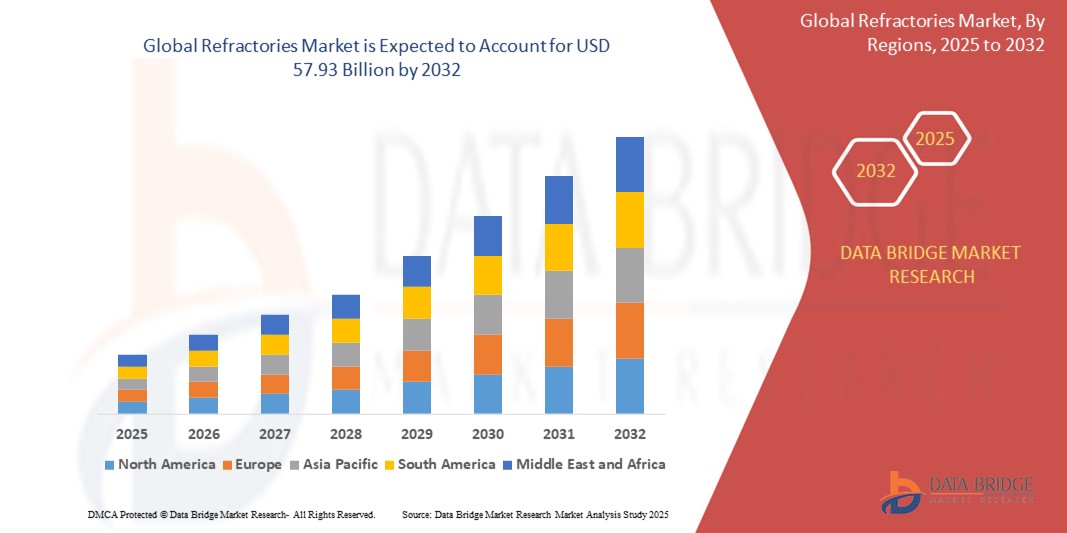
- Selon l'analyse de marché de Data Bridge, la taille du marché mondial des réfractaires a été évaluée à39,51 milliards de dollars en 2024et devrait atteindre57,93 milliards de dollars en 2032, à unTCAC de 4,90%pendant la période de prévision
- Cette croissance est motivée par des facteurs tels que la demande croissante de l'industrie sidérurgique, les progrès technologiques dans les matériaux réfractaires, l'augmentation des investissements dans le développement des infrastructures et l'accent croissant mis sur l'efficacité énergétique et la durabilité.
Taille du marché et prévisions
Valeur marchande mondiale (2024):39,51 milliards de dollars
Valeur marchande prévue (2032) :57,93 milliards de dollars
Prévisions CAGR (2025-2032):4.90%
Quels sont les principaux débouchés du marché des produits réfractaires
- Les réfractaires sont faits de céramique, d'alumine, de silice, de magnésie et d'autres matériaux conçus pour résister aux températures très élevées rencontrées dans la fabrication moderne. Plus résistants à la chaleur que les métaux, ils sont utilisés pour aligner les surfaces chaudes dans de nombreux processus industriels
- Les produits réfractaires relèvent généralement de formes préformées ou de compositions non formées. réfractaires sont utilisés pour contenir la chaleur et protéger l'équipement de traitement des températures intenses
- La variété de matériaux tels que la silice, l'alumine et l'argile, entre autres, sont utilisés pour la fabrication de réfractaires et ces réfractaires ont trouvé de vastes applications dans plusieurs industries comme les fonderies, le fer et l'acier, le verre, entre autres, où ils sont exposés à des conditions chimiques et à des températures extrêmes.
- On s'attend à ce que l'Asie-Pacifique domine le marché des réfractaires avec 73,5 % en raison d'une base industrielle avancée et robuste et de vastes capacités de fabrication.
- On s'attend à ce que l'Amérique du Nord soit la région qui connaît la croissance la plus rapide du marché des réfractaires au cours de la période de prévision en raison des technologies de fabrication et que l'accent mis sur les pratiques durables stimule la croissance du marché des réfractaires.
- Le segment du fer et de l'acier devrait dominer le marché avec une part de marché de la part de ses réfractaires de haute qualité dans le processus de fabrication de l'acier, y compris les hauts fourneaux, les convertisseurs et les fourneaux à arc électrique, en fait le segment d'application dominant.
Portée du rapport et réfractaires Segmentation du marché
|
Attributs |
Réfractaires Principales perspectives du marché |
|
Segments couverts |
|
|
Pays couverts |
Amérique du Nord
Europe
Asie-Pacifique
Moyen-Orient et Afrique
Amérique du Sud
|
|
Principaux acteurs du marché |
|
|
Possibilités de marché |
|
|
Infos sur la valeur ajoutée |
En plus des renseignements sur les scénarios du marché tels que la valeur marchande, le taux de croissance, la segmentation, la couverture géographique et les principaux intervenants, les rapports de marché établis par Data Bridge Market Research comprennent aussi l'analyse des exportations d'importations, l'aperçu des capacités de production, l'analyse de la consommation de production, l'analyse des tendances des prix, le scénario du changement climatique, l'analyse de la chaîne d'approvisionnement, l'analyse de la chaîne de valeur, l'aperçu des matières premières et des consommables, les critères de sélection des fournisseurs, l'analyse PESTLE, l'analyse Porter et le cadre réglementaire. |
Quelle est la tendance clé du marché des réfractaires
Vers des réfractaires économes en énergie et durables
- Des industries comme la fabrication d'acier et de ciment adoptent des réfractaires avancés qui améliorent l'efficacité énergétique. Ces matériaux aident à réduire la dissipation de chaleur, ce qui réduit la consommation d'énergie dans les processus à haute température
- On met de plus en plus l'accent sur la durabilité, ce qui favorise le développement de réfractaires écologiques. Ces matériaux visent à minimiser l'impact environnemental tout en maintenant les normes de performance
- L'industrie se concentre de plus en plus sur le recyclage des réfractaires usés. Cela permet non seulement de réduire les déchets, mais aussi de conserver les matières premières, en adéquation avec les objectifs mondiaux de durabilité
- Les innovations dans les matériaux réfractaires améliorent leur performance et leur durabilité. Ceci inclut le développement de réfractaires légers et ceux avec une meilleure stabilité thermique
- Des réglementations environnementales plus strictes conduisent à l'adoption de réfractaires durables. Les fabricants investissent dans des technologies qui respectent ces normes tout en assurant l'efficacité des produits
Réfractaires Dynamique du marché
Chauffeur
Expansion et modernisation industrielles
- L'expansion rapide de la production d'acier, en particulier dans les marchés émergents comme la Chine et l'Inde, a accru la demande de réfractaires. Les projets d ' infrastructure menés par les pouvoirs publics et les efforts d ' urbanisation continuent de stimuler la consommation d ' acier
- Les investissements mondiaux dans les infrastructures sont des moteurs de croissance importants. À mesure que les pays modernisent leurs bases industrielles et élargissent leurs projets d'infrastructure, la demande de ciment, de verre et d'autres matériaux de construction augmente, ce qui accroît le besoin de réfractaires
- L'expansion et la modernisation continues de diverses industries sont des moteurs importants de la demande mondiale de réfractaires. Des industries comme l'acier, le ciment, le verre, les produits pétrochimiques et les métaux non ferreux dépendent fortement de matériaux réfractaires.
- L'industrialisation rapide dans les économies émergentes entraîne une demande accrue de réfractaires pour soutenir les installations nouvelles et améliorées
- Les progrès dans les méthodes de fabrication améliorent la qualité des produits, ce qui favorise l'adoption de réfractaires dans différentes industries.
Possibilités
Recyclage des réfractaires
- Le recyclage des réfractaires offre une solution durable en répurant les matériaux usés, en réduisant les déchets et en conservant les matières premières. Cela s'harmonise avec les objectifs mondiaux de durabilité et favorise un modèle d'économie circulaire
- Les initiatives de recyclage peuvent générer des ressources secondaires précieuses, promouvoir des économies pour les fabricants et réduire la dépendance à l'égard des matières premières primaires
- Les gouvernements du monde entier offrent des avantages fiscaux pour promouvoir le recyclage des déchets, encourageant davantage l'adoption de matériaux réfractaires recyclés
- Des entreprises de premier plan comme RHI Magnesita investissent massivement dans des initiatives de recyclage visant à améliorer la disponibilité de matières premières secondaires pour l'industrie
- L'accent de plus en plus mis sur le recyclage et la réduction des déchets encourage l'utilisation de réfractaires recyclés dans les procédés de fabrication, contribuant ainsi à la croissance globale du marché des réfractaires
Restriction/Défi
Les prix des matières premières
- L'industrie des réfractaires est fortement dépendante des matières premières comme la bauxite, la magnésite, l'alumine et le carbure de silicium.
- Les fluctuations des prix de ces matières premières, dues à des facteurs tels que les perturbations de l'offre, les tensions géopolitiques et l'évolution des politiques commerciales, constituent un défi important pour les fabricants réfractaires.
- La dépendance à l'égard de sources limitées pour les matières premières critiques accroît le risque de perturbations de l'approvisionnement, en particulier lors de tensions géopolitiques ou de différends commerciaux.
- La fluctuation des prix des matières premières peut avoir une incidence sur les coûts de production et la rentabilité, ce qui rend difficile pour les fabricants de maintenir des prix stables pour leurs clients.
- Les entreprises mettent en œuvre des stratégies telles que l'approvisionnement stratégique et la couverture des prix pour atténuer l'impact des fluctuations des prix des matières premières
- La volatilité des prix des matières premières peut entraîner une instabilité du marché, affectant la croissance globale et le développement de l'industrie des réfractaires.
Comment le marché des réfractaires est-il segmenté
Le marché est segmenté en fonction du type de produit, de l'alcalinité, du type de forme, de la température de fusion, de la technologie et de l'application.
|
Segmentation |
Sous-segmentation |
|
Par type de produit |
|
|
Par Alcalinité |
|
|
Par type de formulaire |
|
|
Par la température de fusion |
|
|
Par technologie |
|
|
Par demande |
|
En 2025, le fer et l'acier devraient dominer le marché avec une part plus importante du segment des applications
Le secteur du fer et de l'acier devrait dominer le marché des réfractaires avec la plus grande part en 2025. en raison de ses réfractaires de haute qualité dans le processus de fabrication de l'acier, y compris les hauts fourneaux, les convertisseurs et les fours à arc électrique, en fait le segment d'application dominant.
L'argile devrait représenter la plus grande part du marché des types de produits au cours de la période de prévision.
En 2025, le segment de l'argile devrait dominer le marché avec la plus grande part de marché en raison de son utilisation polyvalente, en particulier dans les applications à haute température dans des industries comme l'acier, le ciment et le verre. Leur coût relativement faible et leur bonne performance dans les plages de température requises en font un choix privilégié.
Quelle région détient la plus grande part du marché des réfractaires
L'Asie-Pacifique détient la plus grande part du marché des réfractaires
- L'Asie-Pacifique détient une part prépondérante de plus de 70 % sur le marché mondial des réfractaires, grâce à sa solide base industrielle et à ses vastes capacités de fabrication.
- La domination de la région est alimentée par les industries de l'acier, du ciment et du verre, qui comptent parmi les principaux consommateurs de produits réfractaires.
- La Chine, l'Inde et le Japon sont à l'avant-garde, la Chine étant le premier producteur mondial d'acier, contribuant de façon significative à la demande de réfractaire.
- L'urbanisation et l'industrialisation rapides dans des pays comme l'Inde et la Chine ont entraîné une forte demande d'acier et de ciment, ce qui a accru le besoin de réfractaires dans leurs processus de production.
- L'Asie-Pacifique bénéficie d'une production rentable, d'une main-d'oeuvre qualifiée et de matières premières abondantes, ce qui renforce son attractivité en tant que plaque tournante de la fabrication réfractaire.
L'Amérique du Nord devrait enregistrer le plus haut TCAC sur le marché des réfractaires.
- L'Amérique du Nord connaît une forte croissance du marché des réfractaires, les États-Unis détenant la plus grande part de marché et le Canada étant le marché qui connaît la croissance la plus rapide de la région.
- L'industrie automobile en Amérique du Nord se développe, ce qui contribue à l'augmentation de la demande de réfractaires.
- Les progrès des technologies de fabrication et l'accent mis sur les pratiques durables sont à l'origine de la croissance du marché des réfractaires en Amérique du Nord.
- L'augmentation des investissements dans les projets d'infrastructure stimule la demande de réfractaires dans les secteurs de la construction et des machines lourdes
- Les entreprises nord-américaines adoptent des stratégies telles que les fusions et acquisitions, l'expansion des installations et les innovations de produits pour renforcer leur position sur le marché des réfractaires
Quelles sont les meilleures entreprises du marché des réfractaires
Le paysage concurrentiel du marché fournit des détails par concurrent. Les détails inclus sont l'aperçu de l'entreprise, les finances de l'entreprise, les revenus générés, le potentiel du marché, les investissements dans la recherche et le développement, les nouvelles initiatives du marché, la présence mondiale, les sites et installations de production, les capacités de production, les forces et faiblesses de l'entreprise, le lancement de produits, la largeur et l'étendue du produit, la domination de l'application. Les données ci-dessus fournies ne sont liées qu'à la concentration des entreprises sur le marché.
Les principaux leaders du marché sont :
- Ceramiques & Réfractaires Saint-Gobain Performance (PCR)(France)
- SOCIÉTÉ TYK(Japon)
- Coorstek(États-Unis)
- Refratechnique(Allemagne)
- HWI (États-Unis)
- AluChem (États-Unis)
- ALTEO (France)
- CerCo Corporation (États-Unis)
- Almatis GmbH (Allemagne)
- Produits minéraux alliés, Inc. (États-Unis)
- Groupe Magnezit (Russie)
- Minerals Technologies Inc. (États-Unis)
- Puyang Refractories Group Co., Ltd. (Chine)
- Morgan Advanced Materials (Royaume-Uni)
- IFGL Refractories Ltd. (Inde)
- Krosaki Harima Corporation (Japon)
- SHINAGAWA REFRACTORIES CO., LTD. (Japon)
- RHI Magnesita GmbH (Autriche)
- Lhoist (Belgique)
- Vésuve (Royaume-Uni)
- Imerys (France)
Quels sont les derniers développements du marché des réfractaires
- En juin 2023, INTOCAST AG a annoncé sa décision d'acquérir EXUS Refractories S.p.A, une société basée en Italie. Cette acquisition aidera l'entreprise à renforcer son portefeuille de produits réfractaires.
- En avril 2023, RHI Magnesita a annoncé son intention d'acquérir les opérations des États-Unis, de l'Inde et de l'Europe de Seven Refractories, un fournisseur spécialisé de réfractaire monolithique non basique avec un chiffre d'affaires enregistré de USD 110 millions et PBT de USD 12 millions en 2022. L'entreprise possède un vaste portefeuille d'applications finales sur le marché mondial. Cette acquisition apportera des catégories de produits innovatrices et des progrès technologiques pour apporter un changement majeur aux offres des consommateurs.
- En février 2023, le Groupe Vesuvius a annoncé son intention d'investir 61 millions de dollars dans l'expansion de ses bases de fabrication réfractaires en Inde d'ici trois à cinq ans. Ces investissements entraîneront une augmentation de 35% de la capacité de production mensuelle de l'entreprise avec l'expansion de son usine à l'unité Taratala à Kolkata.
- En octobre 2022, Imerys a annoncé qu'elle étendrait ses efforts de production, de R-D et de durabilité dans son usine de fabrication à Visakhapatnam, Andhra Pradesh, en Inde. L'entreprise prévoit d'augmenter sa capacité de fabrication de 30 000 à 50 000 tonnes d'ici 2030. Elle a également continué d'investir 1,4 million de dollars supplémentaires dans la rationalisation de ses activités de production du Secar 71. Cet investissement visait à accroître la production de liants à l'aluminate de calcium en raison de la demande accrue de ce matériau provenant des sites de réfractaire et de construction indiens.
- En septembre 2021, Plibrico Company, LLC a annoncé sa décision d'achever l'acquisition de Redline Industries, Inc., un leader dans la fabrication de produits innovants pour protéger les fours dans le traitement à haute température et promouvoir une plus grande efficacité énergétique. Cette acquisition devait soutenir les clients avec des solutions réfractaires de confiance et a permis à Plibrico d'élargir son portefeuille de produits sur le marché concurrentiel.
SKU-
Accédez en ligne au rapport sur le premier cloud mondial de veille économique

- Tableau de bord d'analyse de données interactif
- Tableau de bord d'analyse d'entreprise pour les opportunités à fort potentiel de croissance
- Accès d'analyste de recherche pour la personnalisation et les requêtes
- Analyse de la concurrence avec tableau de bord interactif
- Dernières actualités, mises à jour et analyse des tendances
- Exploitez la puissance de l'analyse comparative pour un suivi complet de la concurrence
Méthodologie de recherche
La collecte de données et l'analyse de l'année de base sont effectuées à l'aide de modules de collecte de données avec des échantillons de grande taille. L'étape consiste à obtenir des informations sur le marché ou des données connexes via diverses sources et stratégies. Elle comprend l'examen et la planification à l'avance de toutes les données acquises dans le passé. Elle englobe également l'examen des incohérences d'informations observées dans différentes sources d'informations. Les données de marché sont analysées et estimées à l'aide de modèles statistiques et cohérents de marché. De plus, l'analyse des parts de marché et l'analyse des tendances clés sont les principaux facteurs de succès du rapport de marché. Pour en savoir plus, veuillez demander un appel d'analyste ou déposer votre demande.
La méthodologie de recherche clé utilisée par l'équipe de recherche DBMR est la triangulation des données qui implique l'exploration de données, l'analyse de l'impact des variables de données sur le marché et la validation primaire (expert du secteur). Les modèles de données incluent la grille de positionnement des fournisseurs, l'analyse de la chronologie du marché, l'aperçu et le guide du marché, la grille de positionnement des entreprises, l'analyse des brevets, l'analyse des prix, l'analyse des parts de marché des entreprises, les normes de mesure, l'analyse globale par rapport à l'analyse régionale et des parts des fournisseurs. Pour en savoir plus sur la méthodologie de recherche, envoyez une demande pour parler à nos experts du secteur.
Personnalisation disponible
Data Bridge Market Research est un leader de la recherche formative avancée. Nous sommes fiers de fournir à nos clients existants et nouveaux des données et des analyses qui correspondent à leurs objectifs. Le rapport peut être personnalisé pour inclure une analyse des tendances des prix des marques cibles, une compréhension du marché pour d'autres pays (demandez la liste des pays), des données sur les résultats des essais cliniques, une revue de la littérature, une analyse du marché des produits remis à neuf et de la base de produits. L'analyse du marché des concurrents cibles peut être analysée à partir d'une analyse basée sur la technologie jusqu'à des stratégies de portefeuille de marché. Nous pouvons ajouter autant de concurrents que vous le souhaitez, dans le format et le style de données que vous recherchez. Notre équipe d'analystes peut également vous fournir des données sous forme de fichiers Excel bruts, de tableaux croisés dynamiques (Fact book) ou peut vous aider à créer des présentations à partir des ensembles de données disponibles dans le rapport.











