



Global Rice Starch Market Segmentation, By Type (Native, Modified, and Others), Nature (Conventional and Organic), Product (Food Grade, Cosmetic Grade, and Pharmaceutical Grade), Application (Bakery Goods and Bakery Fillings, Confectionary Coatings and Liquorice, Dairy Dessert and Yogurt, Dairy Fruit Preparations, Body Powder, Dry Shampoo, and Others) - Industry Trends and Forecast to 2032
Quelle est la taille du marché du riz Starch et le taux de croissance
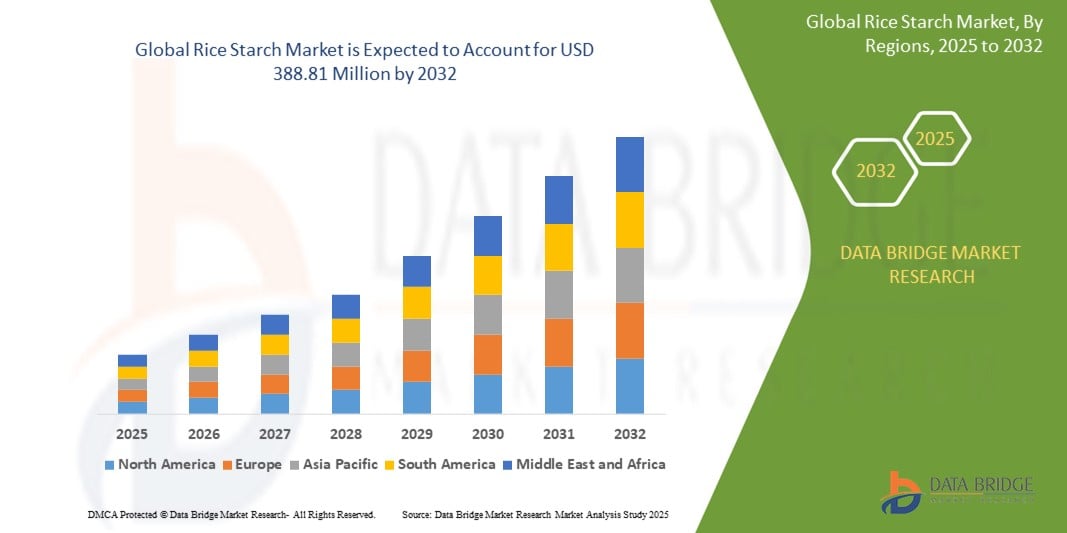
- Selon l'analyse de marché de données Bridge, la taille du marché mondial de l'amidon de riz a été évaluée à224,61 millions de dollars en 2024et devrait atteindre388,81 millions de dollars en 2032, à unTCAC de 7,10 %pendant la période de prévision
- Le marché de l'amidon de riz connaît des avancées significatives avec l'adoption des dernières méthodes et technologies, alimentant sa croissance
- Les innovations dans les techniques d'extraction et les machines de traitement améliorent l'efficacité et la qualité. Utilisation accrue dans les industries comme l'alimentation, les produits pharmaceutiques ettextilesest en train de provoquer une expansion du marché. Cette tendance souligne l'évolution dynamique et l'avenir prometteur du secteur de l'amidon de riz
Taille du marché et prévisions
Valeur marchande mondiale (2024):224,61 millions de dollars
Valeur marchande prévue (2032) :388,81 millions de dollars
Prévisions CAGR (2025-2032):7.10%
Quelles sont les principales ventes de riz Starch Market
- La demande croissante d'aliments transformés et de commodité dans le monde propulse le marché de l'amidon de riz, réputé pour son rôle d'agent épaississant polyvalent et d'améliorateur de texture. Dans les soupes, sauces, desserts et produits de boulangerie, l'amidon de riz contribue à la texture et à la stabilité souhaitées.
- Les consommateurs optant de plus en plus pour des repas prêts-à-manger et faciles à préparer, l'utilisation de l'amidon de riz comme ingrédient clé continue d'augmenter, ce qui stimule la croissance exponentielle du marché.
- L'Amérique du Nord a dominé le marché de l'amidon de riz avec la plus grande part des revenus de 34,9 % en 2024, en raison de la forte demande des consommateurs pour des solutions d'emballage durables, à base de plantes et biodégradables dans les secteurs des aliments, des boissons et des soins personnels
- Le marché de l'amidon de riz de l'Asie et du Pacifique est sur le point de croître au rythme le plus rapide de 14,2 % entre 2025 et 2032, grâce à l'urbanisation rapide, à l'accroissement de la population de la classe moyenne et à l'importance croissante accordée aux consommations durables.
- Le segment autochtone a dominé le marché de l'amidon de riz avec la plus grande part des revenus de 51,6 % en 2024, en raison de son origine naturelle, de son attrait pour l'étiquetage propre et de son utilisation généralisée dans les aliments, les soins personnels, etpharmaceutiqueDemandes
Portée du rapport et segmentation du marché de l'amidon de riz
|
Attributs |
Clé de l'amidon de rizPerspectives du marché |
|
Segments couverts |
|
|
Pays couverts |
Amérique du Nord
Europe
Asie-Pacifique
Moyen-Orient et Afrique
Amérique du Sud
|
|
Principaux acteurs du marché |
|
|
Possibilités de marché |
|
|
Infos sur la valeur ajoutée |
En plus des renseignements sur les scénarios du marché tels que la valeur du marché, le taux de croissance, la segmentation, la couverture géographique et les principaux intervenants, les rapports de marché établis par Data Bridge Market Research comprennent également une analyse approfondie des experts, une analyse des prix, une analyse des parts de marque, une enquête auprès des consommateurs, une analyse démographique, une analyse de la chaîne d'approvisionnement, une analyse de la chaîne de valeur, une vue d'ensemble des matières premières et des consommables, des critères de sélection des fournisseurs, une analyse PESTLE, une analyse Porter et un cadre réglementaire. |
Quelle est la tendance clé du marché de l'amidon de riz
(en milliers de dollars)Utilisation croissante de l'amidon de riz dans des produits alimentaires propres et à base végétale(en milliers de dollars)
- Une tendance significative et accélérée sur le marché mondial de l'amidon de riz est l'incorporation croissante de l'amidon de riz en tant qu'ingrédient naturel et propre dans les produits alimentaires à base végétale, biologiques et peu transformés. L'augmentation de la préférence des consommateurs pour les ingrédients reconnaissables et simples remodelage des stratégies de formulation dans plusieurs catégories d'aliments
- Par exemple, en avril 2024, le BENEO a élargi sa gamme d'amidons de riz étiquetés de façon propre avec des propriétés fonctionnelles améliorées pour les substituts laitiers et les repas prêts-à-manger, aidant les fabricants à obtenir des listes d'ingrédients plus propres sans compromettre la qualité du produit.
- L'amidon de riz offre d'excellentes propriétés de texturisation, d'épaississement et de stabilisation, ce qui le rend idéal pour des applications telles que les substituts laitiers, les viandes végétales, la nutrition infantile et les aliments de commodité, où les formulations d'étiquettes propres sont en forte demande
- Les fabricants d'aliments tirent parti de l'amidon de riz pour remplacer les amidons modifiés et les additifs artificiels, promouvoir des produits non OGM, sans allergènes et adaptés aux régimes alimentaires sensibles, y compris les consommateurs sans gluten et à base végétale
- Le mouvement de l'étiquette propre est particulièrement fort en Amérique du Nord et en Europe, où les consommateurs scrutent de plus en plus l'étiquette des produits et recherchent la transparence, ce qui stimule la demande d'ingrédients naturels et fonctionnels comme l'amidon de riz.
- Les marques alimentaires mondiales s'alignent sur cette tendance en reformulant les produits avec des ingrédients dérivés du riz qui répondent à l'évolution des normes de santé, de durabilité et de transparence, contribuant ainsi à la croissance régulière du marché.
- Au fur et à mesure que les secteurs de l'alimentation axés sur les végétaux et la santé se développent, le rôle de l'amidon de riz en tant que solution multifonctionnelle et propre devrait prendre de l'ampleur, offrant aux fabricants la possibilité d'innover dans différentes catégories de produits.
Quels sont les principaux moteurs du marché de riz Starch
- La demande croissante de produits alimentaires propres, naturels et allergènes est l'un des principaux moteurs de l'adoption de l'amidon de riz, les fabricants cherchant de plus en plus à remplacer les additifs artificiels et les amidons modifiés.
- Par exemple, en février 2024, Ingredion a lancé une nouvelle gamme d'amidons de riz fonctionnels ciblant le marché croissant des produits laitiers végétaux et des plats préparés, en mettant l'accent sur l'amélioration de la texture et les formulations respectueuses de l'étiquetage.
- La sensibilisation croissante des consommateurs à la santé digestive, aux allergies alimentaires et à l'approvisionnement durable pousse les marques à intégrer l'amidon de riz comme ingrédient sûr, facilement digestible et éco-conscient dans leurs applications alimentaires, boissons et soins personnels
- L'augmentation des régimes alimentaires à base de plantes, le développement de produits végétaliens et la consommation d'aliments sans gluten créent de nouvelles possibilités pour l'amidon de riz en tant qu'ingrédient fonctionnel et non OGM qui s'harmonise avec les préférences alimentaires
- En outre, les progrès dans les technologies de transformation du riz ont amélioré la performance et la polyvalence de l'amidon de riz, le rendant adapté pour une utilisation dans les produits alimentaires à forte odeur, stables au gel et traités thermiquement
- Les industries des soins personnels et pharmaceutiques adoptent également de l'amidon de riz pour ses propriétés absorbantes, hypoallergéniques et respectueuses de la peau, contribuant ainsi à l'expansion du marché au-delà du secteur alimentaire.
Quel est le facteur qui remet en question la croissance du marché de l'amidon de riz
- L'un des principaux défis à relever sur le marché de l'amidon de riz est l'augmentation des coûts de production associés aux ingrédients dérivés du riz par rapport aux amidons classiques comme le maïs ou le tapioca, ce qui limite l'accessibilité des marchés sensibles aux prix.
- Par exemple, les fabricants des régions en développement peuvent opter pour des solutions de remplacement de l'amidon plus économiques en raison de pressions sur les coûts, en particulier dans les applications alimentaires de masse où la compétitivité des prix est essentielle.
- Les fluctuations de la chaîne d'approvisionnement, les variations saisonnières de la production de riz et la disponibilité des matières premières peuvent influer sur la tarification et la cohérence des produits, ce qui présente des risques pour les grands utilisateurs industriels.
- En outre, la fonctionnalité de l'amidon de riz peut être limitée dans certaines formulations alimentaires par rapport aux amidons modifiés chimiquement, ce qui nuit à son aptitude dans les produits hautement transformés ou complexes nécessitant des caractéristiques de performance spécifiques.
- Les disparités de réglementation entre les régions en ce qui concerne l'étiquetage des ingrédients, les certifications biologiques et les allégations autres que les OGM peuvent créer des obstacles à l'entrée sur le marché et compliquer la normalisation des produits pour les fabricants multinationaux.
- Pour relever ces défis, les intervenants de l'industrie se concentrent sur l'amélioration de l'efficacité de la transformation, l'accroissement de l'approvisionnement en matières premières et l'investissement dans la R-D pour améliorer la fonctionnalité et la compétitivité de l'amidon de riz à l'échelle mondiale.
Comment le marché du riz Starch est-il segmenté
Le marché est segmenté en fonction du type, de la nature, du produit et de l'application.
- Par type
Sur la base du type, le marché de l'amidon de riz est segmenté en natif, modifié et autres. Le segment autochtone a dominé le marché de Rice Starch avec la plus grande part de revenus de 51,6 % en 2024, en raison de son origine naturelle, de son attrait pour les étiquettes propres et de son utilisation généralisée dans les aliments, les soins personnels et les applications pharmaceutiques. L'amidon de riz indigène est favorisé pour ses excellentes propriétés texturisantes, épaississantes et stabilisatrices, en s'aligneant sur la préférence croissante des consommateurs pour les ingrédients peu transformés.
Le segment modifié devrait connaître le taux de croissance le plus rapide de 2025 à 2032, appuyé par une demande croissante de propriétés fonctionnelles améliorées dans les aliments transformés, les produits laitiers et les produits de commodité. L'amidon de riz modifié offre une stabilité thermique supérieure, une durée de conservation et une polyvalence améliorées, ce qui le rend idéal pour les préparations complexes et les repas prêts à manger.
- Par nature
Sur la base de la nature, le marché de l'amidon de riz est segmenté en classique et biologique. En 2024, le segment des produits conventionnels représentait la plus grande part des revenus du marché, soit 76,4 %, en raison de son caractère abordable, de sa grande disponibilité et de son application étendue aux aliments, boissons et produits de soins personnels traditionnels.
Le segment biologique devrait connaître le TCAC le plus rapide de 2025 à 2032, alimenté par l'augmentation de la demande des consommateurs pour des ingrédients biologiques propres, d'origine durable et certifiés. Le marché de l'amidon de riz biologique prend de l'ampleur dans les secteurs des aliments haut de gamme, de la nutrition des bébés et des soins personnels écoconscients.
- Par produit
Sur la base du produit, le marché de l'amidon de riz est segmenté en grade alimentaire, grade cosmétique et grade pharmaceutique. Le segment de la catégorie des aliments domine le marché avec la plus grande part de revenus de 63,8 % en 2024, attribuable à l'utilisation croissante de l'amidon de riz dans la boulangerie, les produits laitiers, la confiserie et les repas prêts à manger comme épaississant naturel, stabilisateur et texturisant.
Le segment Cosmetics Grade devrait enregistrer le taux de croissance le plus rapide de 2025 à 2032, en raison de la demande croissante d'ingrédients naturels, sans allergènes et respectueux de la peau dans les poudres corporelles, les shampooings secs et les produits de soins de la peau. Les propriétés absorbantes et hypoallergéniques de l'amidon de riz alimentent son adoption dans des formulations de beauté propres.
- Par demande
Sur la base de la demande, le marché de l'amidon de riz est segmenté en produits de boulangerie et de boulangerie, revêtements de confiserie et liqueur, desserts laitiers et yogourt, préparations de fruits laitiers, poudre corporelle, shampooing sec, etc. En 2024, le segment des produits de boulangerie et des garnitures de boulangerie détenait la plus grande part de revenu du marché, soit 29,3 %, en raison de la consommation croissante de produits de boulangerie et du besoin de stabilisateurs naturels et de texturisateurs qui améliorent la texture, le toucher de bouche et la durée de conservation.
Le segment du shampooing sec devrait être témoin du TCAC le plus rapide de 2025 à 2032, soutenu par la popularité croissante de solutions de soins capillaires pratiques et sans eau. L'absorption naturelle, le contrôle de l'huile et les propriétés douces de l'amidon de riz en font un ingrédient privilégié dans les shampooings secs à l'étiquette propre sur les marchés mondiaux.
Quelle région détient la plus grande part du marché de l'amidon de riz
- L'Amérique du Nord a dominé le marché de l'amidon de riz avec la plus grande part des revenus de 34,9 % en 2024, en raison de la forte demande des consommateurs pour des solutions d'emballage durables, végétales et biodégradables dans les secteurs des aliments, des boissons et des soins personnels. Une pression réglementaire accrue pour réduire les plastiques à usage unique et l'adoption croissante de pratiques d'économie circulaire sont des facteurs clés de la croissance dans la région
- Les États-Unis, le Canada et le Mexique connaissent une forte pénétration des produits à base d'amidon de riz dans les emballages, en raison de la sensibilisation accrue à l'environnement, des progrès dans l'innovation matérielle et de la présence de grands fabricants mondiaux d'emballages. La demande croissante d'aliments biologiques, de produits d'étiquetage propre et d'emballages durables dans les industries du commerce de détail et des services alimentaires renforce la position de leadership de l'Amérique du Nord
- De plus, les grandes entreprises d'Amérique du Nord poursuivent activement des objectifs de durabilité, investissant dans des emballages bio-basés, recyclables et compostables, créant ainsi des conditions favorables à la croissance du marché de l'amidon de riz dans toute la région.
Aperçu du marché américain Rice Starch
Le marché américain de l'amidon de riz a remporté la plus grande part de revenus en Amérique du Nord en 2024, alimentée par une forte préférence des consommateurs pour des emballages écologiques, l'expansion des activités de transformation des aliments et les mandats réglementaires visant à réduire les déchets plastiques. Les entreprises des secteurs des aliments, des boissons et des soins personnels intègrent des matériaux d'emballage biodégradables et compostables comme l'amidon de riz pour répondre aux attentes changeantes des consommateurs et respecter des normes environnementales rigoureuses.
Marché de l'amidon de riz Asie-Pacifique
Le marché de l'amidon de riz de l'Asie et du Pacifique est sur le point de croître au rythme le plus rapide de 14,2 %, de 2025 à 2032, grâce à l'urbanisation rapide, à l'accroissement de la population de la classe moyenne et à l'importance croissante accordée à la consommation durable. La hausse des revenus disponibles, l'augmentation de la demande de produits alimentaires emballés et les initiatives gouvernementales visant à promouvoir des emballages écologiques accélèrent l'adoption de Rice Starch dans toute la région. La Chine, l'Inde, le Japon et les pays de l'Asie du Sud-Est sont à la pointe de l'évolution vers des emballages biodégradables, compostables et réutilisables pour lutter contre la pollution plastique et s'aligner sur les objectifs mondiaux de durabilité. En outre, l'augmentation des investissements des acteurs nationaux et internationaux dans les technologies d'emballage de pointe et les matériaux à base biologique propulse la croissance du marché.
China Rice Starch Aperçu du marché
En 2024, le marché chinois de l'amidon de riz a représenté la plus grande part des revenus de l'Asie-Pacifique, sous l'impulsion de la vaste industrie de production alimentaire, de la réglementation environnementale croissante et de la préférence des consommateurs pour des emballages durables. Les principaux fabricants adoptent des matériaux à base de plantes biodégradables pour s'aligner sur les politiques nationales de réduction des plastiques et sur l'évolution des attentes du marché.
Aperçu du marché japonais du riz Starch
Le marché japonais de l'amidon de riz connaît une croissance régulière, alimentée par un secteur d'emballage très développé, une infrastructure de recyclage avancée et une forte demande des consommateurs pour des emballages minimalistes et écoconscients. L'intégration des matières à base d'amidon de riz dans les applications alimentaires, les boissons et les soins personnels prend de l'ampleur à mesure que la durabilité devient une priorité absolue pour les consommateurs et les entreprises japonaises.
Quelles sont les meilleures entreprises du marché de riz Starch
L'industrie de l'amidon de riz est principalement dirigée par des entreprises bien établies, notamment:
- Cargill, Incorporée(États-Unis)
- Dow (États-Unis)
- BASE SE(Allemagne)
- Novozymes A/S(Danemark)
- DSM(PaysBas)
- DuPont (États-Unis)
- Novus International, Inc. (États-Unis)
- Alltech (États-Unis)
- Associated British Foods plc (Royaume-Uni)
- Charoen Pokhand Foods PCL (Thaïlande)
- Nutreco (Pays-Bas)
- Pour les agriculteurs (Pays-Bas)
- De Heus Animal Nutrition (Pays-Bas)
- Terre O'Lakes, Inc. (États-Unis)
- Kent Nutrition Group (États-Unis)
- Fermes Perdues (États-Unis)
- SunOpta (Canada)
- Grattez les aliments pour le cou (États-Unis)
- MEGAMIX (Russie)
- Agrogeed (Hongrie)
Quelles sont les évolutions récentes du marché mondial du riz Starch
- En juin 2023, le BENEO a investi 6,49 millions de dollars pour accroître la capacité de séchage de son installation de Wijgmaal, afin de répondre à la demande mondiale croissante d'ingrédients d'amidon de riz spécialisés. Cette expansion renforce la capacité du BENEO à soutenir les marchés alimentaires propres et fonctionnels dans le monde
- En octobre 2022, le BENEO a inauguré une nouvelle ligne de production d'amidon de riz sur son site Wijgmaal en Belgique, renforçant les capacités de production pour répondre à la demande mondiale croissante de solutions à base de riz propres. Cette évolution renforce la position du BENEO en tant qu'acteur clé sur le marché de l'amidon de riz
- En mai 2022, Ingredion Incorporated a lancé des amidons naturels biologiques dérivés du riz, idéals pour épaissir dans des produits tels que les plats préparés congelés et les sauces. Ces amidons fonctionnels, en étiquetage propre, correspondent à l'évolution des attentes des consommateurs et stimulent la concurrence sur le marché et la croissance des ventes.
- En juillet 2021, le BENEO a élargi sa gamme de Remypure avec une deuxième amidon de riz naturel fonctionnel, produit par un procédé exclusif qui améliore les performances fonctionnelles sans utiliser de produits chimiques. Cette innovation permet aux fabricants d'aliments de livrer des produits propres sans compromettre la qualité ou la fonctionnalité
- En août 2020, le BENEO a élargi son portefeuille d'ingrédients en présentant Remyline O AX DR et Orafti Organic, conçus pour la boulangerie, les produits laitiers et d'autres produits alimentaires, améliorant la texture et la saveur tout en s'harmonisant avec la demande des consommateurs pour des options naturelles et biologiques. Ce lancement a élargi la portée des BENEO , dans le segment des ingrédients fonctionnels
- En juillet 2020, Ingredion Incorporated a achevé l'expansion de son usine de production d'ingrédients de riz à Banglen (Thaïlande) afin de répondre à la demande mondiale croissante d'ingrédients à base de riz. Cet investissement stratégique améliore l'empreinte manufacturière d'Ingredion et sa capacité à servir l'industrie alimentaire.
SKU-
Accédez en ligne au rapport sur le premier cloud mondial de veille économique

- Tableau de bord d'analyse de données interactif
- Tableau de bord d'analyse d'entreprise pour les opportunités à fort potentiel de croissance
- Accès d'analyste de recherche pour la personnalisation et les requêtes
- Analyse de la concurrence avec tableau de bord interactif
- Dernières actualités, mises à jour et analyse des tendances
- Exploitez la puissance de l'analyse comparative pour un suivi complet de la concurrence
Méthodologie de recherche
La collecte de données et l'analyse de l'année de base sont effectuées à l'aide de modules de collecte de données avec des échantillons de grande taille. L'étape consiste à obtenir des informations sur le marché ou des données connexes via diverses sources et stratégies. Elle comprend l'examen et la planification à l'avance de toutes les données acquises dans le passé. Elle englobe également l'examen des incohérences d'informations observées dans différentes sources d'informations. Les données de marché sont analysées et estimées à l'aide de modèles statistiques et cohérents de marché. De plus, l'analyse des parts de marché et l'analyse des tendances clés sont les principaux facteurs de succès du rapport de marché. Pour en savoir plus, veuillez demander un appel d'analyste ou déposer votre demande.
La méthodologie de recherche clé utilisée par l'équipe de recherche DBMR est la triangulation des données qui implique l'exploration de données, l'analyse de l'impact des variables de données sur le marché et la validation primaire (expert du secteur). Les modèles de données incluent la grille de positionnement des fournisseurs, l'analyse de la chronologie du marché, l'aperçu et le guide du marché, la grille de positionnement des entreprises, l'analyse des brevets, l'analyse des prix, l'analyse des parts de marché des entreprises, les normes de mesure, l'analyse globale par rapport à l'analyse régionale et des parts des fournisseurs. Pour en savoir plus sur la méthodologie de recherche, envoyez une demande pour parler à nos experts du secteur.
Personnalisation disponible
Data Bridge Market Research est un leader de la recherche formative avancée. Nous sommes fiers de fournir à nos clients existants et nouveaux des données et des analyses qui correspondent à leurs objectifs. Le rapport peut être personnalisé pour inclure une analyse des tendances des prix des marques cibles, une compréhension du marché pour d'autres pays (demandez la liste des pays), des données sur les résultats des essais cliniques, une revue de la littérature, une analyse du marché des produits remis à neuf et de la base de produits. L'analyse du marché des concurrents cibles peut être analysée à partir d'une analyse basée sur la technologie jusqu'à des stratégies de portefeuille de marché. Nous pouvons ajouter autant de concurrents que vous le souhaitez, dans le format et le style de données que vous recherchez. Notre équipe d'analystes peut également vous fournir des données sous forme de fichiers Excel bruts, de tableaux croisés dynamiques (Fact book) ou peut vous aider à créer des présentations à partir des ensembles de données disponibles dans le rapport.











